Coastal Kitchen Looks That Actually Work in a Real Home
There is something about a coastal kitchen that just feels right. Maybe it is the way the light moves differently in a room with the right shades of white and blue. Maybe it is the way natural materials like rattan and linen make a kitchen feel genuinely lived-in rather than staged. Whatever it is, the coastal kitchen aesthetic has moved well beyond driftwood and seashell trivets. In 2025 and into 2026, this style is richer, more layered, and more honest than ever, pulling in everything from Japandi minimalism to California warmth, and doing it all without feeling like a theme park version of the beach.
The good news is that you do not need to live near the ocean to pull this look off. Coastal design is really about a feeling: open, airy, calm, and grounded in natural materials. It is also one of the most adaptable kitchen styles out there, working equally well in a small galley kitchen in a city apartment and a sprawling open-plan beach house. Whether you are planning a full renovation or just want to refresh your space with some new textures and colors, the ideas below cover the full range of what a coastal kitchen can be. Some are budget-friendly updates you can pull off in a weekend. Others are longer-term investments worth planning for. All of them are real, specific, and built around what actually works.
1. White Shaker Cabinets with Aged Brass Hardware
White shaker cabinets are the backbone of a classic coastal kitchen, and they work because they give you a clean, neutral canvas that plays well with almost every other design choice in the room. The key to keeping them from looking flat or builder-grade is the hardware. Aged brass pulls and knobs add just enough warmth and character to make the cabinets feel intentional rather than default. Look for a slightly antique finish rather than bright polished brass, which can feel too formal against the relaxed coastal vibe. Pair the cabinets with a subway tile backsplash in a soft off-white or a creamy gloss for depth, and keep the countertops in a warm white quartz with gentle veining. In practice, this combination works best when you keep the upper cabinets lighter and bring in some open shelving alongside them to break up the expanse of white. Budget note: white shaker doors are one of the most cost-effective cabinet options on the market, which makes this look very achievable even without a full gut renovation.
Designer Note: Swap just the hardware on existing white cabinets before committing to new doors. A set of aged brass pulls can completely change how your cabinets read in a room for under $100.

2. Soft Blue Lower Cabinets with White Uppers
One of the most popular approaches in coastal kitchen design right now is the two-tone cabinet look, and for good reason. Painting your lower cabinets in a soft, dusty blue while keeping the uppers white creates a sense of visual weight at the base of the room while keeping the upper half light and airy. Colors like Benjamin Moore’s Hale Navy lightened to a softer shade, or anything in the dusty periwinkle or slate blue family, hit the right note without feeling too nautical or matchy. The contrast between the two tones adds enough visual interest that you need less decorative clutter on the countertops, which suits the coastal preference for clean, breathable spaces. Finish the look with white marble or quartz countertops, brushed nickel or unlacquered brass faucets, and pendant lights in a warm white. This look works particularly well in kitchens with good natural light, where the blue will shift beautifully throughout the day.
Designer Note: Be honest with yourself about how much natural light your kitchen gets. In a north-facing or darker kitchen, go one or two shades lighter than your instinct tells you.
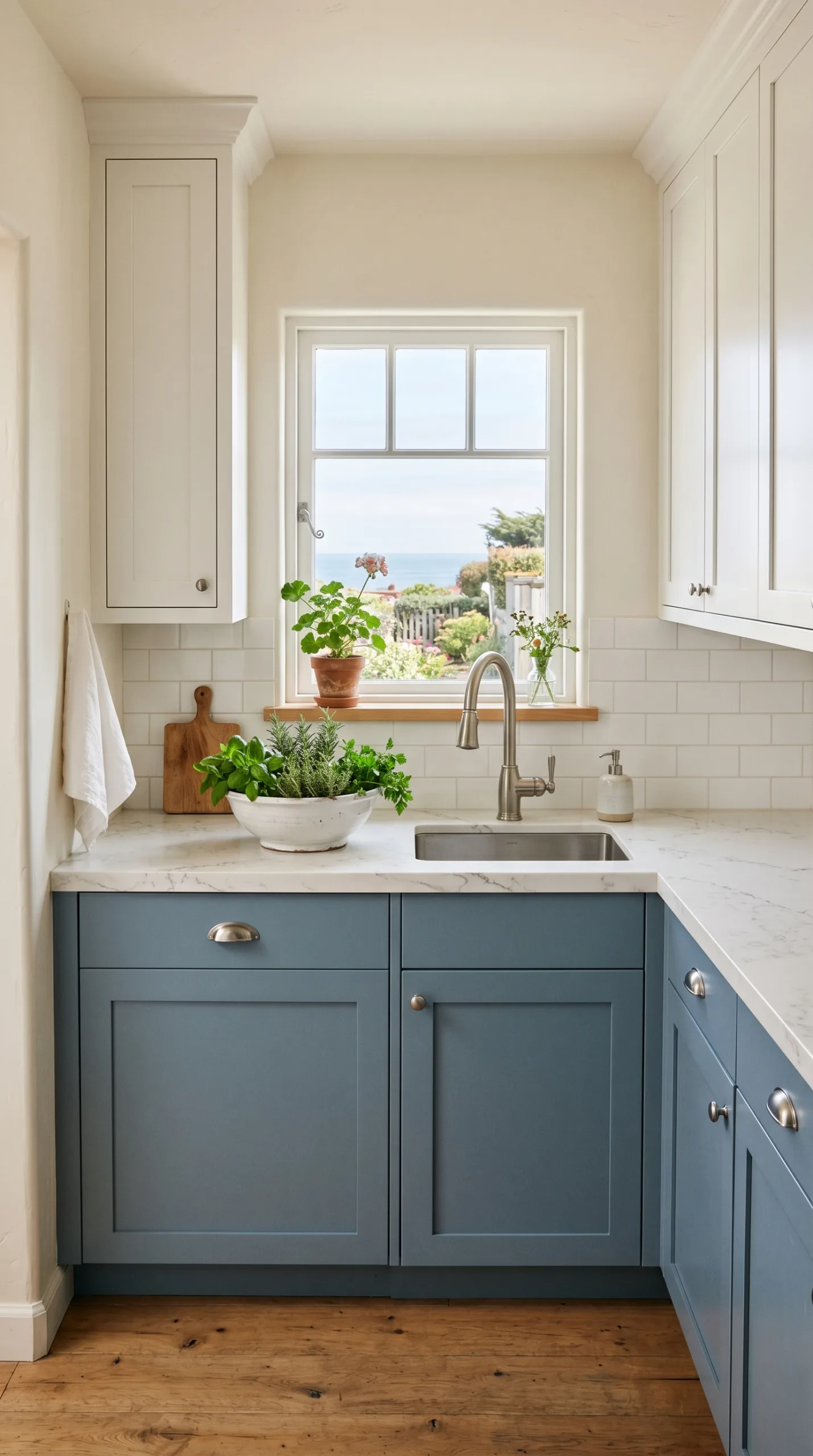
3. Zellige Tile Backsplash in Ocean Tones
Zellige tile has become one of the most exciting materials in coastal kitchen design over the past couple of years, and it earns its place because of what it does with light. These hand-made Moroccan clay tiles have an irregular, slightly undulating surface that catches and scatters light in a way that machine-made tiles simply cannot replicate. In a coastal kitchen, zellige in shades of seafoam green, turquoise, or soft aqua creates a backsplash that almost looks like moving water, shifting in color as the light changes throughout the day. Install it in a simple stacked pattern rather than a complex layout to let the tile itself do the visual work. Pair it with crisp white cabinets and a simple matte black or brass faucet for contrast.
Designer note: zellige is a premium material that runs significantly higher than standard subway tile, so budget accordingly. It is an investment-level choice, but one that dramatically elevates the feel of a kitchen.

4. Open Shelving with Curated Coastal Accents
Open shelving in a coastal kitchen is all about restraint. The most common mistake people make is overloading the shelves with too many seashells, too many decorative pieces, and not enough function. What actually works is a mix of about 60 percent practical items, like everyday dishes, glasses, and a few baskets for storage, and 40 percent decorative pieces. Think a small collection of sea glass in a clear apothecary jar, a couple of coral-toned ceramic bowls, or a wooden cutting board propped upright for texture. Use shelves in light oak, bleached pine, or whitewashed wood to keep things in the coastal palette. Wall-mounted floating shelves in a natural timber with simple bracket hardware keep the look clean and modern rather than rustic. One thing that works really well here is grouping items in odd numbers, with varying heights within each group, which gives the shelves a collected, relaxed look rather than a rigid, showroom feel.
Designer Note: If you are renting or not ready to commit, open shelving bracket systems that require only a few screws are widely available and easy to remove without damage.
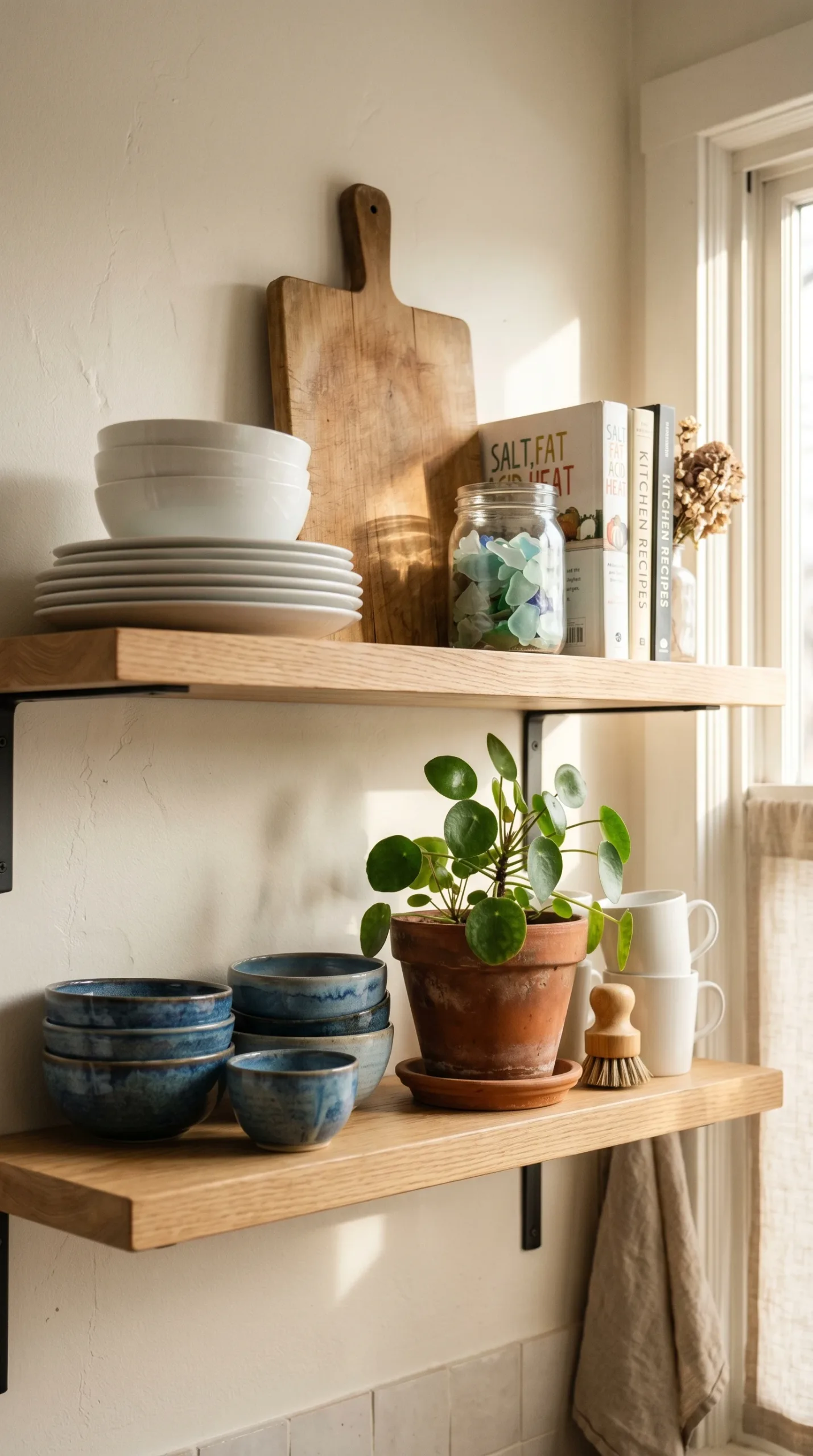
5. Whitewashed Brick or Shiplap Feature Wall
A whitewashed brick wall or a section of shiplap paneling behind the stove or along one kitchen wall is one of the most effective ways to bring that weathered coastal cabin feeling into a kitchen without any major structural changes. Whitewashed brick retains the texture and warmth of the underlying material while reflecting light in a way that raw brick does not, keeping the space feeling bright and coastal rather than rustic or industrial. Shiplap achieves a similar effect with a cleaner, more cottage-style result. For a modern coastal update, consider painting your shiplap in a soft warm white or a very pale greige rather than a stark bright white. This gives depth without making the walls feel cold. Pair the feature wall with simple open shelving in the same tonal range, pendant lights in woven or natural materials, and keep the rest of the kitchen in clean whites and naturals to let the wall do its thing.

6. Woven Rattan Pendant Lights Over an Island
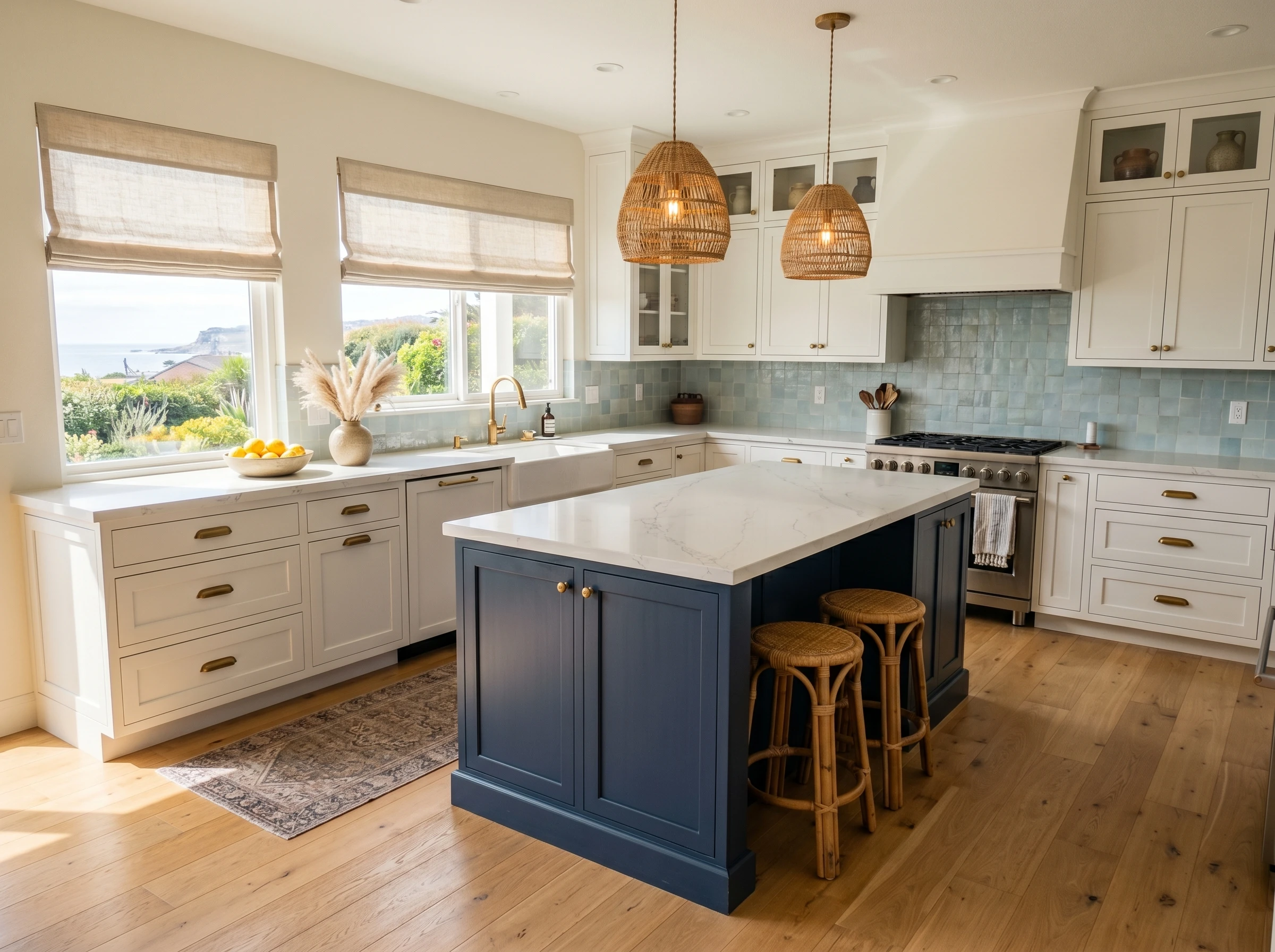
Pendant lighting is one of the fastest ways to shift the mood of a kitchen, and woven rattan or seagrass pendants over an island are among the most effective lighting choices for a coastal kitchen. They add an organic, layered texture that works especially well in kitchens that lean toward the warmer, California coastal end of the spectrum rather than the cooler, more Hamptons-influenced side. Look for pendants with an open weave that allows the warm glow of the bulb to filter through, creating a honeyed, dappled light effect that feels genuinely relaxed. Pair them with Edison-style bulbs for warmth, or use smart bulbs set to a warm white temperature. In practice, two or three pendants hung at slightly different heights, or hung at the same height in a row of three, look better than a single large pendant over a long island. This is a relatively affordable update since quality rattan pendants are widely available at mid-range price points.
Designer Note: Hang island pendants so the bottom of the shade sits roughly 30 to 36 inches above the countertop for both good lighting and clear sightlines across the island.
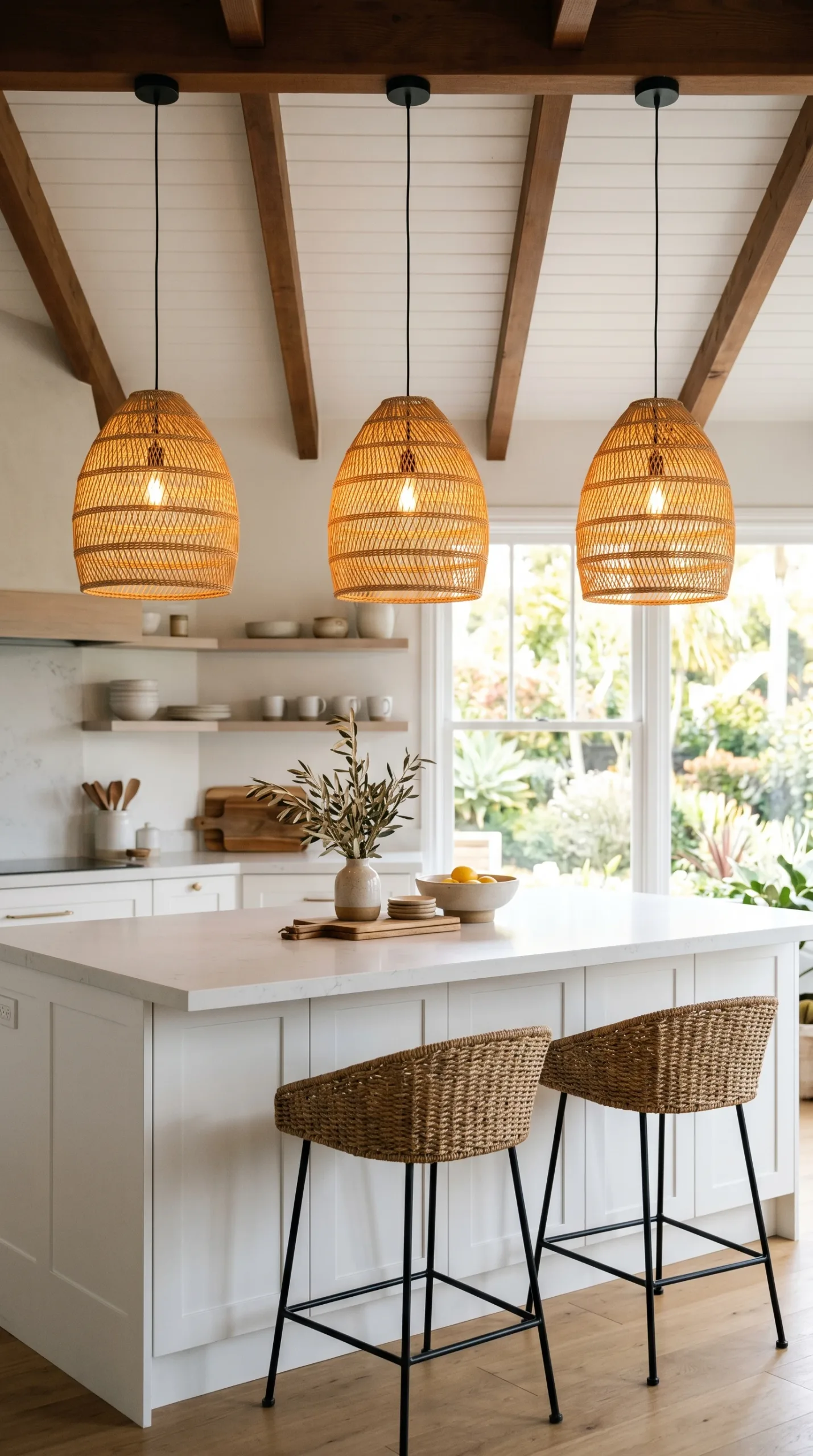
7. Seagrass or Jute Barstools at the Island
The seating at a kitchen island or breakfast bar does a huge amount of work in defining the overall feel of the space, and seagrass or jute-covered barstools are one of the most practical choices for a coastal kitchen. They bring in the organic, natural texture that the coastal palette relies on without introducing any synthetic materials, and they are durable enough to handle daily use. Look for counter-height or bar-height stools with a solid wood or metal frame in a natural or black finish and a seagrass or rattan seat. The combination of the hard frame and the woven seat adds visual interest without being visually loud. In kitchens where the cabinets and countertops are already quite clean and minimal, these stools add exactly the right amount of texture and warmth. For a more polished look, consider stools with a low back rather than fully armless, which adds a touch more comfort for longer meals without cluttering the silhouette.

8. A Navy Blue Kitchen Island as a Focal Point
If you have an all-white or largely neutral kitchen and want to introduce a real coastal color moment without committing every cabinet in the room, a navy blue island is one of the most satisfying solutions available. Navy, properly chosen, manages to be both bold and completely calm at the same time, which is exactly what a coastal kitchen needs. Look for a blue with slight grey or green undertones rather than a pure bright navy, which can read as more formal or nautical than you want. Hague Blue by Farrow and Ball, or a similar deep coastal navy, hits the right note for this. Top the island with a white quartz or honed marble countertop to create contrast, and add brass or antique bronze hardware to warm things up. The island becomes an instant focal point without requiring you to touch any other cabinet in the kitchen, making it a practical scope for those working within a renovation budget.
Designer Note: If you are painting an existing island, do not skip the primer coat. A quality bonding primer before the topcoat makes an enormous difference in how long the finish holds up on a high-touch surface.

9. Driftwood-Style Open Shelving and Floating Surfaces
The driftwood aesthetic in a coastal kitchen is not about using actual driftwood, which can be impractical and difficult to maintain, but about choosing timber with that same bleached, smooth, slightly silvery quality. Light-toned wood species like white oak, ash, or reclaimed pine sanded smooth and finished with a white-wash or natural oil give exactly this effect. Use these timbers for open shelving brackets, a floating shelf along one wall, or even a butcher block island top in a lighter wood tone. The contrast between the weathered-looking wood and crisp white cabinet doors or walls is one of the most quietly effective combinations in coastal kitchen design. This look also pairs well with linen or cotton Roman shades at the window in a natural or soft stripe, which reinforces the layered, organic quality of the space. It works in small kitchens too, where even a single floating shelf in this timber can shift the feel of the whole room.

10. Sandy Neutral Walls with White Woodwork
Not every coastal kitchen needs to be blue and white. Some of the most beautiful examples of this style work in a sandy, warm neutral palette that references the beach without literally quoting it. Colors in the warm greige, soft sand, or pale linen family, think Benjamin Moore’s White Dove or Sherwin-Williams’ Accessible Beige on the walls, paired with crisp white trim, doors, and cabinets, create a kitchen that feels warm, airy, and coastal without any obvious nautical signifiers. This palette is also one of the most forgiving and livable options because it works across seasons and does not feel beach-themed during winter months. Layer in texture through linen window treatments, a jute or sisal runner on the floor, and ceramic accessories in soft clay or terracotta tones to keep the warmth going. This approach is especially well-suited to kitchens with southern or western exposure where the light has a warm, golden quality.
Designer Note: Test paint colors on large poster boards and move them around the kitchen at different times of day before committing. Sandy neutrals shift dramatically between morning and evening light.

11. Glass-Front Cabinets to Display Coastal Dishware
Glass-front cabinet doors are a practical and visually generous choice for a coastal kitchen because they turn your everyday dishware into part of the decor. The key is choosing what goes behind the glass with some care. A collection of white or cream dinnerware, some blue-toned glassware, a few pieces of sea-glass-colored ceramics, or even a set of matching linen napkins folded neatly on a shelf, all look genuinely beautiful through glass panels. This is one of those ideas that works better in practice than it sounds in theory, because the glass adds depth to the cabinetry and makes the kitchen feel more custom and considered. If the idea of keeping the inside of your cabinets tidy feels daunting, start with just one or two glass-front doors in a prominent position, like either side of the range hood, and fill those with your nicest pieces. This is an affordable update if you are retrofitting existing doors rather than buying new cabinetry.

12. A Beadboard Backsplash for Cottage Coastal Warmth
Beadboard paneling used as a backsplash is a classic cottage coastal move that brings instant character to a kitchen without the cost of specialty tile. It is particularly effective in kitchens that lean toward the New England or Cape Cod end of the coastal spectrum rather than the sleeker, modern California look. Painted in a soft white or very pale blue, beadboard behind a farmhouse sink or along the full run of the backsplash creates a warm, layered texture that pairs beautifully with open shelving above and simple white cabinets on either side. One practical point to raise honestly: beadboard in a backsplash position does require proper sealing to handle splashes and steam near the sink and stove, so use a high-quality semi-gloss or satin paint and apply a clear sealant over the top if the beadboard is very close to the cooking area. Away from direct heat and water, it is an extremely durable and easy-to-maintain option.
Designer Note: Extend the beadboard up to the ceiling if the kitchen has low ceilings, as vertical lines draw the eye upward and make the room feel taller.

13. Apron Front Farmhouse Sink in White Fireclay
The apron front sink is one of those design choices that punches well above its weight in a coastal kitchen. A white fireclay farmhouse sink, in particular, hits exactly the right note because it references both the practical, working nature of a beach kitchen and the clean, unfussy quality of coastal style. Fireclay is a genuinely excellent material for kitchens because it is extremely hard, resistant to chipping and staining, and holds its white color well over time without yellowing. Pair it with an unlacquered brass or brushed nickel bridge faucet for a look that feels considered and classic. In terms of proportion, the sink itself becomes a focal point, so keep the area around it relatively simple. A beadboard backsplash, simple open shelving above, and a Roman shade at the window nearby are all that is needed to frame it well.
Budget note: fireclay sinks are a mid-to-upper range investment, but they are extremely durable and rarely need replacing.
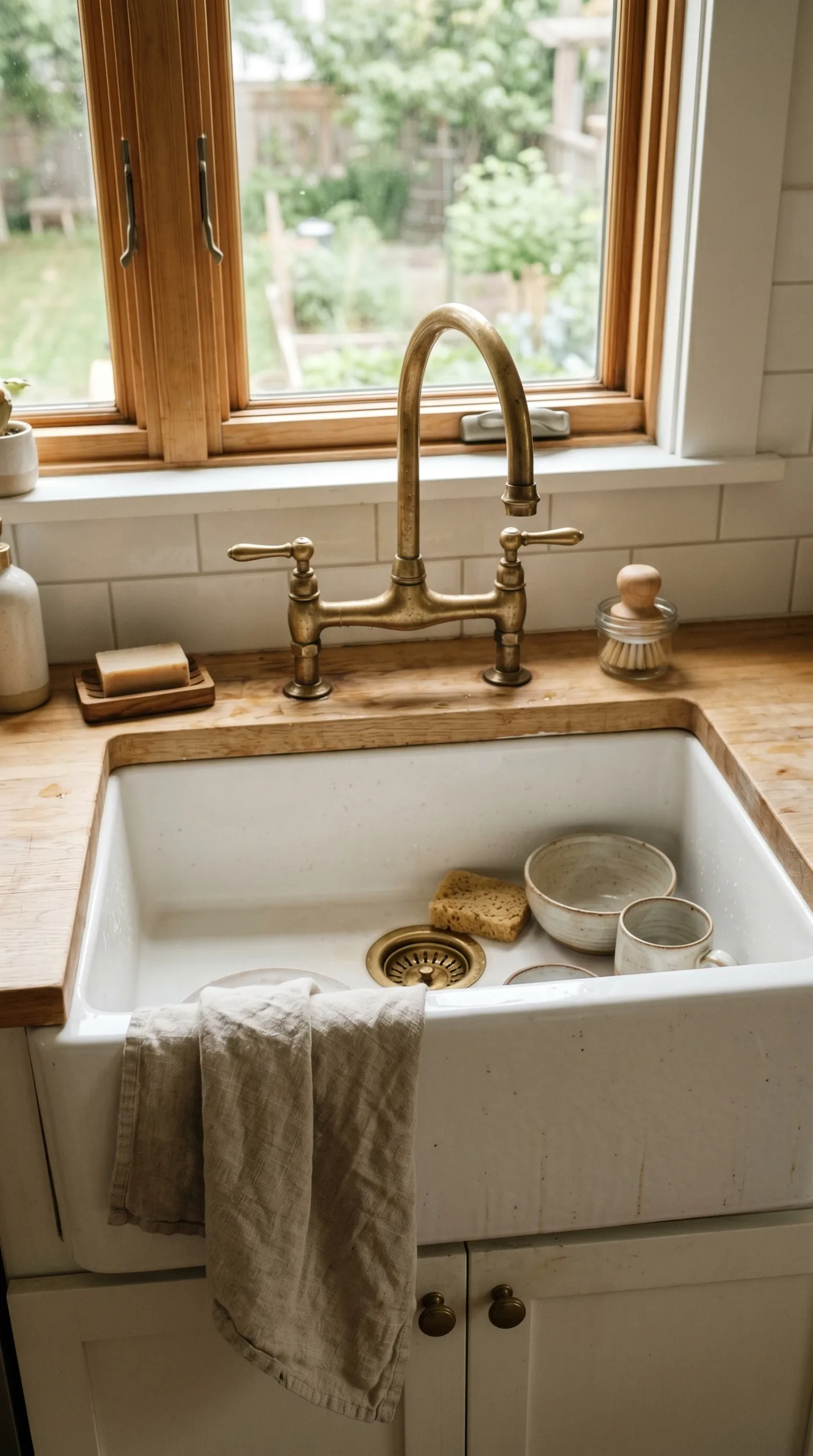
14. Scalloped Tile Details as a Design Accent
Scalloped or fan-shaped tiles are one of the more playful and distinctly coastal choices available for a kitchen, and they work particularly well as an accent rather than covering an entire wall. A row of scalloped tiles as a border above a more standard subway tile backsplash, or a full scalloped tile panel positioned just behind the stove as a focal point, adds a design detail that immediately references the ocean without being heavy-handed about it. Look for scallop tiles in soft white, pale aqua, or sage green for the most versatile results. The three-dimensional quality of the scalloped shape catches light and creates gentle shadow lines throughout the day, which adds visual interest in a way that flat tiles simply cannot achieve. This is an affordable way to introduce a coastal signature detail in a kitchen that is otherwise quite neutral and understated.
Designer Note: Scalloped tiles in matte finishes hide water spots and fingerprints much better than glossy versions, which is worth knowing before you choose your finish for a backsplash area.

15. Natural Wood Countertops on the Island
A butcher block or solid wood countertop in a light, natural timber on a kitchen island introduces warmth and organic texture in a way that stone or quartz surfaces cannot quite replicate. In a coastal kitchen, this works best when the wood is kept in a relatively light, blonde tone rather than a dark stain, which can read as too heavy and traditional for the coastal aesthetic. White oak, maple, or teak with a food-safe natural oil finish all work beautifully and improve with use, developing a gentle patina over time. One thing that is worth being honest about here: wood countertops do require more maintenance than stone. They need periodic oiling, they are not as forgiving of standing water, and deep knife cuts need sanding out over time. For an island that sees heavy food prep, this is worth knowing upfront. For a kitchen where the island is primarily used for seating and light prep, though, the warmth and character a wood top brings is genuinely hard to replicate.

16. Coastal Grandma Maximalism: Pattern, Texture, and Color
Coastal grandma style has become a genuine design movement, and the kitchen is actually one of the best rooms to explore it. The idea is not chaos but rather a confident layering of pattern, texture, and soft color in a way that feels collected and personal rather than coordinated. Think blue and white transferware displayed on open shelves, a vintage floral or botanical print Roman shade at the window, woven placemats and linen napkins in complementary tones, and a ceramic pot or two on the counter filled with fresh herbs or dried botanicals. The walls and cabinets tend to stay relatively calm in this approach, with the personality coming from the accessories and textiles rather than the architecture. This is one of the most affordable iterations of the coastal kitchen because the individual pieces do not need to be expensive. Thrift stores, vintage markets, and estate sales are genuinely great sources for the kind of mismatched-but-harmonious dishware and accessories that make this look work.
Designer Note: The difference between a cohesive coastal grandma kitchen and a cluttered one usually comes down to color discipline. Stick to a palette of two or three colors across all the accessories even as the patterns vary.

17. Concrete or Stone Floors in a Warm Grey Tone
Flooring in a coastal kitchen often gets less attention than it deserves, but it is one of the elements that most powerfully sets the tone of the space. Polished concrete or large-format stone tiles in a warm grey, ranging from a pale greige to a deeper slate, work extremely well in coastal kitchens because they reference the natural textures of rock and sand while being completely practical underfoot. Large format tiles, anything over 24 by 24 inches, are particularly effective because the reduced number of grout lines makes the floor feel more expansive and cleaner, which suits the airy quality of coastal design. For a slightly warmer, more tactile option, tumbled limestone or travertine in a light honey or cream tone adds beautiful organic texture. Honest caveat: stone floors, particularly travertine, do require sealing and periodic resealing to maintain their look, especially in a kitchen where spills are frequent.
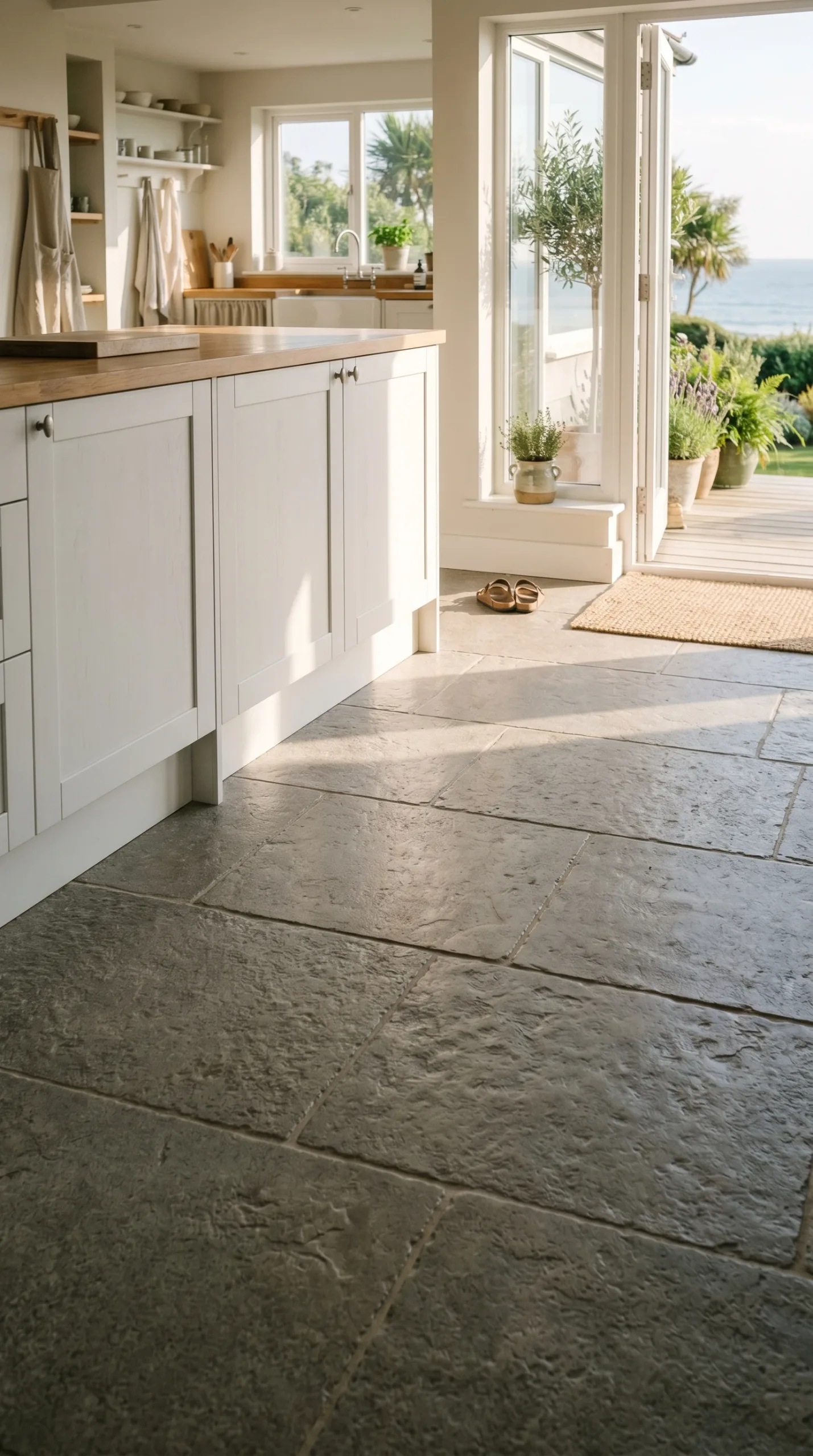
18. Linen Roman Shades for Breezy Window Treatments
Window treatments in a coastal kitchen should feel light, natural, and completely unpretentious, and linen Roman shades hit all three of those marks. A shade in natural, undyed linen or a soft stripe in sand and white allows light to filter through rather than blocking it, which is central to the coastal aesthetic’s emphasis on natural light. Roman shades also have a clean, flat profile when raised that does not clutter the window frame the way drapes or valances can. For a little more character, look for shades with a subtle woven texture, a thin border detail, or a very soft stripe in a coastal color. In kitchens with large windows or windows that look out onto a garden or outdoor space, sheer linen panels hung on a simple rod alongside Roman shades can give you the flexibility to filter light without losing the view. This is a reliably mid-range investment that makes a noticeable difference to the overall feel of a kitchen.
Designer Note: Always order linen shades slightly wider than your window frame and mount them outside the frame to maximize the sense of window size and light.

19. Sage Green Cabinets for a Coastal Garden Kitchen
Sage green sits at an interesting intersection between coastal and garden design that has made it one of the most popular cabinet colors of the past several years, and it shows no signs of fading. A soft, dusty sage green on kitchen cabinets, particularly in a matte or eggshell finish, references sea grasses, weathered boat paint, and the kind of muted, bleached greens you find along a shoreline. It pairs beautifully with white oak or natural wood accents, aged brass hardware, and countertops in white quartz or creamy limestone. The key to making sage green work in a coastal kitchen rather than simply a green kitchen is keeping everything else in the room relatively warm and natural. Linen window treatments, woven stools, and wooden open shelving all reinforce the organic, coastal-adjacent quality of the green. This is a look that works particularly well in kitchens with good southern light, where the green will shift toward its warmer, more golden undertones.

20. A Built-In Banquette for Coastal Breakfast Nook Vibes
A built-in banquette in a kitchen eating area is one of the most practical things you can add to a coastal kitchen because it maximizes seating in a relatively small footprint while creating a genuinely cozy, lived-in moment that feels appropriate to the relaxed spirit of coastal living. Build the banquette with simple shaker-style paneling painted in white or soft blue, and upholster the cushion in a durable outdoor or performance fabric in a stripe, solid blue, or natural linen tone. Add a round or oval table in a light oak or painted white finish, and hang a simple pendant light above it to define the zone within the larger kitchen. The upholstered seat, the enclosed base, and the pendant above create what designers call a layered lighting and texture moment, where the soft cushion, the warm light, and the painted wood all work together to make a corner of the kitchen feel genuinely inviting rather than purely functional.
Designer Note: Use performance fabric rather than standard upholstery fabric for banquette cushions in a kitchen. It handles spills, wiping down, and heavy use dramatically better than anything decorative-only.

21. Exposed Wood Ceiling Beams for Coastal Cabin Character
Exposed ceiling beams in a coastal kitchen do something that almost no other single design element can: they completely change the vertical experience of the room. In a coastal context, beams in a whitewashed, light grey-washed, or natural bleached timber feel like the bones of a beach house, referencing the structural honesty of coastal architecture while adding warmth overhead that balances the coolness of white cabinets and stone surfaces below. If your kitchen does not have structural beams, faux timber beams in lightweight polyurethane are a legitimate and increasingly convincing option that can be installed without structural work. Pair the beams with pendant lights hung from them at varying points along the run of the kitchen rather than ceiling-recessed lighting alone, which adds to the layered, characterful quality that exposed beams create. This is an investment-level update for real timber, but a mid-range project for faux beams.

22. Coastal Blue and White Tile Patterns on the Floor
Patterned tile on a kitchen floor is a bold choice, but in a coastal kitchen it can be extraordinary when done with a degree of restraint. Blue and white encaustic cement tiles, or glazed ceramic tiles in a traditional Portuguese or Moroccan pattern, bring a global coastal quality to a kitchen that references the blue and white tile traditions found in coastal communities from Portugal to the Aegean to colonial New England. The key is keeping everything above floor level relatively quiet. White or off-white cabinets, simple natural wood shelving, minimal accessories, and simple window treatments let the floor do the talking without the room feeling overwhelming. In practice, this works best in smaller kitchens or kitchen areas where the patterned floor can be seen as a complete composition rather than disappearing under furniture and appliances in a very large room.
Designer Note: Use a light-colored grout rather than white grout with patterned floor tiles. White grout shows grime quickly and requires aggressive cleaning to maintain, whereas a warm greige or sandy grout hides far more and ages gracefully.
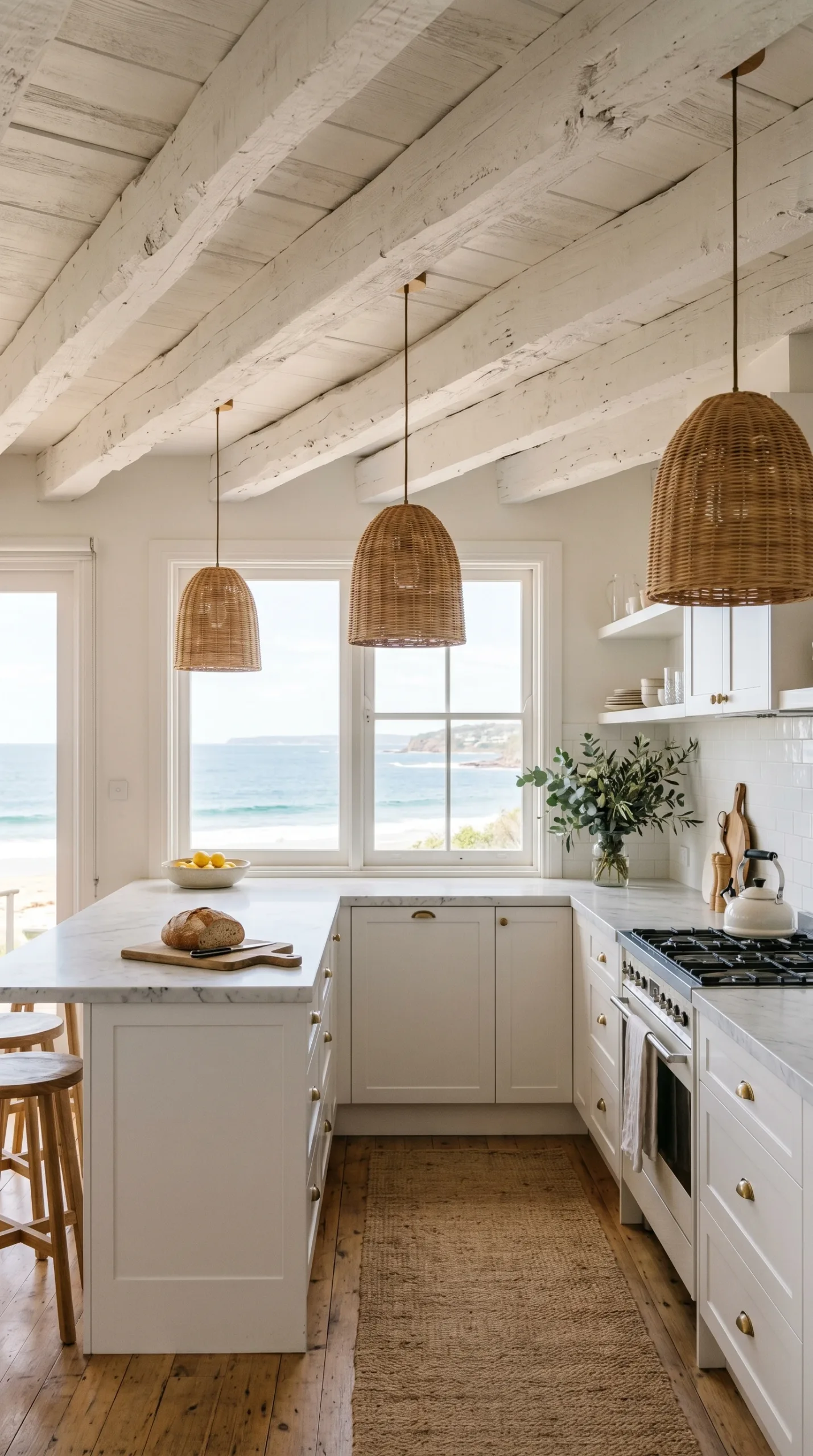
23. Japandi Coastal: Minimalist Meets Ocean Calm
Japandi is the design movement that merges Japanese wabi-sabi principles with Scandinavian minimalism, and it translates exceptionally well into a coastal kitchen context because both aesthetics share the same commitment to natural materials, simplicity, and an honest relationship with imperfection. In a Japandi coastal kitchen, the palette stays extremely restrained: warm whites, muted grey-greens, soft clay, and pale wood. Cabinets tend to be flat-front or very minimal shaker, with integrated handles or simple bar pulls in matte black or brushed bronze. Open shelving in a pale ash or white oak carries just a few considered pieces rather than a full collection. The countertops lean toward honed rather than polished stone, which has a quieter, more tactile quality. The coastal influence comes through in the color palette and the natural material choices rather than any decorative accessories. This is one of the most sophisticated iterations of the coastal kitchen and works especially well in modern homes with clean architectural lines.

24. Layered Lighting: Pendants, Under-Cabinet, and Natural Together
Layered lighting is a professional design principle that makes an enormous difference in how a kitchen feels at different times of day, and it matters more in a coastal kitchen than in almost any other style because the whole aesthetic depends on light feeling natural, warm, and dimensional rather than flat and functional. A well-lit coastal kitchen combines three sources: natural light from windows or skylights, task lighting from under-cabinet LED strips that illuminate the countertop work zones without glare, and ambient or decorative lighting from pendants or a statement ceiling fixture that creates warmth and mood in the evening. Coastal kitchens benefit from choosing warm color temperature bulbs, around 2700K to 3000K, across all three layers, rather than mixing warm and cool sources which creates a disjointed, clinical feeling. In practice, adding a simple dimmer to the pendant lights is one of the most affordable ways to extend the usefulness of the lighting, allowing the kitchen to shift from a practical bright workspace during the day to a warm, inviting social space in the evening.
Designer Note: Install under-cabinet lighting before you tile the backsplash if at all possible. Running the wiring after the fact is significantly more complicated and expensive.
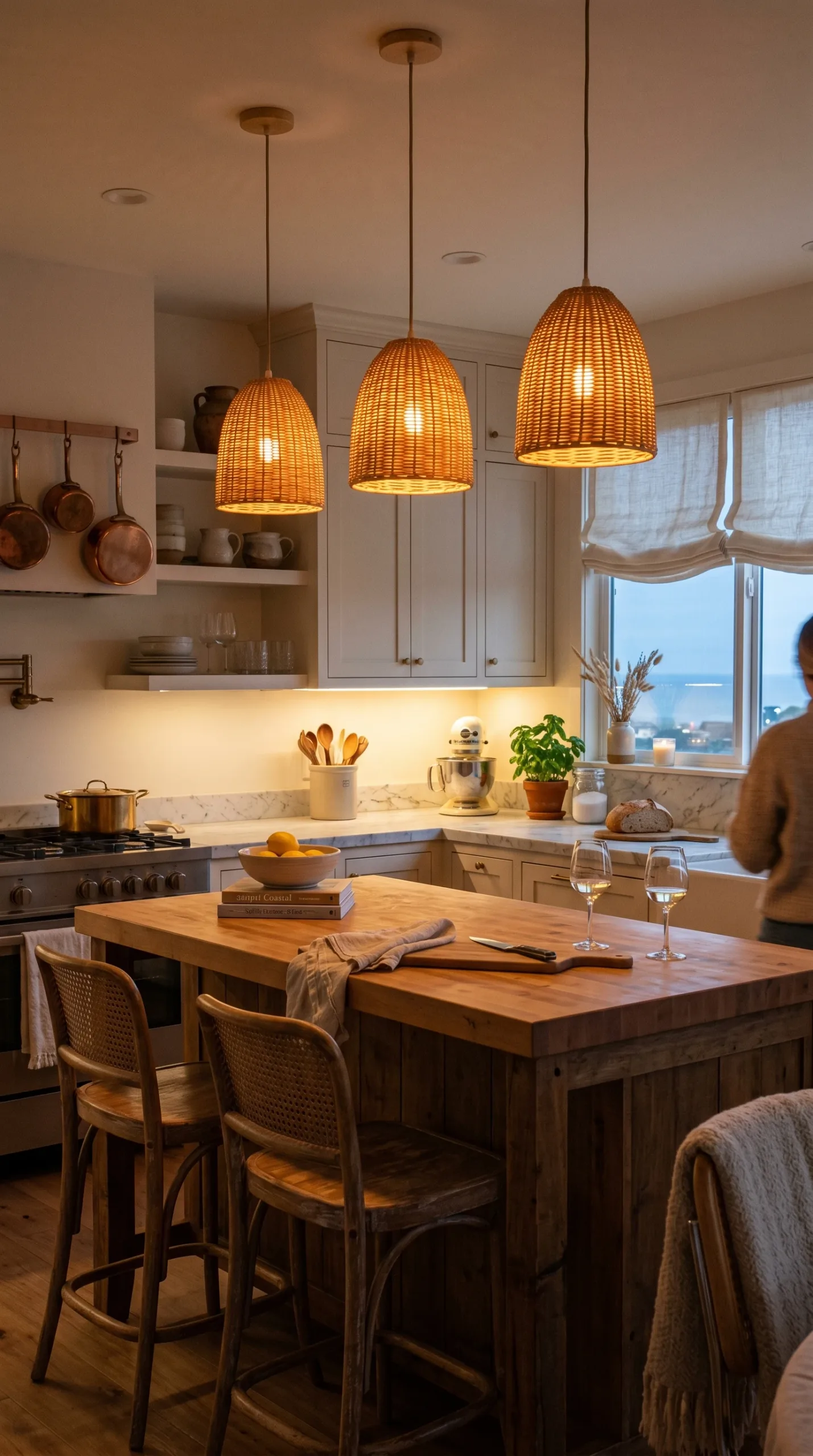
Bringing It All Together
A coastal kitchen is not really about decorating to a theme. It is about creating a space that feels genuinely open, calm, and connected to something natural, whether that is the ocean itself or simply the quality of light and material that the best coastal spaces embody. The ideas in this list range from small, affordable updates you can pull off in a weekend to longer-term investment choices that will reshape your kitchen for years. The most important thing is to choose a direction that actually suits your kitchen’s architecture and your own lifestyle rather than trying to implement every idea at once.
If there is one principle worth carrying through any coastal kitchen project, it is this: edit more than you add. The coastal aesthetic is at its best when there is breathing room, when the eye can move around the space without being interrupted by too many competing elements. A few genuinely good choices, well-executed and layered together thoughtfully, will always outperform a kitchen crowded with coastal references. Start with the big moves, your cabinet color, your countertop, your lighting, and let everything else build from there. The details, the seagrass stools, the rattan pendant, the linen shade at the window, will fall into place naturally once the foundation is right. And remember: the goal is a kitchen that feels like yours, a space you actually want to spend time in, not a Pinterest board brought to life.
Frequently Asked Questions
What colors are most common in a coastal kitchen?
The core coastal kitchen palette centers on whites, soft blues, sandy neutrals, and sea greens. Within those categories there is a lot of room to move: from crisp bright white to warm off-white, from pale sky blue to deep dusty navy, from warm sand to pale greige. The consistent thread is that all of these colors reference the natural tones of a coastal environment without being garish or overly bright. Accent colors in soft coral, terracotta, or weathered gold work well as secondary tones in accessories and textiles.
Can I achieve a coastal kitchen look on a budget?
Absolutely. Some of the most impactful coastal kitchen updates are also the most affordable: new hardware on existing cabinets, a set of rattan barstools, linen Roman shades at the windows, or a few pieces of blue and white ceramic on open shelving. A fresh coat of paint on an existing island in a coastal blue is a weekend project that can completely transform the focal point of the room. Save the bigger budget for the elements that are harder to fake over time, like quality countertops or good lighting fixtures.
Does a coastal kitchen have to feel beach-themed?
Not at all. In fact, the best coastal kitchens tend to avoid obvious nautical or beach-themed accessories and instead focus on the underlying principles of coastal design: natural materials, a light and airy color palette, plenty of natural light, and a relaxed, unpretentious atmosphere. You can create a kitchen that reads unmistakably as coastal without a single seashell or anchor motif in sight. Think of it as referencing a feeling rather than a location.
What backsplash works best in a coastal kitchen?
The best backsplash for a coastal kitchen depends on the overall direction of the design. For a classic coastal look, white subway tile or beadboard is a reliable, affordable choice. For something with more texture and visual depth, zellige tile in a coastal color is outstanding. For a pattern-led approach, Portuguese or encaustic cement tile in blue and white makes a bold and beautiful statement. For a cottage or New England coastal feel, scalloped tile or a simple brick-laid marble mosaic both work extremely well.
How do I add coastal style without making my kitchen feel like a rental beach house?
The key is quality and restraint. Avoid mass-produced nautical accessories like anchor hooks, rope borders, and printed seashell art, which tend to read as costume rather than design. Instead, focus on genuinely good materials and a coherent color palette. A kitchen with white oak open shelving, a zellige backsplash, and rattan pendant lights feels coastal and sophisticated. A kitchen with the same white cabinets but covered in seashell-shaped hooks and lighthouse art feels like a theme. Less is almost always more in this style.
What flooring works best in a coastal kitchen?
Light-toned wood or wood-look flooring is one of the most popular and practical choices for a coastal kitchen because it brings in natural warmth without darkening the space. White oak hardwood or a quality luxury vinyl plank in a pale, wide-plank format both work well. Large-format stone or porcelain tiles in a warm grey or sandy tone are another excellent option, particularly in climates where a cool underfoot surface is welcome. Patterned cement tile in blue and white is a bolder choice that works beautifully in smaller kitchens or eating areas where the full pattern can be appreciated.