Bathroom Looks That Actually Feel Like a Spa

There is a specific kind of quiet that hits you when you walk into a well-designed spa bathroom. It is not just the warm water or the good products — it is the whole atmosphere. The lighting feels soft without being dim. The surfaces feel cool and deliberate. Nothing is out of place, and nothing is trying too hard. That feeling, it turns out, is not reserved for five-star hotels. With the right choices in color, material, lighting, and layout, your bathroom at home can deliver that same sense of ease every single morning and night.
The good news is that you do not need to gut your entire bathroom to get there. Some of these ideas are full renovations, yes, but many are achievable with a weekend, a budget, and a clear direction. Whether you are starting from scratch or layering over what you already have, these 24 ideas cover the full spectrum from small, affordable swaps to long-term investments worth saving up for. Pick what fits your space, your budget, and the way you actually live.
1. Swap Your Showerhead for a Rainfall Model
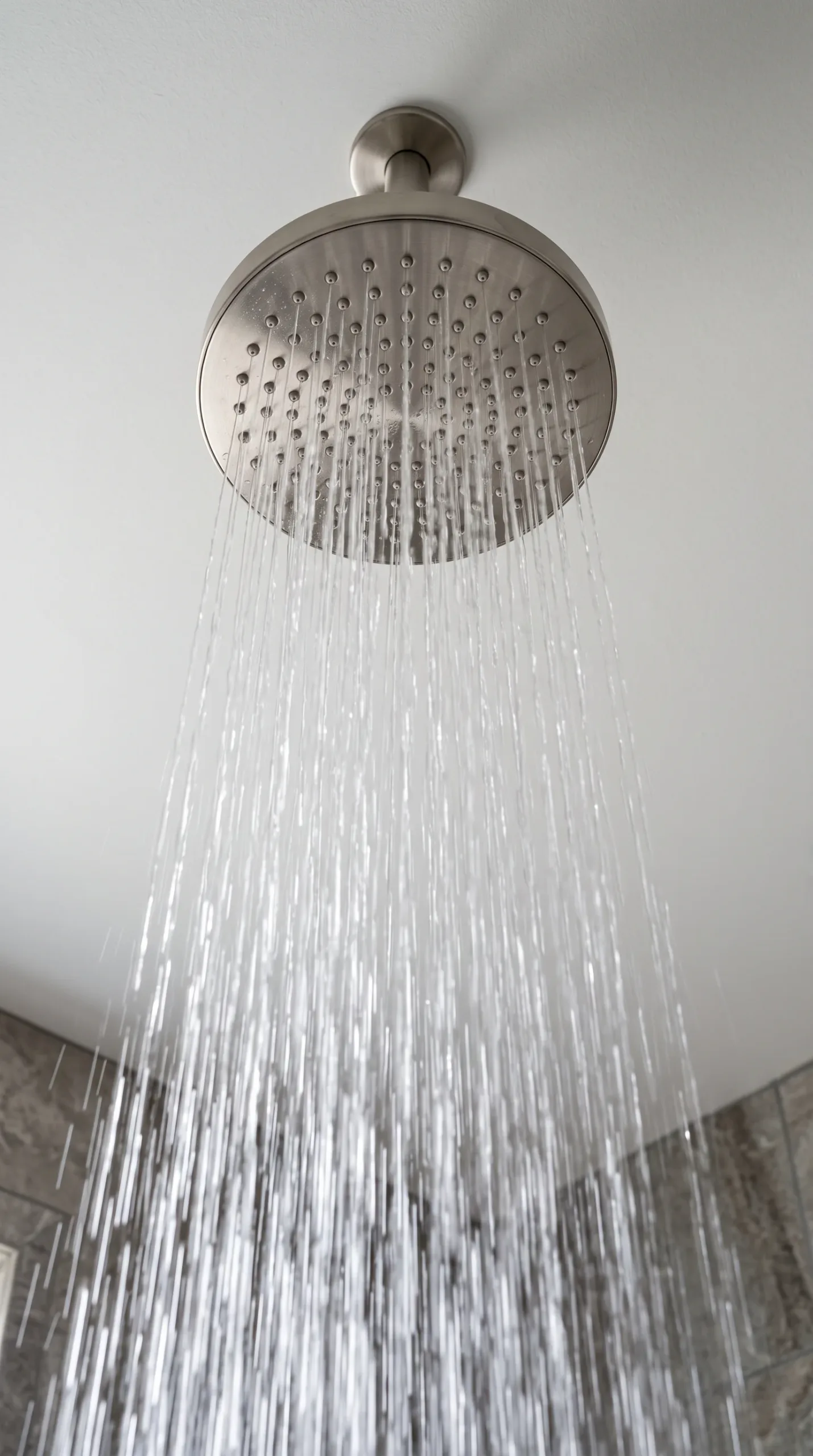
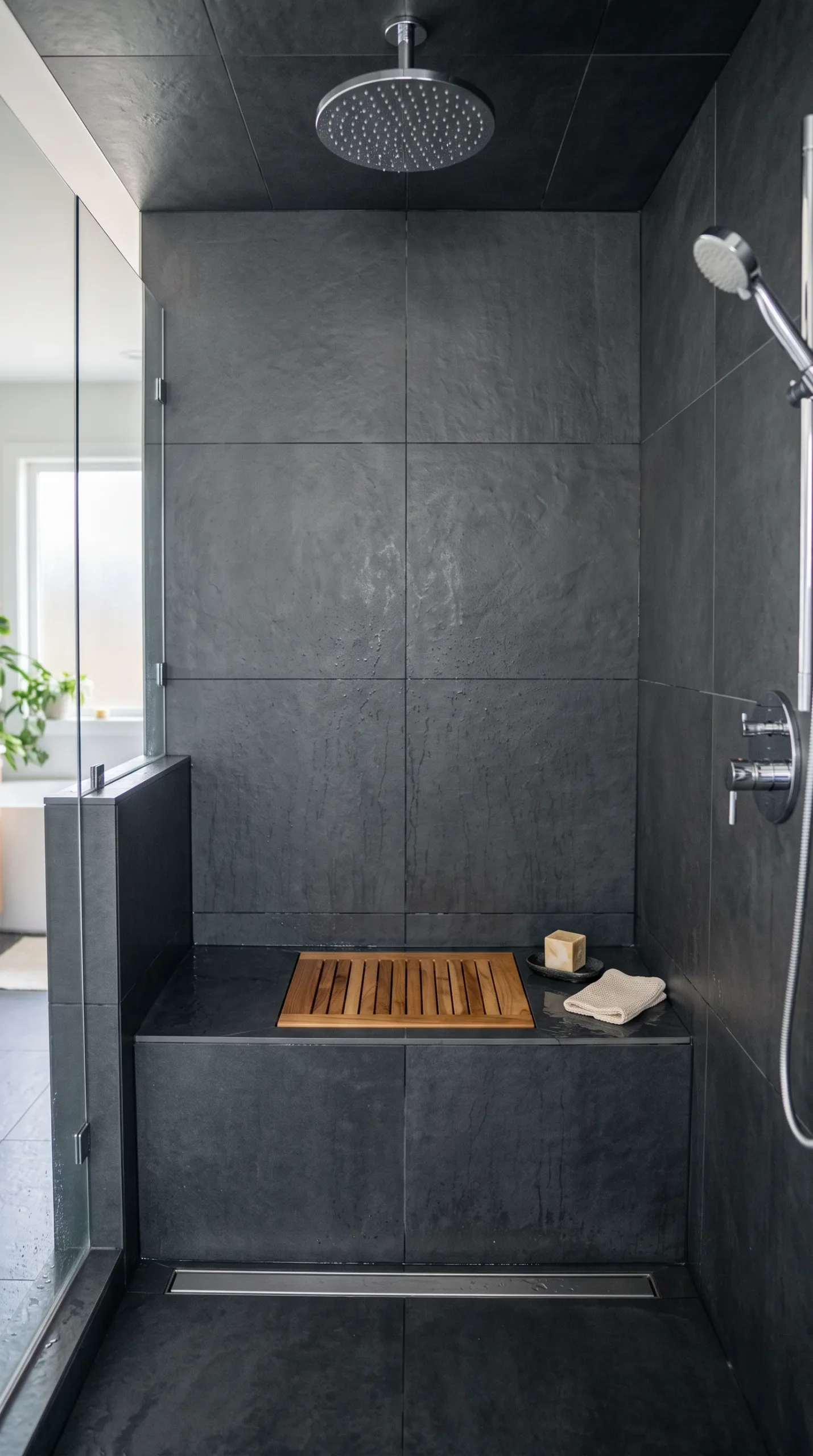
You step into the shower in the morning and get hit with a tight, pressurized spray aimed directly at your face. It works, but it does not exactly feel restorative. A rainfall showerhead changes that completely. Installed directly overhead, it delivers water in a wide, gentle sheet that mimics the feeling of standing in warm rain, and in practice, that sensation genuinely slows you down. Look for a ceiling-mounted model in a brushed nickel or matte black finish, sized at least 10 inches in diameter for full coverage. Pair it with a neutral stone or large-format porcelain tile surround in warm greige or soft white to keep the visual weight calm. The lighting matters here too — a recessed downlight centered above the showerhead reinforces the rainfall effect beautifully. Keep in mind that ceiling-mounted models require a plumber if your existing plumbing runs through the wall, so budget for installation alongside the fixture itself.
Designer Note: Go for a thermostatic valve alongside your rainfall head. Being able to set your water temperature before stepping in is one of those small upgrades that makes a bathroom feel genuinely considered.
2. Build a Neutral Color Palette Around Warm Stone Tones
Walk into almost any high-end spa and you will notice that the colors are almost the same everywhere: warm sand, pale travertine, soft linen, dusty taupe. That is not a coincidence. Cooler or brighter color palettes stimulate the brain, while warm neutrals in the mid-range of the value scale genuinely calm it down. In practice, this means choosing wall paint in a tone like Benjamin Moore’s Pale Oak or Sherwin-Williams’ Accessible Beige, then layering in natural materials that match that warmth. Think travertine floor tiles, a walnut vanity, and a linen shower curtain in a tone a shade or two deeper than the walls. Avoid stark white — it reads as clinical rather than spa-like unless you balance it with warm wood and matte textures. This palette works in bathrooms of any size, which is one of its biggest strengths. The limitation is that it does not photograph dramatically, but it lives beautifully.
Designer Note: Test paint colors on a large swatch board and live with them for two days before committing. Bathroom lighting, especially in windowless spaces, changes everything about how a neutral reads.

3. Add a Freestanding Soaking Tub as a Focal Point
There is something about a freestanding bathtub that signals luxury in a way almost no other bathroom fixture does. It says: this room is not just functional. It has a focal point, a centerpiece, something worth walking into. Oval or elongated tub shapes in matte white or warm stone composite work beautifully centered under a window or against a feature wall clad in large-format tile or limewash plaster. Keep the floor around it clear, which in practice means resisting the urge to crowd it with side tables and candles everywhere. A single cedar or teak bath stool placed beside it, holding a folded towel and one good candle, is more than enough. Floor-mounted tub fillers in a brushed brass or polished chrome finish add a sculptural quality that wall-mounted faucets simply cannot match. Worth noting: deep soaking tubs require more water to fill, so factor that into your utility usage if you plan to use it regularly.
Designer Note: If you have a small bathroom, a freestanding tub can still work — choose a more compact 55-inch model rather than a standard 67-inch, and position it to maintain a clear traffic path of at least 24 inches on both long sides.

4. Layer Your Lighting Like a Designer
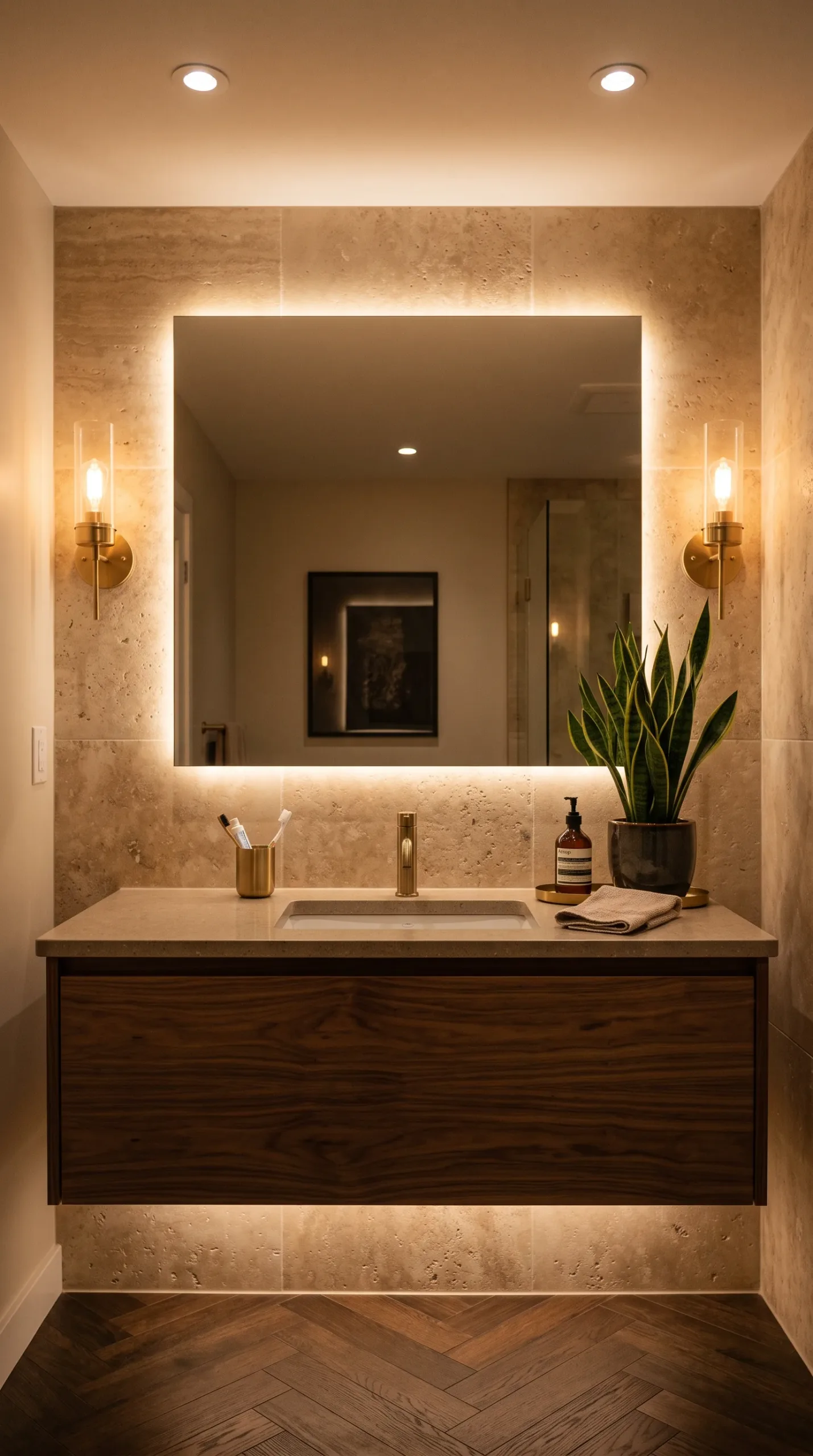
Most bathrooms have one overhead light and maybe a vanity bar, and that combination is almost always either too bright or too dim depending on the time of day. Layered lighting is a core principle in spa design and it means thinking about three separate sources: ambient light for overall illumination, task lighting for grooming at the vanity, and accent lighting to create atmosphere. In practice, this looks like a dimmable recessed LED overhead, backlit mirrors or Hollywood-style sconces flanking the vanity, and LED strip lighting tucked under a floating vanity or inside a niche. All three circuits should be on separate dimmer switches so you can shift the mood from bright and functional in the morning to soft and atmospheric in the evening. Color temperature is equally important — aim for bulbs in the 2700K to 3000K range, which reads as warm white rather than the harsh blue-white of most builder-grade fixtures. This is one of the highest-return upgrades you can make to any bathroom for the cost.
Designer Note: A backlit mirror alone can do more for a bathroom’s atmosphere than almost any other single change. It eliminates harsh shadows on the face and gives the whole room a soft, even glow.
5. Install Heated Floors for That Hotel-Level Comfort
There is a specific disappointment in stepping out of a warm shower onto a cold tile floor, especially in winter. Radiant floor heating solves this completely and, once you have experienced it, it is very difficult to go back. Electric mat systems are the most accessible option for bathroom retrofits — they sit beneath tile and connect to a programmable thermostat, so the floor is warm when you wake up and steps back down when you leave. The system works best under porcelain or natural stone tile, both of which conduct and hold heat efficiently. Hydronic systems, which run warm water through pipes, are more efficient long-term but require a more involved installation and are generally better suited to new builds or full bathroom renovations. Budget for the thermostat and a licensed electrician alongside the mat itself. The running cost is modest for a small bathroom — roughly the same as leaving a light on — and the daily experience it delivers is genuinely spa-level.
Designer Note: Pair heated floors with a programmable timer that turns on 30 minutes before your morning alarm. Stepping into a warm bathroom is a better start to the day than most people realize until they try it.

6. Use Large-Format Tiles to Reduce Visual Noise
One of the most immediate ways to make a bathroom feel more spa-like is to reduce the number of grout lines on the walls and floor. Smaller tiles mean more grout, and more grout means more visual activity, which works against the calm you are trying to create. Large-format tiles, anything from 24×24 inches up to 48×48 inches or larger slabs on the walls, create a surface that reads as almost seamlessly smooth. Porcelain tiles that mimic natural stone, like Calacatta marble or warm travertine, give you the look of an expensive material at a fraction of the cost and with far better durability. In a small bathroom, running the same large tile from floor to ceiling with minimal grout lines makes the space feel significantly bigger. The practical note here is that large tiles require a very flat, well-prepared substrate, and installation is less forgiving of uneven walls than smaller tiles would be — factor in a skilled tiler for this one.
Designer Note: Keep your grout color close to the tile color rather than contrasting it. Matching grout makes even average-sized tiles read as more refined and spa-like immediately.

7. Hang Eucalyptus in Your Shower
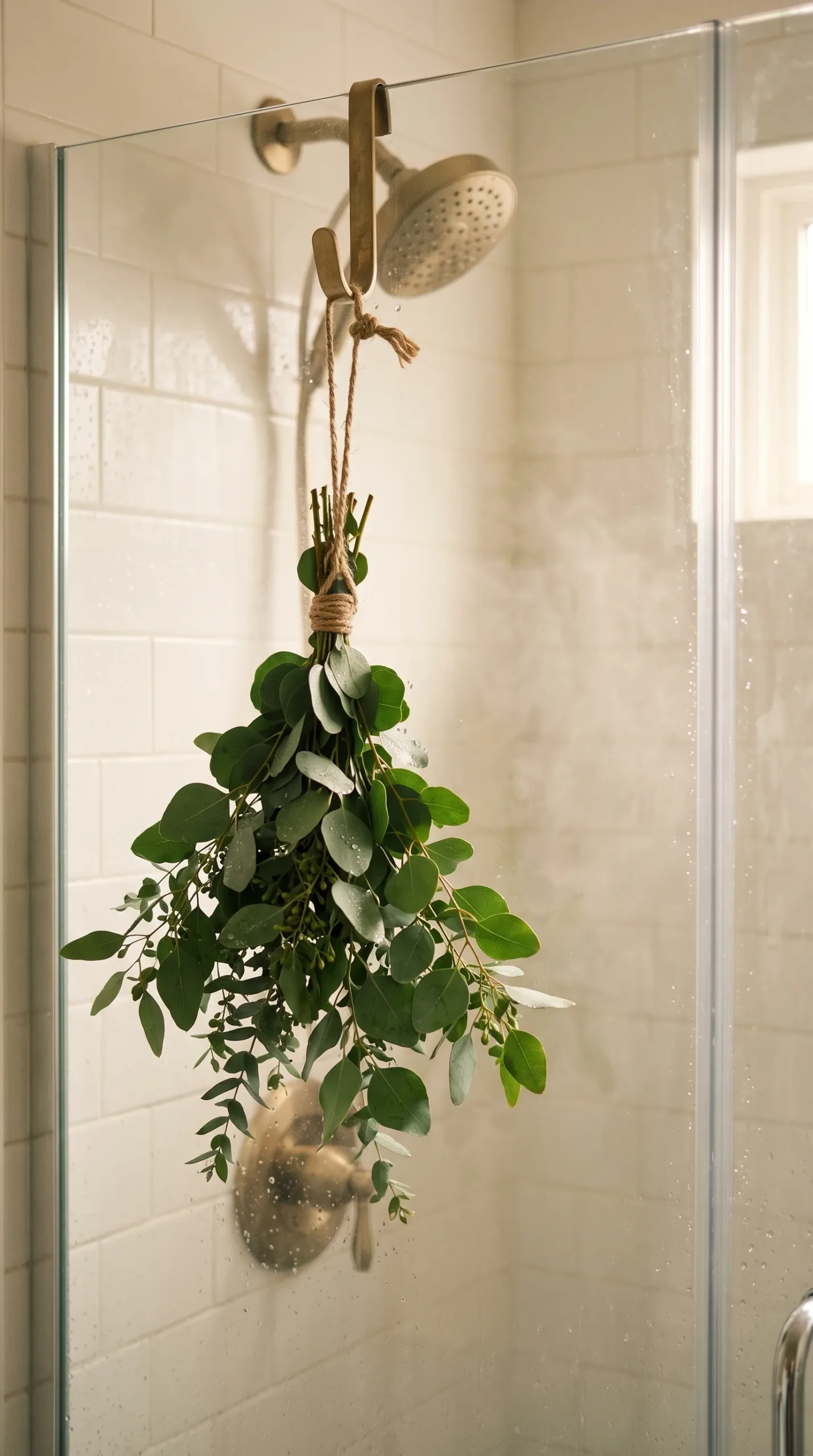
This one costs almost nothing and is more effective than most people expect. A bundle of fresh eucalyptus tied to your showerhead or hung from a hook just outside the spray zone releases its natural oils in the steam, filling the shower with a clean, slightly herbal scent that genuinely changes the atmosphere of the experience. Eucalyptus also has a mild decongestant quality, which makes a morning shower feel noticeably more invigorating. The bundle lasts anywhere from two to three weeks before the scent fades and the leaves dry out. Replace it with a fresh bundle when needed, or switch to dried eucalyptus, which lasts longer and still looks beautiful even after the scent has gone. For a slightly different sensory note, try hanging lavender for an evening bath routine instead — it reads as more calming than eucalyptus, which tends to energize.
Designer Note: Source fresh eucalyptus from a florist or farmer’s market rather than a grocery store — the bundles are usually larger, fresher, and last considerably longer.
8. Declutter with Concealed Storage
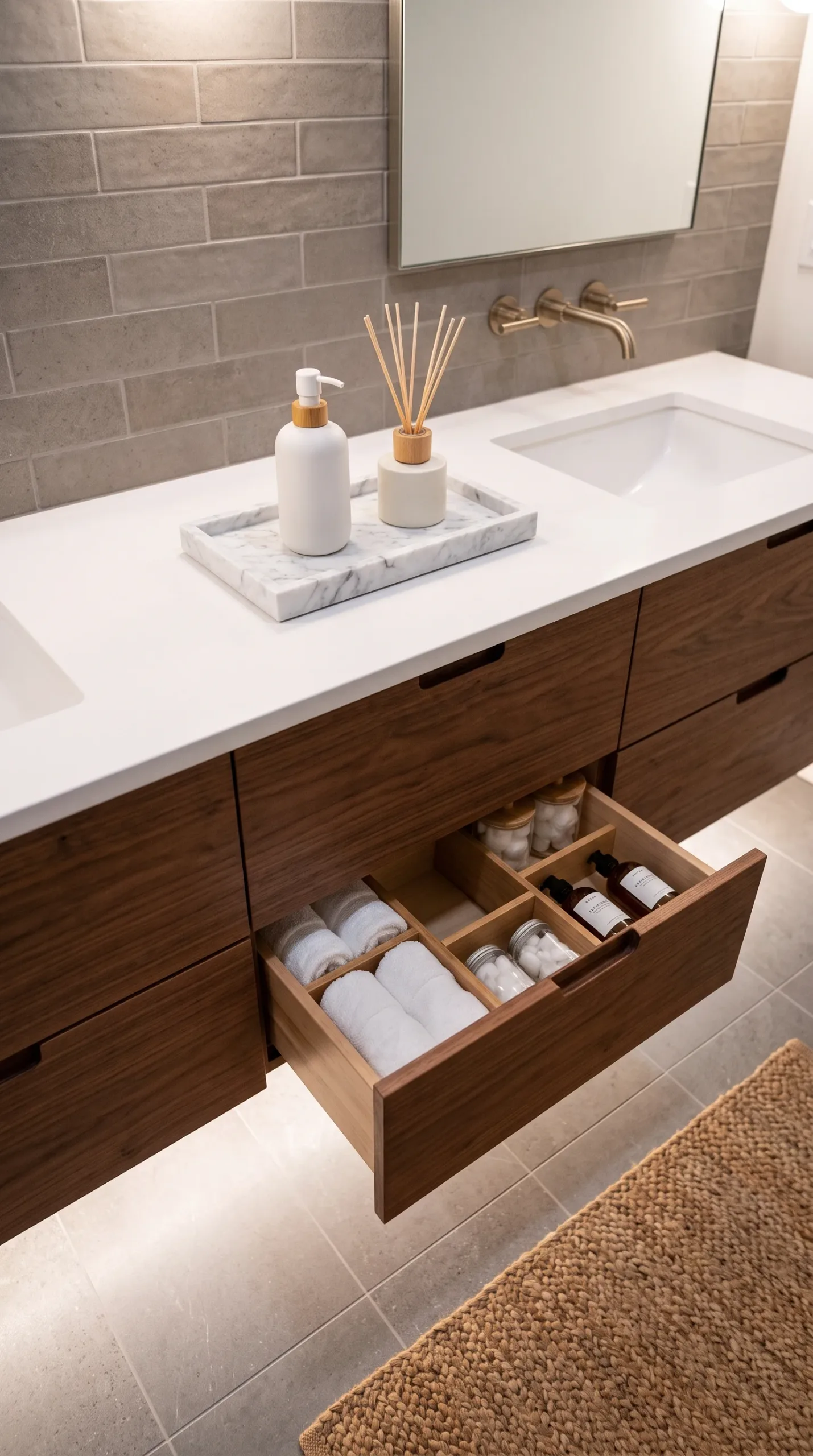
Nothing undermines a spa atmosphere faster than a crowded countertop. A row of half-used bottles, a collection of hair tools, a bar of soap on a dish surrounded by residue — these are the visual details that keep a bathroom feeling like a utility space rather than a place to relax. Concealed storage is the fix, and it does not have to mean a full renovation. Vanity mirrors with built-in shelving behind them are a straightforward option. Recessed niches built into the shower wall during a renovation keep shampoo and body wash off the floor. A floating vanity with full-extension drawers gives you much more usable storage than a traditional vanity cabinet while making the floor appear larger. For rentals or spaces where you cannot build in, a set of matching baskets or lidded canisters on a single shelf keeps things tidy without requiring any installation. The goal is one surface, one tray, three items maximum visible.
Designer Note: Spend one hour pulling everything out of your bathroom and editing down to what you actually use weekly. The storage problem in most bathrooms is partly a volume problem — too much stuff, not too little space.
9. Invest in Thick, Spa-Quality Towels
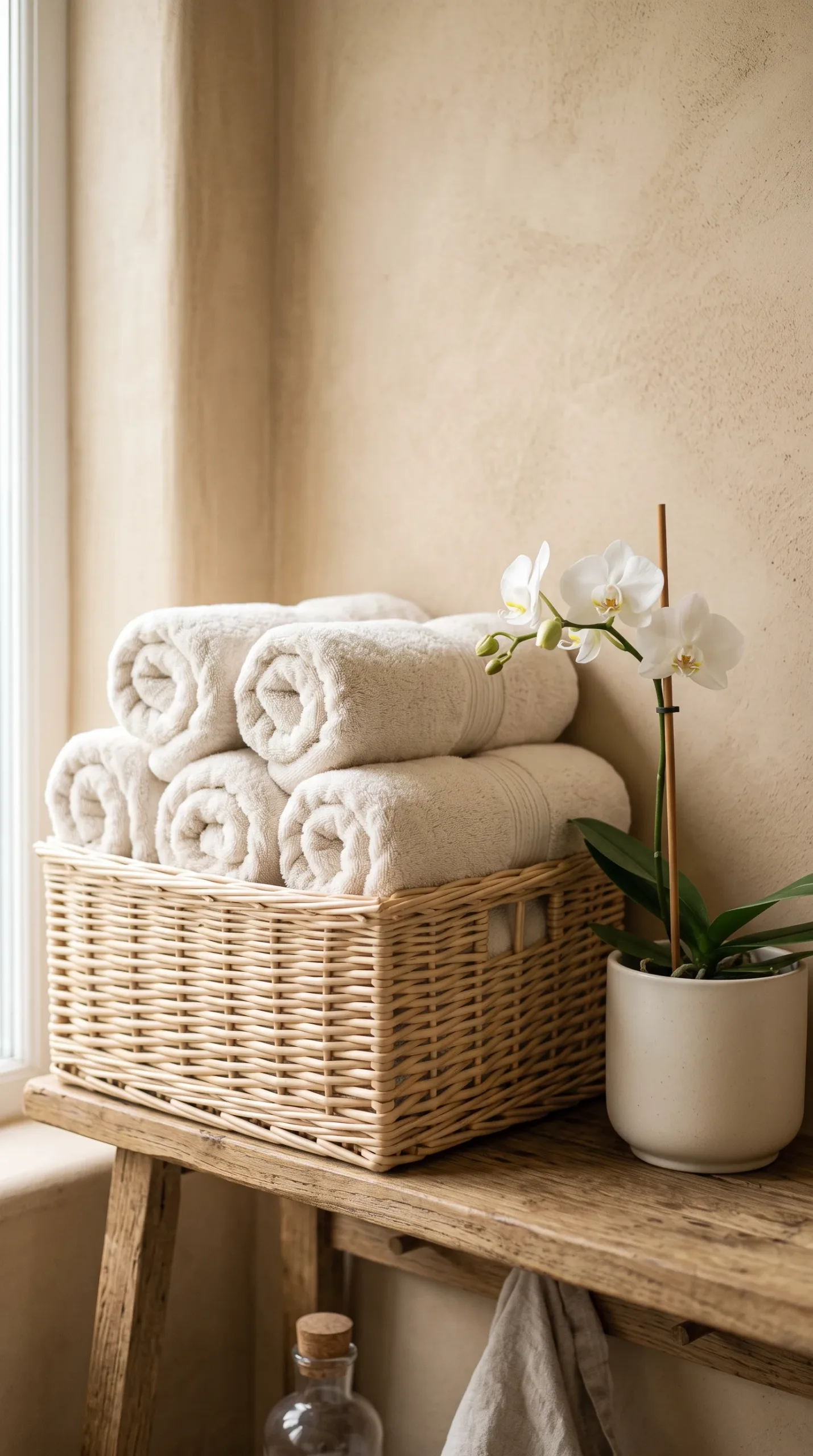
Towels are one of those things that most people do not think about as a design decision, but they are visible every time you walk into the room and they are the first thing you touch when you step out of the shower. The tactile experience of a genuinely good towel is completely different from a thin one. Look for 100% long-staple Turkish or Egyptian cotton with a weight of at least 600 GSM — the higher the GSM, the denser and more absorbent the towel. White or ivory towels read as most spa-like and have the added benefit of being bleachable, which means they stay looking clean longer than colored options. Roll them rather than folding flat and store them in an open basket or on a heated towel rail to complete the look. A heated towel rail serves double duty as a drying rack and a way to deliver a warm towel after every shower, which is one of the simplest spa luxuries available.
Designer Note: Replace all visible towels with matching sets. Mixed colors and sizes are one of the main things that make a bathroom feel casual rather than curated — a small change with a disproportionate visual impact.
10. Bring in a Live Plant or Two
Bathrooms with plants feel different from bathrooms without them, in the same way that a room with natural light feels different from one without it. Plants add life, softness, and a connection to the natural world that no amount of tile or paint can fully replicate. The best bathroom plants are those that tolerate humidity and low to medium light: pothos, peace lilies, snake plants, ZZ plants, and certain ferns all do well in bathroom conditions. A single large plant, like a bird of paradise or a fiddle-leaf fig in a bathroom with enough natural light, makes an immediate statement. In smaller or windowless bathrooms, stick to low-light tolerant species and rotate them with plants from other rooms every few weeks to keep them healthy. Terra cotta or matte ceramic pots in earthy tones complement a spa palette better than plastic nursery containers.
Designer Note: Even one healthy plant in a good pot does more for the atmosphere of a bathroom than ten struggling ones. Start with a pothos — it is nearly impossible to kill and looks genuinely beautiful trailing down from a shelf.

11. Choose a Stone or Wood Vanity for Natural Warmth
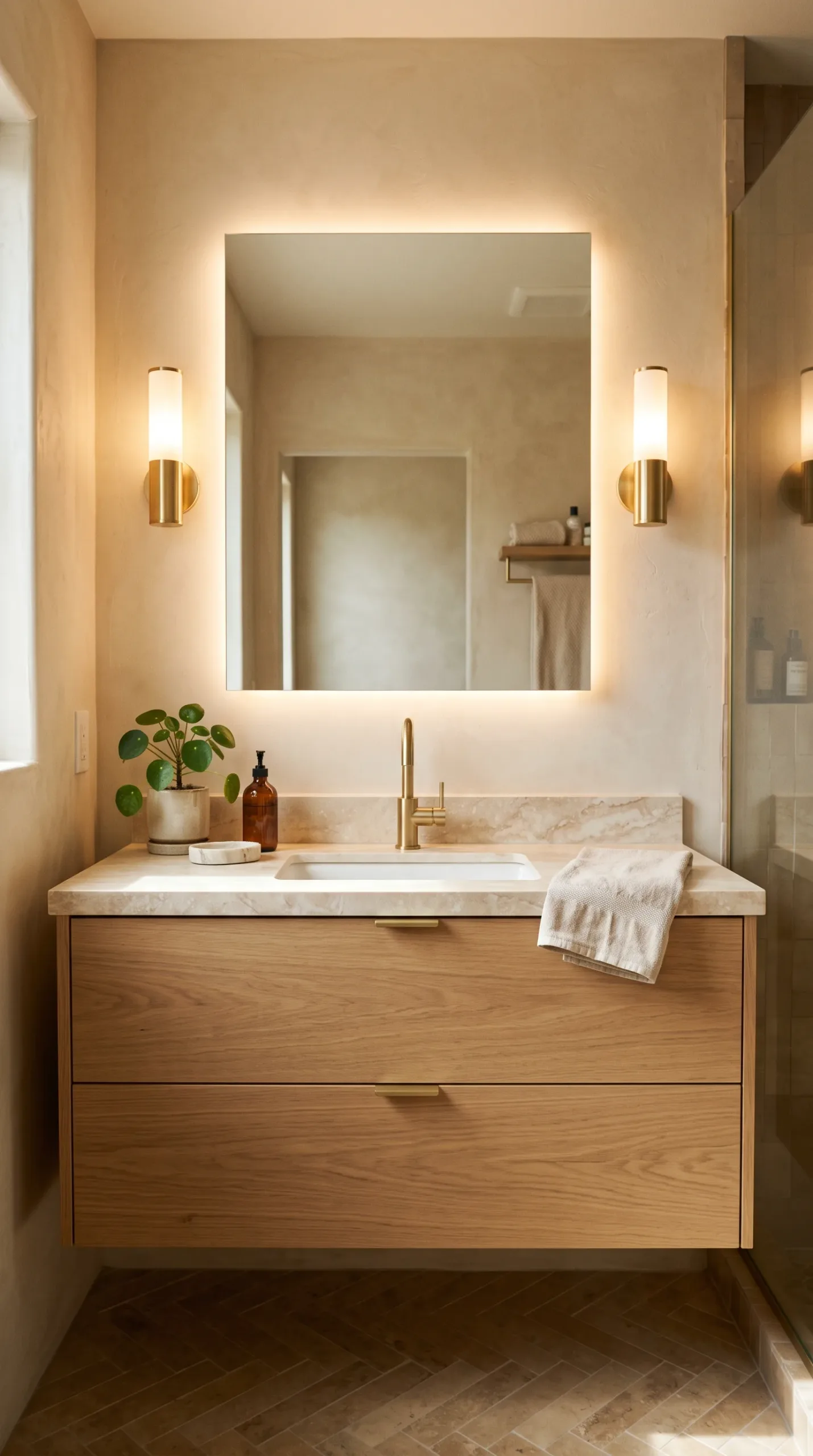
Builder-grade vanities in white laminate are functional, but they are not doing anything for the atmosphere of your bathroom. Replacing the vanity, or even just the vanity top, is one of the most impactful single upgrades you can make. Honed marble, leathered quartzite, or solid travertine countertops in warm ivory or sand tones add a sense of material quality that is immediately noticeable. Walnut or white oak vanity bases add organic warmth that painted MDF simply cannot replicate. If a full vanity replacement is not in the budget, replacing just the countertop and hardware is a meaningful middle ground. Brushed brass or unlacquered brass fixtures complement warm wood and stone beautifully. One honest note: natural stone requires sealing once or twice a year and does not tolerate acidic products left sitting on the surface, so it is a material that rewards a tidy counter habit.
Designer Note: If natural stone is beyond budget, look at porcelain slabs designed to mimic stone. Modern large-format porcelain in a stone-look finish is convincing at a distance and far more durable in a bathroom environment.
12. Create a Steam Shower Experience
A steam shower is as close as a home bathroom gets to the experience of a professional spa treatment room. The moist heat relaxes muscles, opens pores, and has a genuine calming effect on the nervous system that a regular shower simply cannot replicate. Converting an existing shower to steam requires a generator, a fully waterproofed and sealed enclosure, and a solid door or panel to contain the steam — so this is a renovation-level project rather than a quick swap. The best enclosures for steam are either full-height glass panels or tiled walls, with no gap at the top. Bench seating inside, either built-in tile or teak, makes the experience usable for longer sessions. A chromatherapy light or aromatherapy port on the generator adds another sensory layer. This is an investment item, with generator plus installation typically running into the several-thousand-dollar range, but for people who use it regularly, the daily return is hard to argue with.
Designer Note: Size the steam generator to your shower’s cubic footage, not just the floor area. A generator that is too small for the space will struggle to fill it and wear out faster.

13. Use Limewash or Venetian Plaster on the Walls
There is a reason why high-end spas and boutique hotels increasingly favor textured wall finishes over paint or tile. Limewash plaster and Venetian plaster both create a surface with depth, variation, and a hand-applied quality that flat paint can never achieve. Limewash gives walls a soft, chalky, slightly aged appearance in tones ranging from warm white to deep clay, and it is actually a traditional finish with roots in Italian and Mediterranean architecture. Venetian plaster is smoother and develops a subtle sheen when burnished, which reads as more polished and refined. Both finishes are water-resistant when properly sealed, making them viable for bathroom walls, though they are not recommended for areas of direct water contact like inside the shower. The application process is more involved than painting and is best left to a skilled plasterer, but the result genuinely cannot be replicated with any paint finish.
Designer Note: Sample limewash colors on the actual wall before committing — the color shifts noticeably as it dries and looks completely different on a small chip card than it does at full scale.
14. Add a Teak or Bamboo Bath Mat
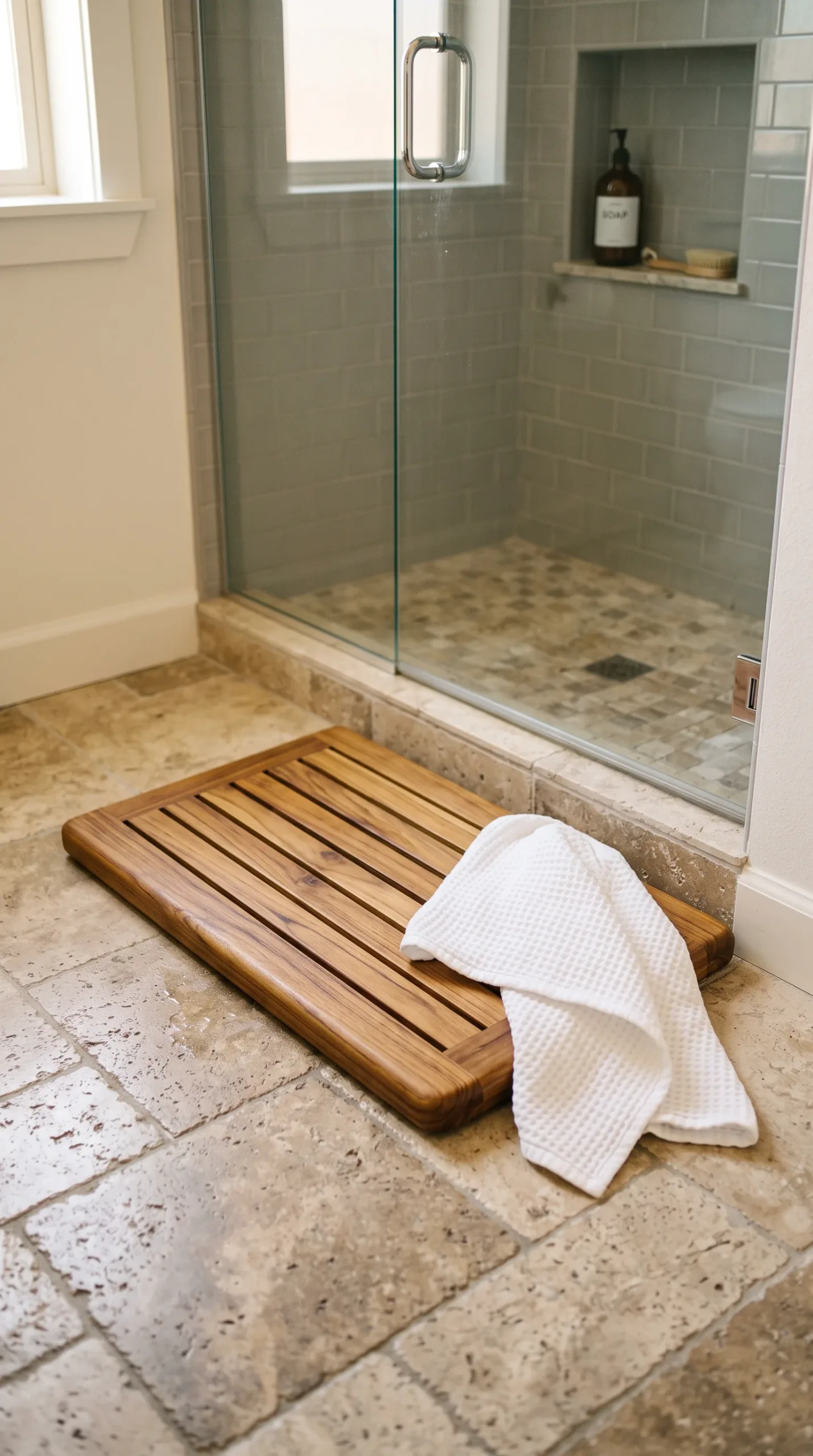
This is a small swap with an outsized sensory impact. A slatted teak or bamboo bath mat placed outside the shower or tub connects the bathroom visually to nature in a way that fabric mats cannot. The natural grain of the wood and the slight elevation off the floor give it a visual quality that reads as intentional and refined. Teak is naturally water-resistant due to its high oil content, which makes it genuinely appropriate for a wet bathroom environment without warping or deteriorating quickly. It also dries much faster than a fabric mat, which means no lingering damp smell. Bamboo is a more affordable alternative with similar visual appeal, though it requires occasional oiling to maintain its appearance. Both materials pair beautifully with a stone floor, a neutral tile, or even older ceramic tile if you are layering over an existing bathroom rather than renovating.
Designer Note: Lift the mat occasionally and let the floor beneath dry fully. Even teak benefits from air circulation underneath to prevent any moisture buildup on the floor surface below it.
15. Install a Backlit Mirror
A backlit mirror is one of those upgrades that looks like a design decision and functions like a lighting decision at the same time, which makes it unusually efficient. The diffused light that radiates from behind the mirror eliminates the harsh shadows cast by overhead lighting, gives the face an even, flattering illumination, and simultaneously fills the room with a warm ambient glow that feels more atmospheric than functional overhead lights alone. LED backlit mirrors are available across a wide price range, from affordable options with basic backlighting to higher-end models with adjustable color temperature, touch dimmers, defog functions, and built-in USB ports. A larger mirror reads as more spa-like than a small one, so if the wall space allows, err toward a wider format. Frameless backlit mirrors tend to look the most refined and work with a broader range of bathroom styles.
Designer Note: Match the color temperature of your backlit mirror to your other bathroom lighting sources. Mixing warm and cool light in the same room creates a disjointed feeling that is hard to identify but immediately noticeable.

16. Build a Recessed Shower Niche
A recessed shower niche is a small architectural detail that has a meaningful effect on both the look and the function of a shower. Rather than a plastic corner caddy or a line of bottles on the floor, a niche built into the wall sits flush with the tile, holds your products neatly, and adds a finished, intentional quality to the overall design. Niches are built during the framing or tile installation phase and need to be waterproofed carefully — this is not a detail to cut corners on. They can be sized to hold bottles upright comfortably, which typically means a niche that is at least 12 inches tall and 12 inches wide, set at a height between the shoulder and the chest for easy reach. Tile the niche in a contrasting material, like a small-format mosaic or a single slab of marble, to make it a feature rather than just a storage solution. A single niche on one wall looks more considered than multiple niches scattered around.
Designer Note: Add a small LED strip light inside the niche during installation. It is a subtle detail that catches the eye and adds a layer of atmosphere that most people notice without being able to identify exactly why.

17. Choose Matte Black or Brushed Brass Hardware
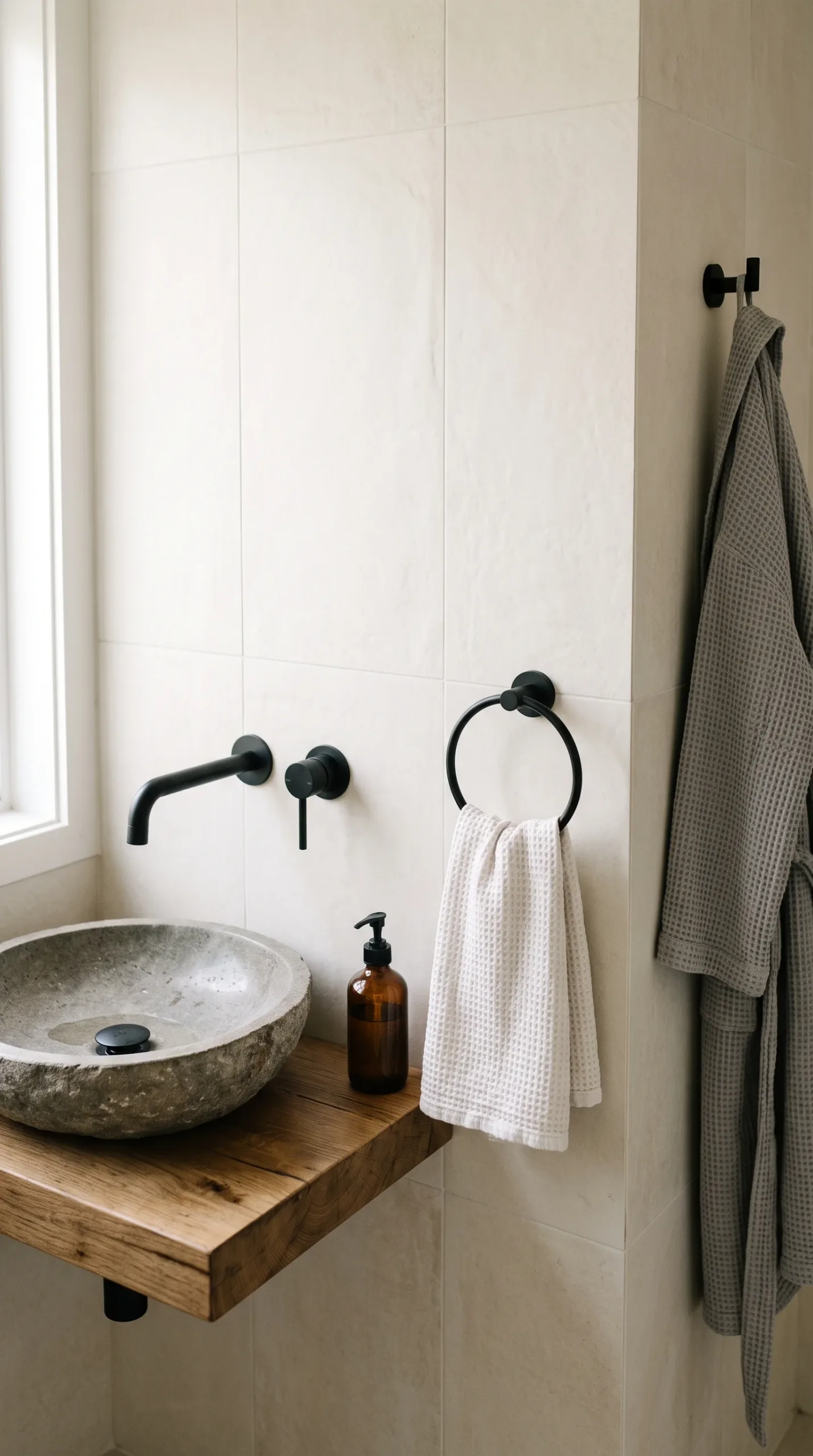
Fixtures and hardware are the jewelry of a bathroom, and they have a much larger effect on the overall feeling of a space than their size would suggest. Swapping out chrome faucets, towel bars, toilet paper holders, and robe hooks for a unified finish in matte black or brushed brass is one of the most affordable high-impact changes you can make to an existing bathroom. Matte black reads as modern and graphic, pairing well with white, grey, and dark tile palettes. Brushed brass reads as warm and refined, complementing wood tones, cream tiles, and natural stone beautifully. The key is consistency — mixing finishes creates visual noise, while a single finish across every fixture in the room creates a sense of deliberate design. Most hardware can be swapped without any plumbing work, making this one of the most accessible upgrades on this list.
Designer Note: Check that your faucet stems are compatible before buying a new fixture. Some faucet handles are universal and some are brand-specific, so confirm compatibility before ordering.
18. Add Aromatherapy with a Reed Diffuser or Oil Burner
Scent is one of the most immediate and underused tools in bathroom design. The brain processes smell faster than any other sense, which means the right fragrance genuinely changes the atmosphere of a space within seconds of walking in. Reed diffusers are the most low-maintenance option for a consistent background scent — look for fragrances built around eucalyptus, cedar, white tea, bergamot, or sandalwood, all of which are common in professional spa environments for good reason. Essential oil burners or ultrasonic diffusers give you more control over intensity and allow you to switch scents easily. Avoid overly sweet or heavy floral fragrances, which tend to feel more perfume-counter than spa. A single diffuser placed near the entry to the bathroom is enough to set the tone as you walk in. Candles are another option, though they work best in bathrooms with good ventilation to prevent soot buildup on walls and ceilings.
Designer Note: Reset the fragrance in your bathroom periodically by airing it out completely for a few hours. Our sense of smell adapts to constant background scents, so a regular reset keeps the experience fresh.

19. Try Japandi Style for Minimal Calm
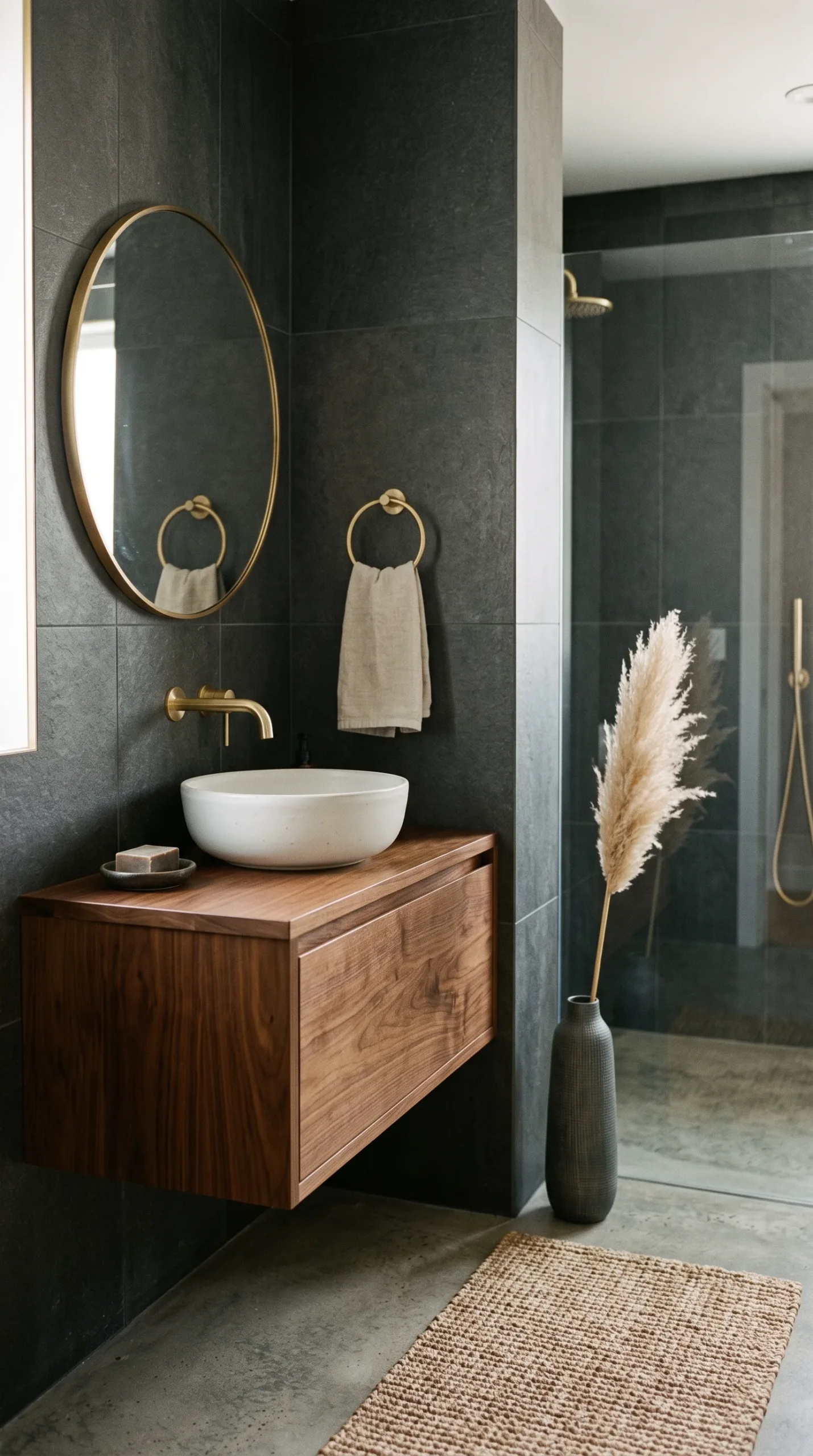
Japandi is the design shorthand for a fusion of Japanese minimalism and Scandinavian functionality, and it produces some of the most genuinely calming interiors currently popular in high-end design. In a bathroom, this translates to a very specific look: low visual weight, natural materials, a palette of warm whites and dark muted tones, and an almost complete absence of decoration. Think a walnut floating vanity with a matte white ceramic vessel sink, charcoal grey wall tiles with a fine texture, a single branch of dried pampas grass in a tall ceramic vase, and a cotton bath mat in oatmeal. Everything serves a purpose and nothing is added for the sake of filling space. The style rewards restraint, which means the fewer items you add, the better it usually looks. This is a particularly good approach for small bathrooms, where clutter is the primary enemy of a calm atmosphere.
Designer Note: Negative space is an active design element in Japandi, not an oversight. Leave surfaces intentionally clear, and resist the habit of filling every shelf and corner.
20. Upgrade Your Bathrobe and Towel Display
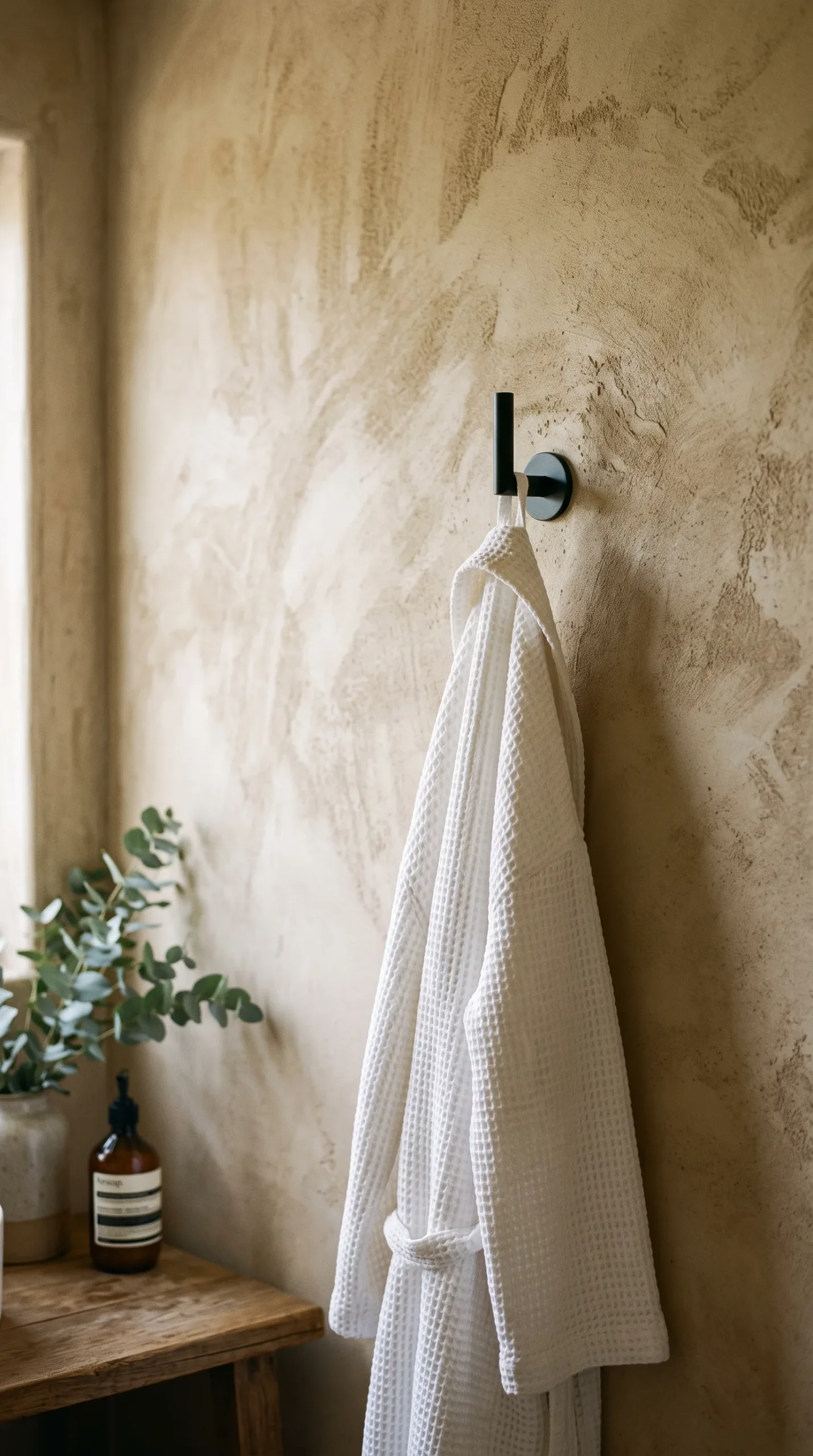
How you display your towels and robes is a detail that professional spa designers think about carefully, and it is one that most homeowners overlook entirely. A thick cotton robe hanging from a generously sized matte black hook near the shower immediately reads as spa-like in the same way a hotel room does. Folded towels rolled and arranged in a basket or on an open shelf add texture and visual order. If you have the wall space, a ladder shelf in natural oak or teak holds both towels and small plants and adds a lot of warmth without requiring any installation. The key is keeping everything matching: same color towels, same fold, same hook or display. Mixing mismatched towel sizes and colors is one of the most common things that prevent bathrooms from feeling put-together even when everything else is in good shape.
Designer Note: Buy one extra set of towels so you always have a fresh, display-ready set on hand. Rotating between two sets means your display never looks tired or half-empty.

21. Install a Wet Room for Total Luxury
A wet room takes the spa bathroom concept further than almost any other design decision by removing the distinction between the shower and the rest of the bathroom floor. The entire floor is waterproofed, gently sloped to a central drain, and finished in a continuous tile surface, with the shower area defined only by a partial glass panel or simply by the placement of the showerhead. The result is a space that feels open, expansive, and genuinely luxurious in the way that only a few other design choices can match. Wet rooms are particularly effective in smaller bathrooms, where removing a shower enclosure visually opens the space considerably. The waterproofing is the most critical aspect — a poorly waterproofed wet room is an expensive problem, so do not cut corners on the liner, the screed, or the membrane. This is a project for an experienced bathroom fitter.
Designer Note: Include a linear drain along one wall rather than a central drain if your layout allows. Linear drains are easier to slope toward and look more refined than a traditional circle drain in the center of the floor.

22. Use Candles and Mood Lighting for Evening Rituals
The transition from daytime to evening in a bathroom can feel jarring if the lighting never changes. Overhead lights that work well for a morning routine are often too harsh and stimulating for an evening bath. Building an evening ritual around lowered lighting and candles is one of the simplest and most affordable ways to make a bathroom feel like a spa without changing a single fixture. A cluster of unscented or lightly scented pillar candles on a small tray near the bathtub, combined with your dimmer switch set low, creates an atmosphere that genuinely invites you to slow down. Beeswax candles burn cleanly and last longer than paraffin options. Battery-operated flameless candles are a practical alternative for those who prefer not to leave open flames unattended. The ritual itself matters as much as the physical setup — keeping a small basket of bath salts, a book, or a face mask near the tub reinforces the idea that this time is set aside.
Designer Note: Avoid placing candles directly under towels or near fabric window treatments. Keep them on a stable, non-flammable surface and never leave them burning in an unattended room.

23. Add a Built-In Bench to the Shower
A shower bench is one of those features that seems like a nice-to-have until you have one, at which point it becomes something you cannot imagine living without. Beyond the obvious accessibility benefits, a built-in bench adds a spa dimension to the shower that changes how you use the space. You are more likely to linger, to shave your legs without balancing on one foot, to sit under a steam shower, or to simply pause for a moment in the warm water. Built-in benches are typically constructed from the same tile as the walls and floor, which keeps the look unified and avoids the visual interruption of a teak insert. For smaller showers, a corner bench takes up less room than a full-width one while still delivering the function. The bench height should sit between 17 and 19 inches from the floor, which is comfortable for most adults. This is a feature best planned at the tile stage of a renovation rather than added afterward.
Designer Note: Slope the bench surface very slightly toward the shower drain so water does not pool on it. Even a 1-degree pitch is enough to prevent standing water without being noticeable when you sit on it.
24. Curate a Small Tray of Spa Essentials on the Vanity
The final detail, and one of the most immediate, is the vanity tray. A single marble, slate, or lacquer tray placed on the vanity counter, holding three to five carefully chosen items, does more to communicate “spa” than almost anything else at the surface level. The items inside should be beautiful and functional at the same time: a good hand cream in a refillable glass pump, a small candle in a ceramic vessel, a linen face towel folded neatly, a simple ceramic soap dish. Keep the tray edited. The discipline is in removing things rather than adding them. A tray with two items looks intentional. A tray with ten items looks like a surface that needs tidying. This is the finishing touch that pulls everything else together, and it costs almost nothing to achieve if you already have the pieces — it just requires the willingness to edit down to what is actually worth displaying.
Designer Note: Replace the tray contents seasonally. A small eucalyptus bundle and neutral candle in winter, a sprig of dried botanicals and citrus-scented cream in summer. It keeps the bathroom feeling fresh and alive without requiring any permanent changes.

Conclusion
Making your bathroom feel like a spa is less about spending a lot of money and more about making deliberate choices. The spaces that actually deliver that sense of calm and quality are the ones where every element was considered, from the color on the walls to the weight of the towels to the scent in the air. Some of the ideas in this list are large investments that take planning and a renovation budget. But many of them cost very little and deliver a disproportionate return in how the space feels to use every day.
The most important thing is to start somewhere specific. Pick one or two ideas that speak to the way you actually use your bathroom and begin there. A rainfall showerhead. A backlit mirror. A set of matching towels and a teak bath mat. Small changes that speak to the same idea accumulate quickly, and before long, the bathroom stops feeling like a utility space and starts feeling like somewhere you actually want to spend time. That shift — from functional to genuinely enjoyable — is what the spa experience is really about, and there is no reason it has to live only at a hotel.
Frequently Asked Questions
How much does it cost to make a bathroom feel like a spa?
The range is genuinely wide. On the low end, you can achieve a meaningful spa feel for a few hundred dollars through better towels, a teak bath mat, a reed diffuser, some candles, and a decluttering session. Mid-range upgrades like a backlit mirror, a rainfall showerhead, and new hardware might run between $500 and $2,000 depending on brands. Full renovation elements like radiant floor heating, a freestanding tub, or a steam shower are investment-level decisions that can run into the tens of thousands. Start small and build from there.
What color makes a bathroom feel most like a spa?
Warm neutrals are the most reliable choice, particularly soft sand, warm greige, taupe, and pale travertine tones. These colors sit in the middle of the value scale, neither too light nor too dark, and they pair well with natural materials like wood and stone. Avoid cool greys or stark whites in isolation — they tend to read as clinical rather than calming unless carefully balanced with warm textures and lighting.
Can I make a small bathroom feel like a spa?
Absolutely. In some ways, a small bathroom is easier to work with because the sensory details, scent, texture, lighting, are all experienced in a tighter space, which makes them feel more immediate. Key moves for small bathrooms include large-format tiles to minimize visual noise, a floating vanity to open up the floor, a backlit mirror to add depth and light, and extremely disciplined decluttering. Less is genuinely more in a compact bathroom.
What plants work best in a spa bathroom?
For bathrooms with natural light, pothos, peace lilies, and certain tropical ferns all do well in the humid conditions. For low or no-light bathrooms, ZZ plants and snake plants are the most forgiving. The key is to choose one or two plants that genuinely thrive in your conditions and keep them healthy, rather than filling the room with plants that are struggling. A healthy single plant always looks better than several unhappy ones.
Is a steam shower worth the investment?
For people who prioritize wellness and plan to use it consistently, yes, the daily return on a steam shower is hard to match. The health benefits of regular steam bathing are reasonably well documented, including muscle relaxation, improved circulation, and skin hydration. The honest caveat is that if you travel frequently or tend not to use your bath features regularly, it is a significant investment for occasional use. Be honest with yourself about your habits before committing.
What is the single most impactful change for a spa-like bathroom?
Lighting. Every bathroom designer asked this question eventually points to lighting as the highest-return change you can make. Dimmable overhead lights combined with a backlit or well-lit mirror changes the entire atmosphere of a bathroom without touching a single tile or fixture. It is the first thing to get right and the easiest thing to overlook.