Black Modern Living Room Ideas That Actually Suit the Way You Live
A black modern living room means different things to different people. For some it is a sleek, spare space where black functions as precision: clean lines, minimal objects, and the kind of quiet confidence that does not need to announce itself. For others it is a warm, cocooning room where dark walls and rich textures create the best possible version of somewhere to sink into after a long day. For others still it is a graphic, high-contrast space with a strong design identity, or a luxurious layered interior where black provides the depth that makes every material around it look more expensive. All four of these are valid and all four are genuinely modern, but they require different decisions to execute well and they produce very different rooms.
The ideas in this article are organized by design personality rather than by individual element or technique, so you can find the version of a black modern living room that matches how you actually want to live in the space and then use the specific ideas within that group to build it. Each idea tells you what the specific design decision is, why it creates the mood it creates, and what to watch out for so the room does not veer into the version of black that looks like a mistake rather than a choice.
Sleek and Minimal: Black as Architectural Precision
In a sleek minimal black living room, black is not a colour. It is a material decision about line, proportion, and visual weight. The room is edited to its most considered elements and every object earns its presence through form and function rather than decoration.
1. Matte Black Walls With White Architectural Trim
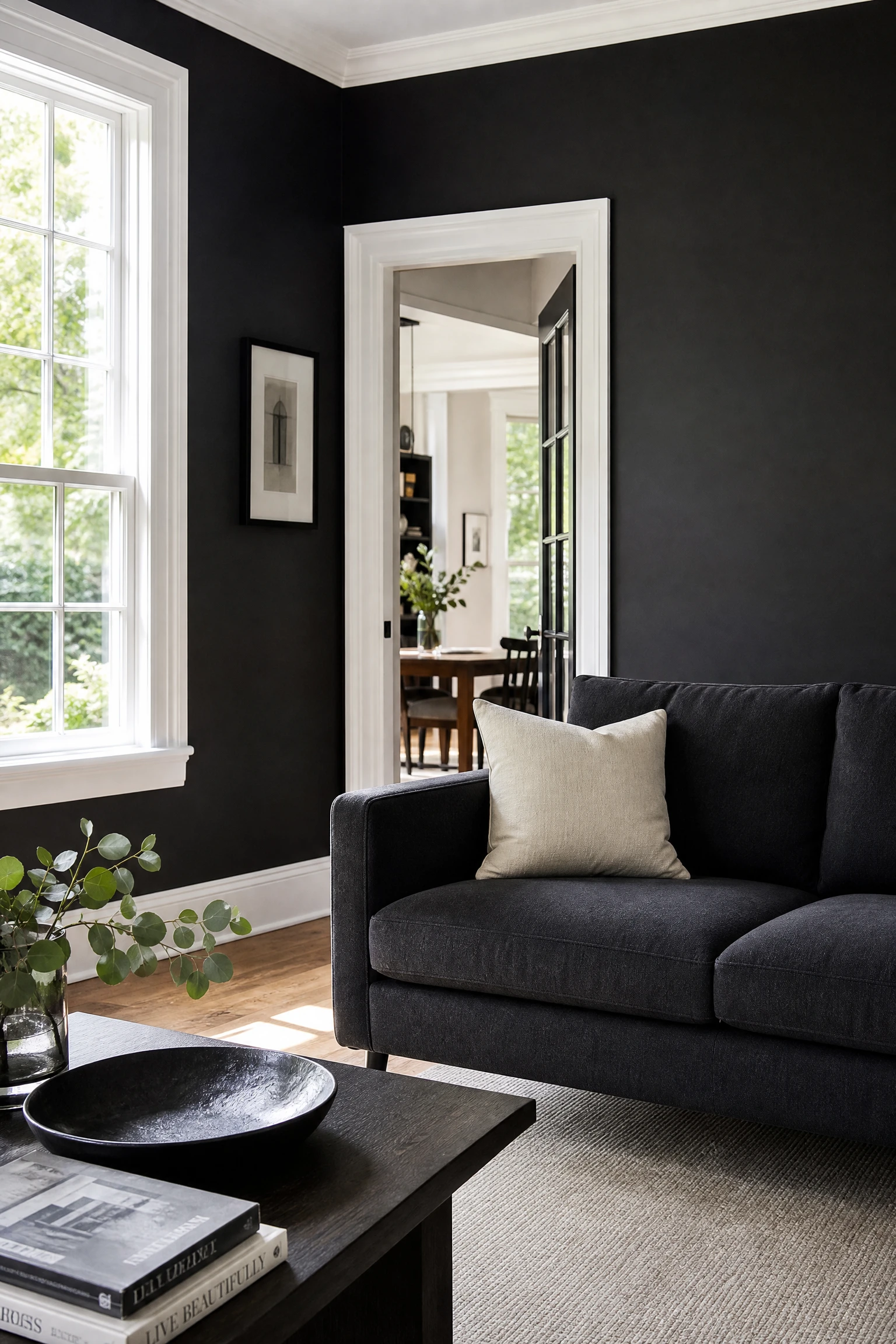
A living room with matte black painted walls and crisp white painted trim, whether skirting boards, cornicing, window frames, or door architrave, creates the most precisely graphic version of a modern black interior because the white trim does not soften the black walls so much as it defines them. The line between the matte black surface and the white profile of the trim creates a sharp, clean boundary that makes every architectural detail of the room more visible and more deliberate. In a room with interesting original features, crown mouldings, deep window reveals, or panelled doors, this treatment gives those architectural elements a visibility and drama they have never had under white or neutral paint. In a newer room without strong features, the white trim creates its own architecture by making the geometry of the room, its corners, its door and window positions, visually explicit against the dark background.
Pro Move: Use a satin or semi-gloss finish on the white trim alongside a matte black wall finish. The slight sheen difference between the two surfaces adds a layer of refinement that makes the boundary between black and white read as intentional and precise rather than simply two coats of paint meeting at an edge.
2. Black Minimal Sofa With a Single Sculptural Coffee Table

A low-profile matte black or charcoal sofa with clean-lined arms and a simple geometric silhouette, paired with a single sculptural coffee table in a contrasting material, either travertine, smoked glass, pale oak, or polished concrete, creates the kind of edited, gallery-like living room arrangement that defines the minimal black aesthetic. The single coffee table as the only object between the sofa and the facing wall or fireplace leaves the floor plan open and the eye uncluttered. The choice of the coffee table material is the most important decision in this arrangement: it is the one piece of colour, texture, and material warmth in the room and it does the entire warming work for the whole composition. A travertine table against a matte black sofa and charcoal walls is the combination that interior photographers have returned to most consistently in the past two years, and the reason is the specific relationship between the warm fossil tones of natural stone and the cool precision of matte black.
Designer Advice: Choose a coffee table that is slightly lower than the seat height of the sofa rather than the same height. A table at seat height reads as a barrier. A table at calf height when seated reads as a surface that floats below the seating plane, creating a visual openness that suits the minimal black aesthetic considerably better.
3. Black Floating Media Unit as the Room Anchor

A floor-to-ceiling or full-width floating media unit in matte black lacquer or painted MDF, with the television recessed into it or wall-mounted above it, turns the media wall of the living room from a functional necessity into a considered architectural element. In a minimal black living room, the media unit serves as the primary organizing principle of the space: it defines the focal wall, determines the sofa position, and provides the storage that keeps all other surfaces clear. When the unit is in matte black and the wall behind it is also in a dark tone, the television screen blends into the surface when switched off rather than appearing as a black rectangle floating on a wall, which is the visual detail that makes a minimally styled living room look consistently designed rather than assembled around a TV. The unit needs to be genuinely full-width or genuinely floor-to-ceiling to read as architectural: a floating unit that is shorter than the wall on all sides reads as a piece of furniture rather than a design decision.
Heads Up: A full-width floating media unit in a room with an irregular ceiling height, angled walls, or alcoves on either side of the chimney breast requires precise measurement and usually professional installation. An off-the-shelf unit in a slightly wrong size in a black minimal room is considerably more visible than the same misfit would be in a neutral room.
4. Black Steel Window Frames as a Design Statement
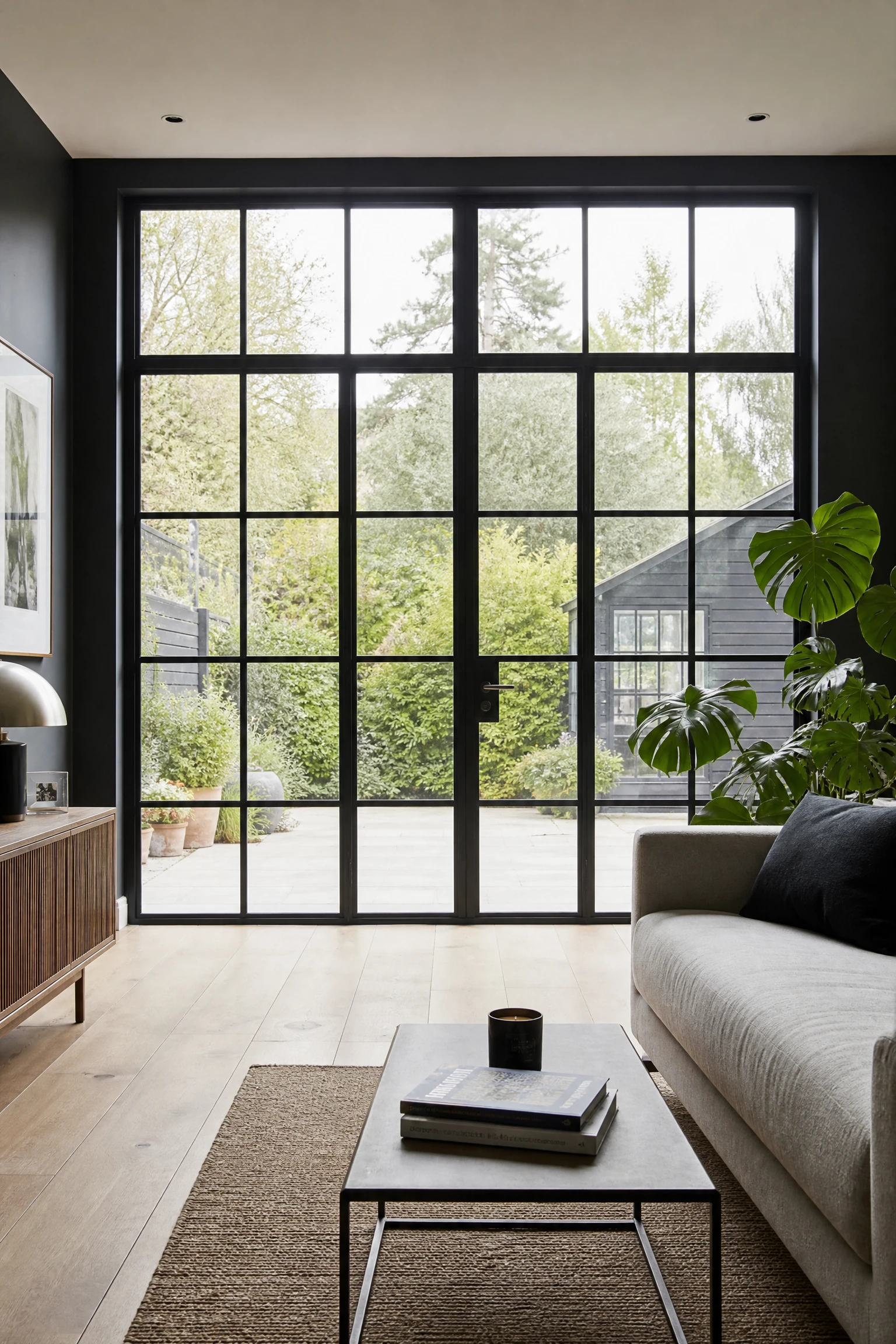
In a living room where the windows are large or architecturally prominent, steel or steel-effect black window frames turn a functional element into the most graphic and modern design feature in the room. Crittall-style steel frame windows and doors with large glass panes divided by slim black profiles have become one of the defining visual signatures of contemporary interiors, and in a living room they function simultaneously as architecture, as a graphic element, and as a connection between the interior and the exterior world. The slim black steel profile of the frame reads as a drawing on the glass surface, creating a grid or geometric pattern that is visible from across the room and connects the interior palette to the dark detailing of the window itself. In a room with standard timber or UPVC window frames, replacing them with a crittall-style system or adding black-framed internal doors or partitions with glazed panels creates the same effect without requiring the windows themselves to be changed.
Quick Tip: Black steel-effect aluminium frames achieve the same visual result as genuine steel at a fraction of the cost and with better thermal performance. Most specialist window suppliers offer steel-effect powder-coated aluminium in a matte or satin black finish that is visually indistinguishable from steel in a finished interior.
5. Black and White Monochrome Art as the Only Colour
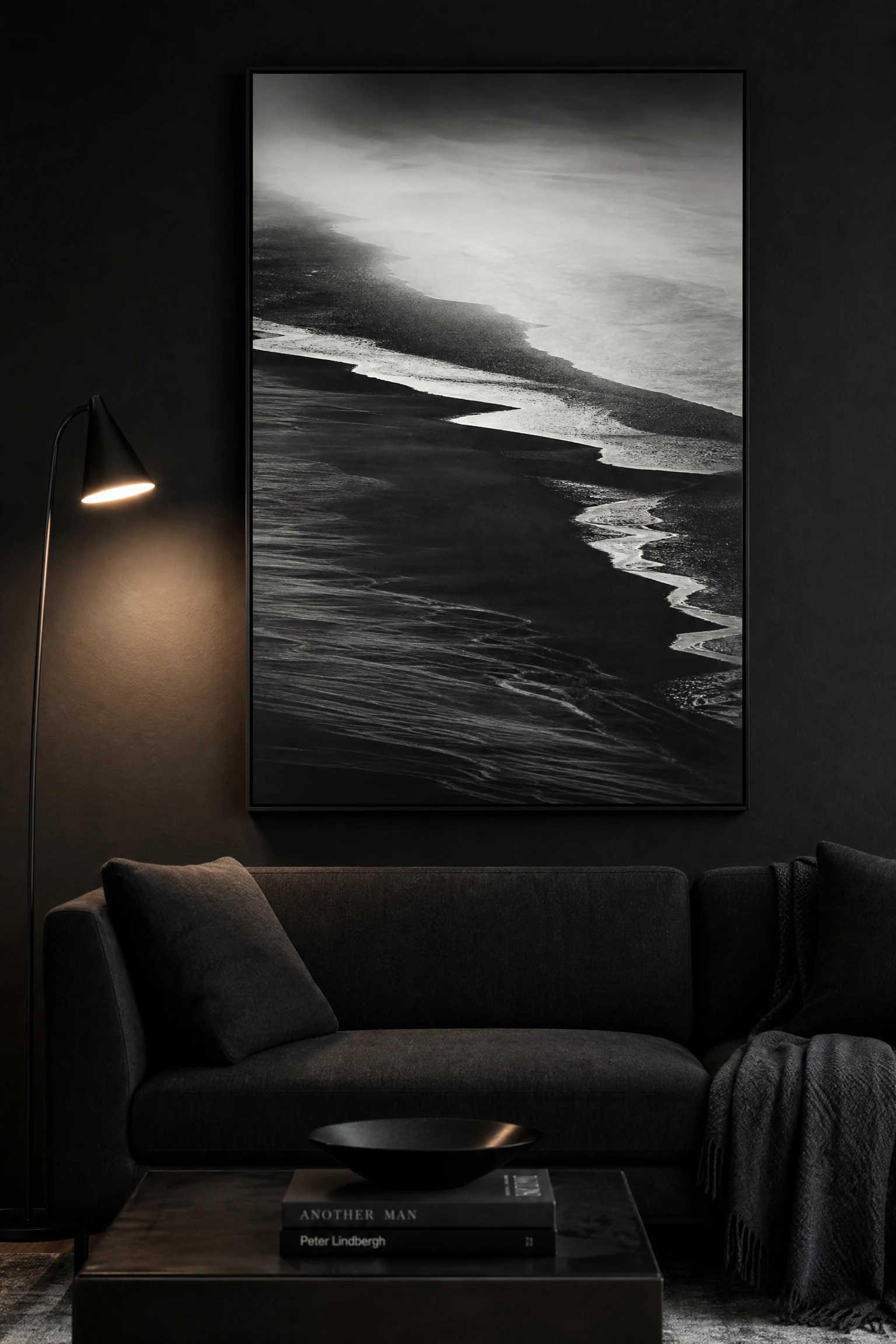
In a minimal black living room where the walls, sofa, and furniture are all in black, dark grey, or charcoal, restricting the artwork to black and white photography or monochrome prints creates a room where the palette is so disciplined and so consistent that it reads as a single unified design decision rather than a collection of individual choices. A large-format black and white photograph above a black sofa creates a composition where the tonal range of the image, from near-white highlights to deep black shadows, extends the tonal range of the room itself. The art is not decorating the room so much as continuing it. This approach requires genuine editorial confidence because the temptation to introduce colour through cushions, books, or accessories is significant, and every coloured object introduced into a monochrome room immediately pulls the attention away from the design system and toward itself.
Reality Check: A fully monochrome black and white living room requires consistent upkeep of every visible surface and object in the room to maintain its impact. One coloured book spine on a coffee table, a child’s toy left on the sofa, or a plant pot in terracotta immediately breaks the palette. This aesthetic suits households who are genuinely disciplined about the surfaces they keep visible.
6. Concealed Storage in Matte Black Joinery

A living room where all storage is concealed within full-height matte black built-in joinery along one wall, with handleless push-to-open doors that create a continuous flat surface across the width of the wall, achieves the minimal black interior at its most resolved. When all the objects of daily life, books, electronics, games, media equipment, spare cushions, and charging cables, disappear behind a flat black surface, the room is left with only the furniture, the art, and the light sources, which is the condition the minimal black aesthetic requires to read at its best. The joinery wall also provides an opportunity to integrate lighting within the unit: recessed LED strips inside open-shelf sections, or uplighting on top of the unit pointed at the ceiling, create a warm ambient glow that makes the dark surface of the joinery feel luminous rather than heavy.
Pro Move: Include at least one section of open shelving within a concealed storage joinery wall, styled with three to five objects in consistent materials, to prevent the full-wall unit from reading as a room divider or a commercial installation. A single curated open shelf section in a wall of concealed storage creates the visual break that makes the rest of the flat surface read as deliberate rather than institutional.
| Sleek Minimal Element | Key Decision | What Makes It Work | What Makes It Fail |
| Matte black walls + white trim | Trim sheen level | Satin trim, precise edge | Flat white trim losing definition |
| Black sofa + sculptural table | Coffee table material | Warm stone or timber contrast | Matching black table, no relief |
| Floating media unit | Full-width or floor-ceiling | Architectural scale | Undersized unit looking like furniture |
| Steel frame windows | Frame profile width | Slim profiles, large glass | Chunky profiles losing the graphic quality |
| Monochrome art only | Palette discipline | No colour exceptions | Single coloured object breaking the system |
| Concealed black joinery | Open shelf inclusion | One curated open section | Full flat wall reading as a partition |
Warm and Moody: Black as a Cocooning Backdrop
A warm and moody black living room uses dark walls and surfaces as the backdrop for layers of texture, warmth, and material richness. This is not a spare or minimal room. It is a room that wraps around you, where the darkness is the condition that makes every warm element more visible and more inviting.
7. Deep Charcoal Walls With Warm Brass and Candlelight

A living room with walls in a deep charcoal or soft black and lighting delivered primarily through warm brass table and floor lamps rather than overhead fittings creates the most immediately cocooning version of the dark modern living room. The warm amber light from brass-shaded lamps at different heights in the room creates pools of warmth against the dark wall surfaces that the dark background amplifies: the same lamp in a white room creates a functional light source, but the same lamp in a charcoal room creates a genuinely atmospheric glow because the darkness around it makes the warm light appear more concentrated and more deliberate. Candlelight on a coffee table, a small group of candles on the mantelpiece, or a single pillar candle on a side table introduces the warmest and most organic light possible and reinforces the cocooning quality of the space in a way that no electric light source replicates.
Designer Advice: In a warm and moody black living room, use at least four separate light sources at different heights across the room rather than relying on one or two. A floor lamp in one corner, a table lamp on each side table, and a low pendant or cluster of candles on the coffee table create the layered light that the dark room needs to feel atmospheric rather than simply dim.
8. Velvet Sofa in a Rich Jewel Tone Against Black Walls

A velvet sofa in a deep jewel tone, forest green, sapphire blue, burgundy, or deep plum, against matte black or charcoal walls creates the warmest and most distinctively moody version of a dark modern living room because the combination of the rich saturated colour of the velvet and the deep darkness of the walls creates a visual depth that feels genuinely enveloping rather than simply dramatic. Velvet as a fabric contributes to this effect in its own right: the pile direction changes the apparent tone of the colour in different light conditions and from different viewing angles, creating a surface that reads as never quite the same colour twice and that catches warm lamp light in a way that flat woven upholstery does not. The jewel tone sofa against black walls is also one of the most practically versatile approaches to the dark living room because the three walls that are not the back wall against which the sofa sits can remain lighter without interrupting the cocooning quality of the dark feature wall behind the main seating.
Quick Tip: Velvet upholstery in a living room needs a fabric with a durable weave rather than the most delicate pile available. Look for a velvet rated for at least 30,000 Martindale rubs for a sofa that will be used daily. A velvet that is too delicate will develop permanent pile crushing in the seat and back areas within the first year of regular use.
9. Black Walls With Warm Timber Built-In Bookshelves
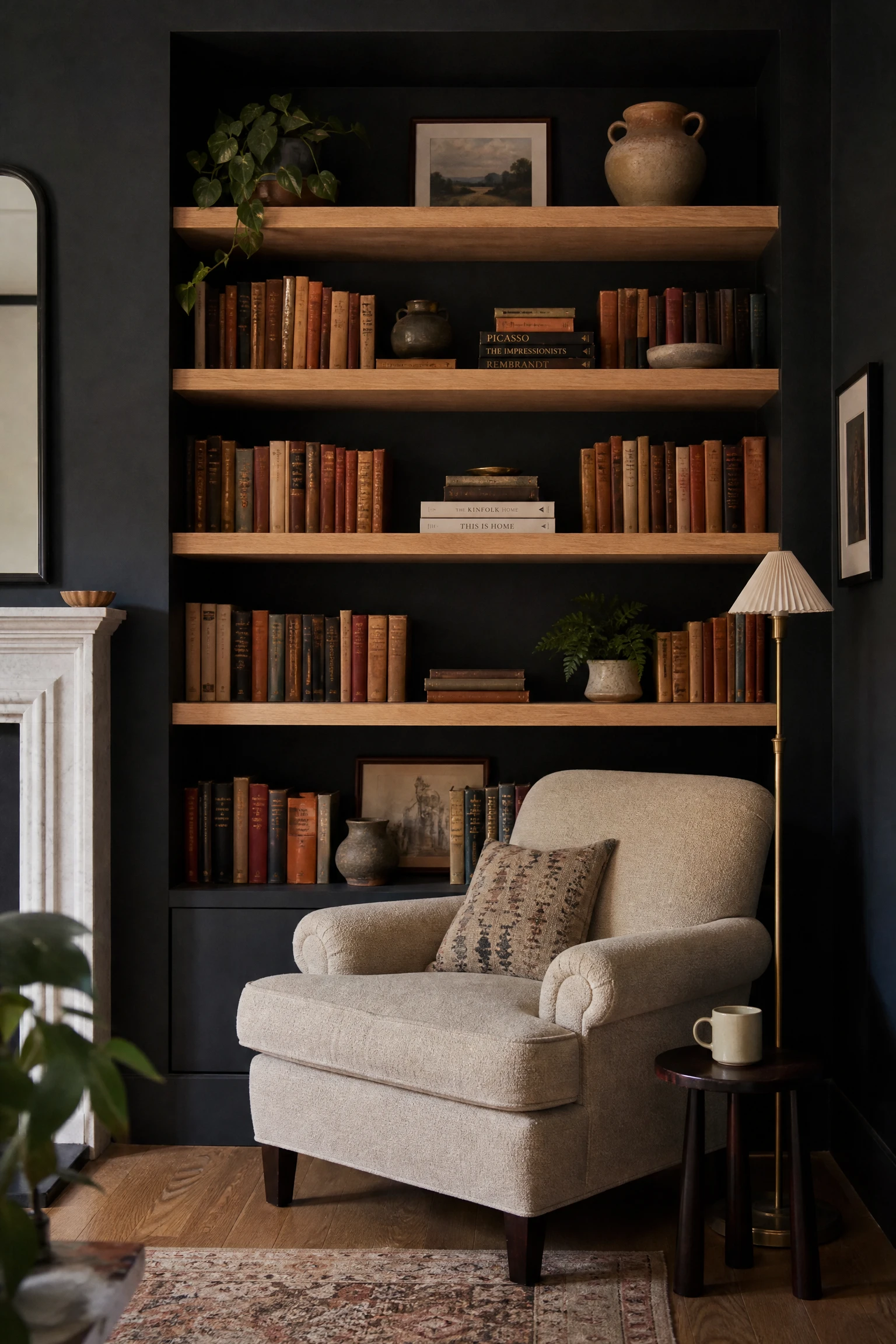
A living room wall fitted with built-in bookshelves in warm timber within an otherwise black-painted room creates a specific and extremely effective contrast: the warm natural colour and grain of the timber shelves stand out against the dark surrounding wall with a warmth and depth that white painted shelving never achieves. When the shelves are filled with books, the multi-tonal spines of the books introduce colour, pattern, and visual interest at the shelving scale, and the whole wall reads as a rich, layered composition that is simultaneously warm and dramatic. This arrangement works particularly well in alcoves flanking a chimney breast where the black walls and timber shelving can frame a fireplace or a television in the central section, creating a living room focal wall with multiple layers of material warmth and visual interest.
Heads Up: Natural timber shelving in a dark room needs a protective finish that maintains the warmth of the wood tone over time. Raw or lightly oiled timber can darken with age in a room that receives limited natural light, losing some of the warm contrast with the black walls that makes the combination work. A hard wax oil or a clear satin varnish maintains the timber tone and protects the surface.
10. Black Living Room With a Statement Fireplace

A working fireplace or a high-quality ethanol or gas fireplace in a dark living room is the most powerful single element for making black walls feel genuinely welcoming rather than dramatically cold. The combination of an open fire and dark walls is historically rooted in the atmospheric interiors of Victorian and Edwardian drawing rooms, and the modern version of this combination, with a contemporary concrete, marble, or steel fireplace surround set against matte black or charcoal walls, creates a room that has both the warmth of the fire and the graphic quality of the dark contemporary interior. The fireplace becomes the focal point of the room in a way that even the most carefully styled living room without one can rarely achieve, and the flickering, organic light of a real fire on dark walls creates an atmosphere that no lamp or lighting system replicates.
Reality Check: A black living room with a fireplace requires genuinely good ventilation and a regular cleaning schedule for the walls nearest the fire. Soot and smoke residue are invisible on white walls but can accumulate visibly on dark painted surfaces near a working fire over time. A quality matte paint with a washable finish and an annual wipe-down of the surrounding walls is the maintenance requirement.
11. Layered Rugs and Textiles on a Dark Floor
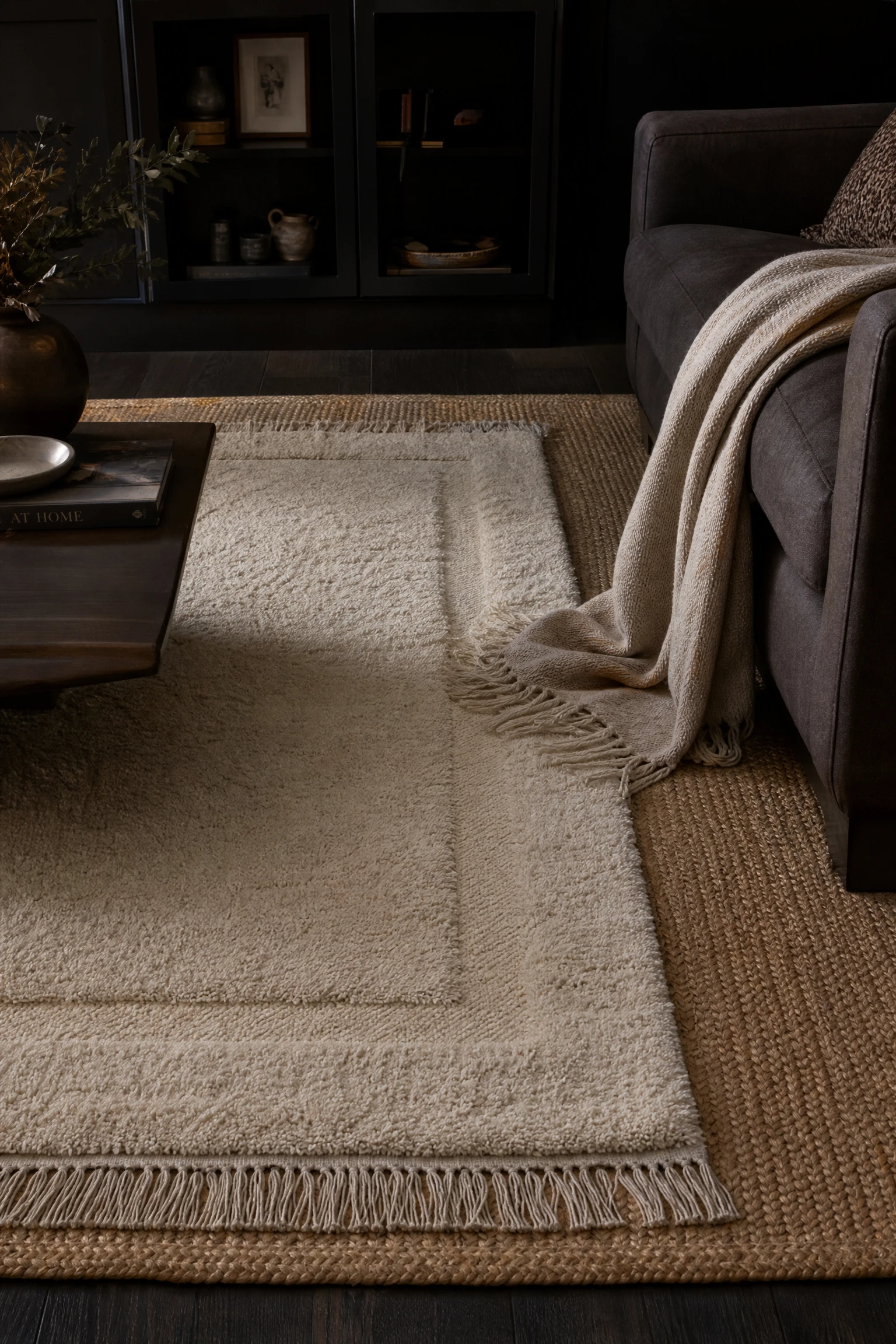
In a warm and moody black living room, the floor is as important as the walls in creating the cocooning effect, and layering multiple textiles at floor level, a large flatweave rug as a base, a sheepskin or tufted pile accent rug on top, a throw draped over the arm of the sofa that falls to the floor, creates a soft, tactile ground plane that absorbs sound, creates warmth underfoot, and introduces the organic material textures that prevent the dark room from feeling hard and cold. A dark room with a hard bare floor, whether dark timber, black tile, or polished concrete, can feel austere and slightly unwelcoming regardless of how well the walls and furniture are styled. The same room with layered soft textiles at floor level immediately shifts in atmosphere from minimal to genuinely inviting. The colours of the layered textiles should stay within the warm neutral and dark tonal range of the room: cream, oatmeal, warm charcoal, and deep ochre all work well within a black room without pulling the attention away from the overall dark palette.
Designer Advice: Layer two rugs of different textures rather than two rugs of different colours for the best result in a dark room. A flatweave jute or cotton base rug with a tufted or loop-pile rug on top creates textural contrast that reads as warm and deliberate. Two rugs in different colours in the same space create visual competition that reduces the cocooning quality rather than enhancing it.
12. Dark Room With Abundant Indoor Plants
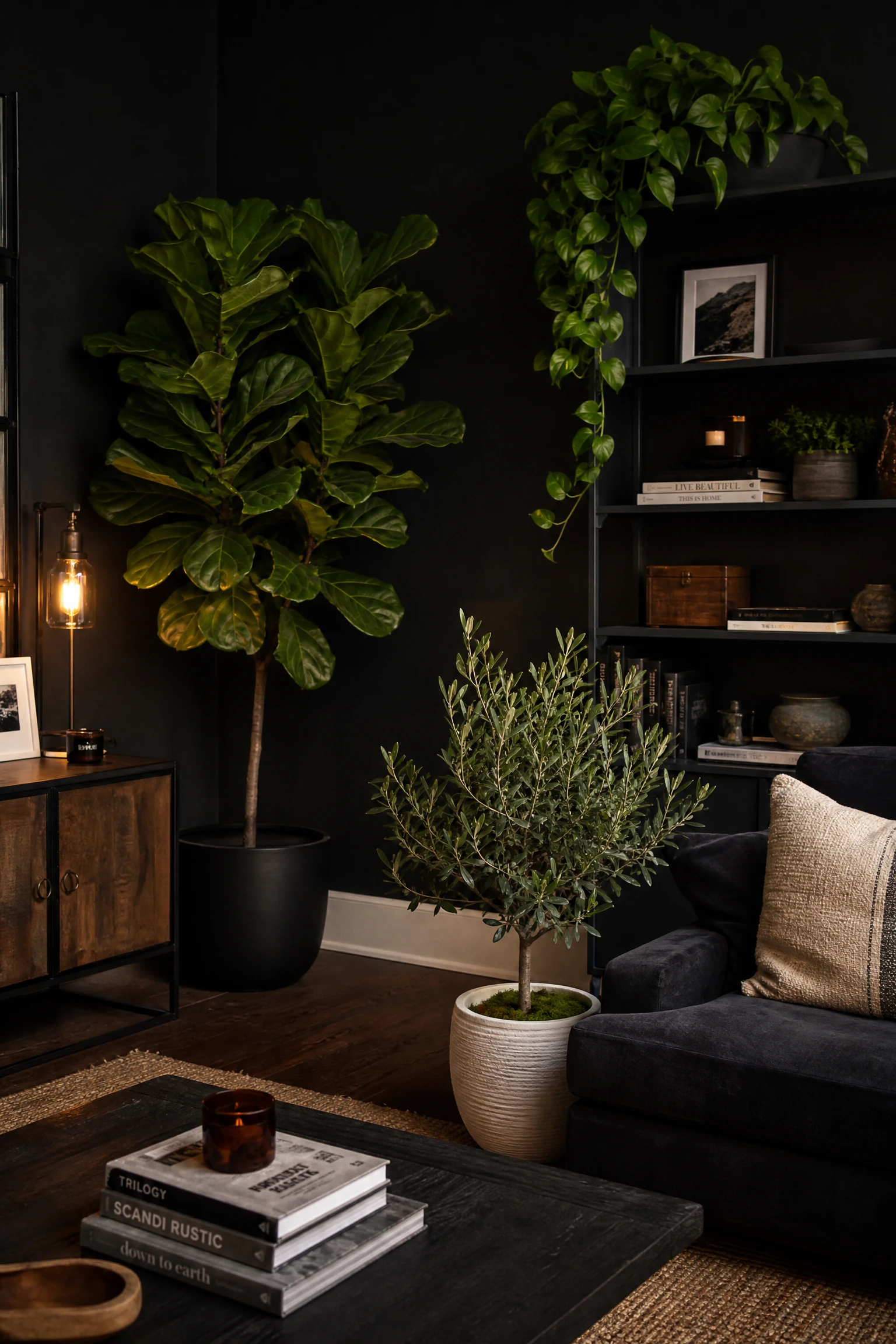
Indoor plants in a dark living room do something that no accessory or decorative element achieves: they introduce a living, growing, organic presence that makes the dark space feel genuinely connected to the natural world rather than sealed off from it. Against black or charcoal walls, the green of plant foliage, from the deep forest green of a large monstera to the softer sage of a trailing pothos to the near-black of a dark-leaved rubber plant, reads with a vividness that the same plant in a white room never achieves because the dark background increases the perceived saturation of the green. A tall fiddle-leaf fig in a floor corner, a trailing pothos on the top of a dark bookshelf, and a small olive tree beside the window create three different plant moments at three different heights that make the room feel layered, alive, and genuinely inhabitable in a way that is unique to the combination of living plants and a dark interior.
Quick Tip: Choose plants with larger leaves rather than fine-textured or small-leaved varieties for a dark living room. Large leaf forms, monstera, fiddle-leaf fig, philodendron, and elephant ear, read clearly as distinct silhouettes against a dark background. Fine-textured plants with small leaves can look like undifferentiated dark mass against a dark wall and lose their visual impact.
Bold and Graphic: Black as High-Contrast Statement
A bold and graphic black living room uses strong contrast between black and one or two other colours to create a room with a clear, confident design identity. The contrasts here are intentional and precise: nothing is accidental and the room reads as a considered palette rather than a collection of individual decisions.
13. Black Walls With Oversized Abstract Artwork in a Single Bold Colour
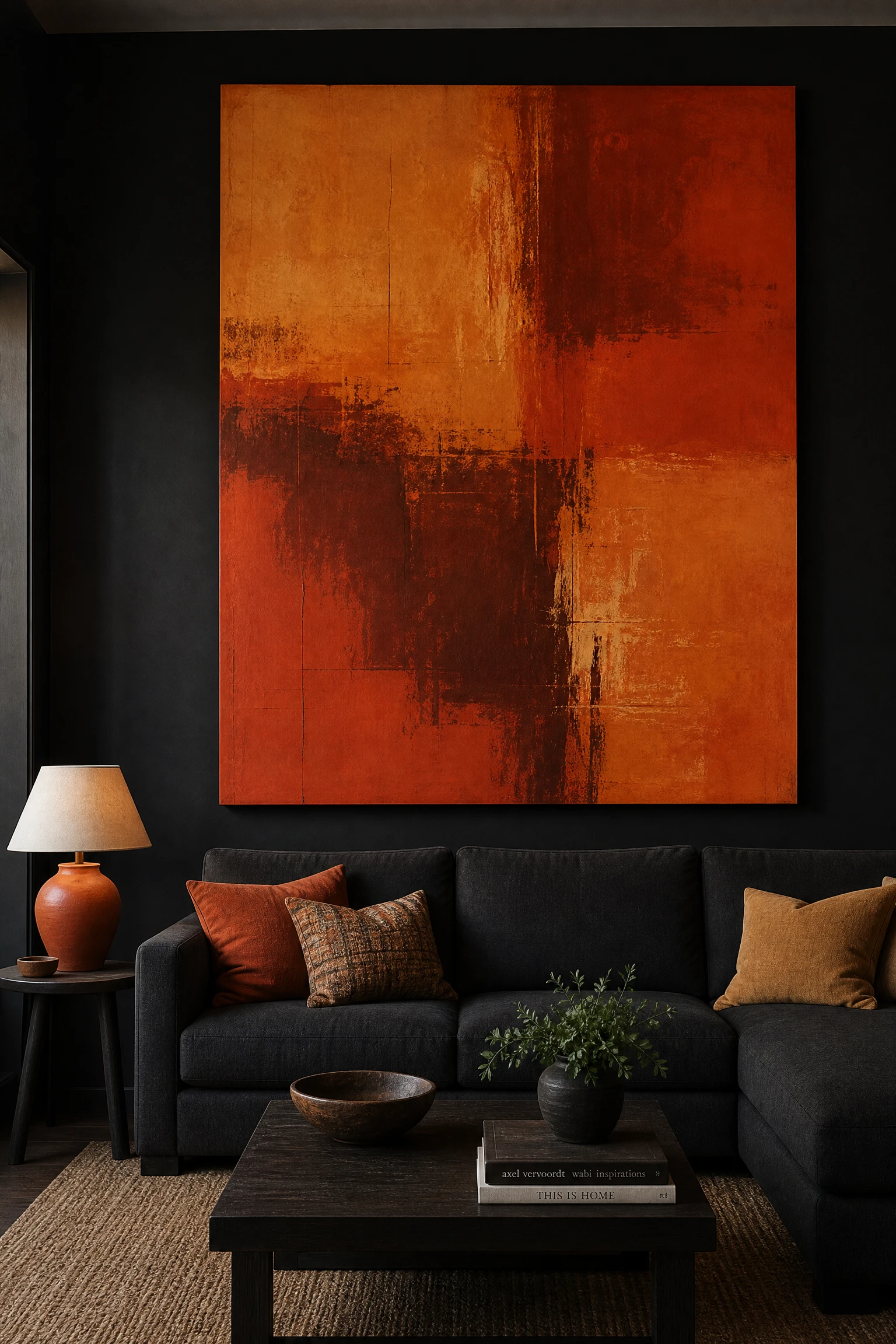
A large-format abstract canvas or print in a single bold colour, a warm terracotta, a deep cobalt, an emerald green, or a warm gold, positioned on a matte black living room wall creates the most direct and visually powerful version of the graphic black interior. The black wall functions as the picture frame for the artwork, receding behind the canvas and giving the colour in the painting an intensity it would not have against a white or pale background. The key decisions are scale and colour saturation: the artwork needs to be genuinely large relative to the wall, covering at least half the wall height, to read as a design decision rather than an accessory, and the colour needs to be genuinely saturated and bold rather than muted or pastel, because the dark background amplifies contrast and a pale colour against black can read as washed out rather than subtle.
Pro Move: Echo the dominant colour of the artwork in one element elsewhere in the room, a cushion, a vase, or a lamp shade, to connect the artwork to the room rather than leaving it as an isolated object on the dark wall. The echo does not need to be exact: a terracotta canvas with a burnt orange ceramic lamp on the side table connects the two without matching them precisely.
14. Black and Warm White Two-Tone Living Room
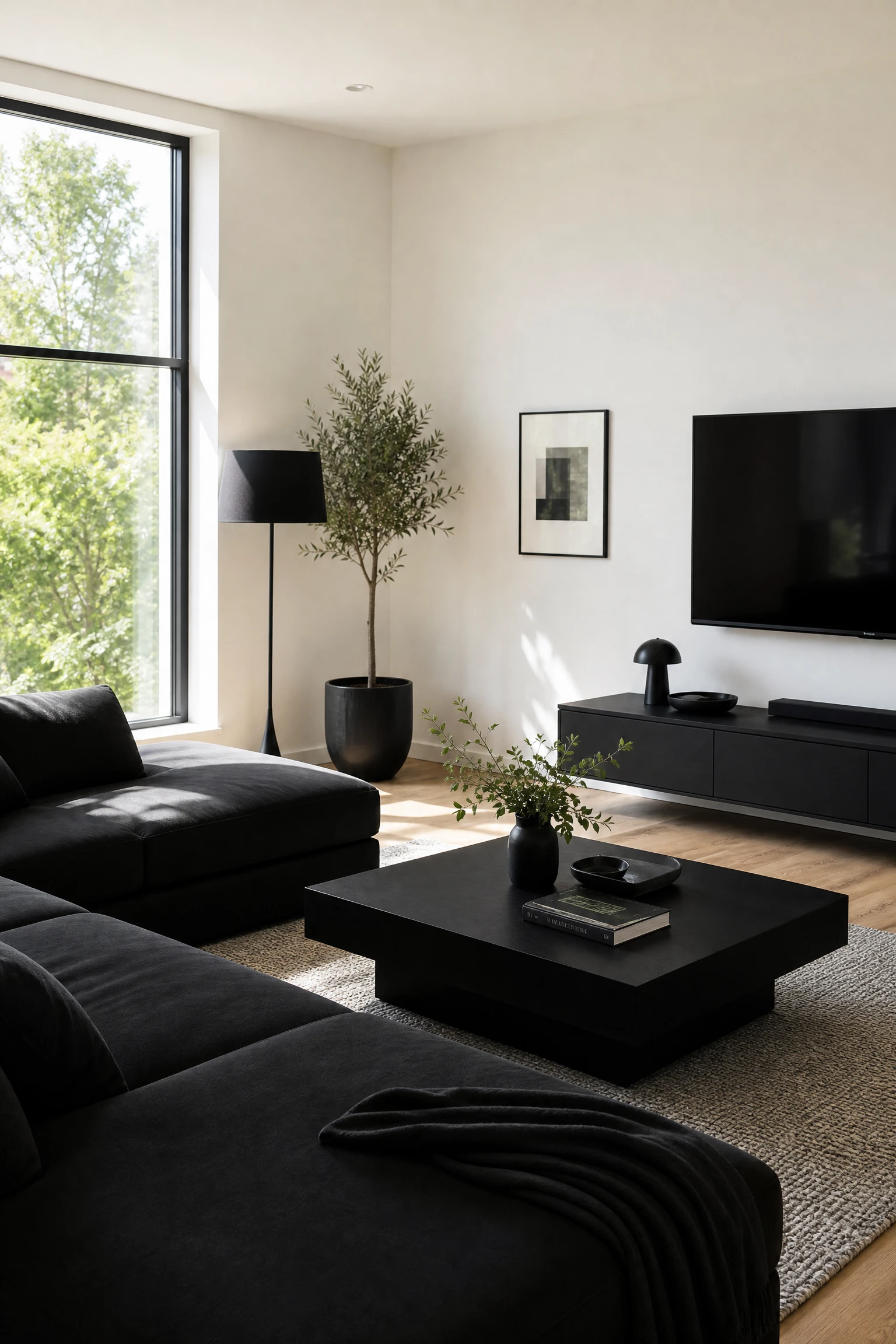
A living room where the walls are in a clean warm white and all the furniture, from the sofa to the coffee table to the shelving and the light fixtures, is in matte black creates the maximum possible contrast version of the graphic black interior, and it is also the version most suited to smaller living rooms or rooms with limited natural light where full black walls would make the space feel too enclosed. The warm white walls reflect all available light back into the room while the black furniture reads as graphic, precise elements within that bright space. The proportional balance between white and black in this arrangement, significantly more white wall than black furniture, prevents the room from feeling oppressive and creates a living room that is simultaneously bold and genuinely bright. This is also the most practical version of the black living room for households with children or pets, because the walls stay clean and lighter than any surface below seating height.
Heads Up: In a black furniture and white walls living room, the quality and condition of the white walls becomes the most visible thing in the room. Every mark, scuff, or yellowing area on white walls is amplified by the contrast with the graphic black furniture. Use a washable satin finish on the white walls and plan for repainting or spot-cleaning more frequently than in a neutral room.
15. Black Living Room With Gold and Brass Accents
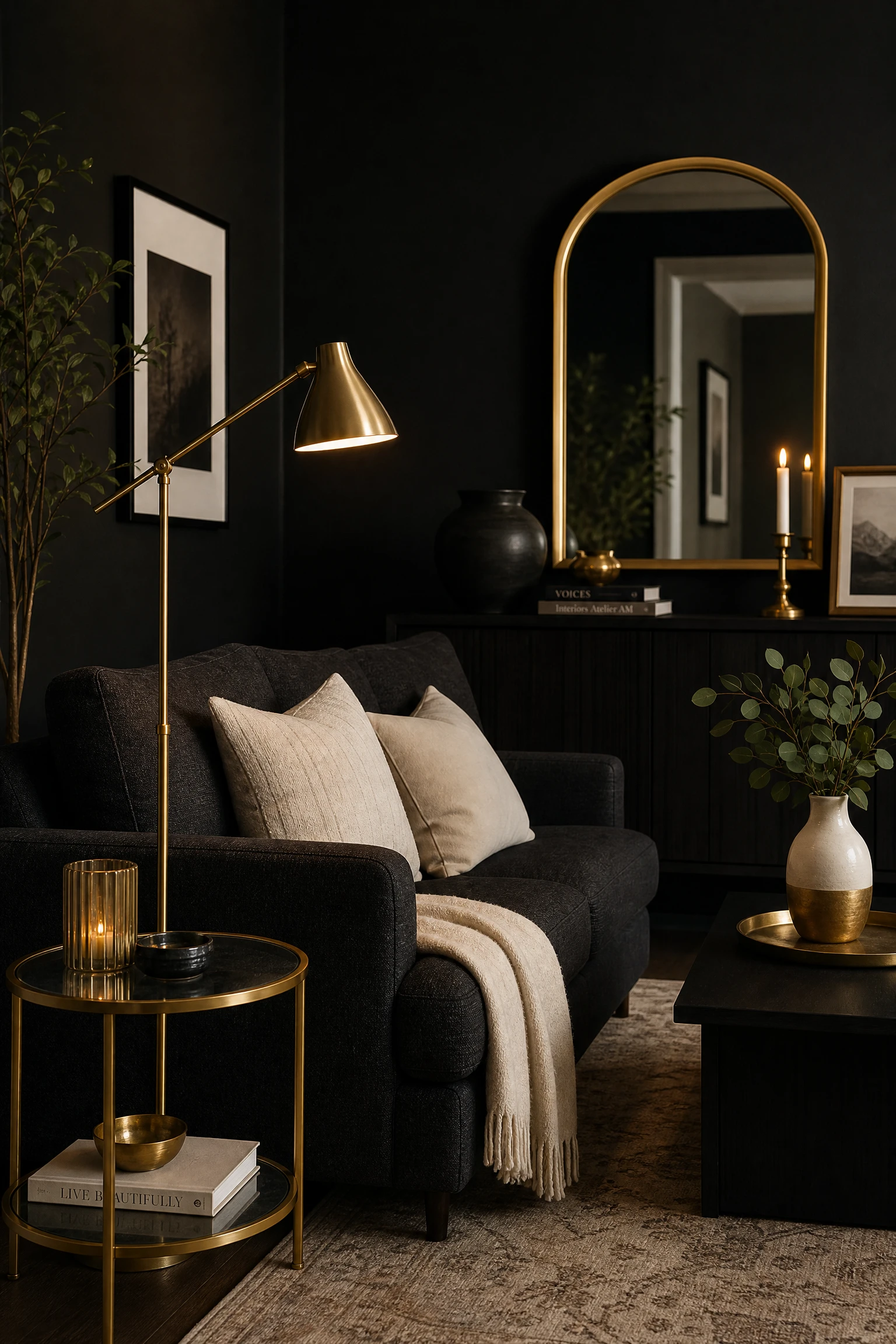
Black and gold is one of the most consistently referenced pairings in luxury interior design, and in a living room it creates the most opulent version of the graphic black aesthetic. Gold and brass accents arrive through table lamp bases in brushed or polished brass, a gold-framed mirror above the fireplace or behind the sofa, brass handles on dark furniture, a gold-dipped ceramic vase on the coffee table, or a brass and glass side table beside the sofa. The warmth of the gold against the cool precision of matte black creates a visual tension that reads as genuinely luxurious rather than simply expensive, and the reflective quality of polished brass in a dark room creates points of warm light that register from across the space. The risk with this combination is excess: gold and black are both strong visual presences and the combination can tip from opulent to gaudy if the gold is used in too many positions or at too large a scale.
Reality Check: Distinguish between warm aged brass, burnished gold, and bright polished gold before purchasing any fitting or accessory for a black living room. Bright polished gold in a modern dark interior can read as costume jewellery rather than considered design. Warm aged brass or brushed gold reads as genuinely luxurious. The same shape in the wrong finish in this palette is a significant difference.
16. Black Living Room With a Single Vivid Green Accent Wall

In a living room where three walls are painted in matte black and one wall, typically the wall opposite the entry door or the wall without furniture against it, is painted in a vivid emerald or deep forest green, the result is a two-colour graphic interior where the green and black sit in a close tonal relationship but the colour of the green wall creates the focal point of the room without competing with the darkness around it. This approach suits homeowners who want the atmosphere of an all-black room but are concerned about the room reading as too heavy or too dark: the green wall introduces a living material quality that lifts the palette while maintaining the deeply saturated atmosphere that black walls create. The specific green matters: a muted sage or dusty olive against black reads as tonal and earthy, while a vivid jewel-tone emerald against black reads as graphic and bold.
Designer Advice: Position the green accent wall at the end of the room that receives the most natural light. A vivid green in strong natural light reads as luminous and alive. The same green on a north-facing wall with limited natural light can read as slightly murky. The light direction is the first decision, the colour is the second.
“Black in a living room is not a commitment to darkness. It is a commitment to contrast. Everything you place in a black room will be seen more clearly than it would be anywhere else.”
17. Black Living Room With Exposed Natural Concrete

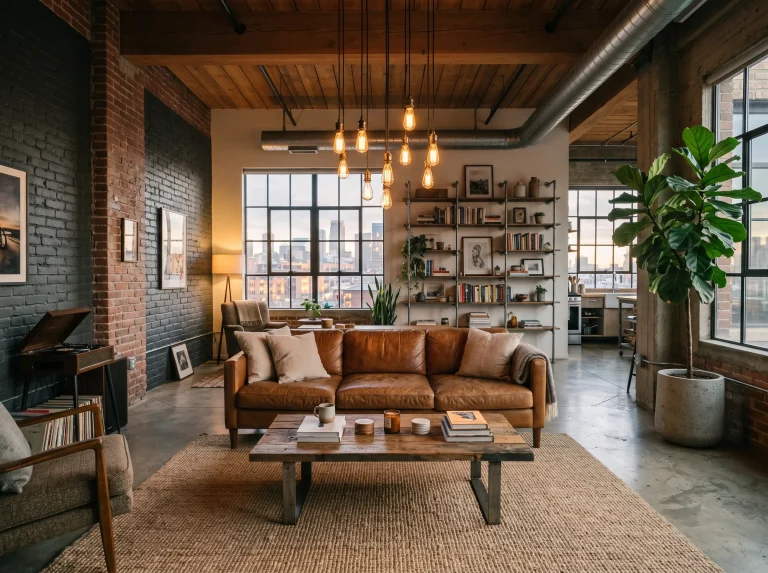
A living room that combines matte black painted walls or black panelling with an exposed concrete floor, a polished concrete fireplace surround, or raw concrete ceiling gives the black modern interior its most distinctly urban and industrial character. The combination of two matte, light-absorbing materials in a cool dark palette creates an interior that reads as architectural and considered, where the room itself feels like a material statement rather than a decorated space. The warmth needed to prevent this combination from feeling cold and austere comes from the furniture: a low-slung sofa in warm caramel leather, a worn timber coffee table, a vintage woven rug at floor level, and warm-toned pendant lighting above the seating area all introduce the organic warmth that the concrete and black surfaces do not provide. This is a combination that suits open-plan living spaces with generous ceiling heights where the raw materials have the scale they need to read as deliberate rather than unfinished.
Reality Check: Exposed concrete in a domestic living room requires sealing to prevent dust, staining, and moisture penetration regardless of how architectural the raw surface looks. A penetrating concrete sealer maintains the raw visual quality of the surface while making it genuinely liveable. Unsealed concrete in a living room will mark, absorb spills, and produce concrete dust that settles on furniture and surfaces.
Luxurious and Layered: Black as the Base for Material Richness
A luxurious and layered black living room uses the dark palette as a base that makes every material placed within it look richer, more expensive, and more precisely chosen than it would in a neutral room. This is the most complex version of the black living room to execute well and the one with the highest ceiling when it works.
18. Black Walls With Marble Fireplace and Hearth
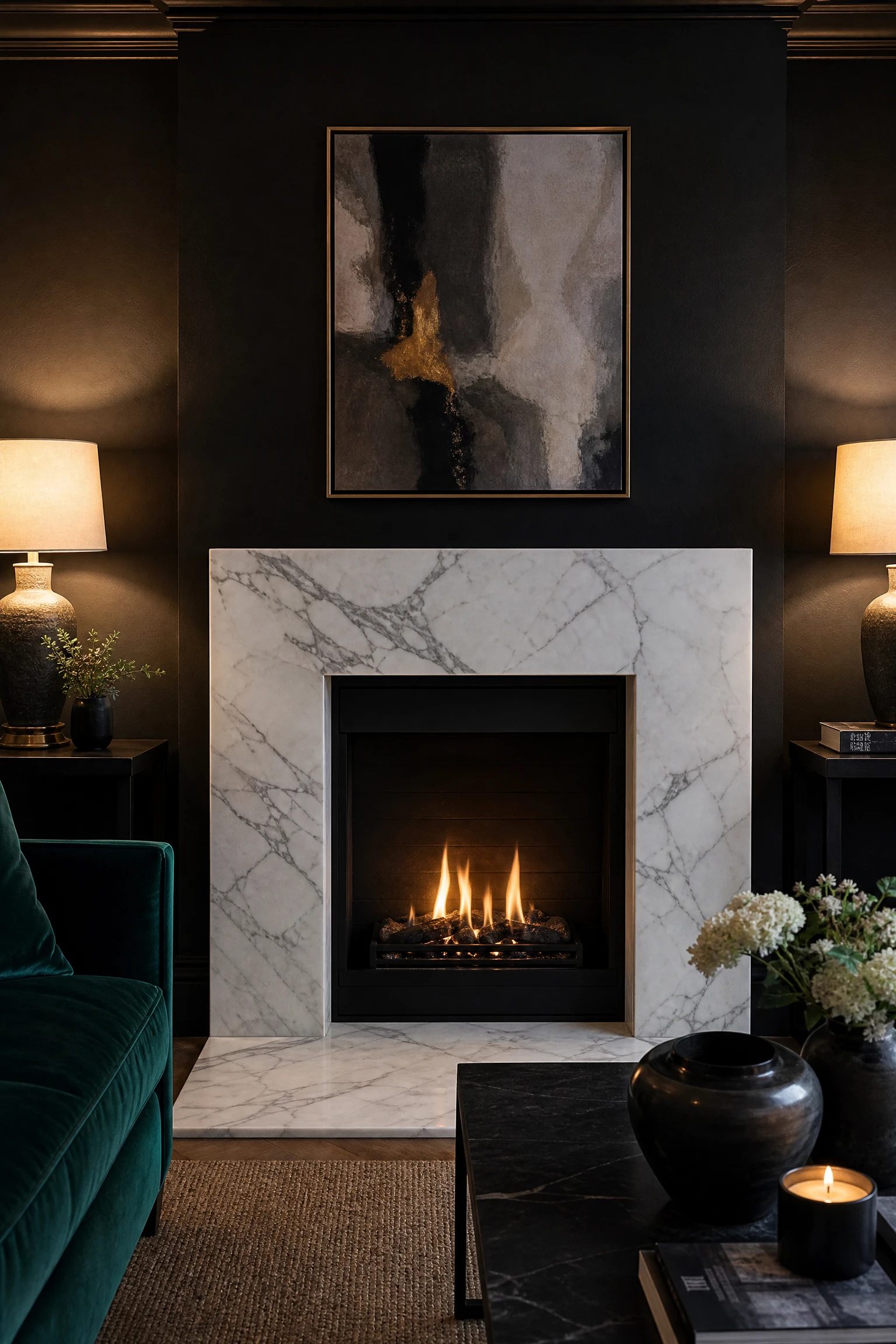
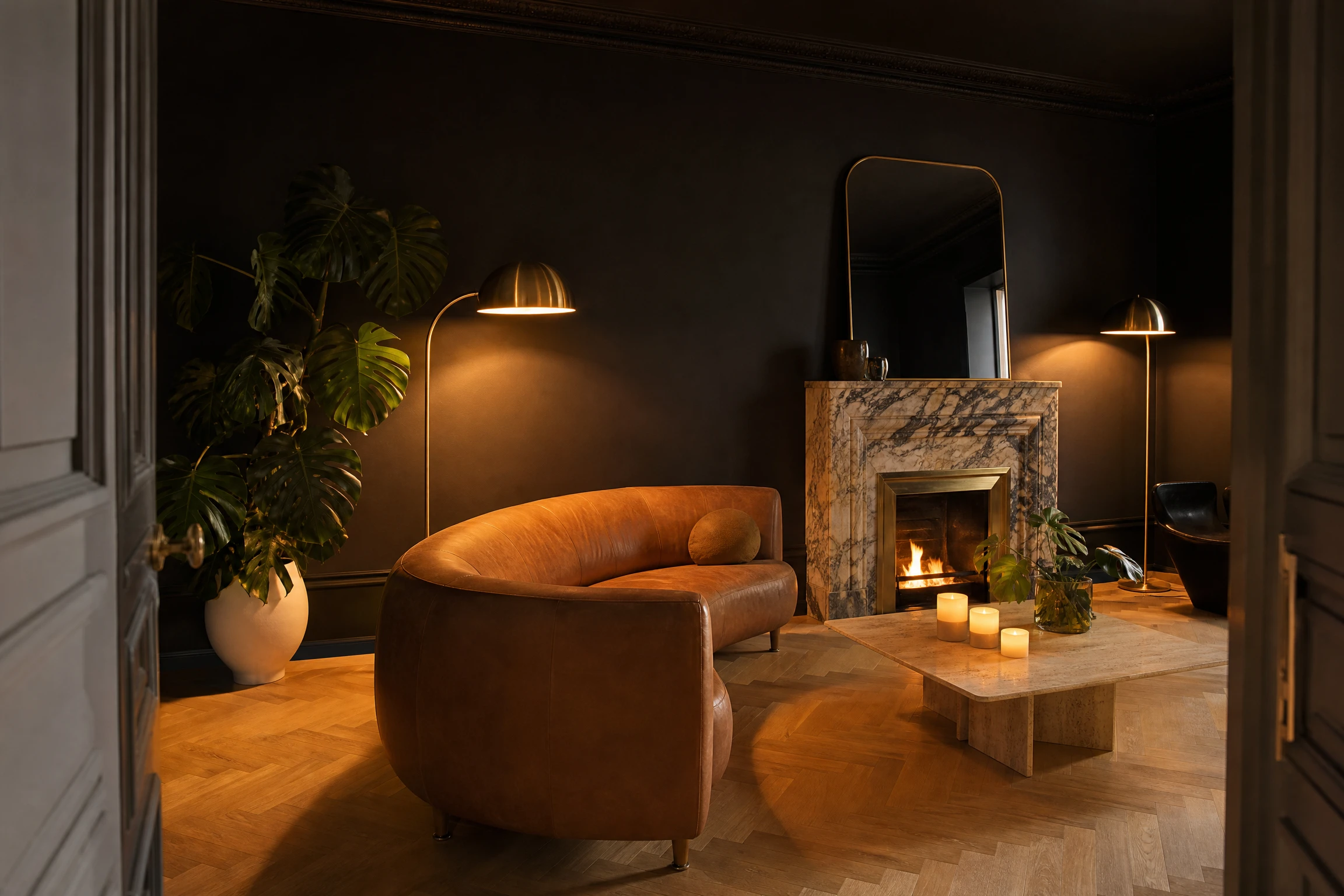
A white or pale grey marble fireplace surround and hearth against matte black walls is one of the most visually luxurious combinations available in a living room because the contrast between the warm white of natural marble, with its grey, gold, or green veining, and the flat darkness of the black wall makes both materials look more expensive and more refined than they do in any other context. The veining in the marble reads clearly against the dark background and the fireplace becomes a genuinely architectural focal point of the room rather than simply a functional fitting. In a living room with black walls and a white marble fireplace, the fireplace is the first thing the eye finds on entering the room, and the relationship between the marble and the dark wall creates a permanent visual drama that no amount of furniture or accessories can replicate. Paired with warm lamplight and a sofa in a deep jewel tone or warm neutral, this combination achieves a level of considered luxury that reads as genuinely invested rather than decorated.
Pro Move: Choose a marble with warm veining, greige, gold, or warm grey tones rather than cool blue or green veining for a black living room. The warm undertone of the marble connects the cool precision of the black walls to the warm lamplight and textiles of the room and prevents the marble from reading as cold and clinical in a dark interior.
19. Black Living Room With a Statement Curved Sofa
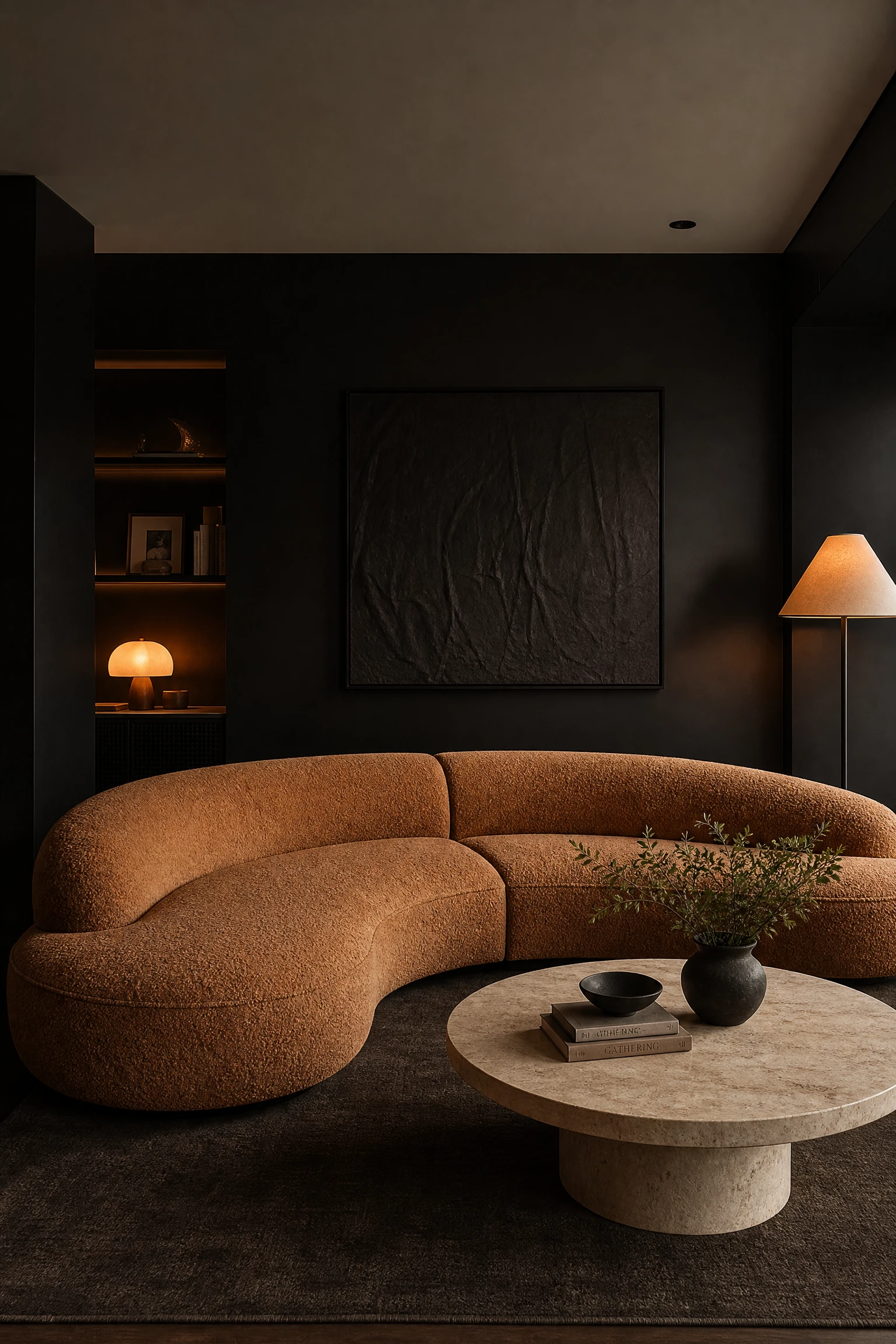
A curved or kidney-shaped sofa in a living room with black walls introduces a sculptural element that disrupts the angular geometry of the room in a way that flat-backed traditional sofa forms do not. In a dark room where the walls create a precise rectangular envelope, a curved sofa sitting within that envelope reads as a deliberate compositional contrast between the room geometry and the furniture form. Curved sofas in the living room have become one of the most widely referenced interior design directions of the past three years, and in a black-walled room the combination is particularly effective: the soft sculptural form of the curved sofa against the precise flat planes of the dark walls creates a visual tension between geometry and organic form that makes the room feel more artful and considered. Upholstered in a warm caramel boucle, a dusty rose velvet, or a cream linen, the curved sofa provides the colour and textural warmth that the dark room needs at its centre.
Heads Up: Curved sofas are difficult to re-upholster and the curved frame is considerably more expensive to repair than a straight-backed sofa if the structure is damaged. Choose a curved sofa from a manufacturer with a repairable frame construction and keep the fabric choice within a standard weight and weave that a domestic upholsterer can work with rather than a proprietary or specialist fabric that requires returning to the original supplier.
20. Black Living Room With Layered Curtains and Fabric
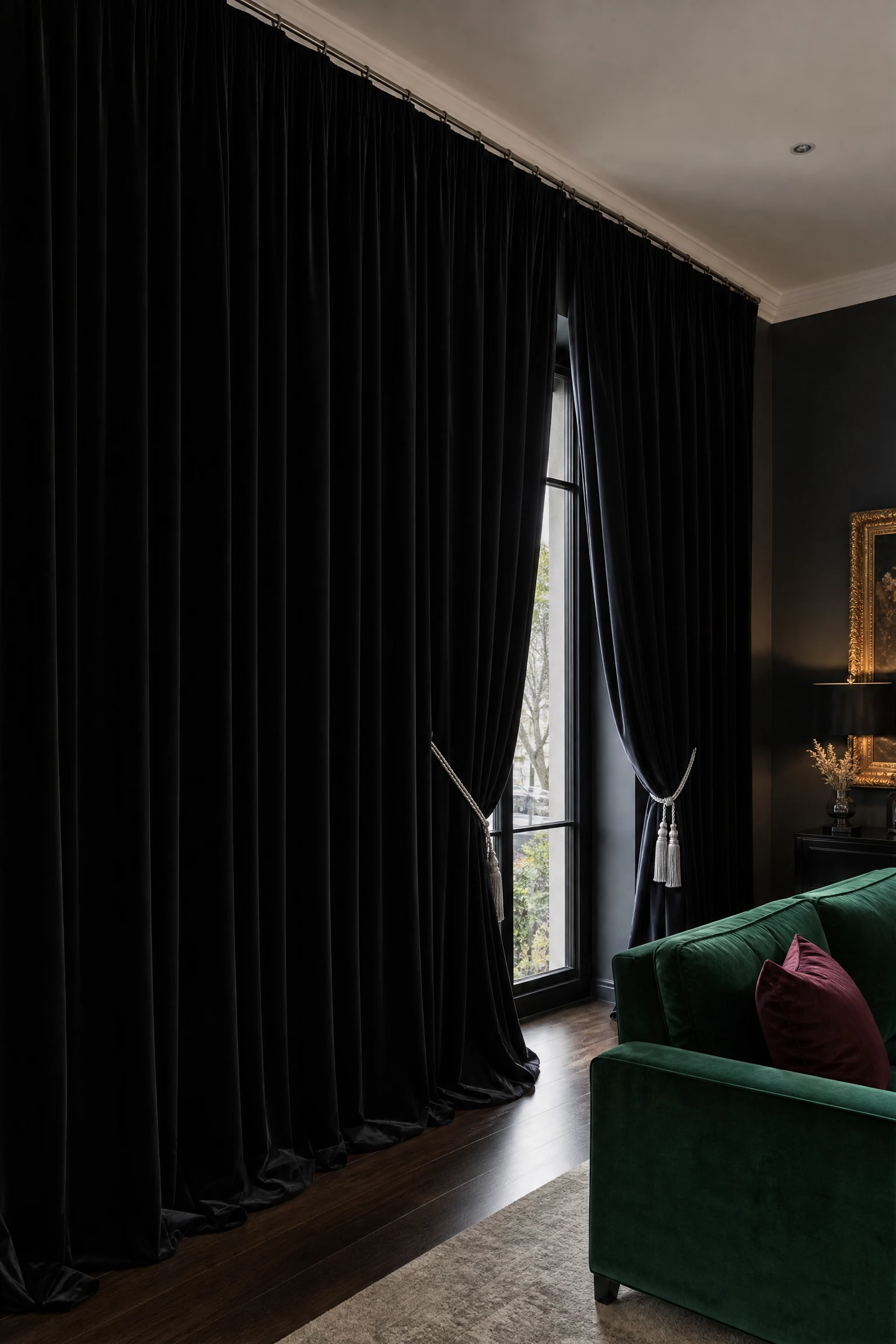
Floor-to-ceiling curtains in a dark living room, whether in black velvet, deep charcoal linen, or a rich emerald or burgundy fabric, introduce the most generous and most theatrical version of textile warmth in the black modern interior. Curtains at ceiling height, hung from a pole positioned as close to the ceiling line as possible and falling to the floor with a slight puddle or break, create a wall of fabric that adds insulation, absorbs sound, and gives the room a dramatic, enveloping quality that bare windows alongside dark walls rarely achieve. Within a layered approach, a pair of sheer curtains on an inner track for daytime diffused light alongside heavier outer panels for evening enclosure creates both the atmospheric quality of the heavy fabric and the luminous daytime diffusion that prevents the dark room from feeling sealed and oppressive during daylight hours.
Designer Advice: Hang curtain poles wider than the window opening by at least 30 to 40 centimetres on each side so that when the curtains are pulled fully open, the fabric stack sits entirely clear of the glass. Curtains that hang partially across the window even when fully open block light and make the window appear smaller than it is, which in a dark room compounds the sense of enclosure rather than alleviating it.
21. Black Living Room With Sculptural Lighting as Art

In a luxurious layered black living room, the lighting fixtures are not just sources of light but objects of design interest in their own right. A sculptural floor lamp in matte black or aged brass beside the sofa, a cluster of hand-blown glass pendants in amber or smoked tones above the seating area, a table lamp with an architectural ceramic base and a linen shade on the side table: these are the objects that define the room as much as the furniture they sit alongside. The dark room amplifies the visual presence of every light fitting because the contrast between the warm illuminated fitting and the dark surrounding surface makes each fixture more visible and more clearly defined than it would be in a pale room. A standard lamp that disappears into a white-walled room becomes a focal point in a black one, and this quality rewards investment in genuinely interesting lighting choices that will be seen and noticed at every hour of every day.
Quick Tip: Choose lamps with shades in a warm opaque material, cream linen, natural paper, or amber glass, rather than white or translucent shades in a black living room. An opaque warm-toned shade creates a warm pool of light around the lamp without allowing the bright interior of the shade to be visible as a high-contrast point against the dark room. Translucent white shades in a dark room can appear as glowing white orbs that draw the eye rather than creating the diffused warm atmosphere the dark room needs.
22. Black Living Room With a Gallery of Framed Mirrors

A collection of framed mirrors in different shapes and sizes arranged as a gallery on a matte black living room wall creates a surface that is simultaneously reflective, decorative, and spatially expansive. The mirrors reflect the room back at itself from multiple positions and at different scales, creating a sense of depth within the dark surface that makes the wall feel like it extends beyond its actual plane. The frames of the mirrors contribute to the decorative quality: a mix of ornate gold-leaf frames, simple black metal frames, and one or two more unusual shapes, an arch, an oval, a faceted geometric, creates a gallery arrangement with genuine visual interest at every point. In a dark room, the reflective surfaces of the mirrors capture and redistribute whatever light is available, including lamp light, firelight, and natural daylight from across the room, and use it to brighten the dark surface from within.
Reality Check: A gallery of multiple mirrors on a dark wall requires precise installation with properly load-rated fixings for each piece. Multiple mirrors of different weights installed with inadequate fixings on a dark wall create a safety risk that is less visible than on a pale wall but no less serious. Have the wall structure checked and use appropriate plasterboard anchors or timber stud fixings for every mirror in the arrangement.
23. Black Living Room With a Warm Caramel or Tan Leather Sofa
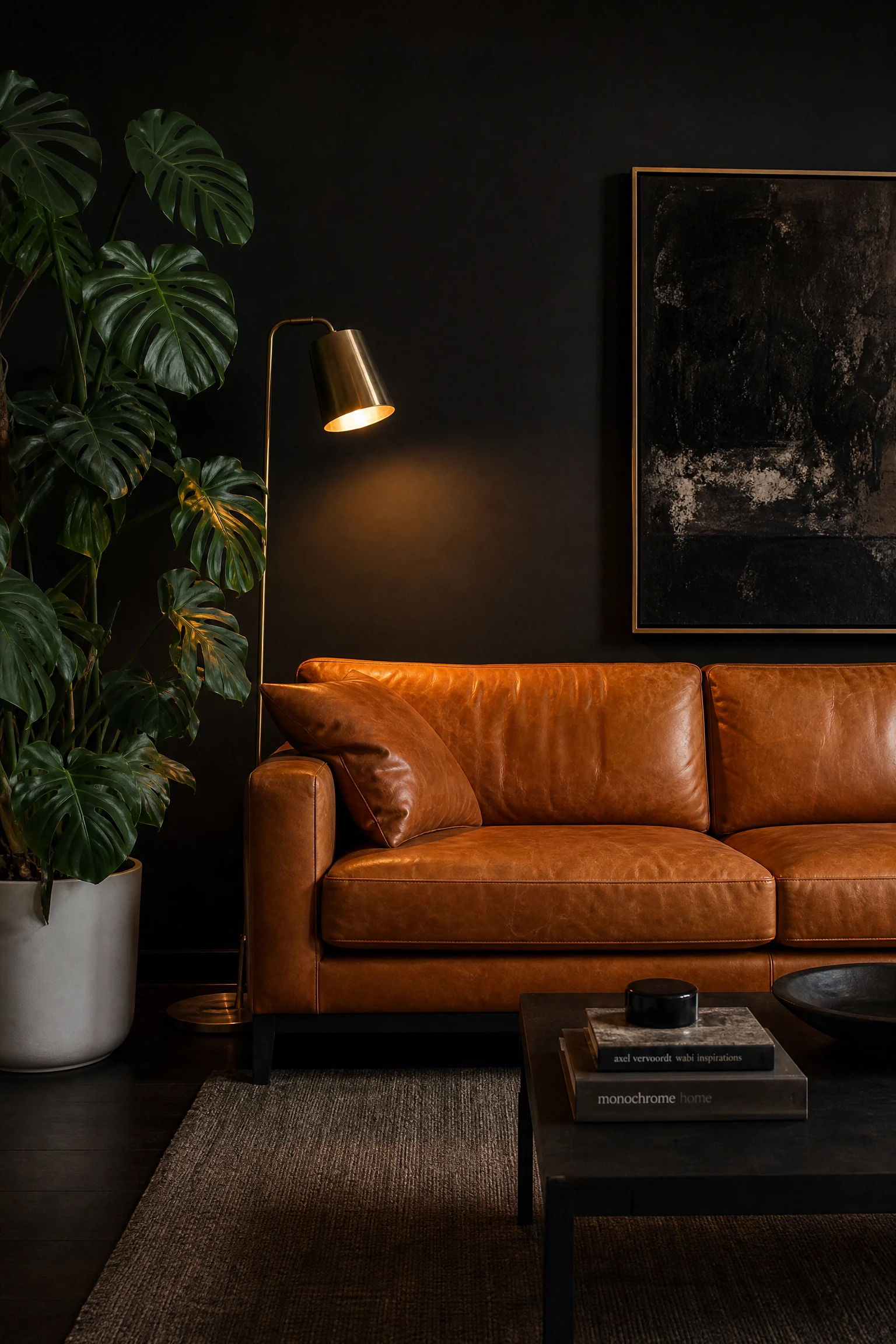
A caramel, tan, or cognac leather sofa in a black living room is one of the most photographed and most consistently successful pairing combinations in current interior design because the warm amber-brown of natural or well-crafted synthetic leather sits at an almost perfect colour and material distance from matte black: warm where black is cool, reflective where black is absorbing, organic where black is precise. The leather sofa in a dark room also improves in appearance with age in a way that fabric sofas typically do not: the patina that develops on good leather over years of use, the slight darkening of the seat cushions, the slight lightening of the arm rests where hands rest, adds a character and depth to the piece that increases the warmth of the dark room rather than reducing it. A caramel leather sofa in a black living room with warm brass lamps, a marble fireplace, and a large monstera plant is one of the most reliably satisfying living room combinations in existence.
Designer Advice: Choose a sofa with an aniline or semi-aniline leather rather than a pigmented or bonded leather for a black living room where the sofa will be the primary warm material anchor. Aniline leather has a natural translucency that shows the grain and character of the hide and develops a genuine patina over time. Pigmented leather has a uniform surface coating that prevents any patina development and can look increasingly plastic rather than richer as the years pass.
24. Black Living Room With Natural Rattan and Woven Accessories

Natural rattan, woven bamboo, and handcrafted basket accessories in a black living room introduce organic texture and natural material warmth at a smaller scale than furniture pieces but with a significant cumulative effect on the atmosphere of the dark room. A rattan tray on the coffee table holding candles and a plant cutting, a woven bamboo magazine holder beside the sofa, a large handwoven basket at floor level in the corner, a rattan-framed wall mirror beside the window: each element individually is modest, but together they shift the room from stark and graphic to warm and lived-in without introducing any colour beyond the natural honey and amber tones of the woven materials themselves. The visual texture of woven natural fibres also interacts with dark walls in a specific way: the open weave of rattan or bamboo allows the dark background to show through it, creating a slightly dappled quality that makes the material appear three-dimensional and complex rather than flat.
Quick Tip: Group natural woven accessories in pairs or trios rather than scattering individual pieces across the whole room. A single rattan tray on the coffee table and a single basket in the corner look like two objects that happened to arrive in the same room. Two rattan pieces on the coffee table and a pair of woven accessories near the window look like a material decision that was made for the room.
25. Black Living Room With a Maximalist Cushion Arrangement
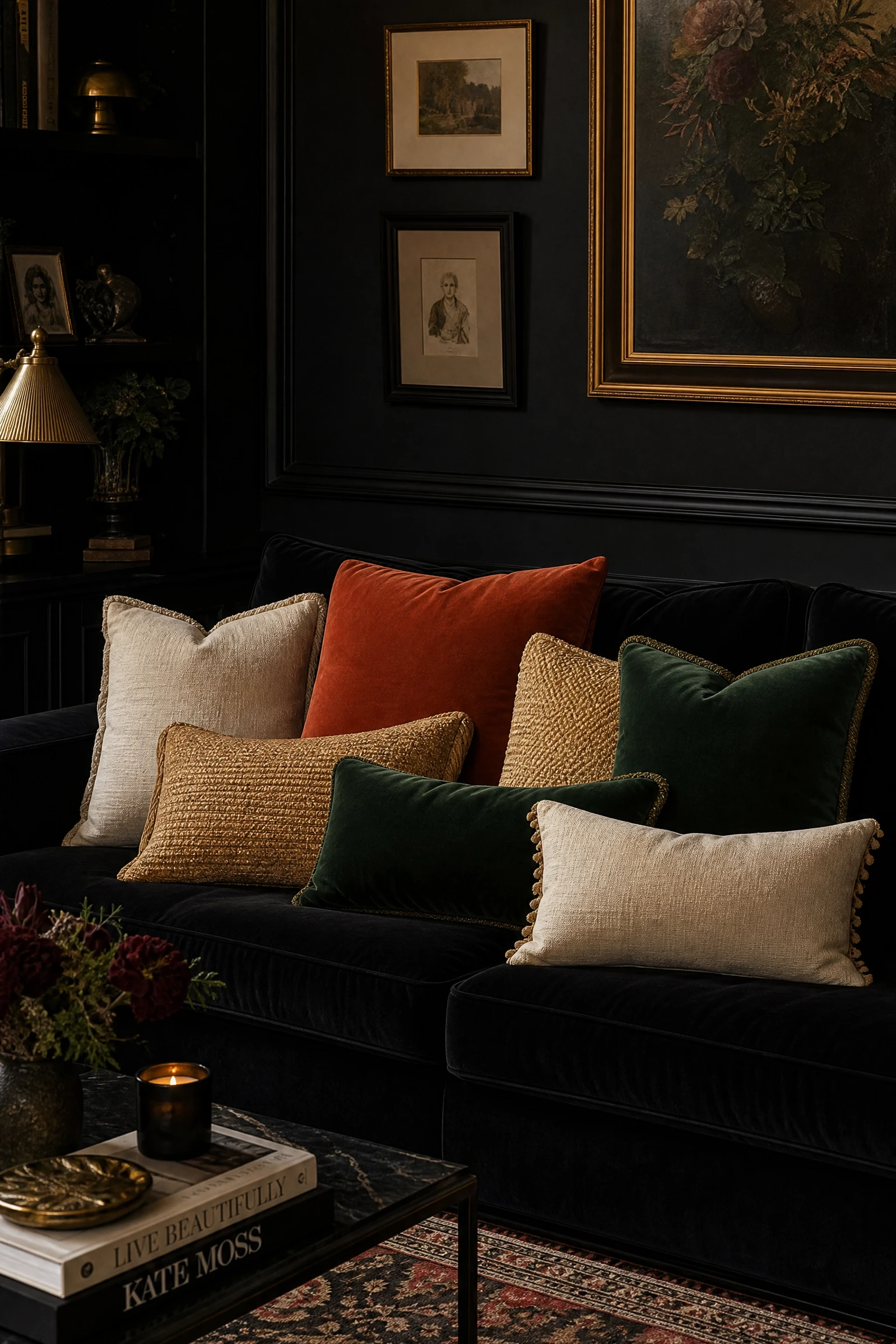
In a luxurious layered black living room, the cushion arrangement on the sofa is the primary surface where colour, texture, and material richness are concentrated and where the room makes its most personal and changeable design statement. A maximalist cushion arrangement on a dark sofa or against a black wall, with five to seven cushions in a combination of velvet, linen, and woven fabrics across a range of sizes and in tones from cream and warm white through gold and terracotta to deep plum or forest green, creates a composition of material warmth at the centre of the room that is immediately visible from the doorway and that makes the dark room feel genuinely abundant rather than spare. The cushions in a dark room do a disproportionate amount of the warming work relative to their physical size because the dark background makes every rich fabric texture and warm colour more visible than it would be in a pale room.
Pro Move: Invest in down or down-alternative cushion inners rather than polyester hollow fibre for any cushion arrangement that will be photographed or that you want to maintain a well-dressed appearance. Down inners create the full, slightly oversized plumpness that makes a cushion arrangement look considered. Polyester inners compress under the weight of other cushions and quickly produce the flat, under-stuffed appearance that even beautiful cushion covers cannot overcome.
26. Black Living Room With Mixed Metal Finishes

A living room that is primarily dark in its walls, floor, and furniture but uses two or three different metal finishes in its light fittings, hardware, and accessories, combining brushed brass with polished chrome, aged bronze with satin nickel, or smoked gunmetal with warm gold, creates a layered metallic quality that reads as collected and personal rather than matched and deliberate. The conventional wisdom in interior design is to choose one metal finish and use it consistently, but in a black room where the dark background makes every metal element register very clearly, the mixing of warm and cool metal tones creates a richness and visual complexity that a single consistent metal cannot achieve. The key is using metals that share a similar depth of tone rather than mixing very light and very dark finishes: brushed brass alongside aged bronze both share warmth and depth and work together naturally, while polished chrome alongside burnished copper share similar levels of surface brightness regardless of their colour temperature.
Heads Up: Mixed metal finishes in a black living room work when the mixing is intentional and limited to two or three tones. More than three metal finishes in the same room, regardless of the wall colour, starts to read as chaotic rather than collected. Decide on two primary finishes and allow one secondary finish as an occasional accent.
27. The Complete Black Modern Living Room: The Four Decisions That Matter Most
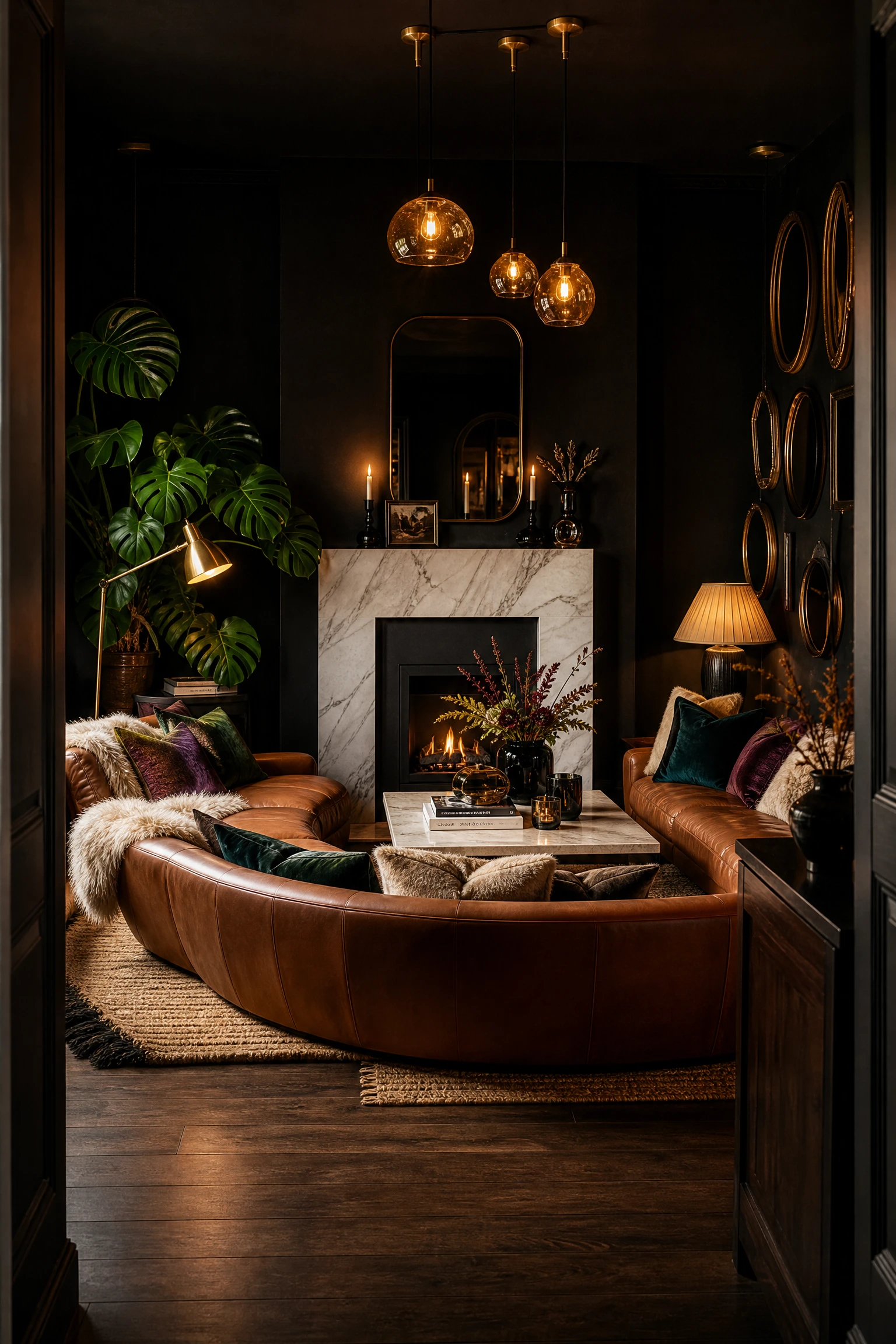
A black modern living room that feels genuinely designed rather than simply dark always comes down to four decisions made before anything is purchased: the specific shade and finish of the black (matte absorbs light and creates depth, satin is more practical but slightly reflective, gloss is very specific and the most demanding of all); the warm counterpoint material (timber, leather, rattan, and natural stone are all reliable, synthetic or cold materials are not); the light source strategy (warm-toned lamps at multiple heights and positions, never relying on a single overhead fitting); and the palette anchor (whether it is all-black with one colour, black with warm whites, black with metals, or black with jewel tones, there should be one clear colour relationship rather than multiple competing ones). Get these four decisions right before choosing a sofa, a rug, or a light fitting, and the individual purchases become significantly easier because each one has a clear design framework to fit within.
Pro Move: Paint a large section of the actual living room wall in the shortlisted black shade and live with it for a full week before committing, observing it in morning light, afternoon light, and at different times of evening with different light sources on. Black paint looks completely different at different times of day and under different light sources, and the only reliable test is the actual wall in the actual room.
Final Thoughts
A black modern living room is one of those design decisions that people spend months circling before committing to, and then, when they finally do it, they almost always wish they had done it sooner. The fear of darkness, of the room becoming too heavy or too cold or too oppressive, is almost always worse than the reality, provided the four core decisions, the shade, the warm counterpoint, the lighting, and the palette anchor, have been made thoughtfully before anything goes on the walls.
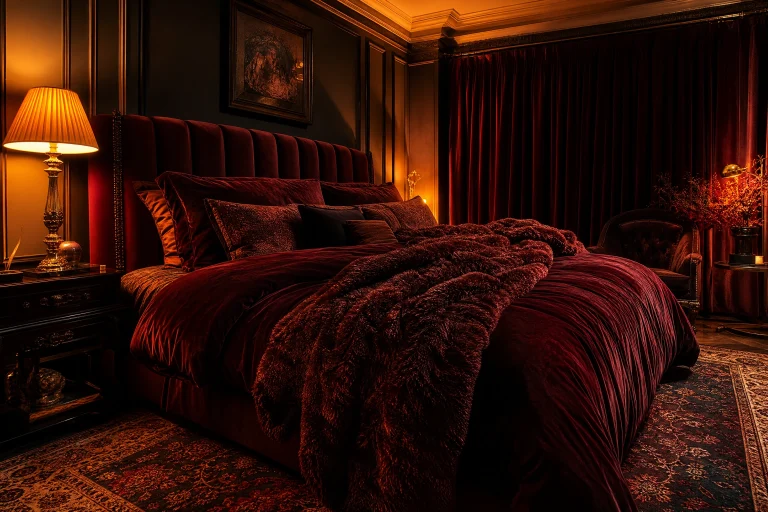
The living rooms that fail in this palette are not the ones that went too dark. They are the ones where the darkness was chosen without a clear sense of what was going alongside it. A black wall with the wrong bedding, or in the bedroom analogy, with no warm material, no considered lighting, and no colour strategy, will disappoint regardless of how well the wall itself is executed. Start with the group in this article that most closely matches the mood you want the room to have, make the four core decisions within that framework, and let every purchase after that serve the direction you have already chosen.
“Which of these four versions of the black modern living room matches what you have been picturing? Drop your answer in the comments below.”
Frequently Asked Questions
Will a black living room make the space feel smaller?
Not necessarily, and in many cases a black living room can feel larger than the same room painted in a pale neutral. Matte black paint absorbs light rather than reflecting it, which means it does not bounce the boundaries of the room back to the eye the way white paint does. The result is that walls painted in deep dark tones can appear to recede rather than advance, giving some rooms a sense of depth that pale paint does not create. The rooms that feel smaller with black walls are those where the dark colour is combined with heavy window treatments, dark furniture at every level, and insufficient lighting. A black wall with lighter furniture, sheer curtains, and warm layered lighting rarely makes a room feel smaller.
What colours work best with a black modern living room?
Warm neutrals including cream, oatmeal, warm white, and caramel are the most reliable companions for a black living room because they provide contrast without introducing a competing colour. Warm metals, brass, bronze, and aged gold, provide reflective warmth that the dark palette needs. Jewel tones including emerald green, sapphire blue, and deep burgundy create rich, saturated contrast that suits the depth of the dark palette. Natural materials including warm timber, marble, rattan, and leather provide organic contrast at a material rather than a colour level. Cool greys, bright whites without warmth, and very light pastels all tend to feel slightly clinical alongside black rather than creating the warm contrast the room needs.
What is the best lighting approach for a black modern living room?
Multiple warm-toned light sources at different heights throughout the room. Warm white bulbs at 2700K to 3000K in every fitting. A floor lamp in at least one corner to illuminate the dark walls from below. Table lamps at sofa level on each side table. A pendant or statement ceiling fitting above the seating area to create ambient height. Candles on the coffee table or mantelpiece for the warmest possible light source. Dimmer switches on every circuit so that the light levels can be adjusted through the evening as the room transitions from daytime functional to evening atmospheric. A single bright overhead fitting in a black living room is the most reliable route to a room that looks like a car park rather than a considered interior.
How do I stop a black living room from looking like a cliche?
By being specific about which version of the black living room you are creating and making every decision in service of that specific direction. The black modern living rooms that look cliched are the ones that try to include all versions simultaneously: a black sofa, black walls, gold accents, a skull-shaped vase, and a neon sign. Choose one clear design personality from the four groups in this article and edit every purchase through that lens. A warm and moody black room with a fireplace, a caramel leather sofa, and warm rattan accessories looks specific and personal. The same room with a matching black leather sofa, black curtains, and a collection of edgy accessories looks like a mood board rather than a home.
Is black suitable for an open-plan living room?
Yes, and it can be particularly effective in an open-plan space because the dark colour on the living room walls creates a visual zone that defines the seating area as a distinct space within the larger open-plan layout. In a kitchen-dining-living open plan, black or charcoal walls in the living zone alongside lighter walls in the kitchen or dining area create a natural spatial division without requiring any physical partition. The dark zone reads as a more intimate, lower-key space within the overall open plan, and the contrast between the dark living area and the lighter surrounding zones can make the whole open-plan space feel more considered and more varied in its atmosphere.
What flooring works best in a black modern living room?
Warm-toned timber flooring in a medium to light oak tone is the most versatile floor choice for a black modern living room because the warmth of the timber provides a natural counterpoint to the dark walls and creates a warm base that the room can be built on. Very dark timber flooring alongside dark walls creates a monolithic effect that can feel oppressive. White or very pale timber flooring alongside black walls creates a very high-contrast effect that suits the sleek minimal version of the palette but can feel starkly clinical in warmer, moodier interpretations. Polished concrete suits the bold and graphic urban version of the palette. Natural stone in a warm fossil tone, such as travertine or light limestone, suits the luxurious layered version most effectively.