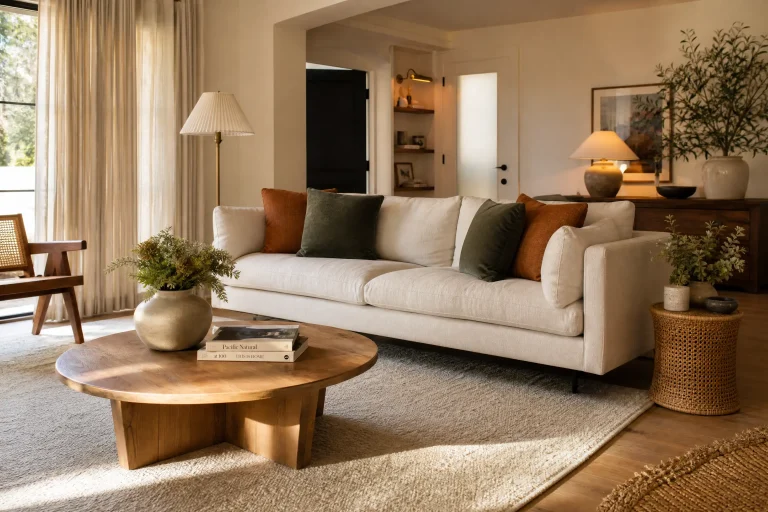
Coastal Wall Decor Looks That Actually Work in Real Homes
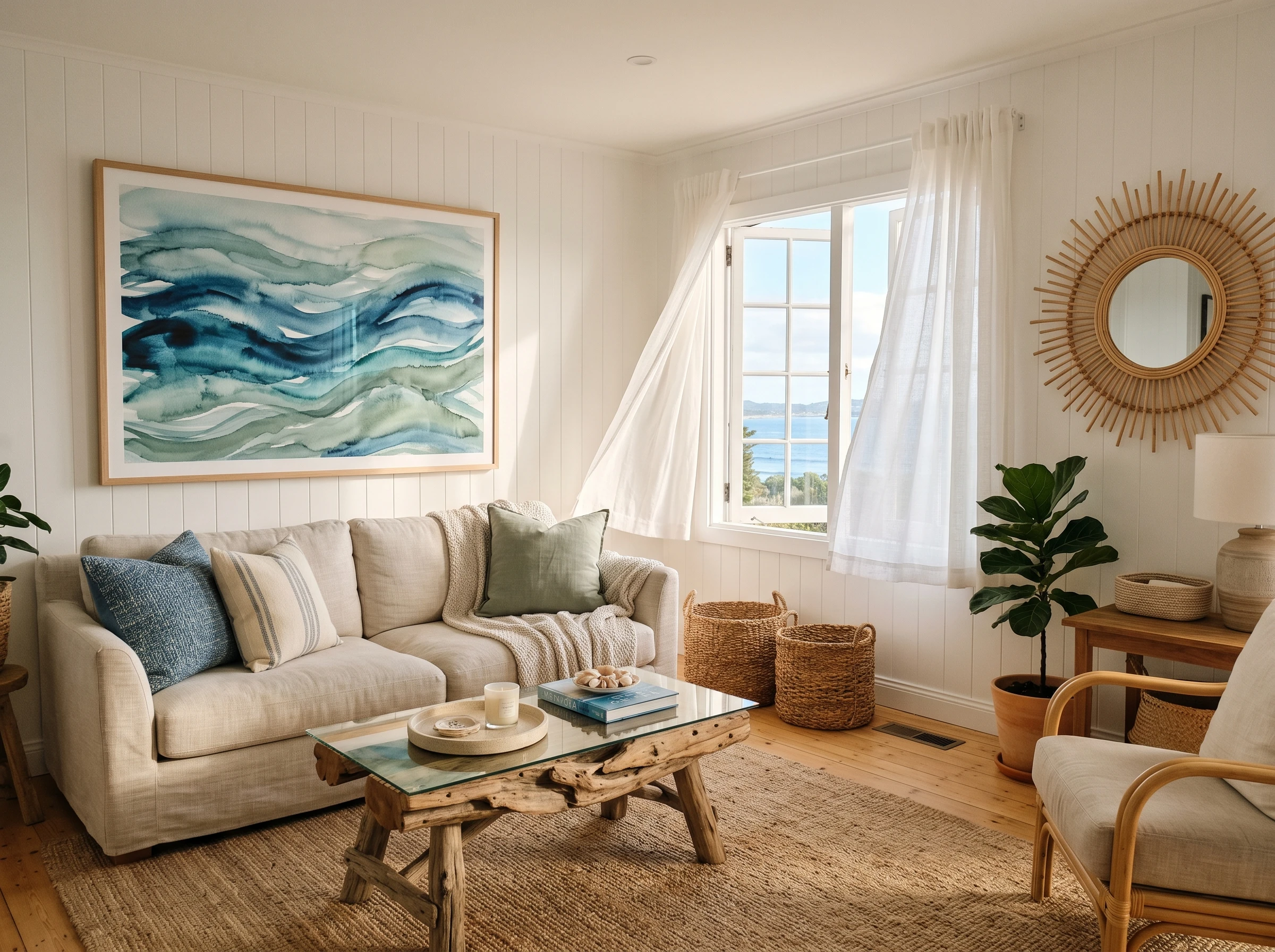
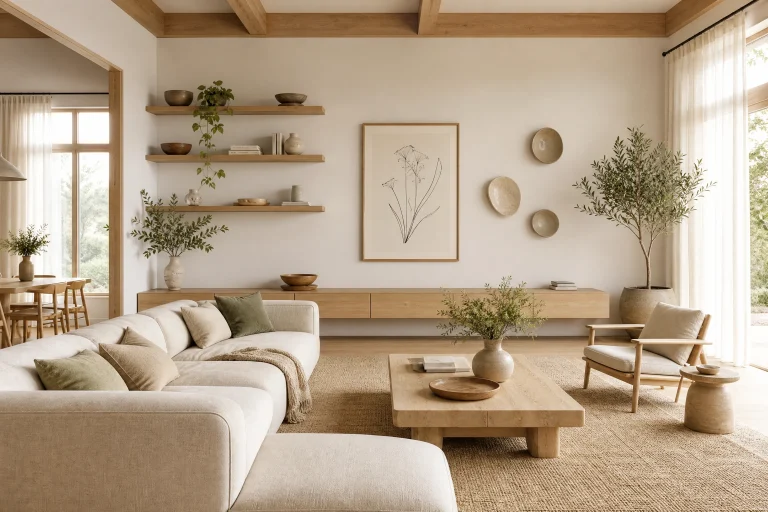
There is something about coastal wall decor that people get wrong more often than they get right. They pile on the driftwood signs, the plastic anchor hooks, and the faded seashell prints, and then wonder why the room feels more like a souvenir shop than a home. Real coastal style is calmer than that. It is about the quality of light, the weight of materials, and the sense that the sea is somewhere nearby without beating you over the head with the message. When it is done well, you do not even notice the individual pieces at first. You just feel relaxed the moment you walk in.
The 22 ideas below are grouped by style territory so you can find the ones that match the direction your room is already heading. Whether you are leaning into a moody, deep-toned coastal palette or keeping things bright and breezy, there is a wall approach here that will fit without forcing anything. Each idea covers the materials, colors, and practical thinking behind the look, not just what it is, but why it works and where it tends to fall short. These are the ideas worth actually trying.
Natural Textures and Organic Materials
1. Woven Seagrass Wall Panels
Seagrass panels have quietly become one of the most versatile pieces in coastal decorating, and once you see them installed correctly, it is easy to understand why. The natural weave creates depth and warmth without adding visual clutter, which is exactly what you want when you are working with a white or soft greige wall. They come in large flat squares or rectangular sections that can be arranged in a grid pattern, hung as a single statement piece, or even used as a headboard alternative in a coastal bedroom. The color sits somewhere between honey and warm sand, which means it pairs naturally with navy blue, sea glass green, or soft terracotta accents without much styling effort. One thing that works really well here is layering a small woven basket or driftwood sculpture in front of the panel rather than beside it, creating a foreground and background effect that feels genuinely considered. These panels are mid-range in price, typically between $40 and $120 per panel depending on size and density, and they hold up well in rooms without direct humidity, though they are not the best choice for a bathroom wall.
Designer Note: Hang panels with at least two inches of breathing room between them if using a grid layout. Too tight and the texture loses its visual impact.

2. Driftwood Branch Arrangements
Driftwood wall arrangements are one of those ideas that look effortless when they are done well and chaotic when they are not thought through. The key is working with pieces that share a tonal family, bleached whites, soft grays, and pale silver-browns, rather than mixing dark bark pieces with pale bleached ones. When you group three to five pieces of varying lengths horizontally across a wall, the eye reads it as a compositional element, almost like abstract art, rather than a pile of sticks. This works particularly well above a console table in an entryway or over a fireplace mantle where the horizontal line of the furniture grounds the arrangement. Use invisible floating shelf hardware or simple picture rail hooks rather than nails through the wood, which can split thinner pieces. In practice, this look comes together best when you resist the urge to fill every gap. The negative space between the branches is part of what makes it feel coastal and airy rather than crowded. Budget-conscious decorators can source genuine driftwood from beaches for free or find convincing faux versions at craft stores for around $20 to $50 per piece.
Designer Note: Odd numbers of pieces almost always look more natural than even groupings. Three or five branches read as intentional; four tends to look symmetrical and stiff.

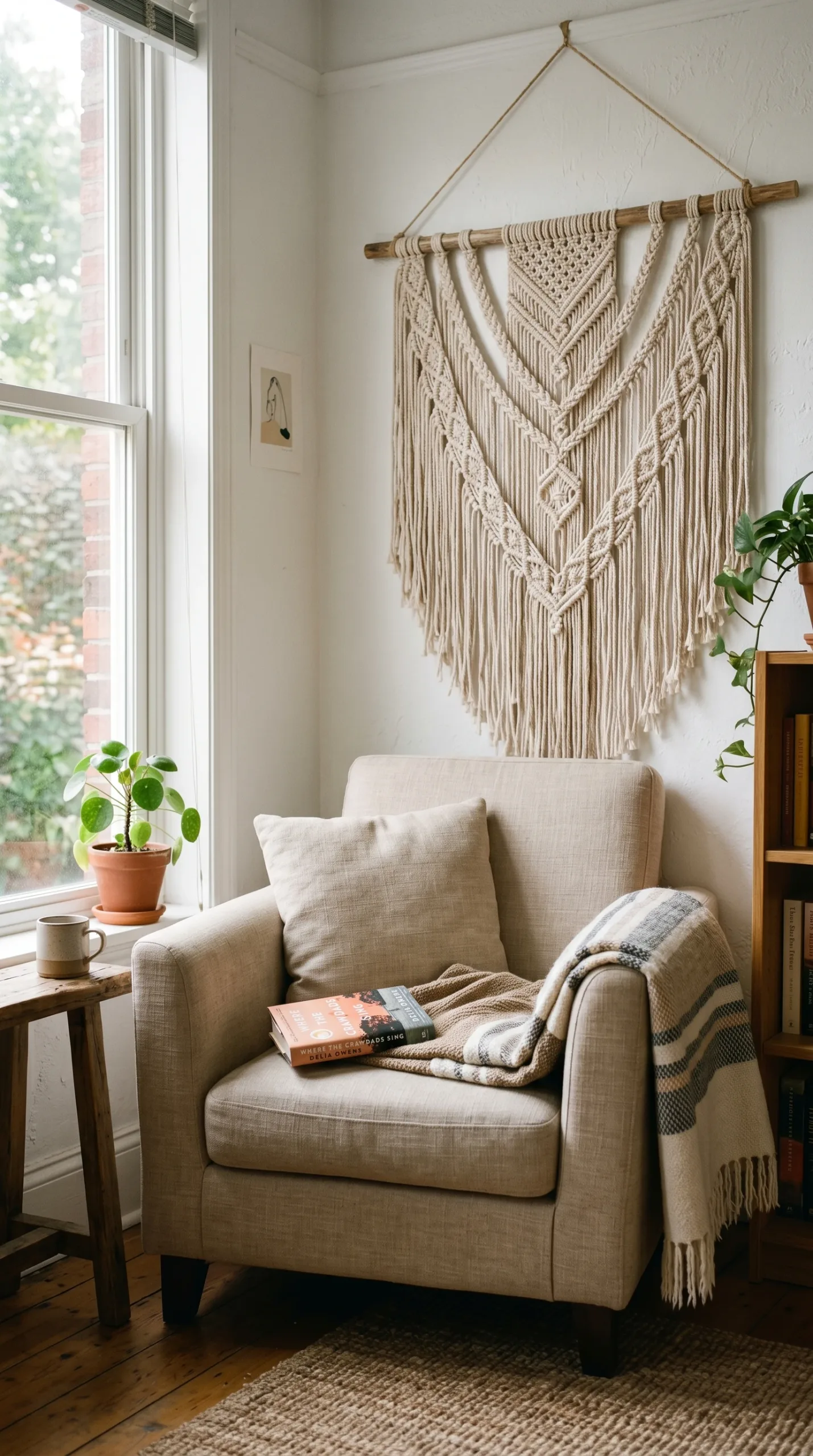
3. Macrame Wall Hangings in Natural Cotton
Macrame had its moment as a purely bohemian statement piece, but the newer, more refined versions sit comfortably in coastal spaces without tipping into hippie territory. The details that keep macrame feeling coastal rather than boho are the material and the palette. Look for natural unbleached cotton rope in a tighter, more geometric knot pattern rather than the loose fringe-heavy styles that dominated a few years ago. Hang it against a wall painted in soft white, warm linen, or pale driftwood gray, and the texture reads as organic and beach-adjacent in a way that feels current. Scale matters here more than most people expect: a small macrame piece on a large wall looks like an afterthought, while a piece that fills roughly a third of the wall height becomes a genuine focal point. These work especially well in bedrooms and reading nooks where the soft texture contributes to the quiet, restorative feeling coastal decor does best. Handmade pieces from independent makers on craft marketplaces range from $60 to over $200, while mass-produced versions are available from most home stores for considerably less.
Designer Note: Avoid macrame in high-humidity rooms. Cotton fiber absorbs moisture and can develop a musty smell over time if used near showers or in poorly ventilated kitchens.
4. Rattan Sunburst Mirror
The rattan sunburst mirror has become something of a coastal staple, and there is a reason it keeps showing up: it genuinely does a lot of work in a single piece. The circular shape references the sun and the natural world, the rattan frame brings texture and warmth, and the mirror itself bounces light around in a way that makes smaller rooms feel larger and airier. Hang it in an entryway to greet natural light from a nearby window, or position it above a dresser in a coastal bedroom where it can reflect a glimpse of blue sky or linen curtains. The most common mistake is hanging it too high. The center of the mirror should sit at approximately eye level for the average adult, which typically means the center point lands around 57 to 60 inches from the floor. These mirrors come in a wide range of sizes, from small 18-inch accent pieces to dramatic 36-inch statement versions. Mid-size options around 24 to 28 inches are the most versatile and tend to work in rooms without overwhelming them. Expect to spend between $80 and $250 for a well-made rattan version with a solid hanging mechanism.
Designer Note: Pair the rattan sunburst mirror with a simple ceramic vase or woven tray on the surface beneath it to complete the vignette without overcomplicating it.

Artwork and Print-Based Ideas
5. Abstract Ocean Canvas in Watercolor Style
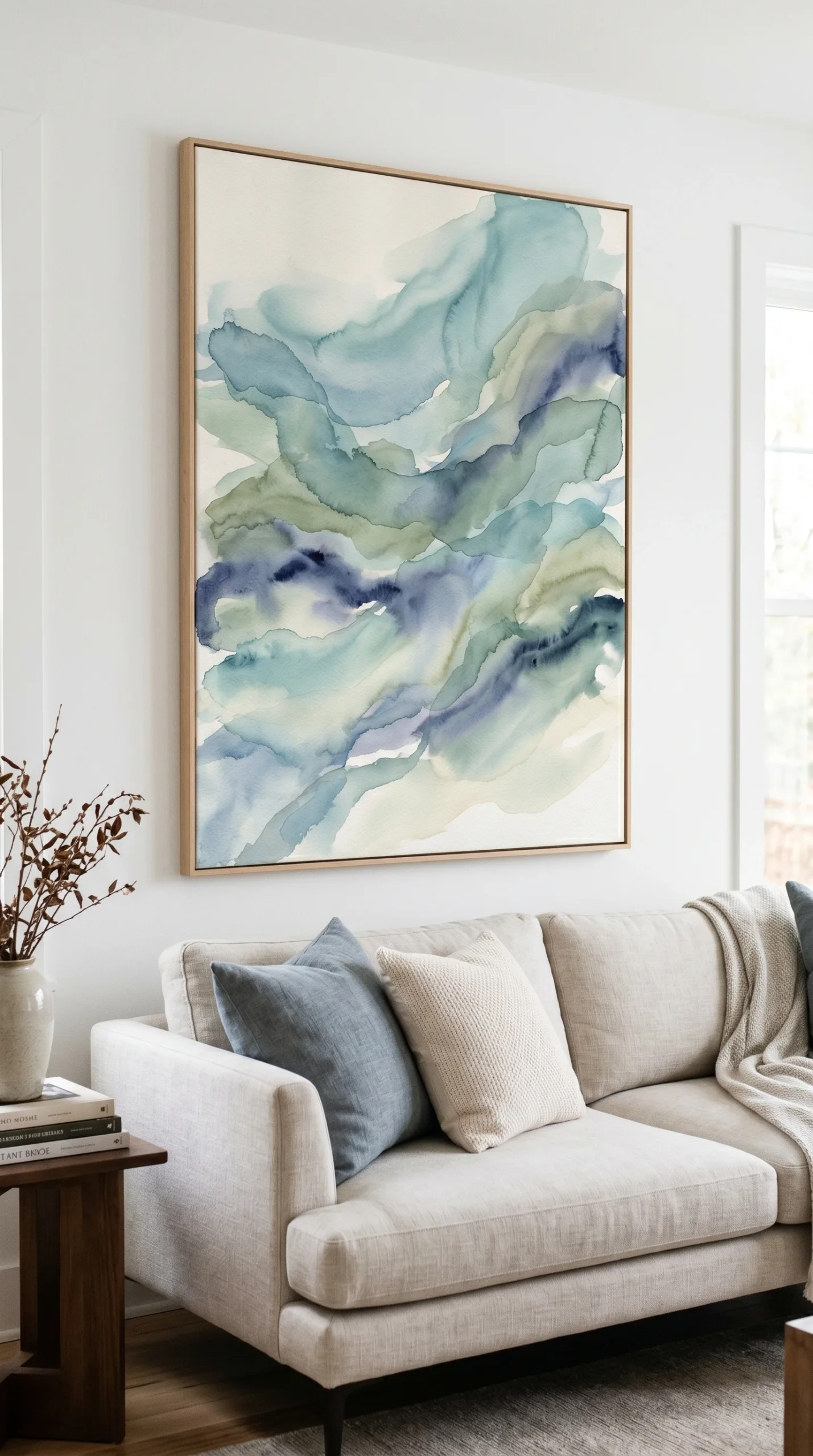
Abstract ocean artwork in a watercolor style is one of those purchases that ages incredibly well in a coastal home, partly because it is not literal enough to feel dated. Instead of painting a specific wave or a recognizable beach scene, a good watercolor abstraction captures the feeling of the ocean: the layering of blue and green tones, the soft edges, the light dissolving into water. The color temperature of the piece matters a great deal here. Cool blues and silver-greens feel more contemporary and work well in rooms with white, gray, or deep blue walls. Warmer pieces with soft coral, sandy yellow, or peachy pink undertones read as more relaxed and laid-back and suit rooms with natural wood furniture and warm whites. In practice, a single large canvas in the 36-by-36-inch or 36-by-48-inch range has far more visual impact than a cluster of small prints and is easier to live with long term. Frame it simply in a thin natural wood frame or go frameless with gallery-wrapped canvas for a more casual feel. Original pieces from emerging artists on art marketplaces can be found for $150 to $400, and quality art prints are often available for under $80.
Designer Note: Buy the biggest piece your budget allows and your wall can hold. Coastal rooms rarely suffer from artwork being too large, but they frequently suffer from artwork being too small.
6. Framed Vintage Nautical Charts
Vintage nautical charts bring a sense of history and specificity to coastal decor that generic beach prints cannot match. The cartographic detail, the depth soundings, the old typography, the way coastlines are rendered with the elegant precision of a different era, all of that combines into something that feels genuinely interesting to look at rather than simply decorative. They work particularly well framed in dark navy, black, or aged brass frames that echo the map’s own color palette of ochre, cream, and faded ink blue. If you can find a chart of a coastline that has personal meaning, a favorite vacation spot, the town where you grew up, or a coast you have always wanted to visit, the piece becomes a conversation starter rather than wallpaper. Reproduction prints are widely available and very affordable, often under $30 for an unframed version, while genuine antique charts from estate sales or map dealers can run into the hundreds. Either way, the framing matters as much as the map itself. A cheap frame undermines the whole effect.
Designer Note: Group two or three charts in matching frames for a quiet, cohesive look, or let a single large chart stand alone as the room’s main wall feature.

7. Black and White Coastal Photography
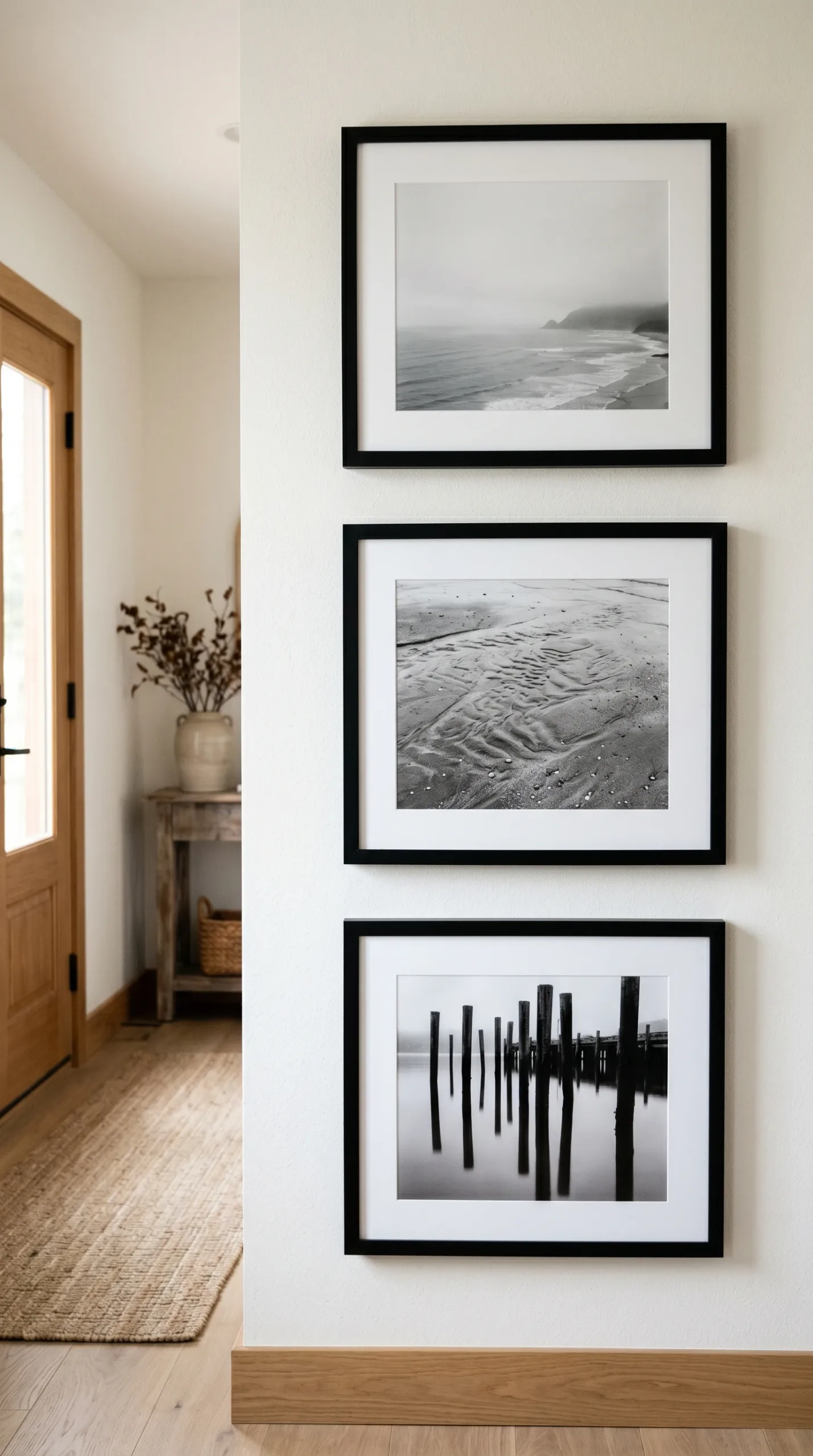
Black and white coastal photography occupies a slightly different space from the usual color-saturated beach prints. The absence of color forces the composition itself to carry the image: the texture of wet sand, the weight of a wave mid-break, the geometry of weathered pier pilings reflected in still water. This kind of imagery tends to read as more sophisticated and less overtly beachy than colorful coastal art, which makes it easier to use in rooms that are not entirely committed to a seaside theme. A set of three black and white ocean photographs in identical simple black frames works beautifully in a living room or hallway where you want a coastal gesture without a full coastal commitment. The prints read quietly alongside nearly any furniture style, from clean-lined contemporary to vintage rattan. Prints can be sourced from independent photographers on art print platforms, which often gives you access to genuinely original images rather than the overused stock shots that show up everywhere. Budget for quality printing on fine art paper or archival matte rather than standard photo paper, which tends to look flat in person.
Designer Note: Vary the subject slightly within a black and white set: one wide seascape, one close-up texture shot, and one mid-distance scene gives the grouping visual rhythm.
8. Coastal Botanical Prints
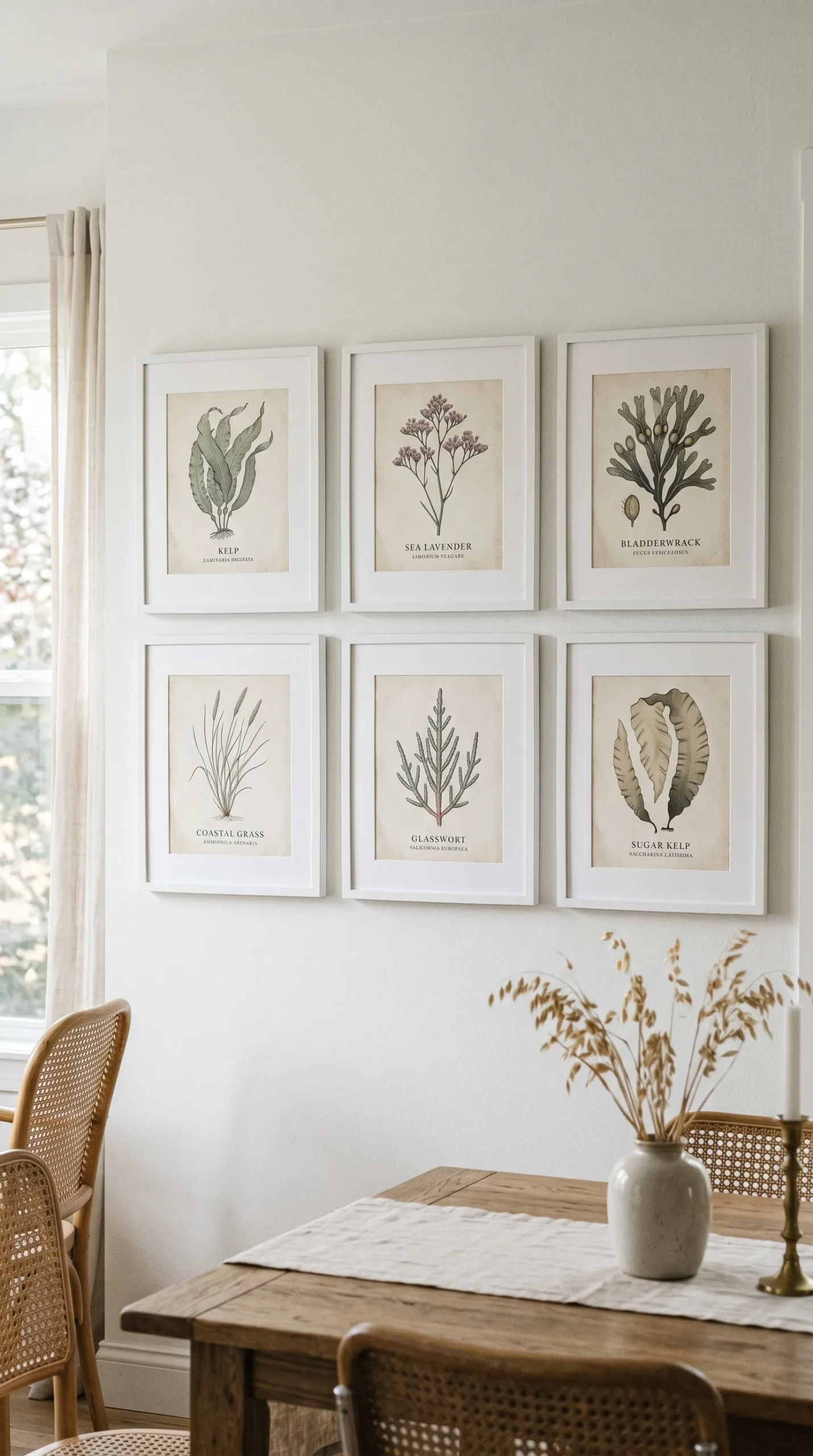
Coastal botanicals, think kelp, sea grass, coral formations, sea lavender, and salt marsh plants, are having a real moment in interior design right now, and they bring something genuinely fresh to the usual lineup of waves and anchors. The scientific illustration style, with its clean lines, muted palette, and careful attention to natural form, sits beautifully in coastal spaces that lean toward a more refined or Hamptons-adjacent aesthetic. Framed in white or soft white with a generous matte border, a set of coastal botanical prints creates a gallery wall that feels cultured and considered without being cold. These work particularly well in dining rooms and home offices where you want a coastal nod without the room feeling like a beach rental. The color palette in botanical prints typically sits in the range of sage green, warm ivory, dusty rose, and muted navy, which makes them easy to coordinate with a wide range of furniture finishes. Quality reproduction sets are available online for $80 to $150 for a coordinated group of four to six prints, which makes this one of the more budget-friendly ways to cover a significant section of wall with something that looks genuinely put-together.
Designer Note: Use identical frames and mats across a botanical set. Mixing frames on this kind of detailed, formal artwork makes the arrangement look unfinished rather than eclectic.
Gallery Walls and Curated Collections
9. Mixed-Media Coastal Gallery Wall
A mixed-media coastal gallery wall is more demanding to put together than a set of matching prints, but when it works, it is one of the most personal and visually rich things you can do with a wall. The goal is to combine pieces from different categories, a framed watercolor painting, a small round mirror, a woven wall hanging, a piece of coastal typography, and a pressed seagrass shadow box, in a way that feels cohesive rather than random. The cohesion comes from limiting the color palette across all the pieces. If everything sits within a range of navy, sandy beige, warm white, and natural tan, the variety of formats reads as intentional curation rather than accumulation. The arrangement itself should have a visual anchor, typically the largest or most detailed piece, positioned slightly left or right of center, with the remaining pieces building around it asymmetrically. In practice, this look comes together best when you lay the whole arrangement out on the floor before hanging anything, photograph it, and live with the photograph for a day before committing to the wall. This is an investment-level approach in terms of time even when the individual pieces are affordable.
Designer Note: Use paper templates cut to the size of each piece and tape them to the wall with painter’s tape before hammering a single nail. It saves enormous frustration.

10. Sea Glass Shadow Box Collection
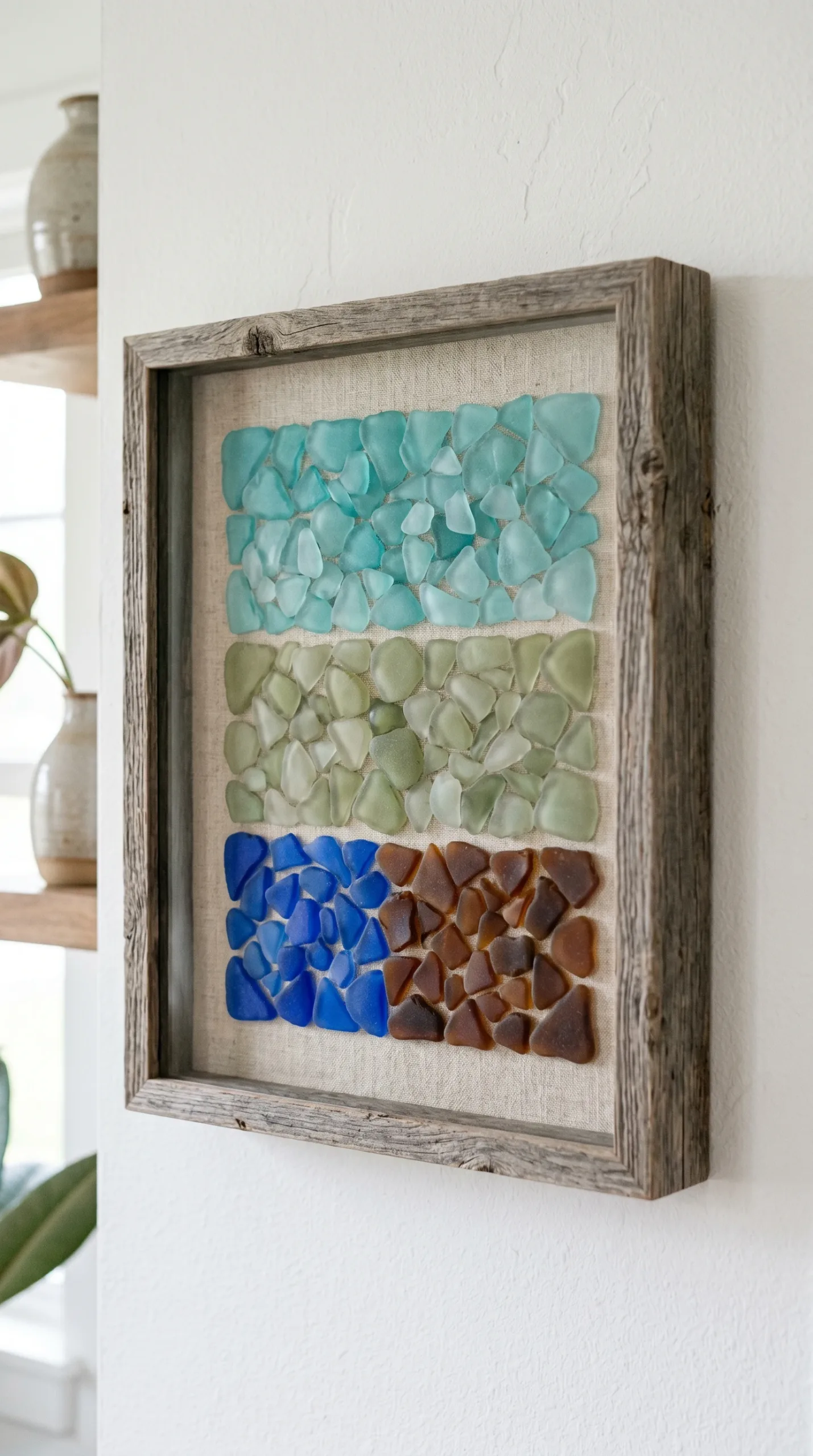
Sea glass collected over years of beach visits carries a different kind of value than anything you can buy at a store, and a well-designed shadow box turns that collection into genuine wall art. The key to making sea glass look elevated rather than craft-project is the presentation: a deep shadow box with a linen or oyster-white fabric backing, pieces arranged with deliberate spacing by color and size rather than randomly scattered, and a frame in natural oak, weathered gray, or matte black depending on your room’s wood tones. The colors found in sea glass, frosted aqua, soft olive, pale lavender, cloudy white, and the rarer cobalt blue or amber, are practically a ready-made coastal palette, and their frosted, light-diffusing surface catches ambient light in a way that framed prints simply cannot. If your own collection is small, you can supplement with ethically sourced sea glass from online specialty suppliers without compromising the personal story of the piece. This is a genuinely affordable DIY option if you already have the glass, with deep shadow box frames available for $25 to $60 at most craft retailers.
Designer Note: Group sea glass by color family within the box rather than mixing all colors together. Color-blocked sections give the arrangement a modern, graphic quality.
11. Framed Antique Shell Illustrations
There is a long tradition of natural history illustration that captured shells, mollusks, and marine life with extraordinary scientific precision, and those prints translate beautifully into coastal wall art today. The difference between a cheap shell print and an antique-style shell illustration is the quality of the draftsmanship: the shading that gives each shell its three-dimensional form, the accuracy of the markings, the way light and shadow define the spiral geometry. Framed with a generous white matte in a thin dark frame, a set of four or six shell illustrations creates a wall arrangement that reads as both coastal and genuinely educated. This approach works particularly well in dining rooms and studies where you want a sense of collected intelligence alongside the coastal mood. Reproduction prints from natural history archives are widely available for very little, often under $15 each as unframed prints, which makes this one of the most affordable gallery wall approaches on this list. Be thoughtful about scale: individual shell illustrations work best printed at a size where the shell itself reads clearly, typically at least 8 by 10 inches per print.
Designer Note: Stick to a consistent species group within your set, all gastropods, all bivalves, or all coral types, rather than mixing categories, which can look scattered.

Statement Pieces and Sculptural Elements
12. Large-Scale Coral Wall Sculpture
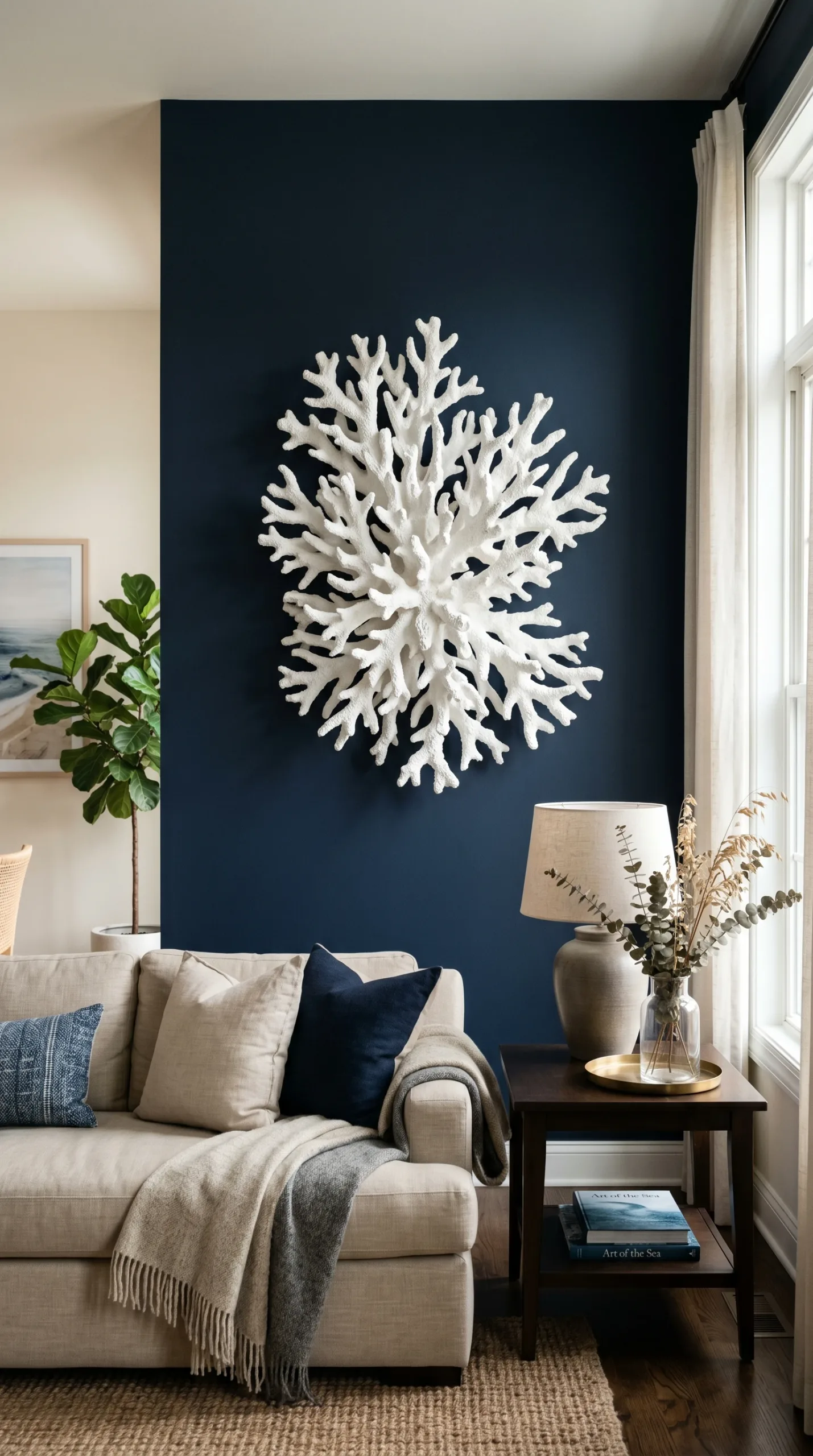
A coral wall sculpture made from resin, plaster, or paper pulp is the kind of piece that stops a room from looking flat, and it is particularly effective in coastal spaces where the goal is to reference the ocean without relying on prints. The three-dimensional quality of a coral form creates actual shadow and depth on the wall, which changes throughout the day as the light angle shifts. White or off-white coral against a wall painted in warm white or soft sage creates a tonal layering effect that feels quiet and sophisticated rather than bold, while the same coral piece against a deep navy or moody slate blue wall becomes a dramatic focal point. In terms of placement, coral sculptures work best in living rooms above a console or on a dining room wall where they can be seen from a distance that allows the full form to read clearly. Close-up in a small hallway, they can feel overwhelming. These pieces range considerably in price depending on material and craftsmanship, from affordable resin versions around $40 at home stores to handcrafted plaster or ceramic versions from independent artists that can reach $200 to $400.
Designer Note: Avoid coral wall art made from actual harvested coral, which raises significant environmental concerns. High-quality resin and plaster replicas are visually indistinguishable and fully sustainable.
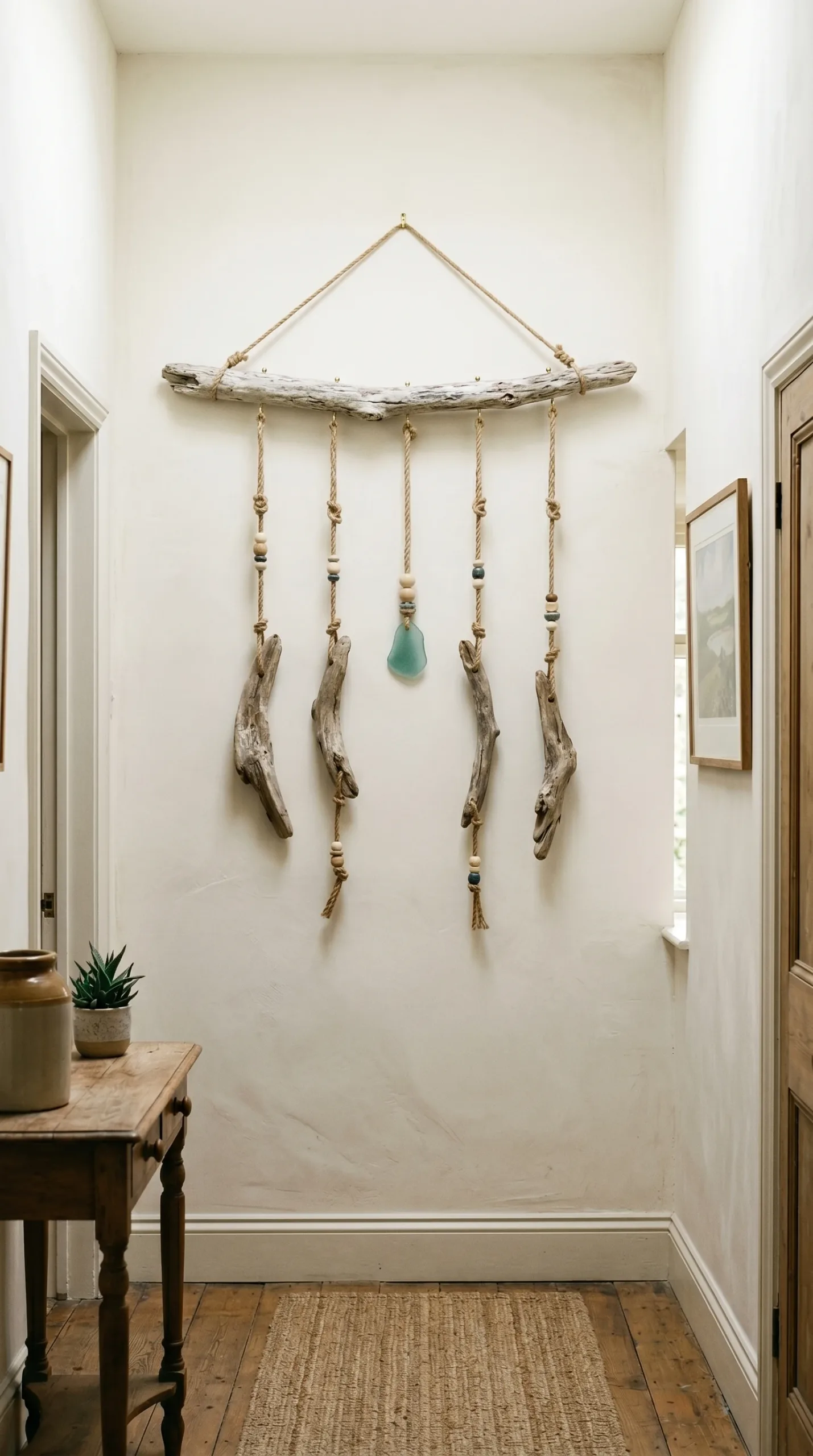
13. Driftwood and Rope Wall Installation
A driftwood and rope wall installation takes the idea of individual driftwood pieces and builds it into something more structural and intentional. The basic concept involves suspending multiple pieces of driftwood horizontally from a longer main branch using natural jute or cotton rope of varying lengths, creating a kind of organic mobile that hangs flat against the wall. The visual effect is layered and rhythmic, with the pieces at different heights creating movement even when everything is still. Small coastal accents can be threaded onto the ropes between the wood sections, a few beads, a piece of sea glass, a small shell, adding detail without complicating the overall line. This is a strong DIY option for people who enjoy making things, with the raw materials available cheaply or free, and several clear tutorials available online for different complexity levels. The installation requires a single secure anchor point at the top, ideally a ceiling hook or picture rail, and looks best hung in rooms with enough vertical wall space to let the piece breathe, at least six feet of clear wall height.
Designer Note: Use a level when hanging the main branch to keep the horizontal line even. A tilted top branch throws off the visual balance of the whole piece.
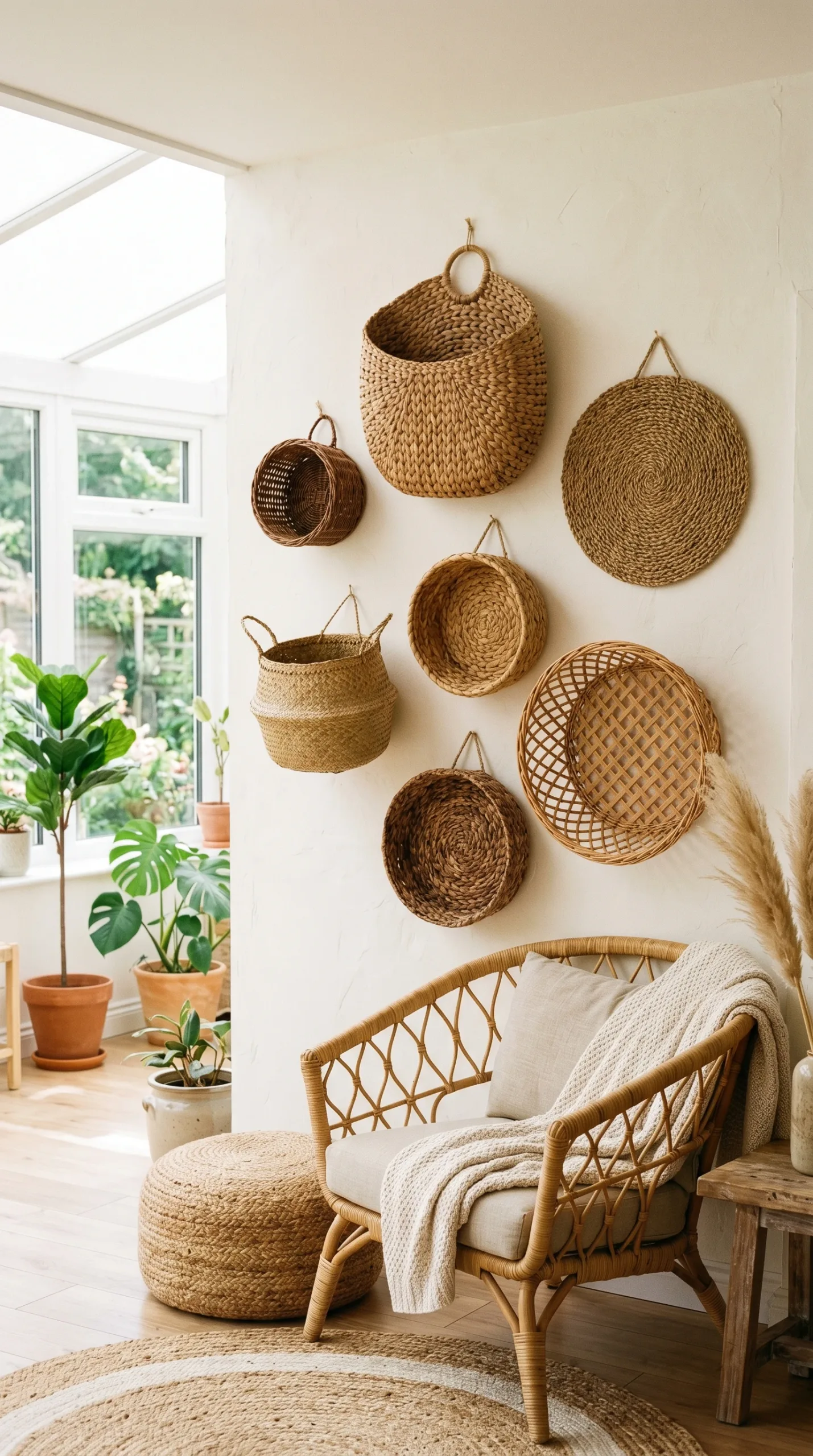
14. Oversized Woven Basket Wall Display
Hanging woven baskets as wall art is an approach that has traveled comfortably between African-inspired, bohemian, and coastal aesthetics, and in a coastal context, the key is choosing baskets that lean toward the natural material end of the spectrum: seagrass, water hyacinth, rattan, and open-weave designs rather than brightly painted or heavily decorated versions. A grouping of five to seven baskets in a variety of sizes and weave patterns creates a wall display that is rich in texture and warmth without requiring a single nail-and-frame approach. The palette of natural baskets, ranging from warm honey to pale straw to warm brown, sits effortlessly alongside coastal blue and green tones. This works particularly well in living rooms and sunrooms where a more relaxed, gathered aesthetic fits the mood of the space. One practical advantage over framed art is that baskets are lightweight and easy to rearrange whenever you want a change. Most basket wall displays can be assembled for well under $100 using a mix of new and secondhand pieces from thrift stores and craft markets.
Designer Note: Vary the depth of the baskets in your grouping. Mixing flat woven pieces with deeper bowl-shaped baskets creates dimensional interest that a flat set of plates does not achieve.
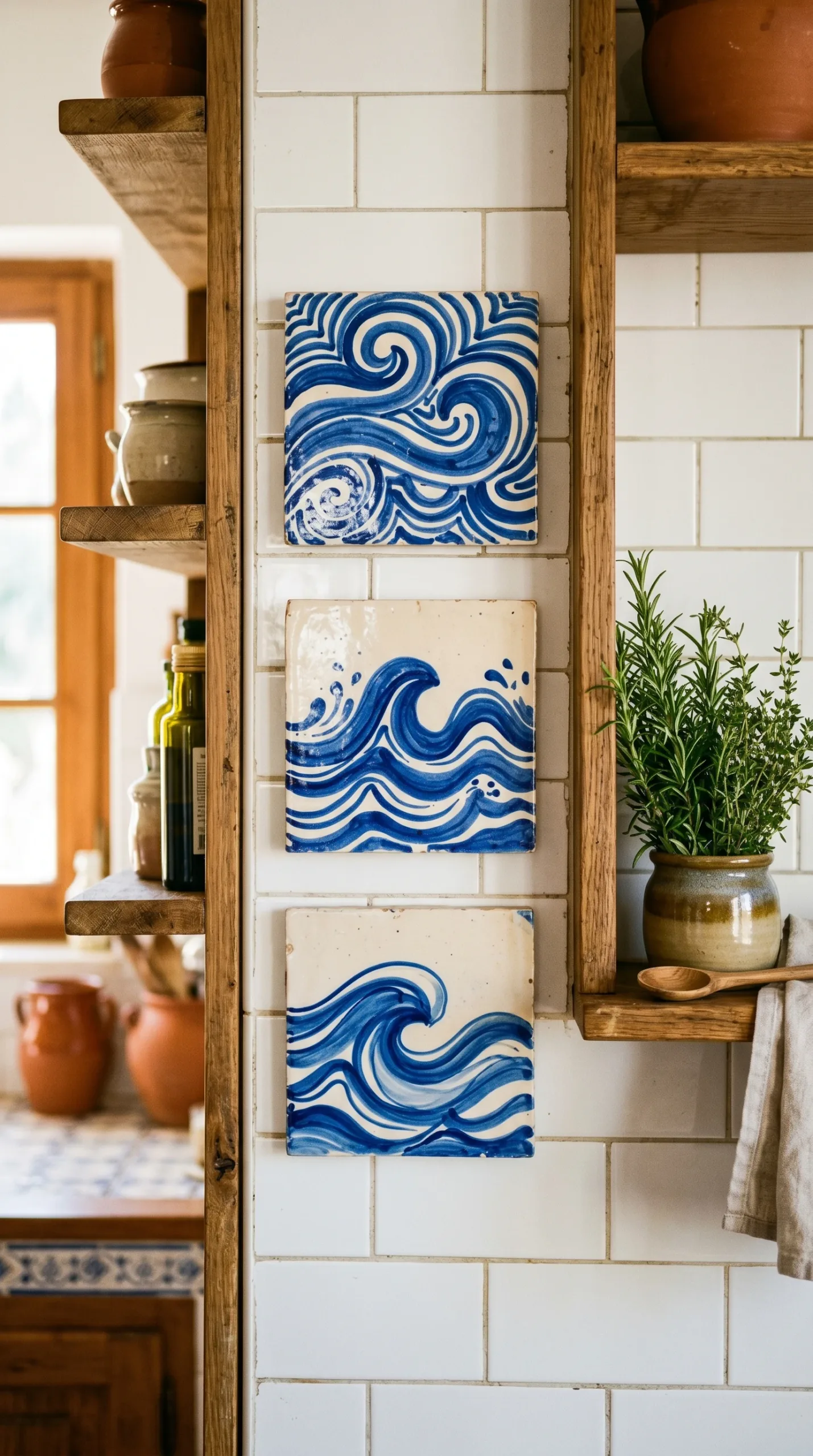
15. Ceramic Seascape Wall Tiles
Handpainted ceramic tiles with coastal imagery, abstract wave patterns, marine life motifs, or simple brushwork seascapes, offer a wall decor option that has a permanence and material richness that paper prints cannot match. A single large decorative ceramic tile hung as a framed piece becomes a focal point with genuine visual weight. A grouping of smaller tiles in a grid or scattered arrangement adds pattern and color in a way that is unique to ceramic work: the slight variations in glaze, the texture of the surface, the depth of color that changes under different lighting conditions. Portuguese azulejo-style tiles in blue and white are a particularly strong choice for coastal rooms because the blue-on-white tradition references maritime European design history in a way that feels authentic. These pieces work beautifully in kitchens and bathrooms where the material is also practical, but they are equally at home as purely decorative elements in living rooms. Handmade ceramic tiles are an investment, typically $50 to $150 per tile, so buy fewer and let them stand as genuine art pieces rather than trying to fill a wall with them.
Designer Note: Hang decorative ceramic tiles with proper plate hangers rated for the weight rather than adhesive strips, which can fail over time with heavier ceramic pieces.
Modern Coastal and Japandi-Coastal Crossover
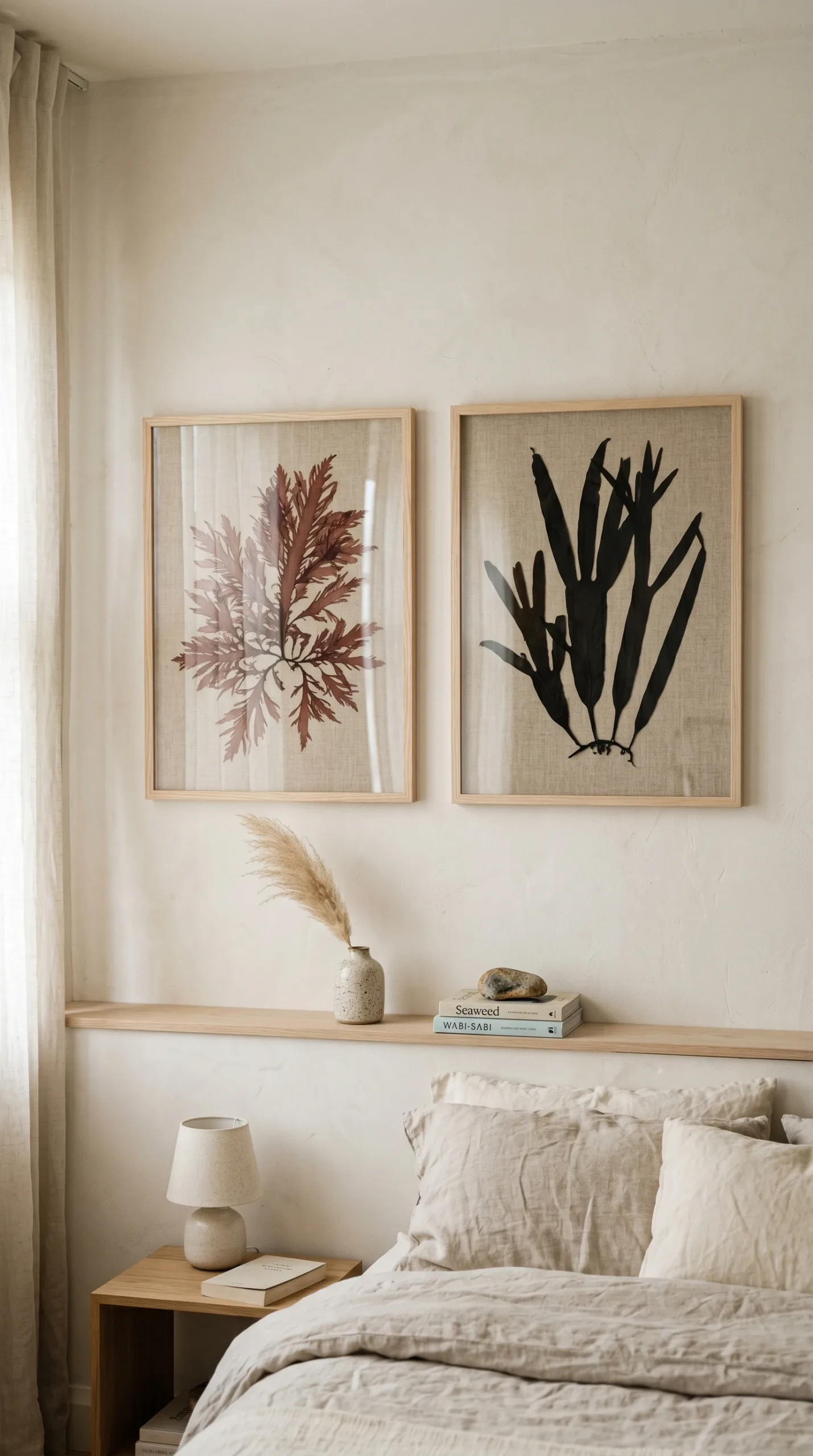
16. Linen-Backed Pressed Seaweed Art
Pressed seaweed art sits at the intersection of the Japandi aesthetic and coastal design, and it is one of the more genuinely beautiful and underused ideas in this whole category. The practice of pressing and mounting marine algae has a Victorian natural history tradition behind it, but in a modern frame it reads as quietly contemporary. Different varieties of seaweed, dulse, sea lettuce, bladderwrack, and kelp, each press into remarkably different forms: some are delicately feathered and almost translucent, others are bold and graphic. Mounted on a natural linen or cotton rag backing and framed simply in a thin oak or light ash frame, the result is a piece of art that is simultaneously natural, graphic, and completely original. This is an achievable DIY project for coastal homeowners who can gather fresh seaweed, press it between sheets of absorbent paper for several weeks, then mount and frame the results. The costs are minimal: linen fabric, museum glass, and a simple frame, typically under $50 total. The limitation is that the colors will fade gradually in direct sunlight, so hang pressed seaweed pieces away from south or west-facing windows.
Designer Note: Use UV-protective museum glass when framing pressed botanicals and seaweed. It significantly extends the life of the color before fading begins.
17. Minimalist Line Art of Coastal Subjects
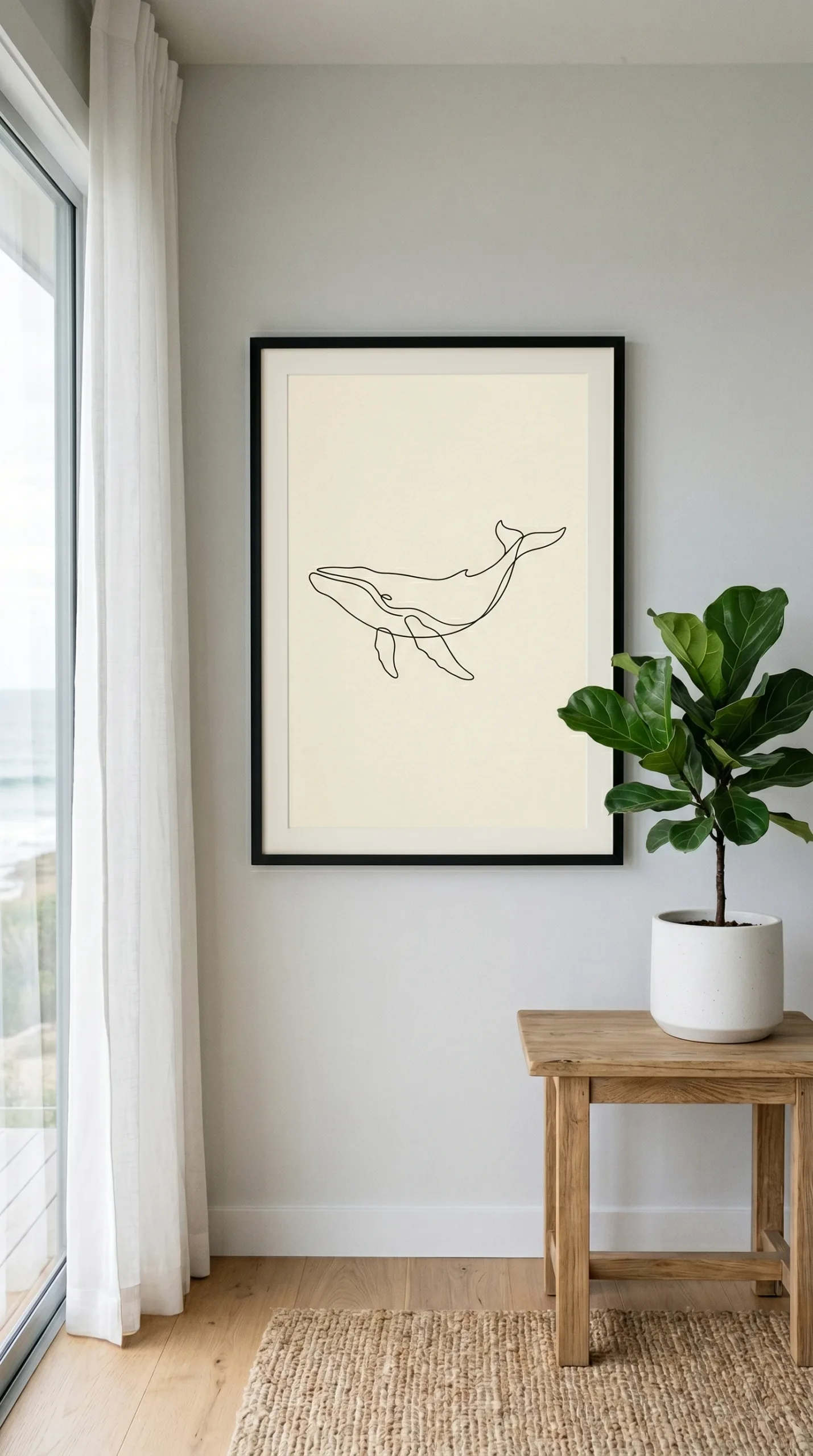
Single-line coastal illustrations, those spare, continuous-line drawings of waves, shells, fish, or shore birds rendered in one unbroken stroke, have moved from graphic design trend to interior design fixture over the past few years, and they hold up well in coastal rooms because of how little visual weight they carry. A line drawing of a whale, a pelican, or a conch shell in matte black ink on a warm white or cream background brings a coastal reference into a room so lightly that it almost disappears into the composition. This is particularly useful in rooms that are only loosely coastal in their overall palette and furniture choices, where a more literal piece of beach art would feel forced. The clean, graphic quality of line art means it also pairs easily with other styles, sitting comfortably alongside Scandinavian furniture, contemporary lighting, and abstract rugs without creating a stylistic conflict. Quality prints of line art are often very affordable, with many independent artists selling digital downloads you can print locally for a few dollars, making this one of the most budget-friendly options on the list.
Designer Note: Frame line art prints with a matte that is at least two inches on all sides. The white space between the print and the frame is part of the minimalist composition.
18. Deep Teal Accent Wall with Layered White Decor
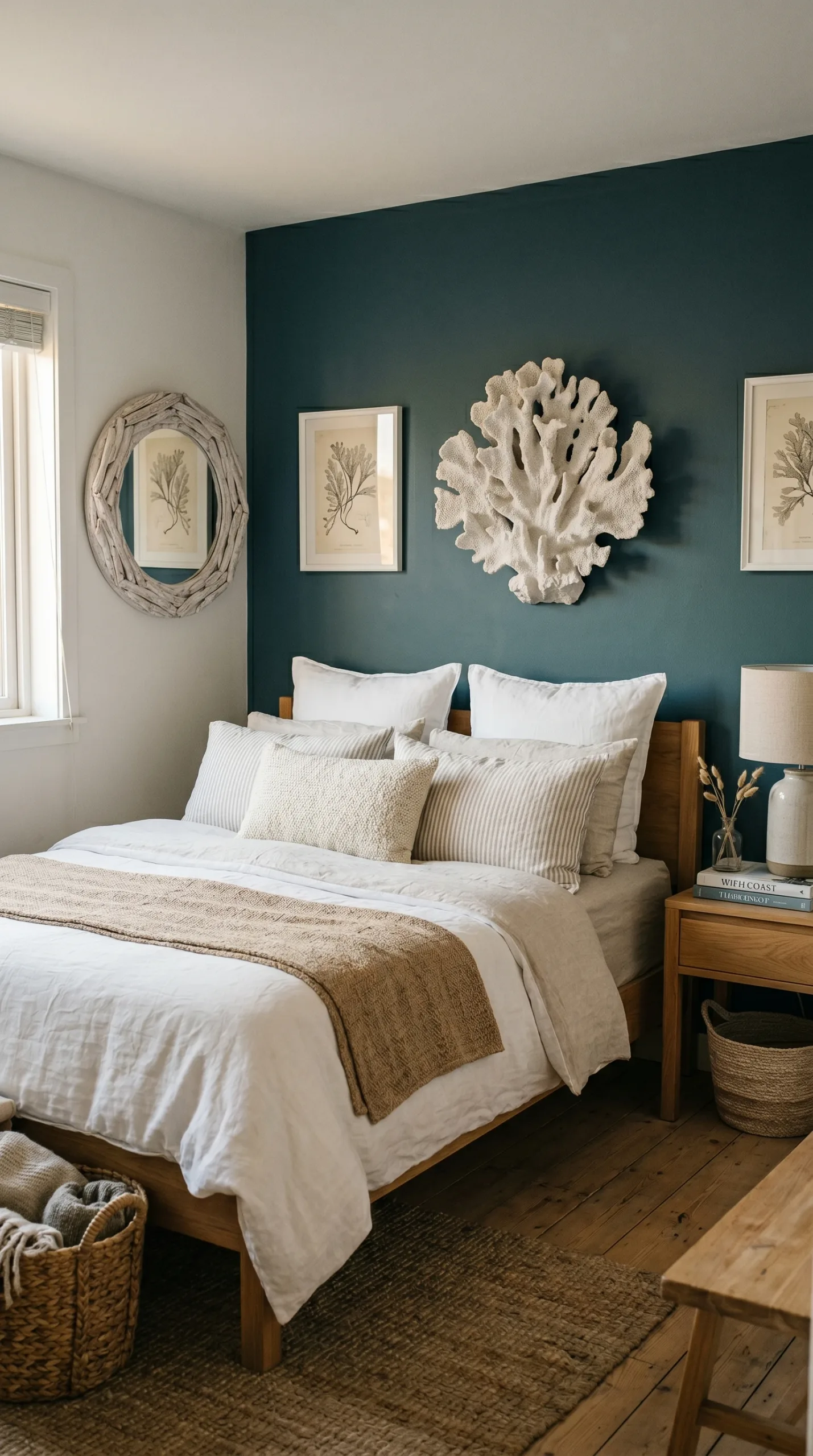
One of the 2025 coastal design shifts that professional designers are genuinely excited about is moving away from the pale, washed-out palette that dominated coastal decorating for years and introducing deeper, richer wall colors as the backdrop for white and natural decor. A deep teal accent wall, somewhere in the range of a muted peacock blue or a slightly grayed teal, creates a wall color that references the deeper water of an open ocean rather than the pale shallows. Against that backdrop, white or off-white wall decor elements, coral sculpture, white macrame, whitewashed driftwood frames, and cream-toned botanical prints, pop with a clarity and elegance that the same pieces would not achieve against a white wall. The color temperature of the teal matters: warmer teals with a slight green lean feel cozier and suit rooms with wood furniture, while cooler, more blue-leaning teals read as more formal and suit linen upholstery and metal accents. This is a more committed approach than hanging art, since it involves painting a wall, but the result is a room that looks genuinely designed rather than assembled from separate purchases.
Designer Note: Test your chosen teal on a large sample card in the actual room before committing. Teal colors shift dramatically between artificial evening light and natural daylight.
Functional Decor with Wall-Mounted Character
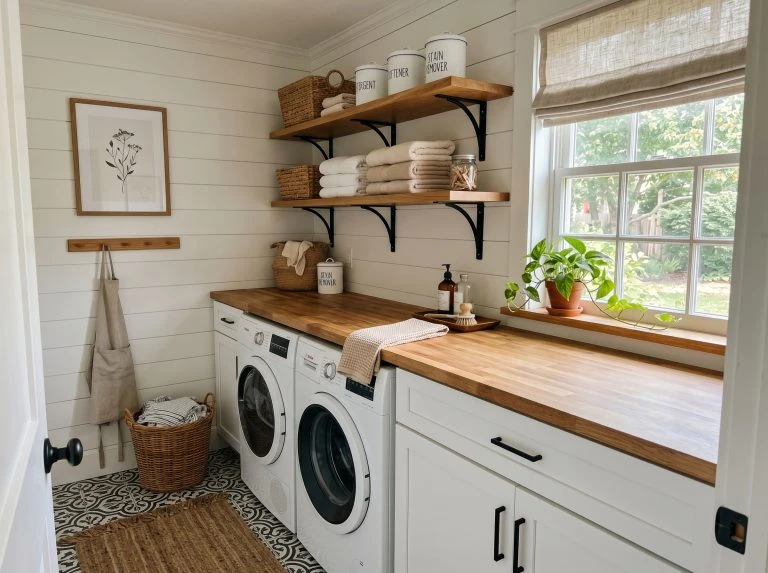
19. Shiplap or Whitewashed Wood Plank Accent Wall
Shiplap remains one of the most reliably effective coastal wall treatments because it adds architectural texture to a flat wall without requiring any art at all. The horizontal lines of shiplap reference the planking of old wooden boats and beach houses, and that reference lands naturally in coastal rooms without needing explanation. The finish choice makes a significant difference in how it reads: pure white painted shiplap feels bright and crisp, more of a contemporary coastal look, while a whitewashed or limewashed finish that lets the wood grain show through feels warmer, more wabi-sabi in its appreciation of natural imperfection, and suits rooms with vintage or coastal bohemian furniture. A shiplap accent wall behind a bed, sofa, or bathroom vanity creates a focal point that is more architecturally permanent than art and requires almost no styling beyond the wall treatment itself. Real shiplap boards are a legitimate carpentry project, but peel-and-stick shiplap panels have improved considerably and are a reasonable option for renters or those who want a lower-commitment version. Budget for the material cost, which runs from around $1 to $4 per square foot for real boards, plus paint or limewash finish.
Designer Note: If you add minimal wall art to a shiplap wall, keep it simple and well-spaced. The texture of the wall itself competes with complex art arrangements.

20. Coastal-Style Wall Sconces with Rattan Shades
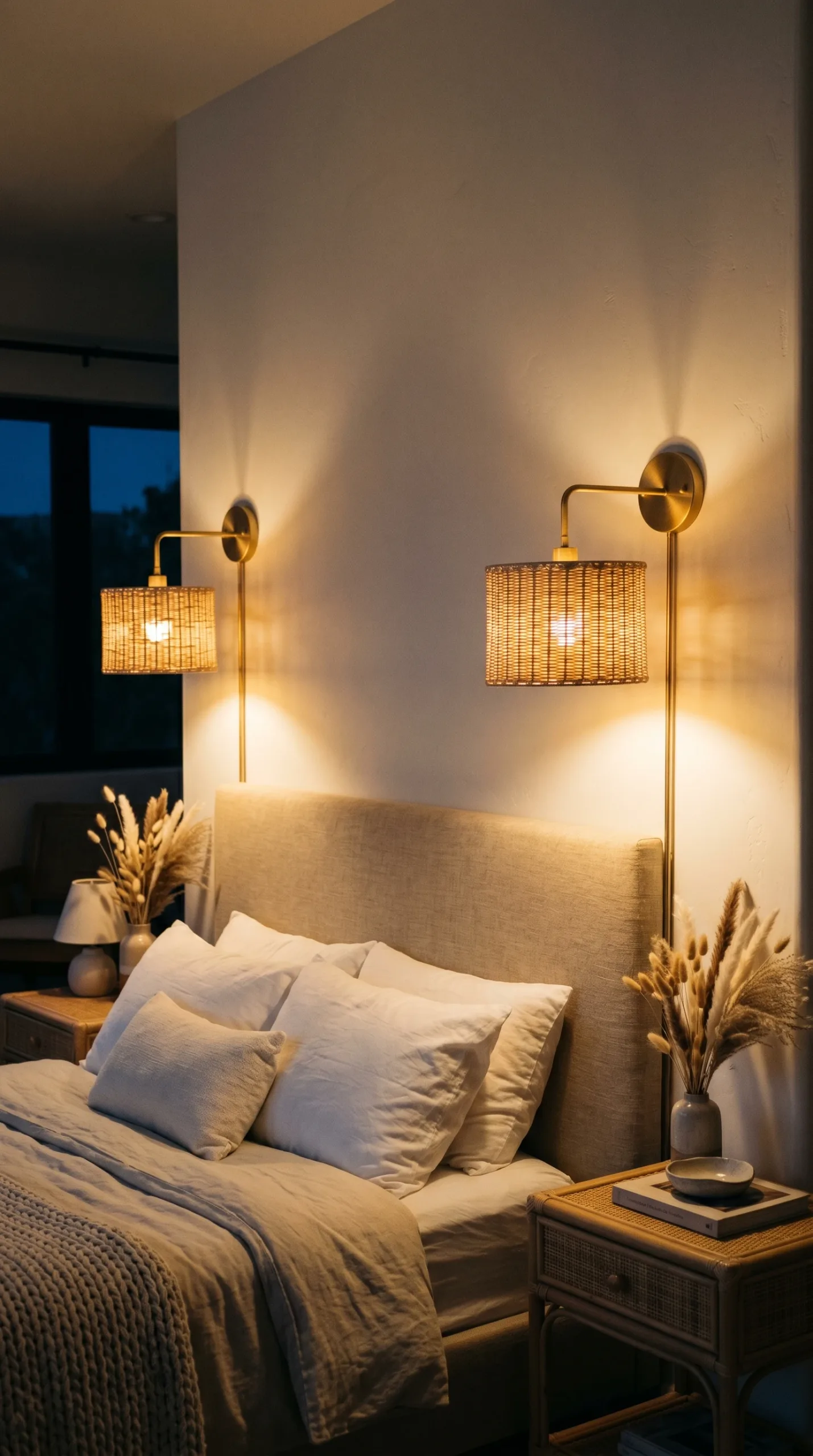
Lighting is wall decor that most people do not think about as wall decor, and that is a missed opportunity in coastal spaces. A pair of wall sconces with natural rattan shades contributes to a coastal wall in three ways simultaneously: the warm glow of the light adds the layered lighting dimension that most designers consider essential to a complete room, the rattan shade material adds texture, and the fixture itself adds visual interest to the wall even when switched off. Sconces work particularly well flanking a bed as bedside reading lights, on either side of a bathroom mirror, or on a living room wall where they contribute to the ambient lighting alongside a central fixture. In coastal rooms, look for sconces with warm brass or matte black hardware, since chrome and nickel tend to read as too contemporary and clinical against natural materials. The warm color temperature of the light itself matters: 2700K to 3000K bulbs give the golden, late-afternoon quality of light that makes coastal spaces feel genuinely relaxing. Wired sconces require an electrician for installation, while plug-in versions with a cord cover offer a more accessible alternative.
Designer Note: Install sconces at shoulder height when used as bedside lights, roughly 24 to 30 inches above the mattress surface, so the light falls correctly onto the reading page.
21. Salvaged Wood Shelves Styled with Coastal Objects
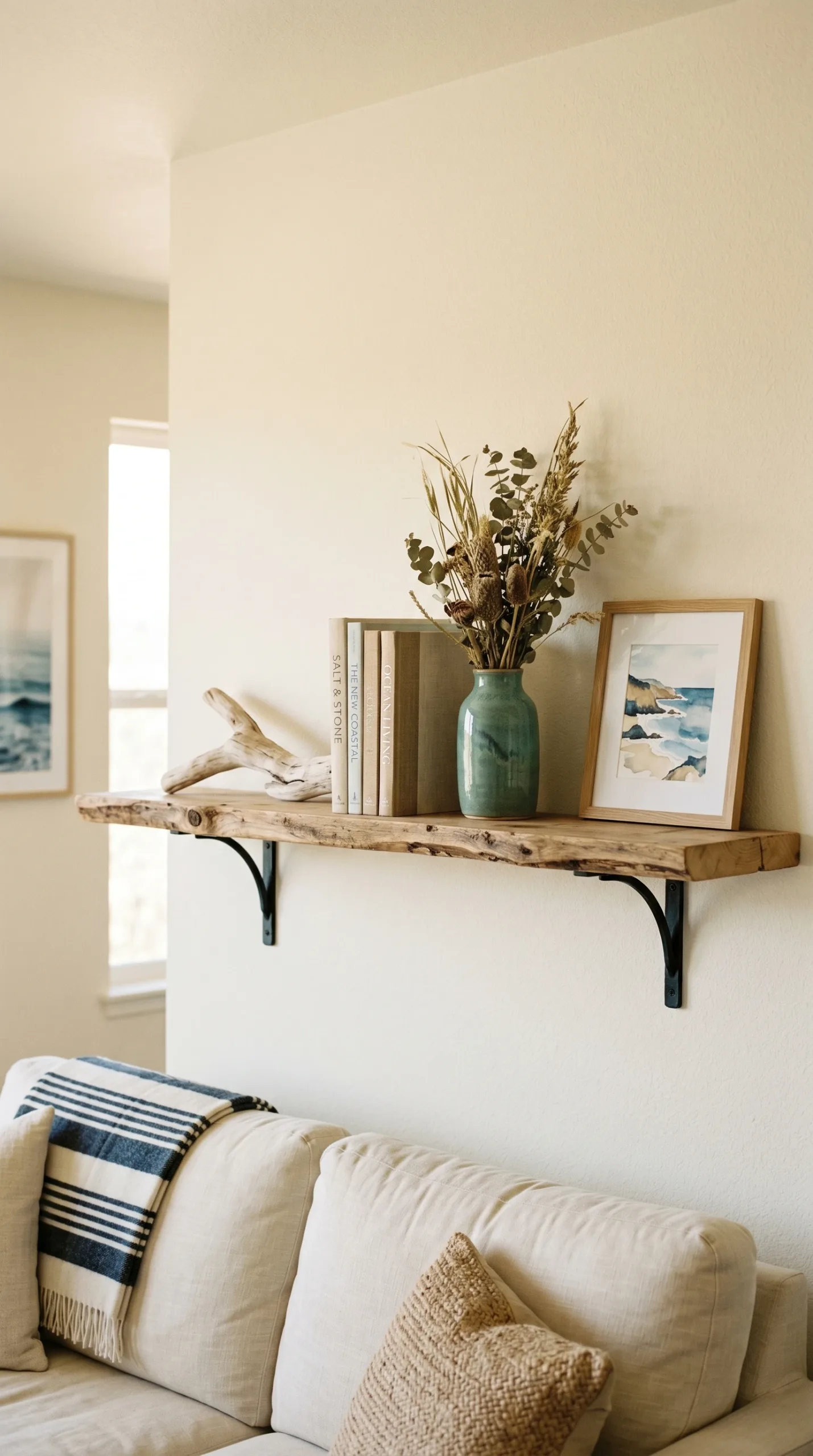
A floating shelf made from salvaged or live-edge wood does double duty as both functional storage and wall decor in a coastal room, and the styling of what sits on that shelf determines how strongly the coastal mood reads. A single wide plank of reclaimed pine or oak with visible saw marks, knots, and natural color variation, mounted on simple black iron brackets, immediately brings a character to the wall that no print can quite match. Style the shelf with a combination of items that vary in height and texture: a small piece of coral or driftwood, a stack of coastal coffee table books with the spines facing out, a ceramic bud vase in a sandy or sea green glaze, and one small framed print leaning rather than hanging. The leaning print is a detail that professional stylists use frequently because it reads as genuinely casual rather than decorated, which is the precise quality that coastal rooms do best. Keep the styling edited: three to five objects maximum per shelf, with visible breathing room between them. A cluttered shelf undermines the whole coastal calm effect.
Designer Note: Replace shelf styling seasonally by swapping one or two items. It keeps the room feeling fresh without requiring a full decor overhaul.
22. Coastal Wallpaper Mural as a Feature Wall
Wallpaper murals have made a genuine comeback in interior design, and the coastal versions available now are a significant step up from the flat, cartoonish beach scenes of the past. The most compelling options are large-scale underwater photography murals, abstract ocean wave graphics in a limited two or three color palette, or the moody deep-sea illustrations that treat the ocean as a visual landscape rather than a postcard. A mural on a single feature wall, the wall behind the bed in a bedroom, the dining room wall opposite the window, or the back wall of an open-plan living room, creates a sense of immersive depth that no single piece of art can achieve. The practical consideration is that modern peel-and-stick mural paper has made this a genuinely renter-friendly option, with quality adhesive papers that remove cleanly from most painted walls. The key design rule is to keep everything else in the room quiet and relatively neutral when a mural is the feature. Furniture, rugs, and other decor should complement rather than compete with the mural’s color palette and scale. Budget for $150 to $400 for a quality mural depending on wall size.
Designer Note: Choose a mural with a color palette you can genuinely live with for several years, not just one that looks exciting in a small preview image online. Order a sample swatch before committing.

Final Thoughts
The best coastal wall decor does not announce itself. It contributes to a feeling in a room, a kind of quiet ease that you notice in the way the light moves, the warmth of the textures, and the calm of the colors, without any single element demanding your attention. The ideas in this list cover a wide range of budgets, skill levels, and design directions, but they share that common thread: each one is about choosing something with real material quality and genuine character rather than reaching for the closest available nautical prop.
Start with one category that matches the overall direction your room is already heading rather than trying to pull from multiple categories at once. A room that leans into natural textures through seagrass panels, driftwood arrangements, and rattan mirrors will feel more cohesive and intentional than a room that combines those elements with graphic murals and bold teal accent walls. Clarity of direction is what separates a coastal room that feels genuinely designed from one that simply has beach things in it.
Whatever combination you land on, keep the underlying palette relatively consistent, keep the textures varied but harmonious, and resist the urge to fill every inch of wall. Coastal design at its best has breathing room. That restraint is the whole point.
Frequently Asked Questions
What colors work best for coastal wall decor?
The classic coastal palette of soft blues, sandy whites, and warm beige is always a safe starting point, but 2025 coastal trends are moving toward richer, more complex tones: deep teals, warm sage greens, moody charcoals, and warm off-whites rather than stark pure white. The key is choosing a wall color and decor palette that share a similar undertone, either all warm or all cool, so the pieces feel like they belong together rather than fighting each other across a temperature divide.
How do I make coastal wall decor look expensive rather than kitschy?
The difference between coastal decor that looks considered and coastal decor that looks like a gift shop mostly comes down to two things: material quality and restraint. Natural materials like genuine seagrass, real rattan, natural cotton rope, and handmade ceramics always read as more elevated than plastic or synthetic versions, even when the shapes are identical. And fewer, better pieces almost always outperform a crowded wall of cheaper items. Invest in one or two quality anchor pieces and keep the surrounding decor quieter.
Can I use coastal wall decor in a room that is not near the beach?
Absolutely. Coastal decor is fundamentally about a mood and a material vocabulary rather than a geographic location. The key is leaning toward the more abstract or textural end of the spectrum rather than the literal nautical end. Abstract ocean art, woven natural fiber pieces, organic driftwood forms, and coastal botanical prints all carry the feeling of the coast without the awkwardness of anchor hooks and rope borders in a landlocked setting. When the coastal references are material and atmospheric rather than iconographic, the look translates naturally to any home.
How many pieces of wall decor should I use in a coastal room?
There is no fixed rule, but coastal design generally favors fewer pieces with more visual weight over many pieces with less. A single large canvas, a statement mirror, or a significant textile piece will almost always serve a coastal room better than a wall covered in small items. If you are drawn to a gallery wall approach, keep the total number of pieces manageable, typically five to nine maximum, and maintain consistent spacing and a coherent color palette across all of them to avoid the chaotic look that undermines the coastal calm you are going for.
What is the best coastal wall decor for a small room?
In a small room, reflective and light-bouncing pieces make the biggest impact: a rattan sunburst mirror, a single large abstract ocean canvas, or a coastal wallpaper mural on one wall can all create the illusion of more space rather than eating into it. Avoid heavy, dark, or overly three-dimensional pieces in very small rooms, since they tend to advance visually and make the space feel more cramped. Light-toned textures like seagrass panels and linen-backed prints work well because they add depth without visual weight.
Are there coastal wall decor ideas that work for outdoor spaces?
Yes, but the material requirements change significantly for outdoor walls. Look specifically for pieces rated for exterior use: powder-coated metal art, sealed concrete or resin sculptures, weather-resistant ceramic tiles, and outdoor-rated canvas prints. Natural materials like rattan, seagrass, and unfinished driftwood will deteriorate quickly in direct sun, rain, or high humidity unless sealed appropriately. Covered porches and screened verandas offer more flexibility, but any outdoor coastal wall piece should be checked annually for weather-related wear and brought indoors or stored during harsh weather seasons.