
The Space Under Your Bed Is Worth More Than You Think
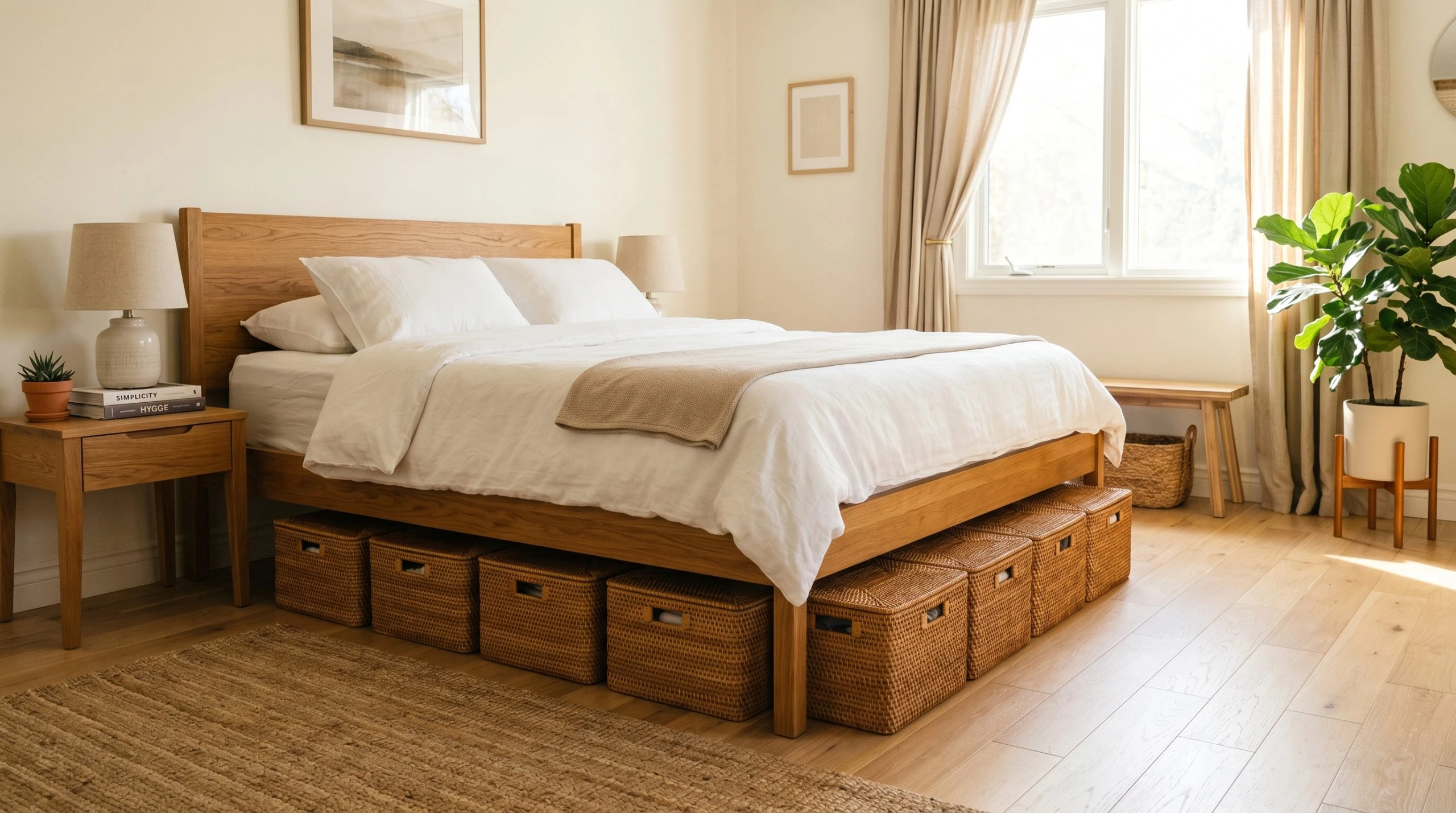
Most people treat the space under their bed like a junk drawer they can ignore. Things get shoved under there during a quick tidy, forgotten for months, and eventually pulled out covered in dust. It feels like a holding area rather than a real storage solution, and that is a shame, because when you actually think about it, the space under your bed is some of the most valuable square footage in your entire home.
Think about the dimensions for a moment. A standard queen bed gives you roughly 36 to 42 square feet of usable floor space beneath it, all of it hidden from view, protected from traffic, and completely out of the way. In a small apartment or a bedroom that is already stretching to fit everything you own, that is not just extra space. That is a potential game-changer. The problem is not the space itself. The problem is that most people have never thought about it seriously as a storage zone with intention and organization behind it.
This article covers 21 genuinely different ways to use the space under your bed well, from built-in frame solutions and rolling drawer systems to vacuum compression bags, DIY platforms, and everything in between. Each idea is presented with a real-life scenario you might recognize, practical advice on what to store and how to store it, and tips on making it look intentional rather than like a pile of things you forgot about. Whether you are working with a tiny studio apartment, a shared kids bedroom, a guest room that needs to do double duty, or simply a closet that has run out of room, there is something here for you. Let us stop wasting one of the best-kept storage secrets in your home.
Built-In Drawer Storage Bed Frame
You are about to move into a smaller apartment and you know your wardrobe will not fit in the tiny closet. You want a bed that works harder than just holding a mattress.
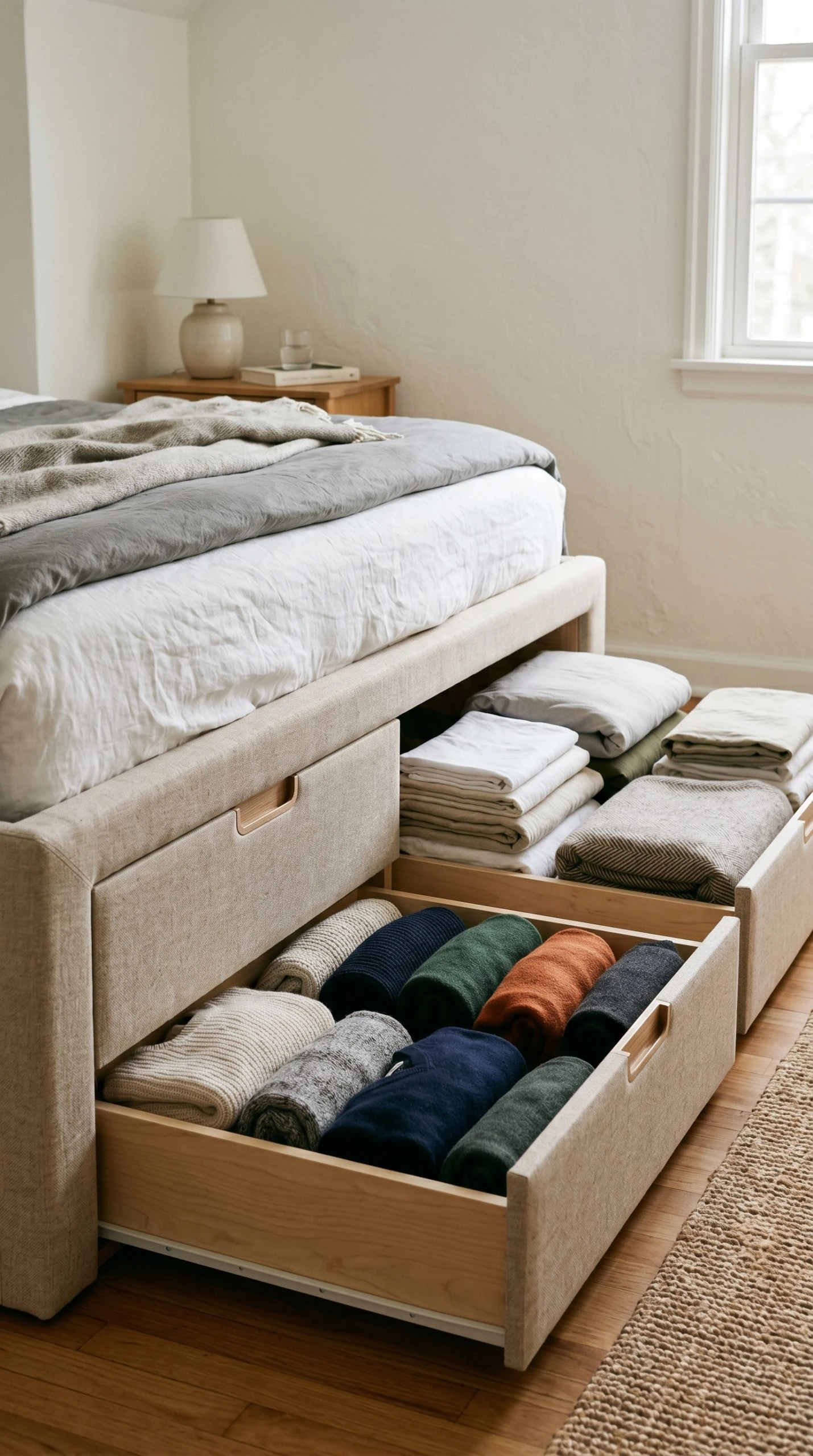
A bed frame with built-in drawers is the gold standard of under-bed storage, and for good reason. These beds are purpose-designed so that every inch of the space underneath is used efficiently, with drawers that run the full length of one or both sides of the frame. There is no awkward gap between the drawer size and the bed frame, no wasted corners, and no need to hunt for containers that fit. Everything is integrated, and it looks completely intentional from the outside.
Built-in drawer beds come in a wide range of styles now, from upholstered platform beds with flush drawer faces in linen or velvet to solid wood frames with simple wooden drawer fronts that look like furniture rather than storage. The drawers themselves are typically deep enough to hold folded sweaters, jeans, extra bedding sets, or a full collection of off-season clothing. Some frames offer two drawers on each side, giving you four large storage zones in total. Others offer a single deep drawer across one end of the bed for a different configuration.
The key advantage beyond the obvious storage is how clean this setup looks. Because the drawers sit flush to the frame and open with integrated handles or recessed pulls, there is nothing visible from across the room that says storage. It simply looks like a well-designed bed. For small bedrooms where visual clutter is the enemy of a calm atmosphere, this seamless quality is worth as much as the storage itself
Quick Tip: Measure your bedroom floor carefully before buying a storage bed. Some frames are significantly heavier than standard beds and may be difficult to reposition later.
Ottoman Lift-Up Storage Bed
You have a guest room that needs to store a whole season of duvets, extra pillows, and a set of luggage. Rolling drawers will not cut it because you need large, open storage access.
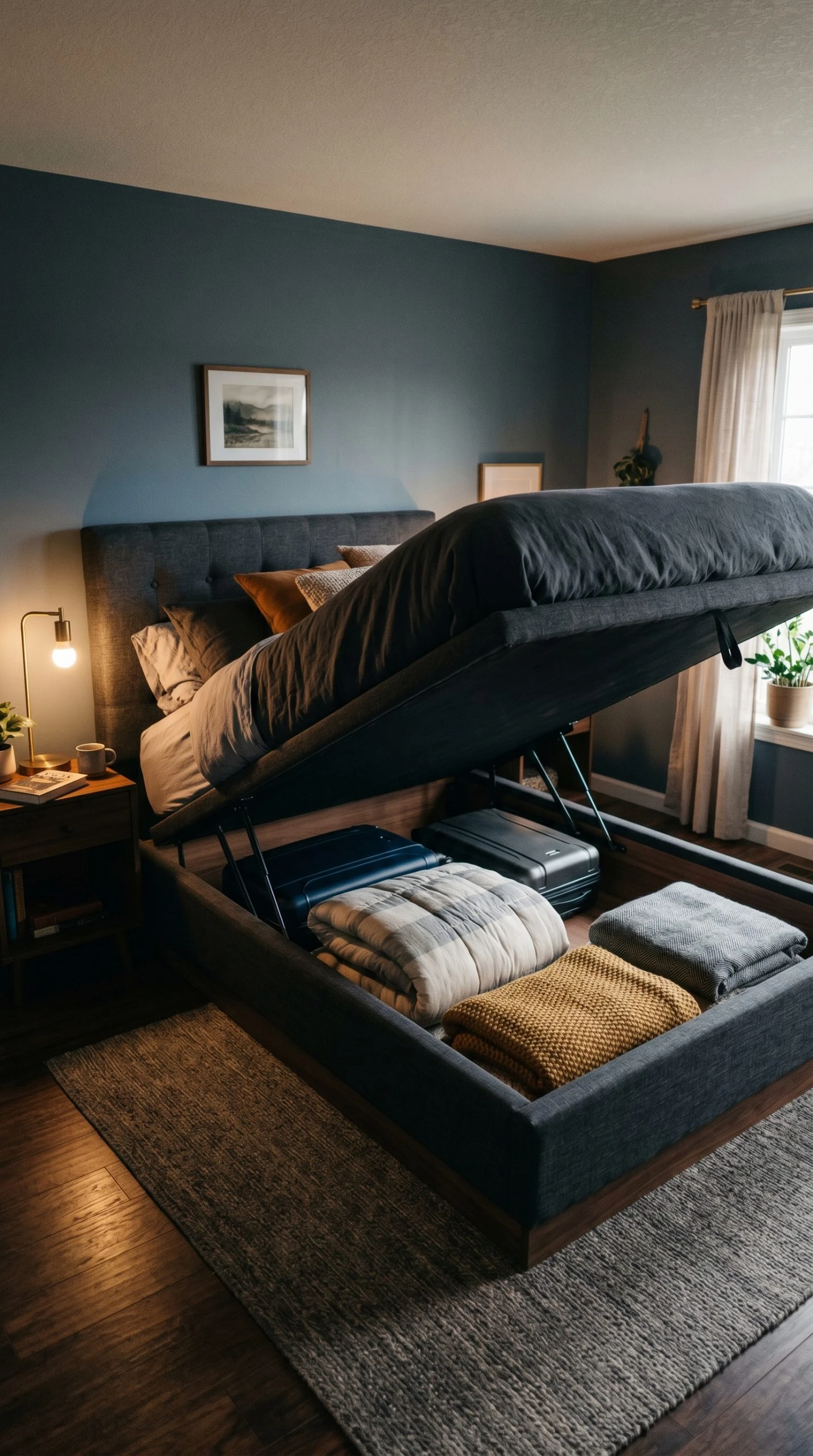
An ottoman storage bed operates on a completely different principle from a drawer bed. Instead of side-pulling drawers, the entire mattress platform lifts up on a hydraulic or gas-piston mechanism, revealing a cavernous open storage space beneath. The whole floor area under the bed is yours to use however you like, with no drawer divisions or size constraints. This makes it the absolute best option for bulky, oversized items that would never fit into a standard drawer.
Think about what you could store in a space that is roughly queen-sized and eight to ten inches deep: two or three full-size suitcases, a rolled-up area rug, an entire spare duvet set including the comforter itself, a folded camping tent, a large collection of throw blankets, or a season’s worth of heavy winter coats. The capacity is genuinely impressive, and because the lid closes completely flat, none of it is visible from the outside. The room looks completely tidy.
The hydraulic mechanism is the key feature to pay attention to when shopping for an ottoman bed. Good-quality gas pistons make the mattress platform feel light and easy to lift, even with a full mattress on top. Lower-quality versions can feel stiff or heavy, which makes accessing the storage frustrating over time. Look for beds that specify the gas piston weight rating and read reviews specifically about the lift mechanism before committing to a purchase.
Quick Tip: Do not store items you need daily access to in an ottoman bed. The lift mechanism is best suited for seasonal storage that you access a few times a year, not everyday essentials.
Wheeled Rolling Storage Drawers
Your bed frame has no built-in storage and you cannot replace it right now. You need a practical, affordable fix that you can slide out and access easily.
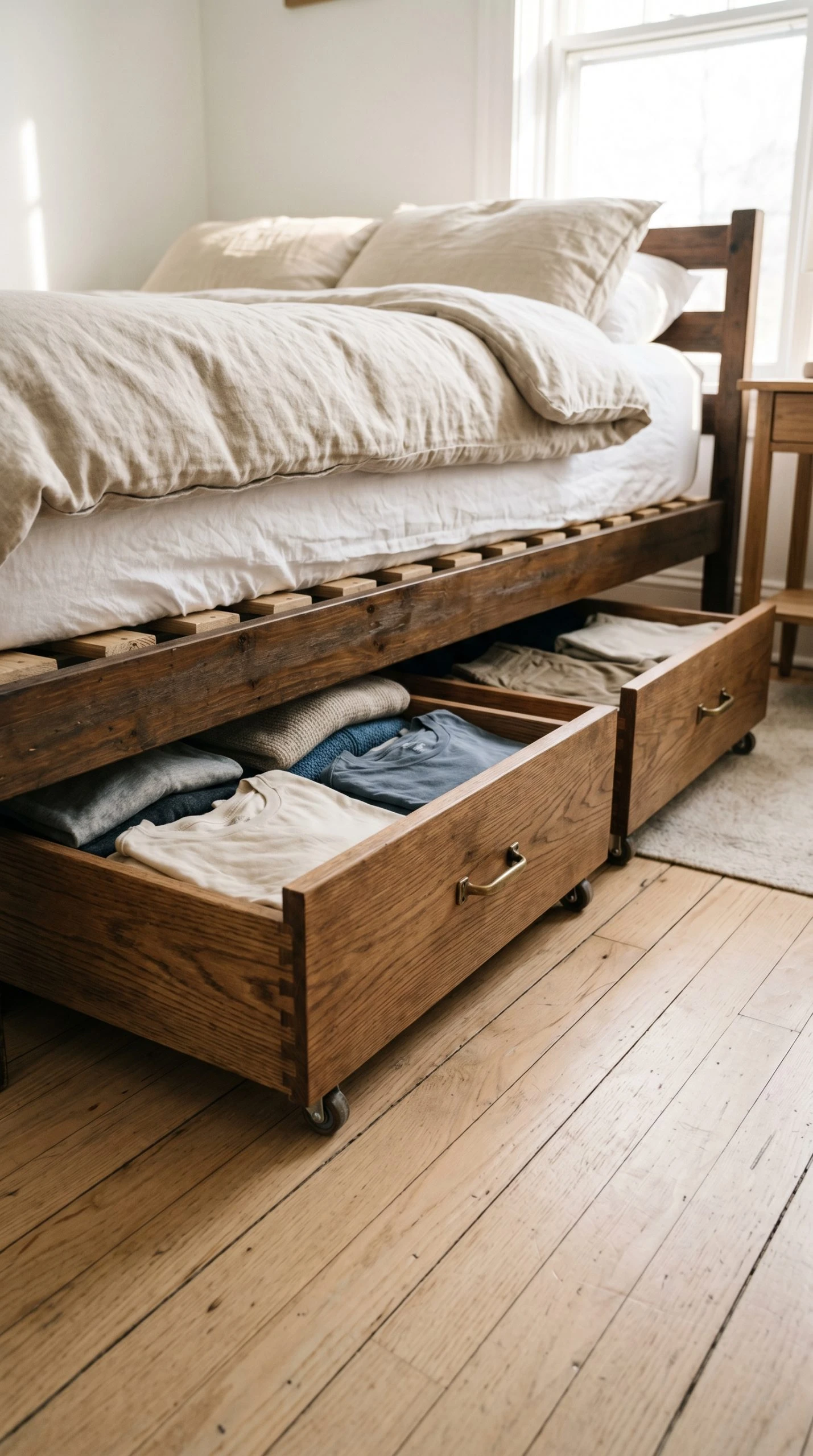
Wheeled rolling drawers are the most versatile and widely used under-bed storage solution for beds without built-in storage, and they deserve more credit than they usually get. A good set of rolling drawers sits low enough to slide completely beneath a standard bed frame, rolls out smoothly on swivel casters, and gives you organized access to whatever you have stored inside without having to get down on the floor and fish around blindly. They solve the most common under-bed storage problem: things getting lost in the back of a dark spa
The best rolling drawer setups are made from solid wood or high-quality composite wood with drawer pulls that match the aesthetic of your bedroom furniture. Avoid the cheapest plastic versions if your bed is in a visible position, because low-quality plastic looks exactly like what it is, and a beautiful bedroom deserves better than storage that looks like a bin from a big-box store. Solid wood rolling drawers in a natural finish or painted color cost a bit more but make the under-bed area look like a deliberate design choice rather than an afterthought.
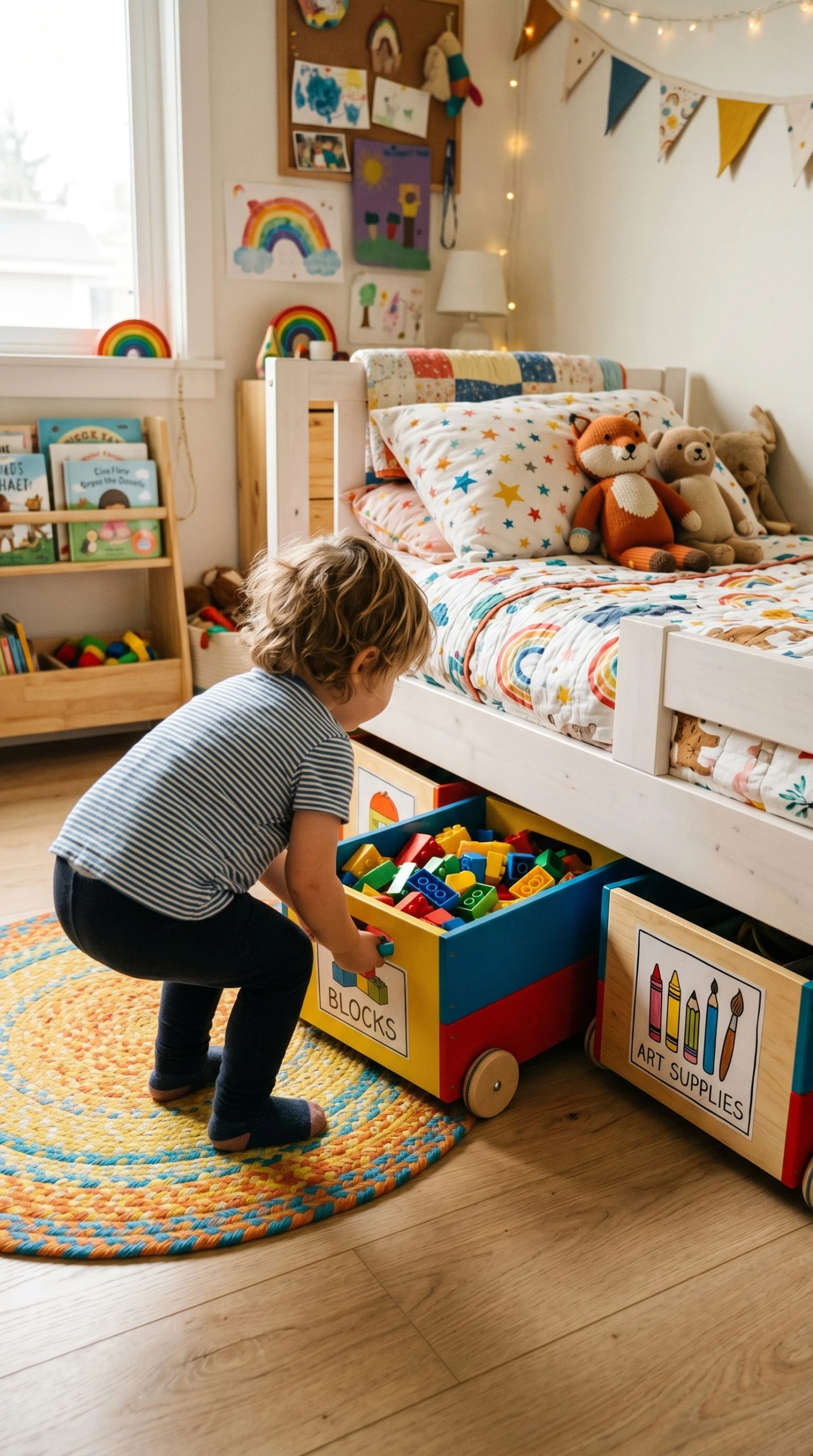
Rolling drawers work particularly well for shoes, accessories, folded clothing, craft supplies, or anything that benefits from being kept in organized, separated compartments. If you have children, rolling drawers under their beds are a brilliant solution for toys, art supplies, and seasonal clothing because kids can access them independently. The wheels make pulling them out easy enough that even young children can manage it without help
Quick Tip: Add small felt pads to the bottom of wooden rolling drawers if you have hardwood floors. Casters can scratch the surface over time, especially when the drawer is fully loaded.
Flat Zippered Fabric Storage Bags
You have a thick duvet and three extra pillow sets taking over your linen closet. You want to move them somewhere sensible without spending much money.
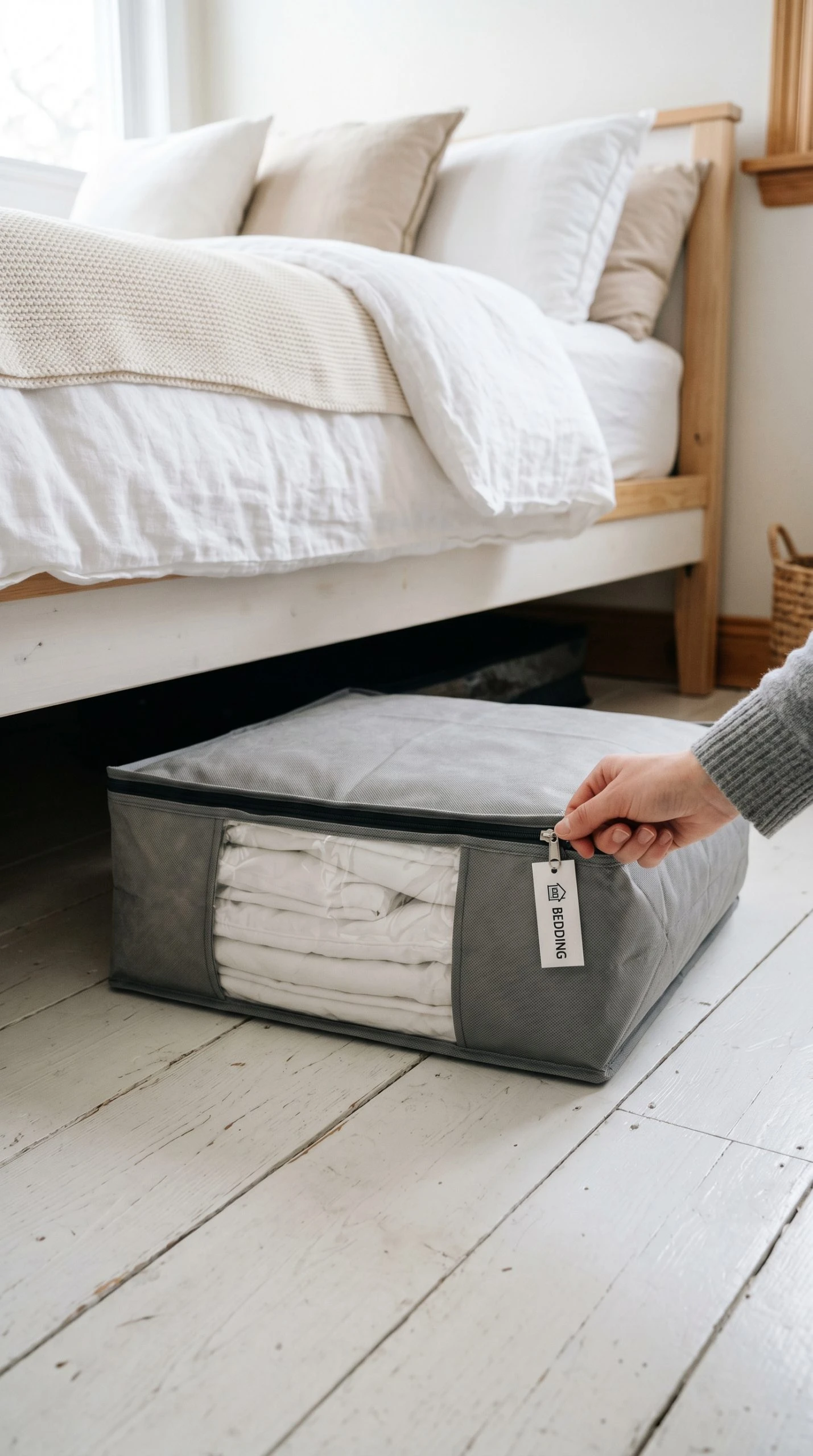
Flat zippered fabric storage bags are one of the most underrated under-bed solutions available, and they are incredibly affordable. These are purpose-designed to be low profile, typically five to seven inches tall when full, so they slide easily under even relatively low bed frames where rigid containers would never fit. They come in sizes designed to hold full comforters, duvet sets, extra pillow sets, blanket collections, and large amounts of folded clothing, making them ideal for seasonal bedding rotation.
The best quality zippered storage bags are made from a breathable non-woven fabric rather than plastic, which is important for anything made of natural fibers like wool or down. Non-woven fabric allows a small amount of airflow that prevents the musty smell and moisture buildup that can happen inside sealed plastic containers over time. Many also have a clear plastic window panel on the top surface, which lets you see what is inside without unzipping the whole bag, a small detail that makes a big difference when you are looking for a specific item quickly.
For a truly organized under-bed setup with zippered bags, label each one clearly before sliding it under the bed. A simple luggage tag on the zipper pull works perfectly. Store one category of item per bag: summer bedding in one, winter extra blankets in another, spare pillow covers in a third. When you rotate seasons, you pull out one bag, use it, and slide the other back under. It takes five minutes and makes the whole process feel genuinely manageable
Quick Tip: Store zippered bags with the zipper pull facing out toward the foot or side of the bed so you can grab the handle and pull without going underneath.
Vacuum Compression Storage Bags
You have a king-size down comforter that takes up half your closet on its own. You need to compress it down without damaging the filling.
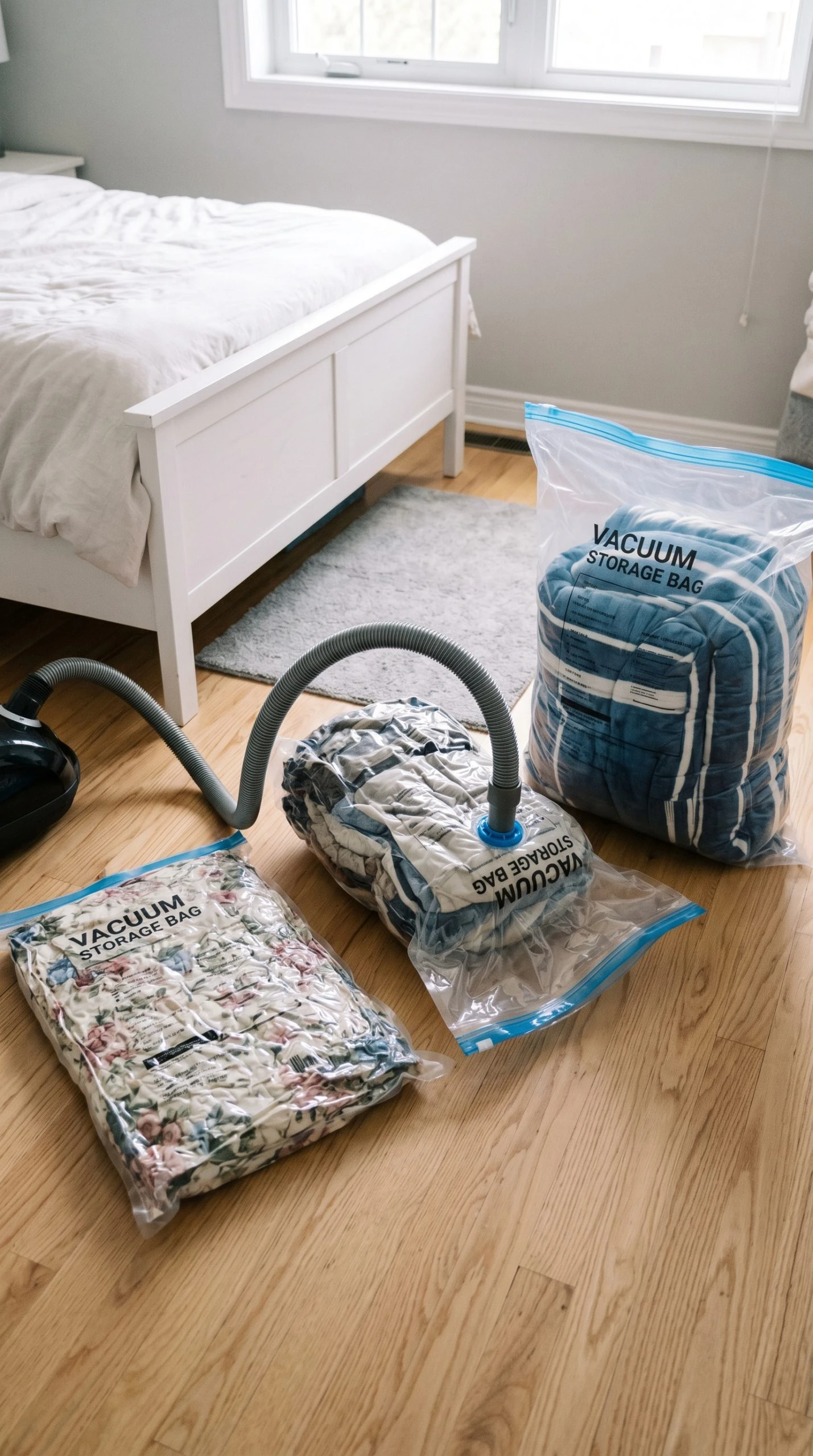
Vacuum compression bags are genuinely impressive when you use them for the first time. A full king-size down comforter, which might normally take up the equivalent of a large suitcase in storage space, compresses down to roughly the thickness of a folded sweater. The science behind it is simple but effective: you pack the item inside, seal the zip closure, then use a standard vacuum cleaner hose on the valve to pull all the air out. The result is a flat, dense package that is a fraction of its original size.
For under-bed storage specifically, vacuum bags are most useful for items that are naturally bulky but not frequently needed: heavy winter duvets during the summer months, thick wool blankets, down-filled throw pillows, or seasonal coats and heavy sweaters. The compression allows you to store what would otherwise take up an entire closet shelf in a single flat bag that slides easily under the bed. You can often fit three or four compressed bags under one bed where you might normally only fit one or two standard containers.
One important note: vacuum bags work brilliantly for synthetics and down, but you should use them with caution for natural fibers like cashmere or delicate wools. Extended compression can eventually affect the loft and texture of very fine natural materials. For anything precious, a breathable non-woven bag without compression is the safer choice. For everything else, vacuum bags are a brilliant space-saving tool that most people do not use nearly enough.
Quick Tip: Release compression and air out items for a few hours before using them again. Down especially benefits from refluffing time after being compressed for several months.
Woven Baskets with Lids
You have a bedroom with a higher bed frame and the under-bed area is partially visible from across the room. You need storage that actually looks good.
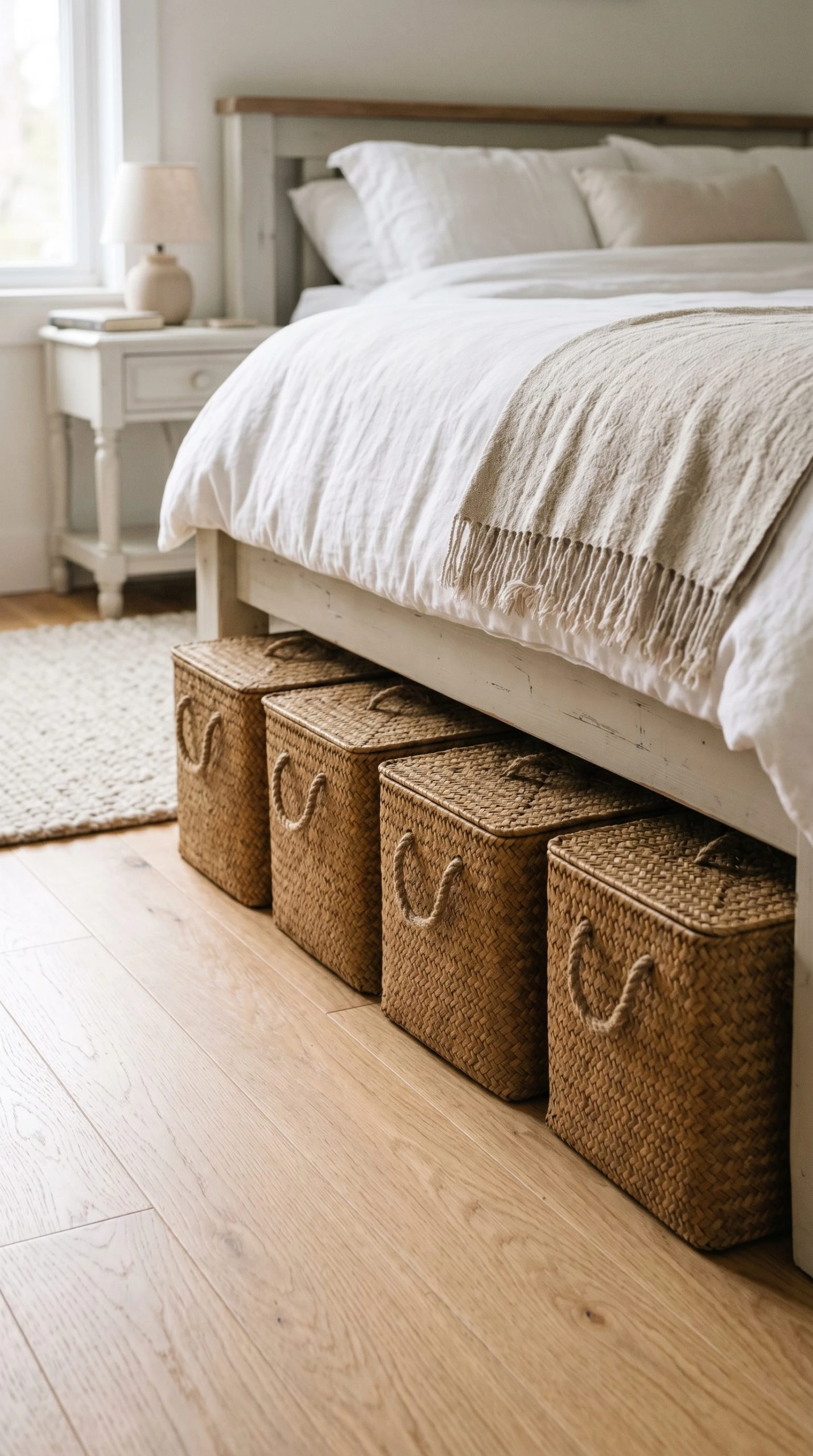
When the space under your bed is at least partially visible, the containers you use there become part of the room’s decor rather than something hidden out of sight. Woven baskets with lids are the best solution for this situation because they look warm, natural, and genuinely attractive, even when you can see them from across the room. A row of matching seagrass, rattan, or water hyacinth baskets lined up beneath a higher bed frame looks like a design choice rather than a storage workaround.
Choose baskets that have flat, fitted lids rather than loose or dome-shaped ones, because flat lids allow you to maximize the vertical space under the bed. Baskets should ideally have some kind of handle on the sides so you can pull them out without having to grip the woven edges, which can distort the shape over time. Look for baskets marketed as under-bed storage specifically, as these tend to be designed with a lower profile that fits standard frame clearances better than decorative living room baskets.
What you store in woven baskets matters too. These are ideal for items made of natural, breathable materials: extra bed linen sets, folded throws and blankets, seasonal clothing in cotton or linen, or accessories like scarves and hats. Avoid storing anything moisture-sensitive in woven baskets that are not lined with fabric, as natural weave baskets can sometimes allow dust to pass through more than a sealed container. A simple fabric liner inside each basket solves this problem neatly.
Quick Tip: Measure the exact clearance under your bed frame before buying baskets. Even one inch less than you expected can make a basket too tall to slide in properly.
Clear Plastic Lidded Containers
You constantly forget what you have stored under your bed and end up buying things you already own. You need a system that lets you see everything instantly.
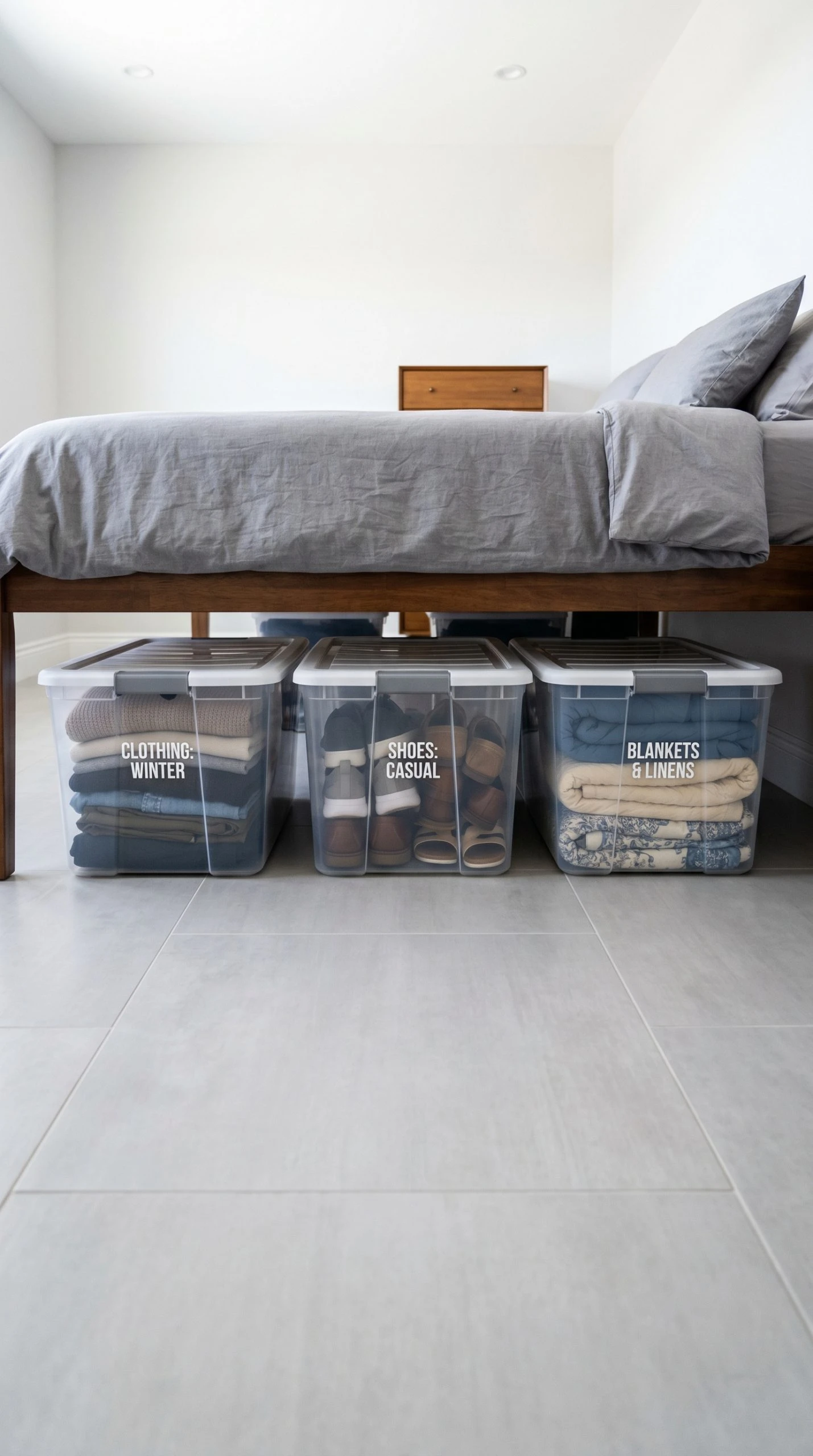
There is a reason professional organizers reach for clear plastic containers when storage visibility is the priority: they eliminate the guessing game completely. A set of clear lidded containers under your bed means you can crouch down, look along the length of the bed, and immediately see exactly what is stored where without pulling anything out, opening anything, or reading any labels. For people who have a tendency to forget about items stored out of sight, this visibility is genuinely life-changing.
The best clear under-bed containers are made from thick, sturdy polypropylene rather than thin, flimsy plastic that cracks easily or warps under the weight of a stacked load. Look for containers with snap-lock or locking latches rather than just friction-fit lids, especially if you plan to stack them or if dust-proofing matters. Many quality versions also have wheels, which is a feature worth paying for because a fully loaded large container can be surprisingly heavy and difficult to slide on carpet.
Use clear containers for the items you access most frequently from your under-bed storage: the gym clothes you rotate seasonally, the hobby supplies you pull out weekly, the shoe collection you swap between regularly. The visibility is most valuable for things you actually want to find quickly. For items that stay put for months at a time, an opaque container with a clear label works just as well and often costs less.
Quick Tip: Color-code what you store: blue containers for bedding, gray for clothing, natural for shoes. The color cue lets you find the right category even faster than reading labels.
Bed Risers for Extra Clearance
Your current bed frame sits very low to the ground and you cannot fit any useful storage container underneath it. You are not ready to replace the entire frame.
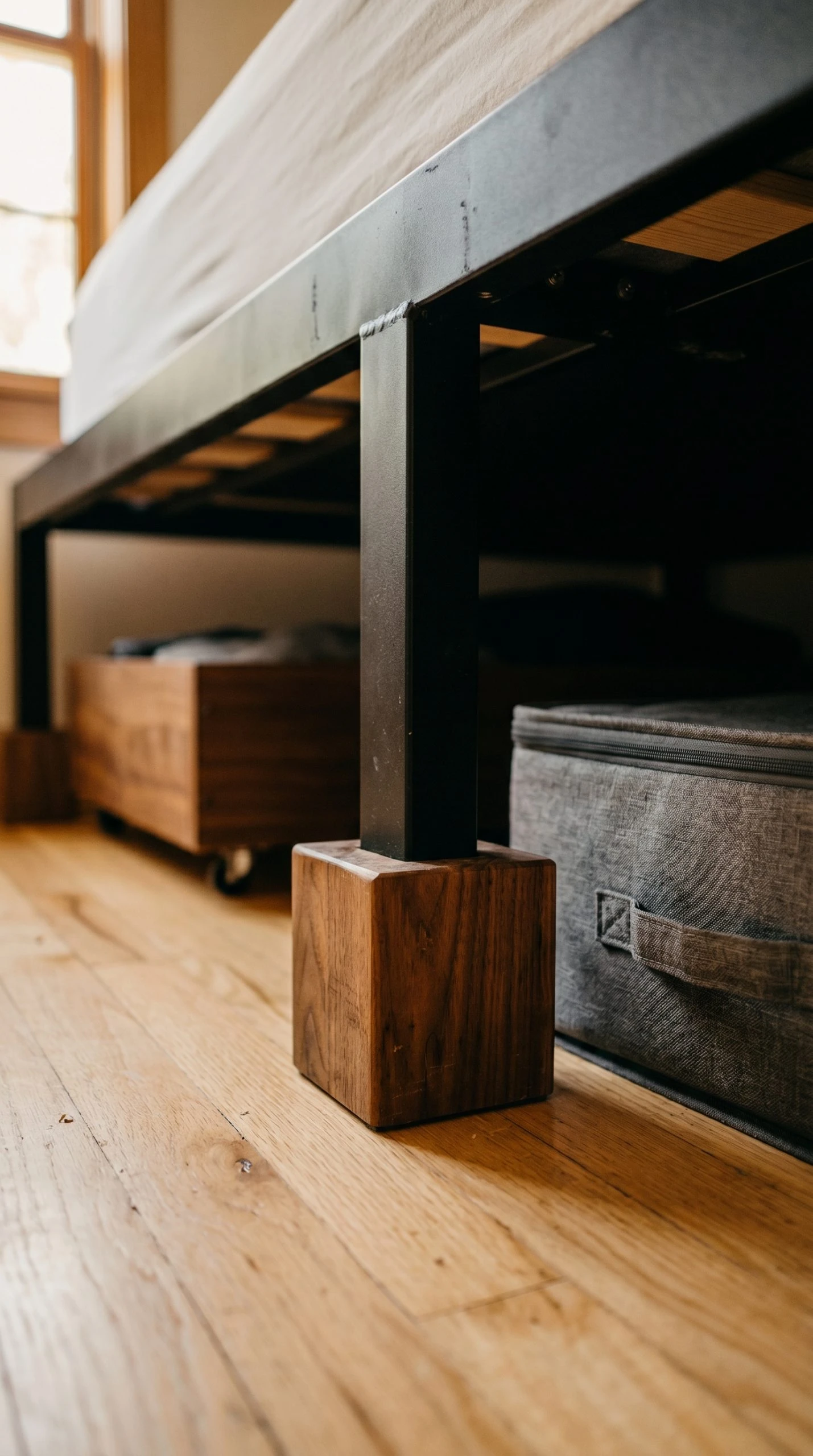
Bed risers are the single cheapest and most immediate solution when your under-bed clearance is too shallow to use for storage. They are exactly what they sound like: solid supports that fit under each leg of your bed frame and lift the entire structure a set number of inches off the ground. A standard set of risers lifts the bed three to six inches, which can transform a previously unusable gap into a space that easily accommodates flat storage containers, rolling drawers, or zippered fabric bags.
Modern bed risers have come a long way from the basic plastic blocks associated with college dorm rooms. You can now find risers in faux wood, concrete-look resin, cast iron, and other materials that look far more intentional under a bedroom frame. Some are designed to look like decorative furniture feet. Others have a built-in electrical outlet or USB port in the top surface, turning a functional accessory into something that also solves the perennial nightstand charging problem.
When shopping for bed risers, match the riser opening size to your bed frame leg diameter. Most standard frames have legs that fit standard risers, but platform beds, sleigh beds, and frames without individual legs may not work with risers at all. Also consider the weight rating: a fully loaded king-size mattress with two people sleeping on it can weigh well over a thousand pounds, and the risers need to be rated for the combined weight without any risk of slippage or collapse.
Quick Tip: Place a non-slip rubber mat under each riser on hardwood floors. Risers under load can shift slowly over time and scratch the floor if there is no friction between the surfaces.
Shoe Organization System
Your shoe collection has officially taken over the closet floor. Three pairs are living by the front door, two are under the bed loosely, and you cannot find the left shoe of anything.
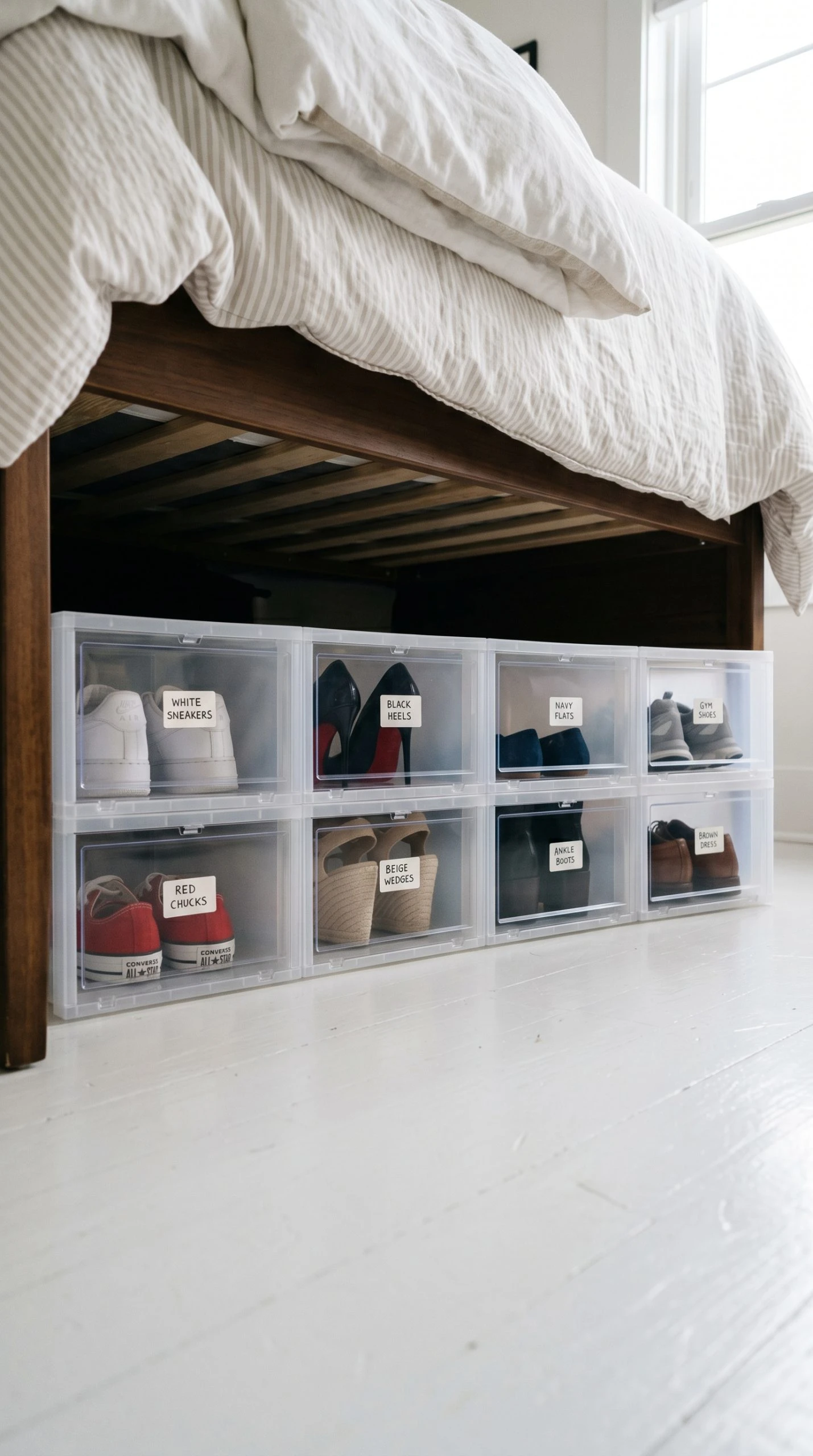
The space under the bed is one of the best locations in the entire home for shoe storage, and yet most people either dump shoes under there loosely or ignore the space entirely. A dedicated under-bed shoe organization system changes the whole situation. Purpose-designed under-bed shoe organizers come in several formats: flat divided trays where each pair sits in its own slot, clear lidded shoe boxes that stack in rows, zippered fabric organizers with individual pockets, and rolling multi-tier shoe racks designed to fit under standard frames.
Clear shoe boxes are particularly popular right now because they allow you to see exactly which pair is inside without opening each box, they protect shoes from dust and damage, and they stack neatly in rows without tipping or sliding. For a truly organized setup, arrange shoes by category, everyday shoes closest to the foot of the bed where they are most accessible, special occasion or seasonal shoes further back. Label each box with a small adhesive tag on the visible side for the fastest possible retrieval.
Flat divided shoe trays are the most space-efficient option for lower beds because they sit only a few inches tall and can hold multiple pairs per tray. They work best for flats, sneakers, and low-profile footwear. For boots, heels, or anything taller, a zippered fabric bag designed specifically for single pairs or small groupings is more practical because the flexible material accommodates height variation better than a rigid divided tray.
Quick Tip: Stuff boots with rolled-up socks or boot shapers before storing them under the bed to help them keep their shape over months of storage.
DIY Platform Bed with Built-In Storage
You are moving into a small studio apartment and need every square inch to work harder than it ever has. You are willing to build something if it means the space works perfectly.
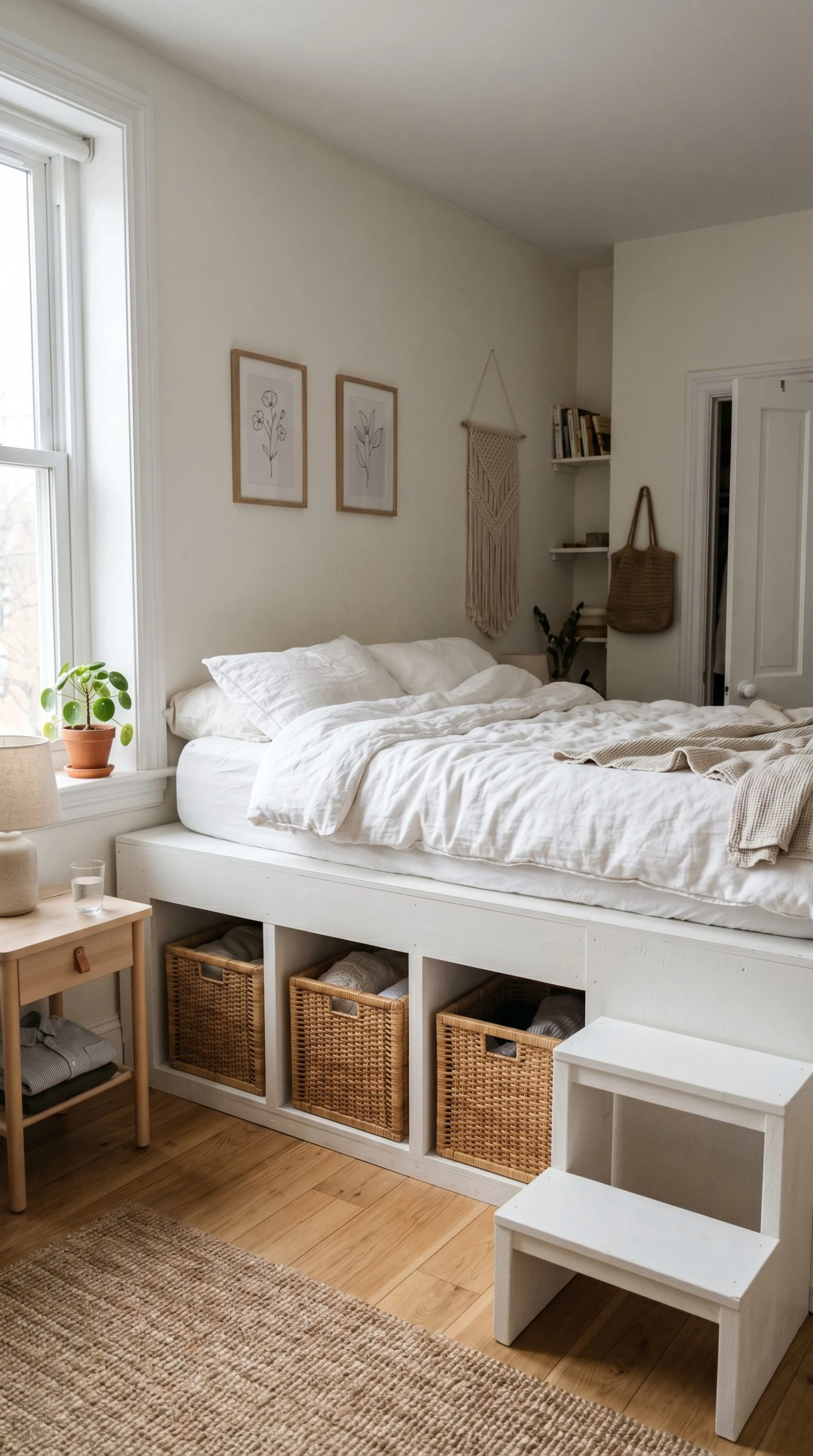
Building a DIY platform bed with integrated storage is one of the most satisfying bedroom projects you can take on, partly because the result looks genuinely custom and partly because you control every dimension to fit your specific space and needs. The basic concept is a raised wooden platform that the mattress sits on directly, with the space beneath the platform divided into open shelving bays, pull-out drawers, or a combination of both. The result looks like built-in furniture rather than a bed with storage awkwardly added on.
The most common DIY platform storage bed uses simple plywood boxes as the structural base, with the mattress resting on a slatted surface built across the tops. The front-facing sides of the plywood boxes become the storage openings: you can leave them open for accessible shelving, fit them with basket inserts that slide in and out, or build actual drawer boxes that run on wooden or metal slides. The height of the platform determines how much vertical storage you get underneath, and most DIY builds aim for somewhere between twelve and eighteen inches of clearance.
For a studio apartment specifically, a higher platform bed, say sixteen to twenty inches, creates enough clearance to store a genuine wardrobe beneath it. Some studio builds go even further, adding a small staircase of two or three steps at the foot of the bed where each step is actually a drawer. This gives you the bed, the storage, and the transition to floor level all in one compact structure. The material cost for a basic platform bed is often less than buying a quality storage bed frame, and the result can look significantly better if you take the time to sand, paint, and finish it properly.
Quick Tip: Use pocket-hole joinery for a DIY platform bed if you want clean, strong joints without visible screw heads. A basic pocket-hole jig is inexpensive and makes the whole project significantly cleaner.
Vintage Trunk or Chest
Your bed sits higher off the ground than most and the under-bed area is very visible. Plastic bins would look terrible. You want something that looks like it belongs in the room.
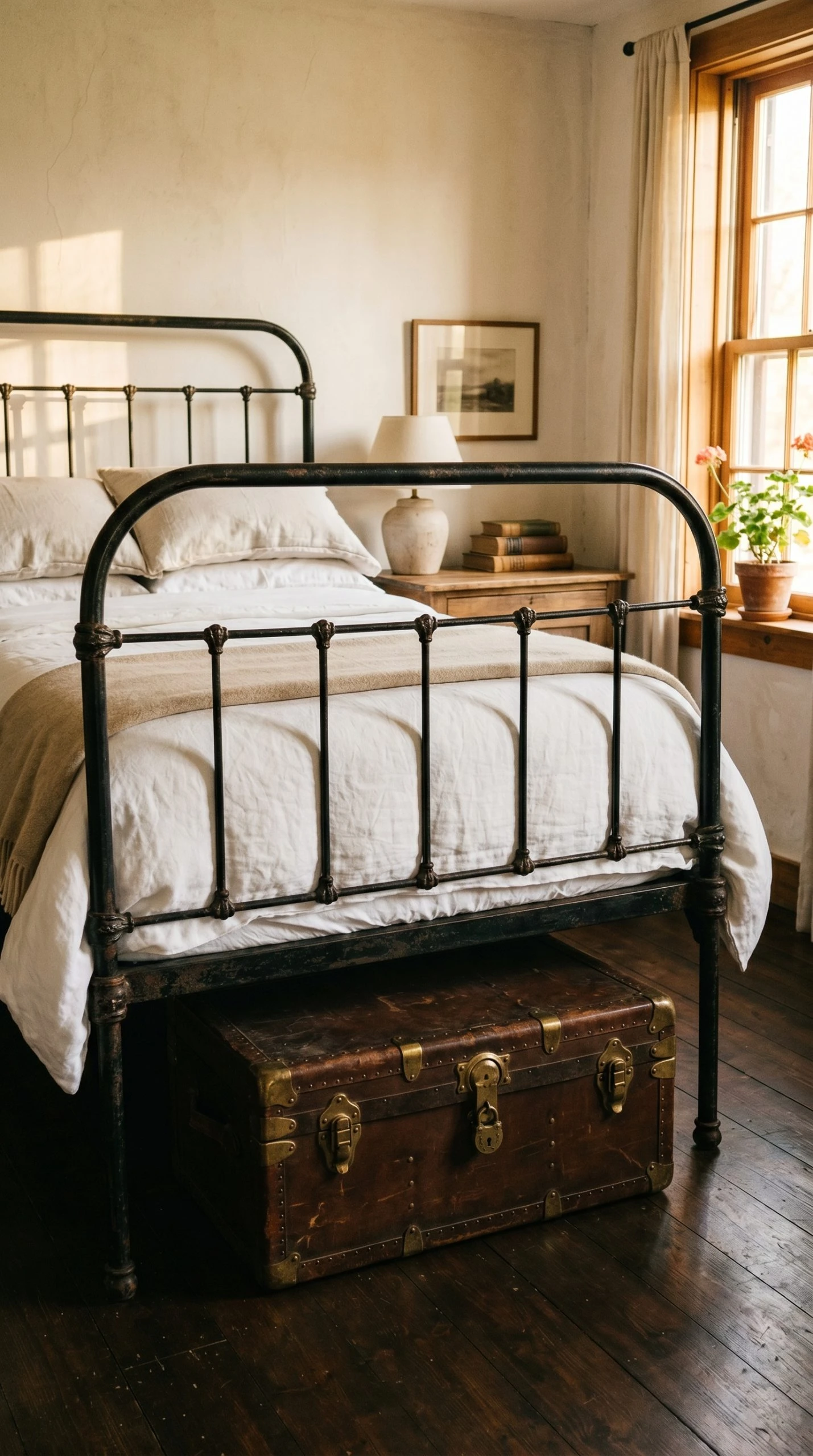
A vintage trunk or chest tucked under a higher bed frame is one of those ideas that somehow manages to be both genuinely practical and genuinely beautiful at the same time. A well-chosen trunk adds character, warmth, and a sense of history to a bedroom that a plastic storage bin could never come close to achieving. If the under-bed area is visible from across the room, this is almost always the better aesthetic choice, full stop.
Look for trunks that are flat-topped rather than dome-topped, because a flat lid allows the trunk to sit flush under the bed frame without the curved surface hitting the slats above. Leather-bound trunks, wicker-wrapped chests, painted wooden boxes with metal hardware, and fabric-covered storage ottomans all work in this role depending on your bedroom’s overall style. Size matters here: the trunk should be wide enough to fill the space under the bed visually without leaving awkward gaps, but not so wide that it overhangs the frame edges.
Trunks are ideal storage vessels for items that are grouped naturally together: extra bed linen sets, a spare duvet, seasonal throws and cushions, or a collection of books and magazines you are not ready to give away. They are not the best choice for small items that need to stay organized in categories, because the interior of a trunk is essentially one large open space. Pair a trunk with a few small organizer pouches inside to create sub-sections if you need to store multiple categories of smaller items in the same space.
Quick Tip: Rub the trunk bottom with a felt furniture pad on all four corners before sliding it into place. The felt protects your floor and makes the trunk significantly easier to slide in and out.
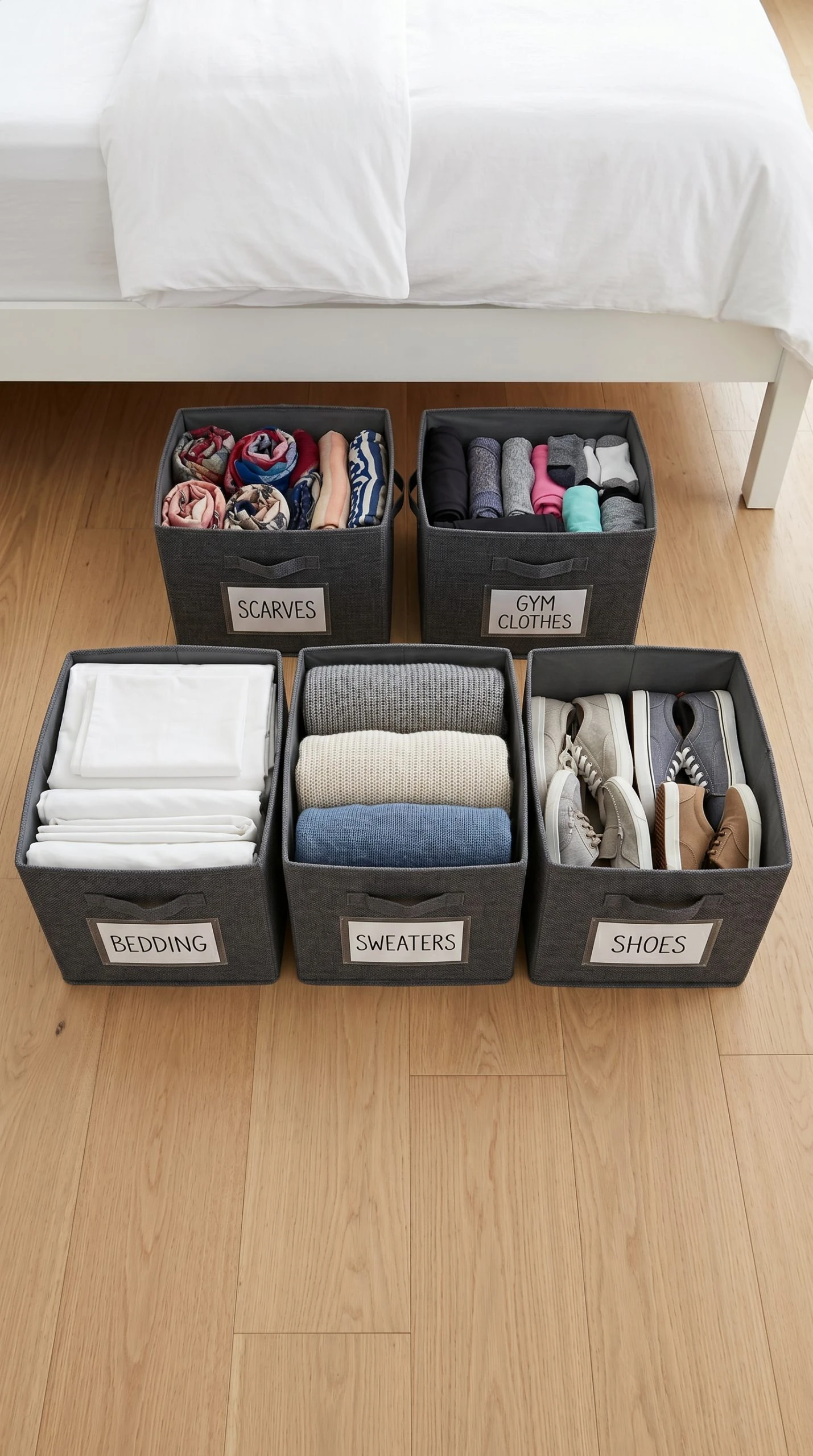
Labeled Bin System by Category
You have been shoving various things under your bed for months and now you have no idea what is actually down there. You need a complete reset with a system that will stick.
A labeled bin system is not about the bins themselves, it is about the system behind them. The idea is to assign every category of thing that needs under-bed storage its own dedicated container, label each container clearly on the visible side, and then position them in a logical order under the bed that makes retrieval intuitive. This sounds almost too simple, but the difference between an organized under-bed space and a chaotic one is almost always the presence or absence of this kind of categorical thinking.
Start by pulling absolutely everything out from under your bed and sorting it into categories on the floor. Common categories include seasonal clothing, extra bedding, shoes, sports equipment, hobby supplies, gift wrapping materials, sentimental items, and guest room supplies. Once you can see the categories, choose a container type and size for each one based on how much you have and how often you access it. Everyday-access categories get containers with wheels nearest the edge. Seasonal or rarely needed categories go in the back.
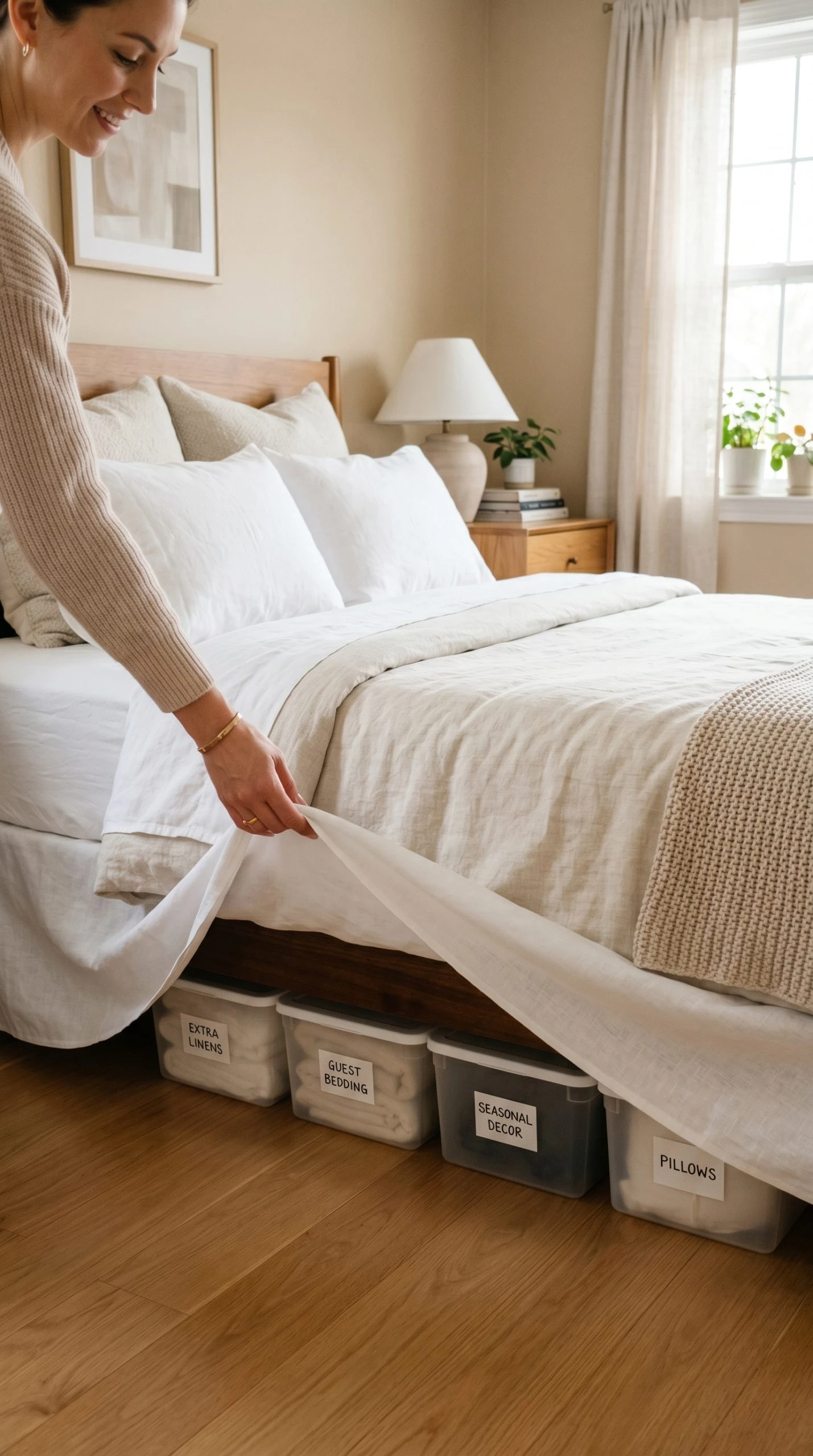
Labels make the whole system usable long-term. A label on the front face of each container means you never need to pull multiple bins out to find what you are looking for. Use a label maker for clean, durable text, or write clearly on adhesive card tags with a marker. Review and update the system twice a year when you do a seasonal clothing rotation: it is the perfect moment to check that everything is still in the right bin and that nothing has accumulated that does not have a designated home.
Quick Tip: Take a photo of your under-bed layout from the foot of the bed and save it on your phone. When you are shopping for new items, you can check the photo to confirm what you have before buying duplicates.
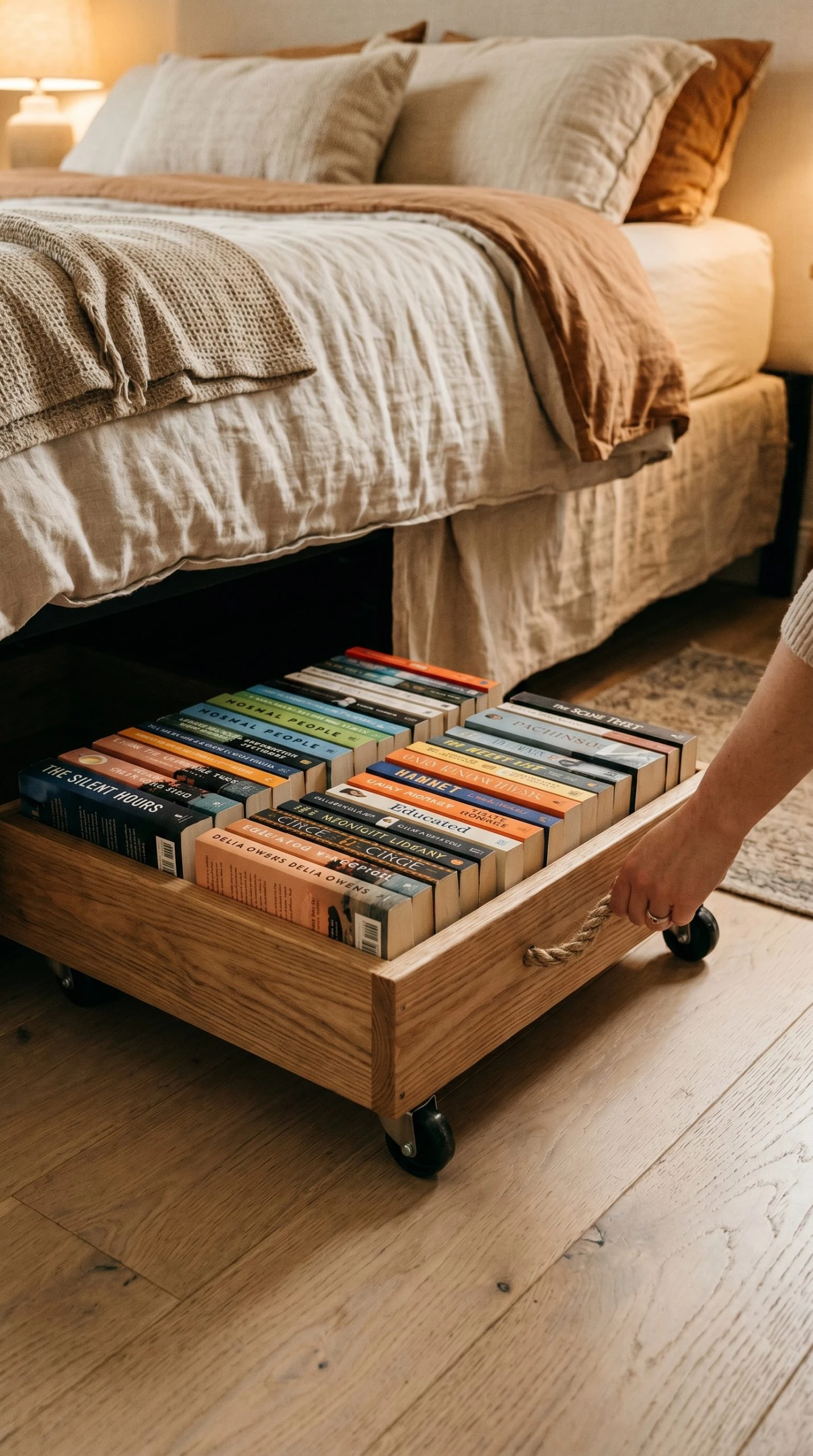
Under-Bed Bookshelves
You are a reader who has run out of bookshelf space but cannot bear to get rid of a single book. Your nightstand has a stack. Your floor has a stack. You need a real solution.
Under-bed book storage is a genuinely clever solution for readers who have run out of conventional shelf space, and it works better than most people expect. The key is approaching it as a mini-library rather than just a pile of books under a bed. Low-profile rolling bookshelves designed specifically for under-bed storage allow you to roll out a collection of spines all at once and browse horizontally, which is far more practical than fishing individual books out from under a dark space.
A simple DIY version of this idea uses a flat wooden tray or a shallow wooden crate on casters. Arrange books spine-up in a single layer so every title is visible when you pull the tray out. Group books by genre, author, or reading status so the browsing process feels organized rather than chaotic. A tray measuring roughly twelve inches by thirty inches can hold somewhere between twenty and thirty paperbacks, or fifteen to twenty standard hardcovers, which is a meaningful addition to your reading collection without taking up any floor space in the room.
For a neater look, choose a matching set of small baskets or fabric bins where books stand upright with spines facing up, and label each bin by category. This works especially well for reference books, cookbooks, or children’s book collections where the categories are natural and consistent. Make sure whatever container you use for books is on wheels or slides, because a fully loaded book container is surprisingly heavy and you will not want to drag it across the floor repeatedly
Quick Tip: Rotate a seasonal reading stack to your nightstand from the under-bed collection regularly. Keeping five to ten books at arm’s reach prevents the under-bed collection from feeling out of sight and out of mind.
Modular Cube Drawers
You want under-bed storage that looks like actual bedroom furniture rather than plastic bins or fabric bags. Your bedroom has a cohesive look and you do not want anything disrupting it.
Modular cube drawers are the furniture-grade answer to under-bed storage, and they bridge the gap between function and aesthetics better than almost anything else in this category. These are low-profile wooden or MDF drawer units in a cube or rectangular format, typically sitting four to six inches tall, that slide under the bed and look like real furniture rather than storage accessories. Many are available in the same finishes and hardware as popular bedroom furniture lines, making it possible to match them to an existing dresser or wardrobe for a coordinated look.
The modular aspect is part of what makes these so useful. You can slide one unit under each side of the bed, or run multiple units end to end across the full width of the bed if the clearance allows. Some systems allow you to connect units side by side with small brackets, creating a continuous drawer wall that fills the under-bed space completely rather than leaving gaps. The result, when done well, looks like the bed frame was designed with storage drawers from the factory.
Use modular cube drawers for the items you access regularly, because the drawer format makes retrieval clean and easy. Clothing categories that do not fit in your dresser are ideal: gym clothes, loungewear, seasonal knitwear, underwear and socks if the dresser is full. Organize each drawer with a simple divider system so items do not slide around when the drawer is opened and closed. A drawer divider insert or even folded pieces of cardboard create reliable category sections at minimal cost.
Quick Tip: Choose modular drawers with a smooth-glide mechanism rather than simple friction-fit drawers. Drawers that open smoothly get used daily. Drawers that stick get ignored.
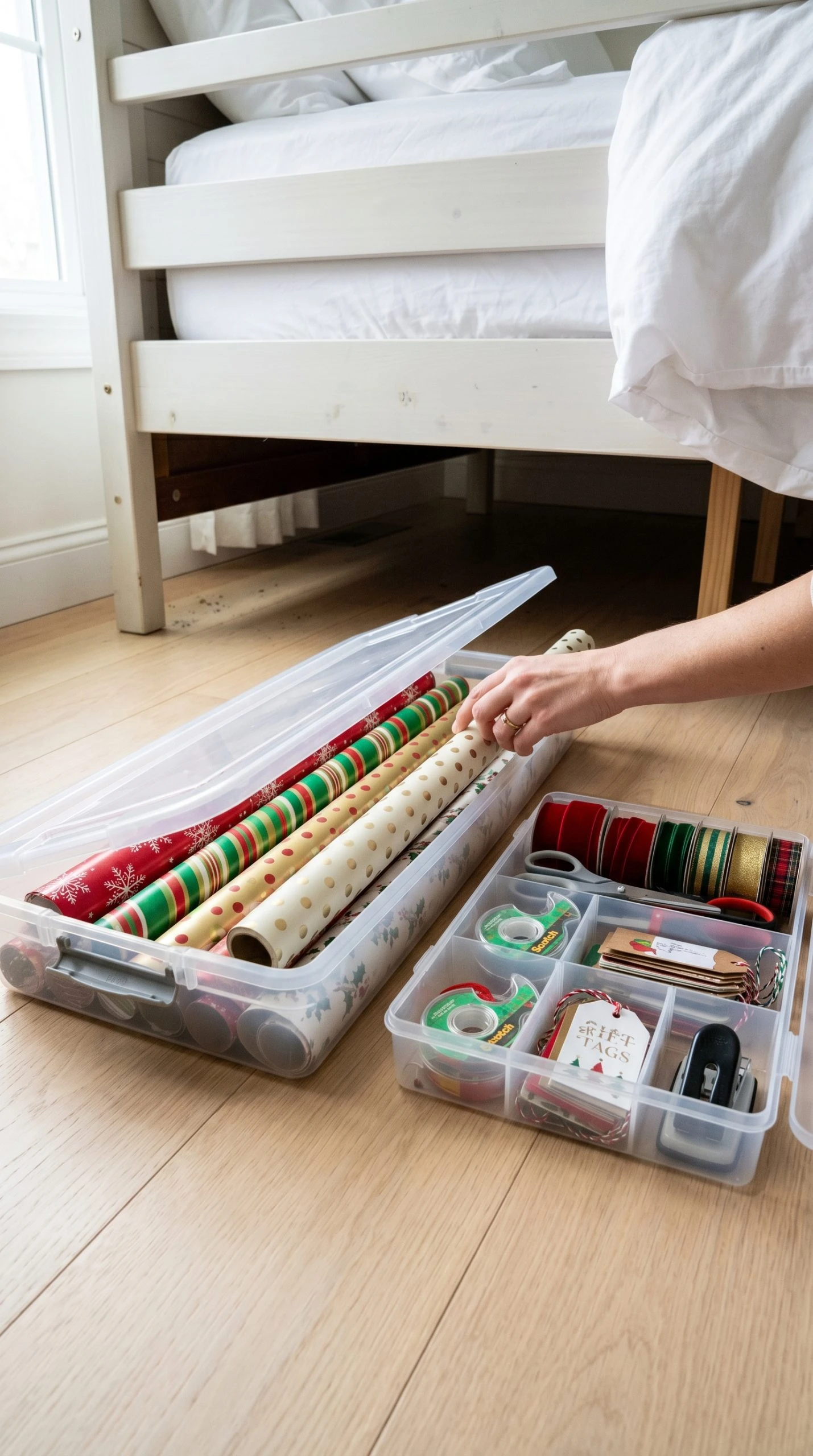
Gift Wrap and Occasion Supplies Station
Every time a birthday or holiday comes around, you spend twenty minutes hunting for tape, scissors, a ribbon that is not tangled, and wrapping paper that is not crushed. You need a dedicated spot for all of it.
The space under the bed is a surprisingly perfect home for gift wrap and occasion supplies, and once you set it up properly, the logic feels completely obvious. A long, flat under-bed container is almost perfectly shaped for storing rolls of wrapping paper horizontally without bending or crushing them. A separate shorter container beside it holds all the accessories: tape, scissors, ribbon, tissue paper, gift bags, tags, markers, and bows, all in one organized place.
For the wrapping paper container, look for a flat under-bed bin that is at least thirty-six inches long on the inside, which accommodates standard roll widths without curling or folding the edges. A clear lidded version lets you see exactly which patterns and papers you have without opening the container. Keep rolls organized by occasion or season: birthday papers together, holiday papers together, everyday occasion papers in their own section. A rubber band or piece of ribbon around each roll keeps it from unrolling inside the container.
The supplies container alongside it should be divided into clear sections so everything stays categorized. A shallow divided tray with sections for tape, a pair of scissors, markers, and small accessories prevents the situation where everything ends up in one jumbled pile at the bottom. Keep a small stock of the occasion supplies you use most often: a dozen gift tags, two or three sizes of gift bags, a roll of tissue paper in neutral colors, and a few lengths of ribbon in your most-used colors. Restocking once or twice a year keeps the system working without requiring constant attention.
Quick Tip: Store a small pair of dedicated wrapping scissors in this container and never remove them. Having dedicated tools in the station means you never have to hunt for scissors in the kitchen junk drawer again.
Kids’ Toy Rolling Cart
Your child’s toys are migrating to every room in the house. The bedroom floor is an obstacle course and bedtime involves a ten-minute cleanup that nobody enjoys.
Under the bed is one of the best toy storage locations in a child’s room, and not just because it gets things off the floor. It is also at a height that children can access independently without help from an adult, which matters enormously for building the habit of putting things away. A rolling cart or set of rolling drawers under a child’s bed that the child can pull out, use, and push back in on their own creates a storage system that actually gets used rather than one that requires parental intervention every time.
The best approach for kids is to keep the system simple enough that a child can maintain it without confusion. One rolling bin for building toys like blocks or construction sets, one for art supplies, and one for dress-up clothes or action figures covers most situations without creating so many categories that the system breaks down. Label each bin with both a word and a simple picture drawing or printed image of what belongs inside, which works for pre-readers and readers alike.
Make sure the rolling cart or drawers you choose are genuinely easy to operate. Casters that swivel smoothly, drawers that open with a light pull, and containers without lids that need to be removed before accessing the contents are all features that help children use the system consistently. A storage system that is slightly annoying for an adult is completely abandoned by a child. The easier it is to use, the more likely it is to actually work as intended.
Quick Tip: Rotate toys seasonally using the under-bed space. Store half the toy collection in the room and half in under-bed containers, and swap them every few months. Toys feel new again and the floor stays clearer.
Suitcase and Travel Gear Storage
Your luggage set lives in the guest room closet because there is nowhere else to put it, which means guests cannot actually use the closet. You need to relocate it without renting a storage unit.
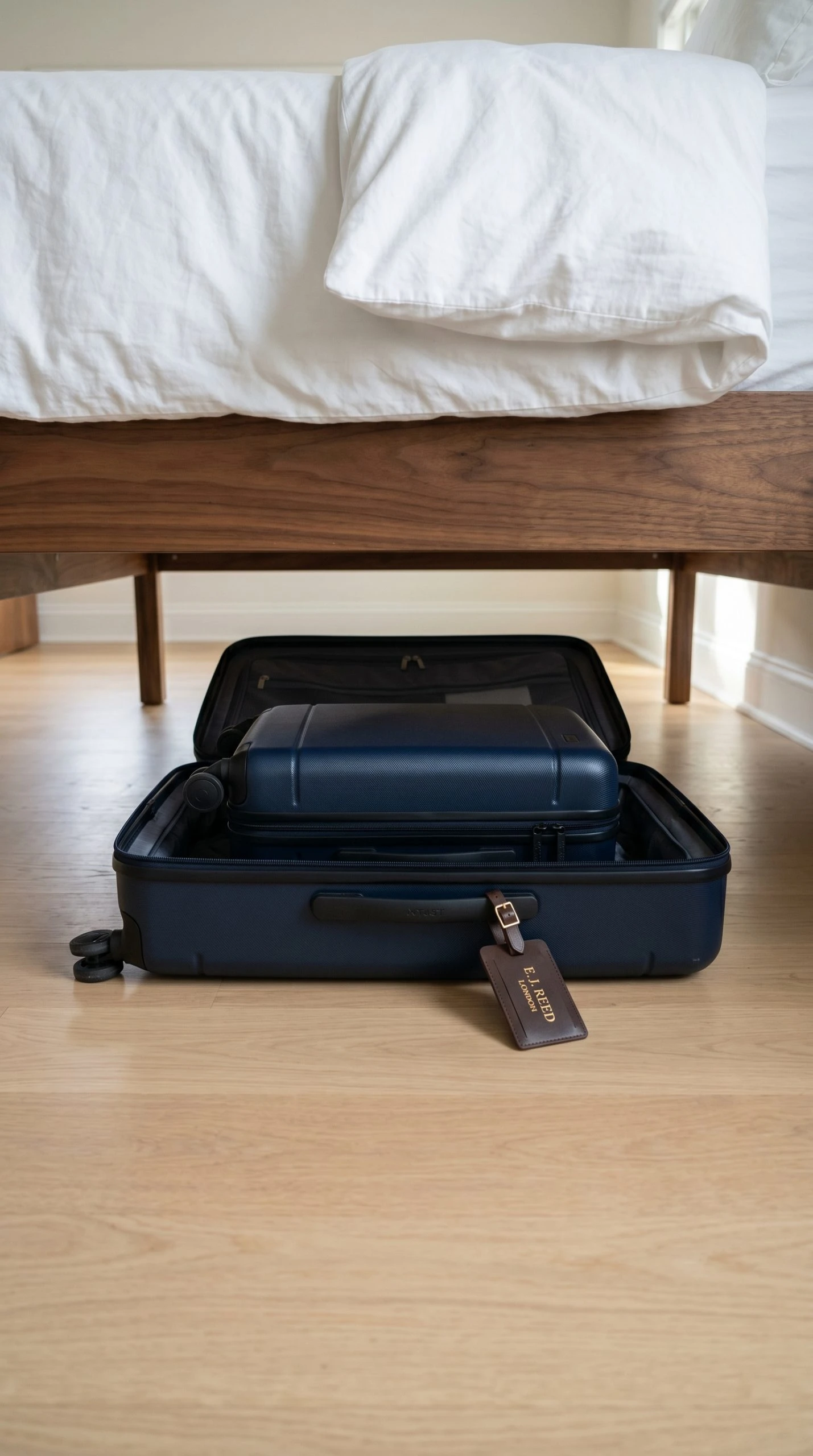
Suitcases are one of the most logical things to store under the bed, and yet they are the last thing most people think to put there. A standard carry-on suitcase fits easily under most bed frames with three to four inches of clearance to spare. A medium-checked suitcase fits under most frames if the wheels are facing down. A large checked suitcase may need a frame with slightly more clearance or a set of risers, but it still fits under most queen and king beds. Getting luggage out of closets and under beds immediately frees up a remarkable amount of closet space.
The smart move is not just to slide the suitcase under the bed empty. Use the suitcase itself as a storage vessel for items that need to stay protected: extra linen sets tucked inside the medium case, a collection of memorabilia or photo albums in the large case, or seasonal clothing and accessories in the carry-on. The suitcase provides dust protection, a contained space, and handles for easy pulling. When you actually need to travel, you pull out the suitcase, empty it into the appropriate spot, pack for the trip, and go.
For families with multiple suitcases of different sizes, nesting them inside each other when storing works extremely well. The smallest fits inside the medium, and the medium fits inside the large if the proportions allow. Then the whole nested set slides under the bed as one unit. Add a small luggage tag on the outer bag indicating what is stored inside the inner bags if you are using them for storage, so you do not have to unzip everything to figure out what is where.
Quick Tip: Store the suitcase with a small sachet of cedar or lavender inside to prevent any stale or musty smell developing while it sits in storage for months at a time.
Memory and Memorabilia Storage
You have boxes of old photographs, birthday cards, childhood mementos, and sentimental items that you cannot throw away but that have no logical home in your current space.
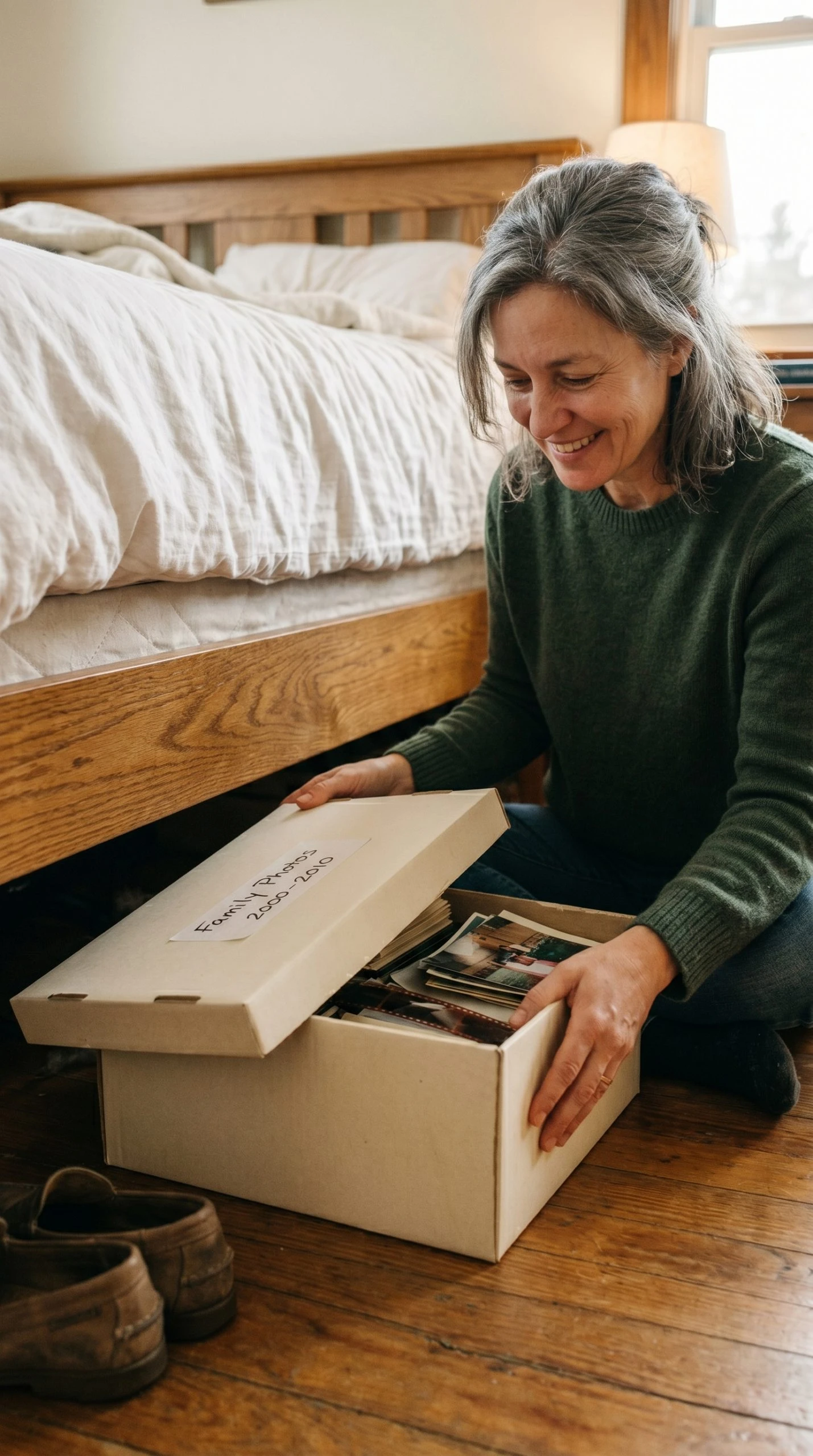
The space under the bed is genuinely one of the best places in the home to store memorabilia and personal keepsakes, and professional organizers often recommend it specifically for this category of items. Sentimental items need protection from humidity, temperature extremes, and light exposure. The area under a bed in a climate-controlled bedroom is naturally stable, dark, and protected from direct sunlight, which makes it better for long-term preservation than a garage, attic, or basement where temperature and humidity can fluctuate dramatically.
For photographs specifically, use archival-quality acid-free boxes rather than standard cardboard or plastic totes. Acid-free boxes prevent the yellowing and deterioration that ordinary cardboard can cause over time through off-gassing. These are widely available online and at craft stores, and they are worth the small additional cost for anything you genuinely want to preserve. Organize photographs chronologically or by event, with a simple index card at the front of each sub-section indicating what the section contains.
Other memorabilia, such as cards, letters, newspaper clippings, childhood artwork, and small three-dimensional keepsakes, can be stored in acid-free archival containers or in sturdy lidded boxes lined with tissue paper. Label each box clearly on the visible side with a brief description of its contents and, if relevant, the date range it covers. A shared family memory box under the bed becomes a genuinely lovely thing to pull out and look through together, which is something that almost never happens when memory items are stored in an attic nobody goes into.
Quick Tip: Digitize printed photographs before storing them. A simple flatbed scanner or a smartphone scanning app creates a backup that protects your memories if the physical copies are ever damaged.
Craft and Hobby Supply Storage
Your knitting, painting, or crafting supplies are spread across multiple rooms with no real home. You spend as much time looking for supplies as you do actually making things.
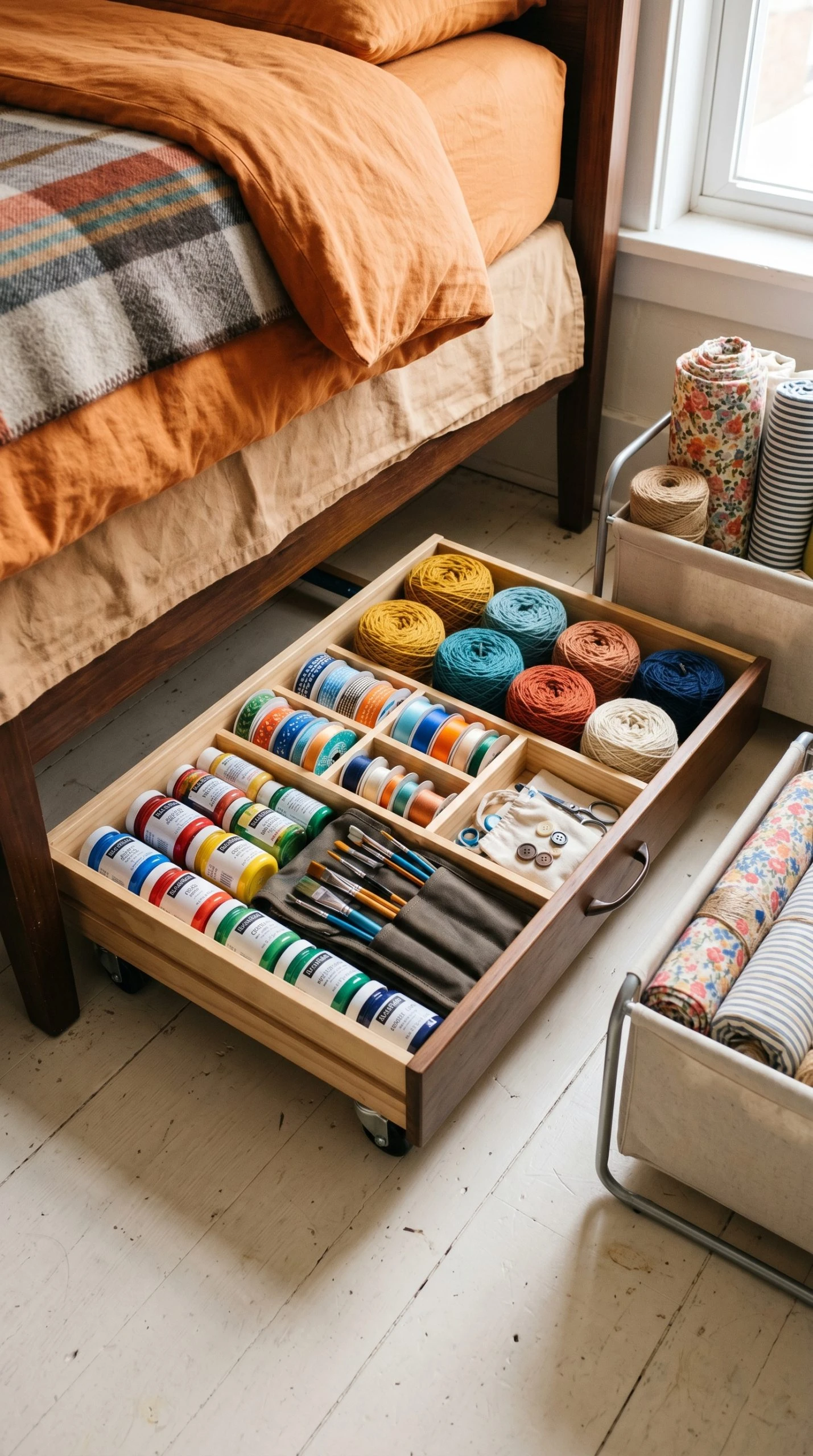
Hobby supplies are among the most chaotic categories of belongings in any home because they tend to span multiple types of items, small tools, materials in various sizes, works in progress, and reference books or patterns, none of which nest or stack neatly together. The under-bed space gives you a dedicated zone for all of it, close enough to wherever you typically work to be genuinely convenient, but contained enough that it does not visually take over the room.
The approach that works best for craft storage under the bed is a combination of container types rather than a single uniform solution. A rolling flat drawer unit holds tools and small supplies: scissors, measuring tape, markers, glue, thread, needles, and similar items that need to be organized by category. A larger open rolling bin beside it holds works in progress, partially used materials, and larger items like yarn skeins or rolled-up fabric. A third slim container holds pattern books, magazines, or printed references lying flat.
The key is making sure the most frequently used category of supplies is the most accessible. If you craft weekly, the active project container should be nearest the edge where you can pull it out without moving anything else. If you are in the middle of a long project, keep that specific project in its own small bin inside the larger craft container so you can pull out just that one thing without disturbing the whole organized system. Keeping works in progress contained and identifiable saves enormous amounts of time and creative frustration.
Quick Tip: Use a small lidded tackle box or divided art supply case inside your under-bed craft containers for tiny items like beads, buttons, and small tools. Small items stored loose in a large bin always migrate to the bottom and become impossible to find.
Bed Skirt with Hidden Storage Behind It
You need to store things under the bed but want none of it to be visible at all, even when someone walks around the room. The under-bed area needs to look completely finished.
A bed skirt is the oldest trick in the book for concealing storage under a bed, and it works just as well today as it ever has. A properly fitted bed skirt hangs from the mattress or box spring level to just above the floor, covering the entire under-bed area from view on all sides. Behind that skirt, you can store virtually anything in any kind of container without caring at all about how it looks, because nobody will ever see it. This freedom makes the under-bed space even more useful because you are not constrained to containers that look acceptable.
The key to a bed skirt that looks polished rather than dated is choosing the right fabric and fit. Linen bed skirts are the most current option, with a relaxed, slightly rumpled quality that looks intentional rather than stiff. Crisp cotton bed skirts in solid neutral tones feel clean and modern. Avoid heavily ruffled or overly decorative bed skirts that date quickly. The skirt should be long enough to graze the floor by about half an inch, which gives the cleanest visual line from across the room.
For an even cleaner look, choose a platform bed skirt that wraps around the base of the platform rather than hanging from the mattress level. These tend to fit more precisely and are less likely to develop the gap between the skirt and the frame that happens with fabric skirts as the mattress shifts. If your existing bed skirt tends to gap or bunch, try tucking it under the mattress on each corner and using small pieces of double-sided foam tape to keep it flush against the frame.
Quick Tip: Remove and wash your bed skirt every few months along with your regular bedding. Dust and allergens accumulate in the fabric naturally over time, and a freshly washed skirt falls more cleanly than one that has stiffened from dust.
Seasonal Decor and Holiday Storage
Your holiday decorations are taking up an entire closet, two storage bins in the garage, and a corner of the guest room. You need to consolidate them into one logical spot.
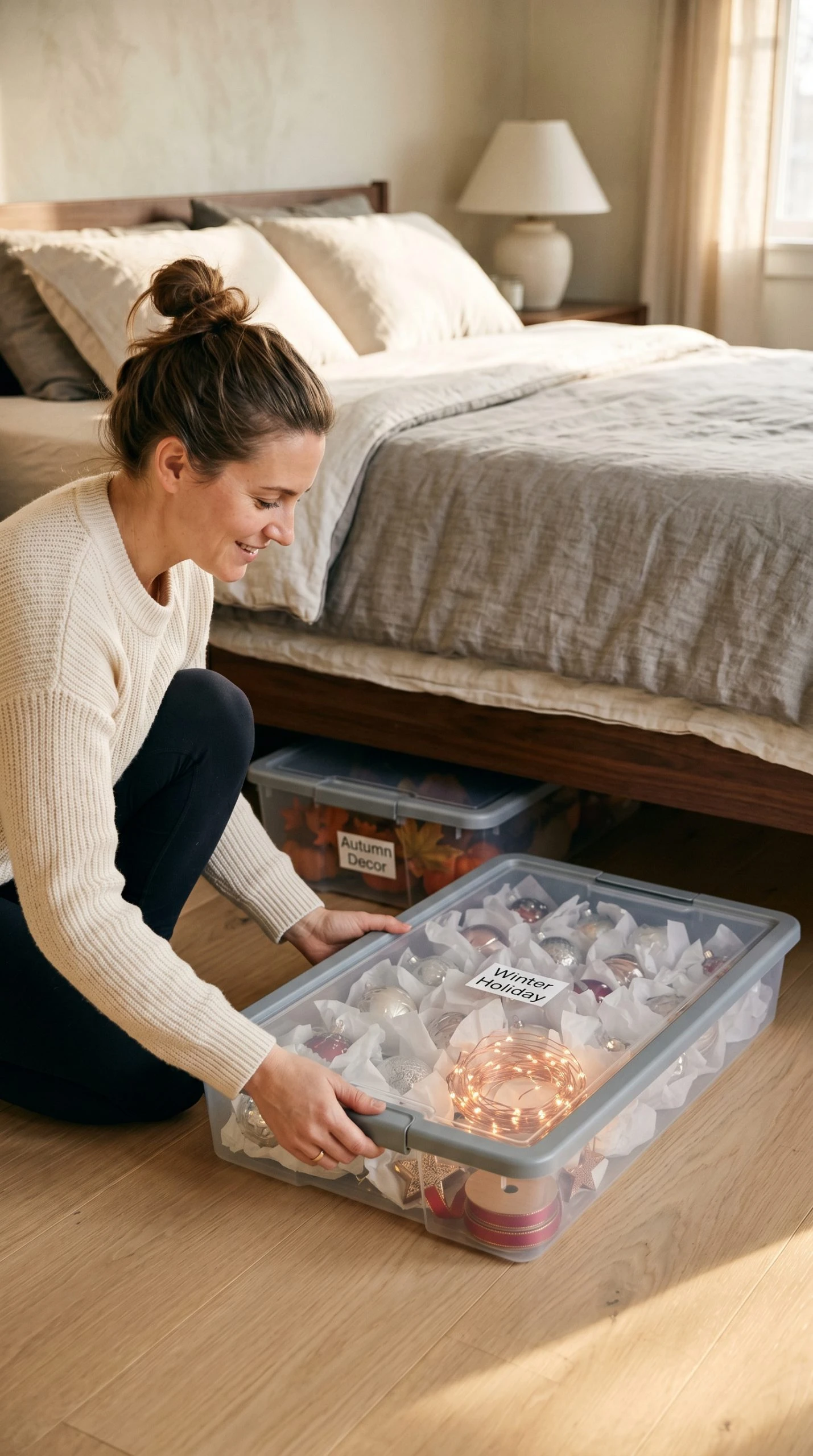
Seasonal decor is one of the most commonly overlooked categories for under-bed storage, but it is actually one of the best fits for the space. Holiday decorations are used once or twice a year, need to be stored safely between uses, do not require daily or even monthly access, and often include fragile items that need more protection than a garage shelf or cardboard box provides. The under-bed environment, stable, dark, temperature-controlled, and protected from the physical disturbance of a busy garage, is actually ideal for keeping decorations in good condition year after year.
Flat, rigid under-bed containers with secure lids work best for holiday decor because they protect fragile ornaments and delicate items from being crushed by anything stacked on top. For breakable ornaments specifically, store them individually wrapped in tissue paper or in purpose-designed ornament storage trays with divided compartments. Label each container with the holiday and the year you last used it so you can quickly identify what is inside and whether anything needs refreshing or replacing before the next season.
The other category that fits perfectly under the bed alongside holiday decor is seasonal home accessories: the set of cozy throw pillows you rotate in for winter, the linen cushion covers you use in summer, the extra table runners for different occasions, and the decorative items that only come out at specific times of year. Keeping all seasonally rotating home decor in one under-bed zone means that when you are ready to switch things up, everything you need is in one place rather than scattered across multiple storage spots throughout the house.
Quick Tip: Store battery-operated lights with the batteries removed. Batteries left inside items during months of storage can leak and corrode the battery compartment, ruining otherwise perfectly good decorative lights.
Making the Most of a Space You Already Have
The space under your bed has probably been there for years doing very little. It collects the occasional lost sock, gathers dust between cleanings, and stores whatever happened to be closest when you needed it out of sight quickly. But as the twenty-one ideas in this article show, it is capable of so much more than that. With the right setup, it can hold an entire season of clothing, a full shoe collection, your complete gift-wrapping station, your children’s toys, your craft supplies, your holiday decorations, and your most precious keepsakes, all in one hidden, organized, and genuinely useful space.
The best part is that you do not have to do all of it at once. Pick one category that is causing you the most trouble right now, the shoe pile by the door, the linen closet that will not close, the craft supplies spread across two rooms, and solve just that one problem with a targeted under-bed solution. Once you feel how much better that single category works when it has a proper home, you will naturally want to extend the logic to the next one.
The goal is not a perfectly styled under-bed area that you photograph and share. The goal is a bedroom that functions better, feels calmer, and gives you back the closet space and floor space you have been missing. That is worth spending a weekend afternoon on. Start with what bothers you most, organize it properly, and let the satisfaction of a genuinely useful space do the rest of the convincing.
Frequently Asked Questions
What is the best thing to store under your bed?
The best items for under-bed storage are things you do not need daily access to but want reasonably close by. Seasonal clothing, extra bedding sets, shoes, holiday decorations, memorabilia, gift wrapping supplies, and infrequently used hobby materials all fit this description well. Avoid storing food, electronics that are sensitive to dust, or anything that needs regular airflow like leather goods without appropriate protection.
How do I keep under-bed storage from getting dusty?
Use containers with lids, zippers, or secure closures rather than open-top bins. For fabric items, zippered non-woven fabric bags are the most breathable dust-resistant option. For rigid items, lidded plastic containers with snap-lock closures keep dust out very effectively. A bed skirt hung around the bed adds an additional layer of dust protection for everything beneath it.
How much clearance do I need under a bed for storage?
Most standard under-bed storage containers require between four and seven inches of clearance. Many standard bed frames sit eight to twelve inches above the floor, which is enough for most solutions. If your frame sits lower than four inches, bed risers are the most practical fix. Ottoman beds and built-in drawer beds create their own clearance as part of the design, so standard clearance rules do not apply to those.
Is it bad to store things under your bed according to feng shui?
Traditional feng shui principles suggest that the space under the bed should remain clear to allow energy to flow freely and support restful sleep. That said, for people with limited storage space, keeping the under-bed area neatly organized with soft, sleep-related items like bedding and clothing is generally considered a reasonable compromise by many modern practitioners. The most important thing is that the space is organized and intentional, not chaotic.
How do I organize under-bed storage for a small apartment?
In a small apartment, treat the under-bed space as seriously as any dedicated storage room. Assign specific categories to specific containers, label everything clearly, and position containers logically with most-needed items at the front. Use bed risers if needed to increase clearance. A combination of flat zippered bags for bedding, rolling drawers for clothing, and a clear-lidded container for shoes covers most small apartment storage needs efficiently.
Can under-bed storage affect mattress ventilation?
Fully enclosed under-bed storage can reduce airflow beneath a mattress, which is worth considering especially in humid climates. To minimize this, choose a mattress with good internal ventilation, rotate your mattress regularly, and avoid sealing the entire under-bed perimeter completely. A bed skirt with some gap at the bottom, or open storage containers on the sides, allows some air circulation even when the space is in use for storage.