Your Bathroom Can Feel Like a Spa — Here Is How to Actually Get There

Think about the last time you walked into a spa. You probably noticed it before you even had a chance to look around. The air smelled clean, maybe a little like eucalyptus or something faintly woody. The lighting was soft. There was nothing sitting on the counter that did not belong there. And somehow, within about thirty seconds, your shoulders dropped and your brain started to quiet down.
That feeling is not magic, and it is not reserved for places that charge by the hour. It is a combination of very deliberate design choices, and every single one of them can be brought into your own home. The good news is that you do not need a major renovation or a big budget to get started. Some of the most powerful changes cost almost nothing. Others are small investments that pay off every single day when you walk through that door and actually feel the difference.
This guide covers 25 ideas organized by category so you can work through them in a way that makes sense for your space and your situation. Some ideas are about the way your bathroom looks. Others are about the way it feels, smells, sounds, or functions. The best spa experiences work on all of those levels at once, and that is exactly what this list is designed to help you do. You do not have to tackle everything at once. Start with two or three ideas that feel immediately doable, and build from there. Your bathroom should be the one room in your house where you go to reset, not another place that stresses you out.
Sensory Atmosphere
The first thing any spa does well is engage your senses before you even settle in. Scent, sound, and temperature work together to signal to your brain that it is time to slow down. Getting these right in your bathroom does not require expensive upgrades. It requires intention.
1. Build a Scent Ritual with Essential Oils and Diffusers
Scent is the fastest way your brain makes a mood connection. A study from Osaka University found that inhaling lavender for just a few minutes can measurably reduce cortisol levels. The goal here is not to make your bathroom smell like a department store, but to pick one or two scents that feel calming to you and use them consistently so your brain starts to associate the smell with relaxation.
A small ultrasonic diffuser on the vanity shelf is one of the easiest ways to do this. Add five to seven drops of your preferred oil before a bath or shower and let it run. Eucalyptus is a popular choice because it opens the airways and pairs beautifully with the steam from a hot shower. Lavender is classic for evening use. Bergamot is lighter and works well in the morning when you want to feel alert but not frantic. You can also place a small dish of dried lavender buds near the drain vent so the warm air carries the scent through the room naturally.
Designer Tip: Stick to one scent family per bathroom. Mixing too many competing fragrances cancels the calming effect and can actually cause headaches over time.

2. Add Sound with a Waterproof Bluetooth Speaker
Most bathrooms are filled with the sound of fans, running water, and whatever anxiety you walked in with. Real spas are deliberately quiet or they pipe in soft background music that gives your brain something gentle to rest on. You can recreate this without spending a lot. A small waterproof Bluetooth speaker that mounts to the wall or sits on a shelf is all you need.
The content matters as much as the hardware. Build a dedicated bathroom playlist with ambient sounds, lo-fi music, soft jazz, or nature sounds like rain and ocean waves. Keep the volume low, around 40 to 50 percent of maximum, so it functions as background texture rather than entertainment. Some people prefer binaural beats or specific spa music playlists available on most streaming platforms. Whatever you choose, keep it consistent. Over time, hearing that playlist will become a cue for your nervous system to start winding down, the same way putting on pajamas signals sleep.
Designer Tip: Look for speakers with a matte finish in white, black, or brushed grey so they disappear into the room rather than drawing attention to themselves.

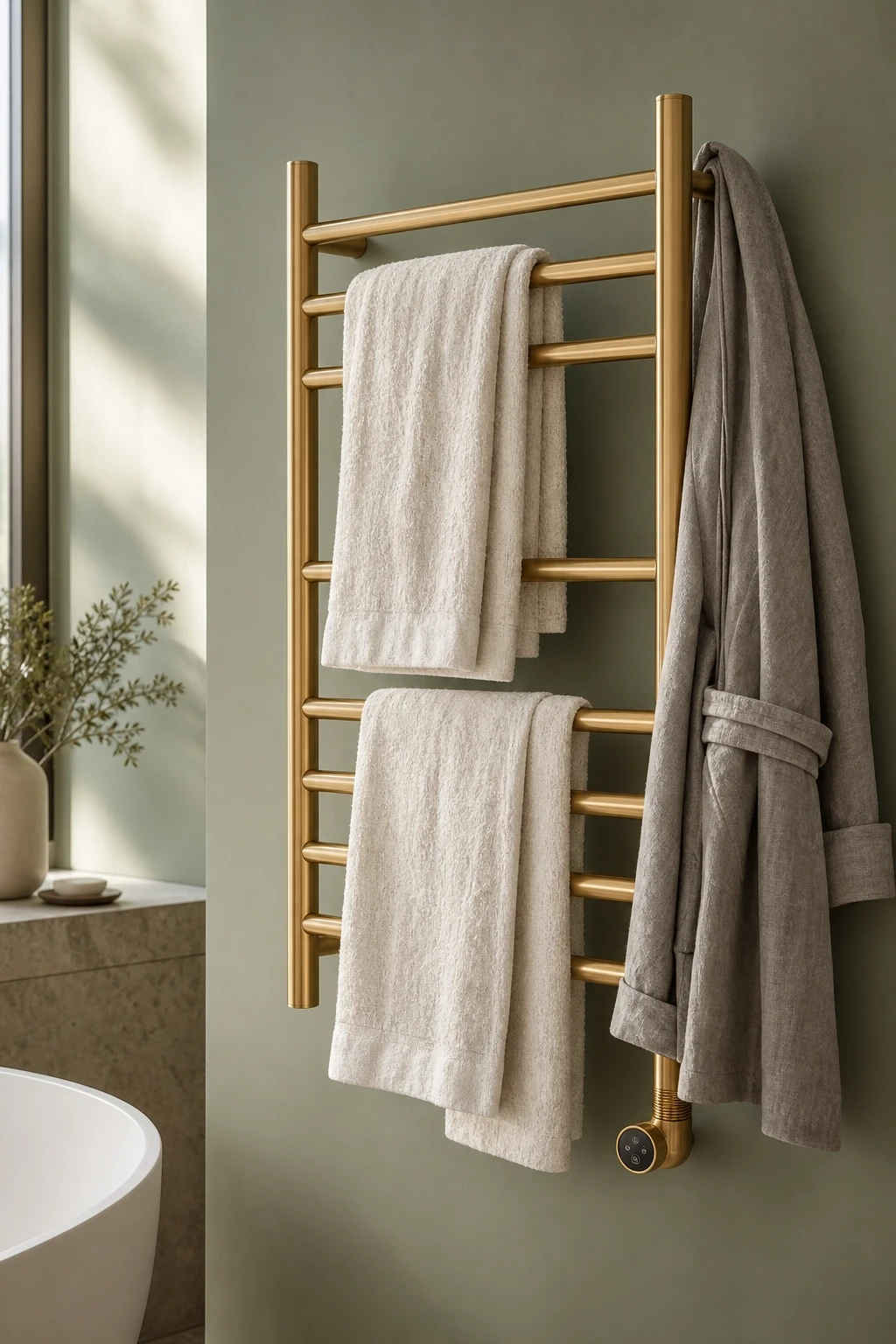
3. Install a Heated Towel Rail
Stepping out of a hot shower into a cold bathroom and wrapping yourself in a room-temperature towel is the fastest way to break the spa illusion. A heated towel rail changes everything. The warm towel feels like a small luxury that you would only get at a high-end hotel or spa, but it is surprisingly affordable to install. Electric models that plug into a standard outlet are available for well under a hundred dollars and require no plumbing work at all.
Beyond the comfort factor, heated rails also keep your towels dry between uses, which prevents the slightly damp smell that builds up in closed bathrooms. Mount it within easy reach of the shower or bath so you can grab your towel the moment you step out. If you are going for a polished look, choose a finish that matches your existing hardware, matte black, brushed nickel, or polished chrome all work well depending on your overall palette.
Designer Tip: Throw your robe over the rail while you shower. Stepping into a warm robe afterward is the single upgrade most people say they did not know they needed.
4. Control Temperature with a Programmable Thermostat
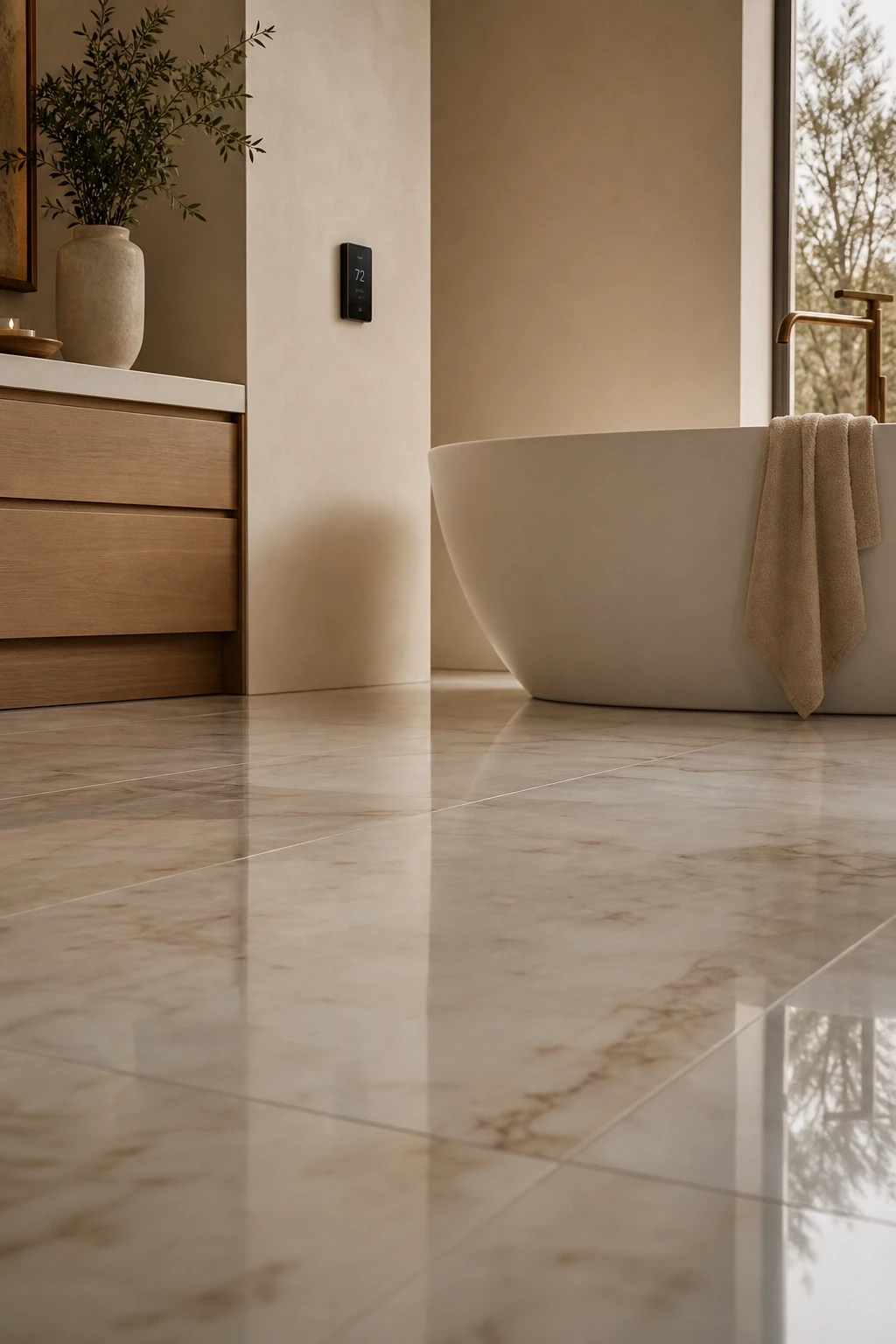
Walking into a cold bathroom at six in the morning or a stuffy one on a summer evening is an instant mood disruptor. Spas maintain a very specific ambient temperature, usually between 72 and 76 degrees Fahrenheit, because that range is warm enough to feel comfortable on bare skin but not so warm that it feels heavy or draining. If your bathroom has a separate heating zone, consider a smart or programmable thermostat that pre-heats the room before your usual morning or evening routine.
For bathrooms with radiant floor heating, this is especially effective. Set the schedule so the floor reaches the right temperature about 20 minutes before you typically use the room. Even in bathrooms without radiant heat, a small portable panel heater on a timer can do the same job for significantly less investment. The goal is to remove the physical shock of cold surfaces from the equation entirely, because that shock is one of the main reasons a morning bathroom routine feels like a chore rather than a pleasure.
Designer Tip: Keep a small teak or bamboo bath mat near the shower. On days when the floor is not pre-warmed, natural wood is much gentler underfoot than cold tile.
Water and Bathing
Water is the centerpiece of every spa experience. The way it falls, the way it feels on your skin, and the way you soak in it all communicate either luxury or routine. These ideas focus on making your water experiences feel more intentional and more restorative.
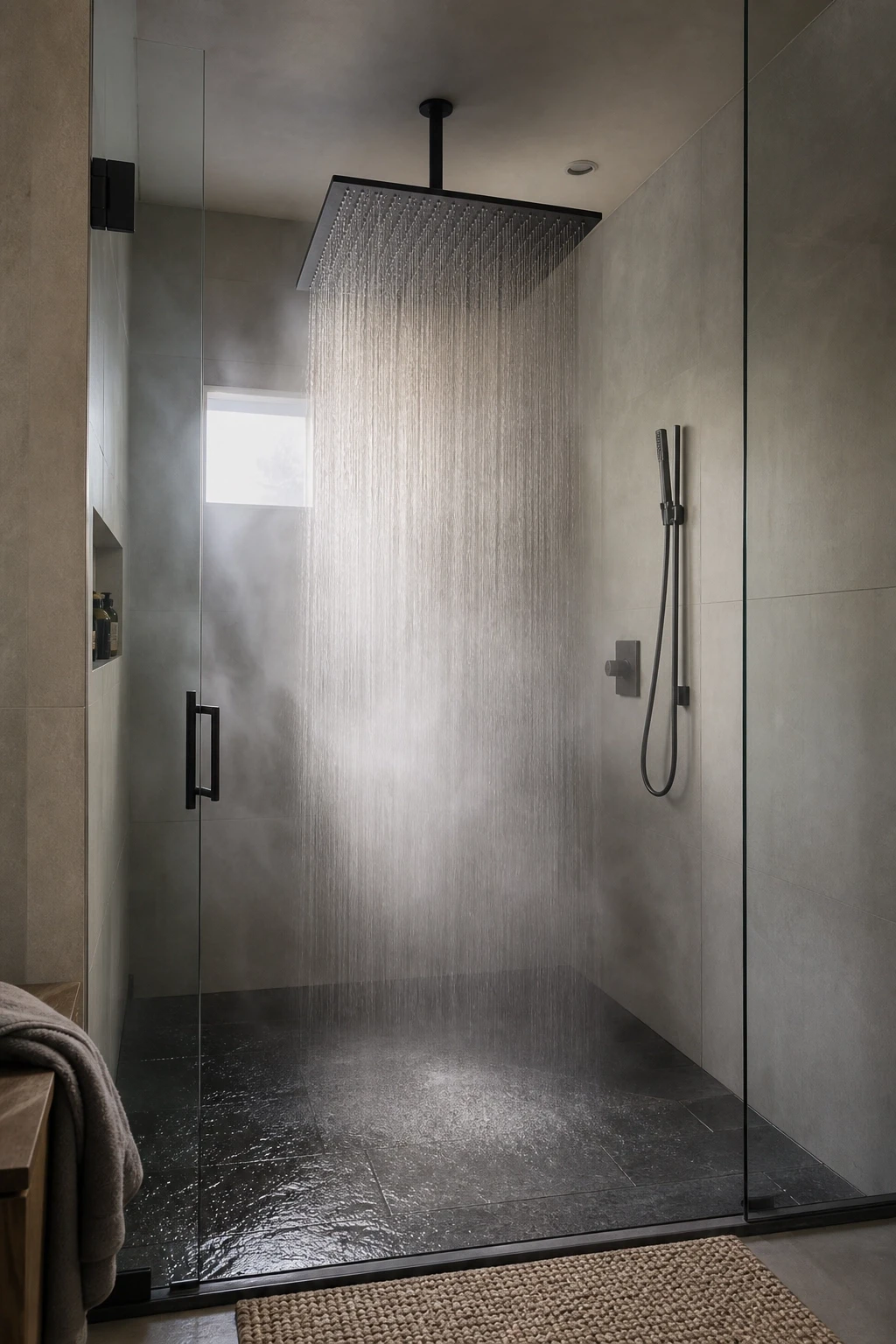
5. Upgrade to a Rainfall Showerhead
Standard showerheads spray water at you. A rainfall showerhead lets water fall down over you, which sounds like a small distinction but feels completely different in practice. The sensation is closer to standing in warm rain than being rinsed off, and that shift changes the entire mood of a shower from functional to restorative. Ceiling-mounted rainfall heads give the most dramatic effect, but an overhead arm extension that attaches to your existing wall connection works nearly as well and costs a fraction of the price.
Look for a head with a wide spray face, anything over eight inches in diameter, and multiple spray settings so you can adjust between a gentle mist and a fuller flow depending on your mood. Brass and matte black finishes tend to photograph better and hold up well against hard water buildup. Pair the rainfall head with a handheld shower wand on a separate valve so you have both options available without replacing your full plumbing setup.
Designer Tip: Clean your showerhead every three to four weeks with white vinegar to keep the spray pattern even. Clogged nozzles ruin the rainfall effect quickly.
6. Create a Deep Soak Setup with a Bath Tray and Accessories
If you have a bathtub that you rarely use, the reason is probably that it feels like a lot of effort for a mediocre result. A proper bath setup changes that. Start with a quality bamboo or teak bath tray that spans the width of the tub and gives you a stable surface for everything you need. Add a waterproof pillow that suctions to the back of the tub so you can actually lean back comfortably. Get a good loofah or a natural sea sponge. Pick one indulgent bath product to use consistently, whether that is a bath oil, mineral salts, or a bath tablet.
The goal is to make a bath feel like something worth doing rather than something you have to set up and then clean up. Keep the tray stocked and ready so the barrier to actually using it stays low. Dim the lights, light a candle on the vanity, put on your playlist, and give yourself a firm thirty-minute window with your phone in the other room. A bath this organized feels genuinely restorative rather than like a chore you talked yourself into.
Designer Tip: A few drops of a carrier oil like coconut or jojoba added to the water just before you get in leaves your skin feeling incredibly soft without needing to apply body lotion afterward.

7. Try a Eucalyptus Bundle in the Shower
This is one of those ideas that sounds a little unusual until you try it, and then you wonder why it took you so long. A fresh bundle of eucalyptus hung from your showerhead with a piece of twine releases its natural oils every time you run hot water. The steam activates the plant and fills the shower with a clean, slightly medicinal scent that opens up your breathing and genuinely feels like the showers you get at a high-end spa or boutique hotel.
Fresh eucalyptus bundles are available at most florist shops, farmers markets, and many grocery stores with a decent floral section. A single bundle typically lasts between two and four weeks before the scent fades. When it does, replace it or dry it and use it in a small vase on the vanity. Pair it with a shower steamer tablet on the floor of the shower for an extra burst of scent during the first few minutes of a hot shower.
Designer Tip: Do not let the eucalyptus bundle touch the water stream directly. Position it just behind the showerhead so it catches the steam but stays dry enough to last longer.

8. Use a Shower Filter for Better Skin and Hair
Hard water is one of the most overlooked reasons a bathroom never quite feels luxurious. Chlorine, minerals, and heavy metals in unfiltered tap water can leave skin feeling dry and tight and make hair look dull even after using quality products. Installing an inline shower filter is a low-cost change that many people describe as one of the most noticeable upgrades they have ever made in a bathroom.
Most shower filters attach directly between the shower arm and your existing showerhead, so no plumbing work is required. They remove chlorine and many heavy metals while keeping water pressure completely unaffected. Your skin will feel softer within a few showers, and hair tends to get noticeably shinier over the first two to three weeks of use. Replace the filter cartridge every three to four months depending on your local water quality. It is a small recurring investment that delivers a noticeably spa-quality water experience every single day.
Designer Tip: Keep a bottle of magnesium body oil near the shower for post-shower application on slightly damp skin. It absorbs faster when the skin is warm and helps with muscle relaxation.

9. Add a Shower Bench or Teak Stool
This is one of those additions that feels slightly indulgent until you have it, and then it becomes one of the things you cannot imagine showering without. A teak shower stool or built-in bench lets you sit during a long shower, which changes the whole experience from something you are rushing through to something you can actually settle into. It is also a practical surface for your products, a place to rest a foot while shaving, and a spot to set a warm washcloth before a facial steam.
Teak is the gold standard material for wet environments because it is naturally resistant to moisture, mold, and warping. Bamboo is a more affordable alternative that performs well if it is properly finished. Look for a stool between 16 and 18 inches tall so it works comfortably for sitting or as a product shelf. Even a small corner stool in a compact shower changes the feel of the space from purely functional to something that invites you to slow down and stay a little longer.
Designer Tip: Oil your teak stool every three to six months with teak oil to keep it from drying out and graying prematurely. It takes less than five minutes and extends the life of the piece significantly.

Materials and Surfaces
The materials in your bathroom communicate quality and calm before you even consciously register them. Real spas use natural, tactile surfaces because they feel better underfoot and against your skin, and because they have a warmth that synthetic materials rarely replicate. These ideas bring those qualities into your space.
10. Bring in Natural Stone Accents
You do not need to retile your entire bathroom to get the look and feel of natural stone. Targeted stone accents, a marble soap dish, a travertine tray on the vanity, a slate trivet under a candle, do a lot of the visual heavy lifting without a renovation. Natural stone has a density and texture that reads as inherently luxurious because it genuinely is. Unlike plastic or resin alternatives, the weight and temperature of real stone add a tactile quality that synthetic versions cannot replicate.
If you want to go a step further, consider replacing a basic vanity top with a marble or quartz slab during your next update. Even a small vanity gets a significant upgrade from a quality stone surface, and the investment holds resale value well. For a budget-friendly option, look for off-cuts from a local stone yard. These pieces are often sold at a steep discount and are perfectly sized for smaller bathroom surfaces like shelves and window sills.
Designer Tip: Seal natural stone surfaces every six to twelve months with a penetrating stone sealer to prevent water damage and staining. It takes ten minutes and keeps the surface looking pristine for years.

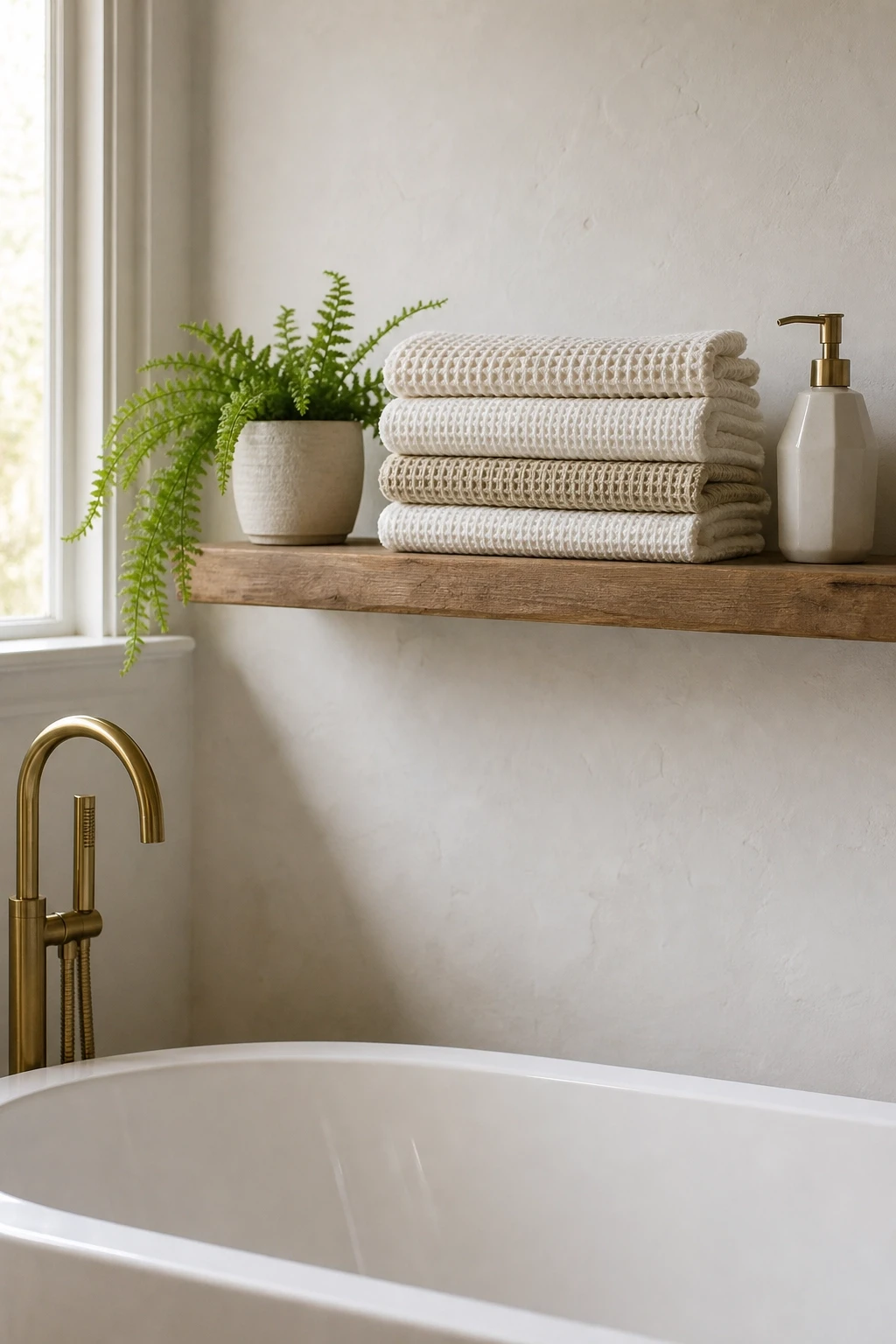
11. Switch to Linen or Waffle-Weave Towels
Most bathroom towels are thick, fluffy, and mediocre. They feel good for a few months and then start to feel heavy, slow to dry, and slightly scratchy after a few washes. Spa towels are different. They tend to be lighter, woven in ways that increase absorbency without adding bulk, and made from higher-quality cotton, linen, or Turkish cotton that gets softer with every wash rather than less so.
Linen and waffle-weave options in particular have a texture that feels more elevated than standard terry cloth. They dry faster, hang better, and give the bathroom a more editorial, curated look when folded or hung. Stick to a palette of two or three neutral tones, warm white, sand, and soft grey work well in most bathrooms, and replace your entire set at once so everything coordinates. Fold your towels simply and stack them in a visible location. A small stack of matching towels on an open shelf reads as intentional and considered rather than utilitarian.
Designer Tip: Wash new towels with a half cup of white vinegar in the first wash to strip any manufacturing residue and set the absorbency. Skip the fabric softener entirely with quality towels, it reduces absorbency over time.
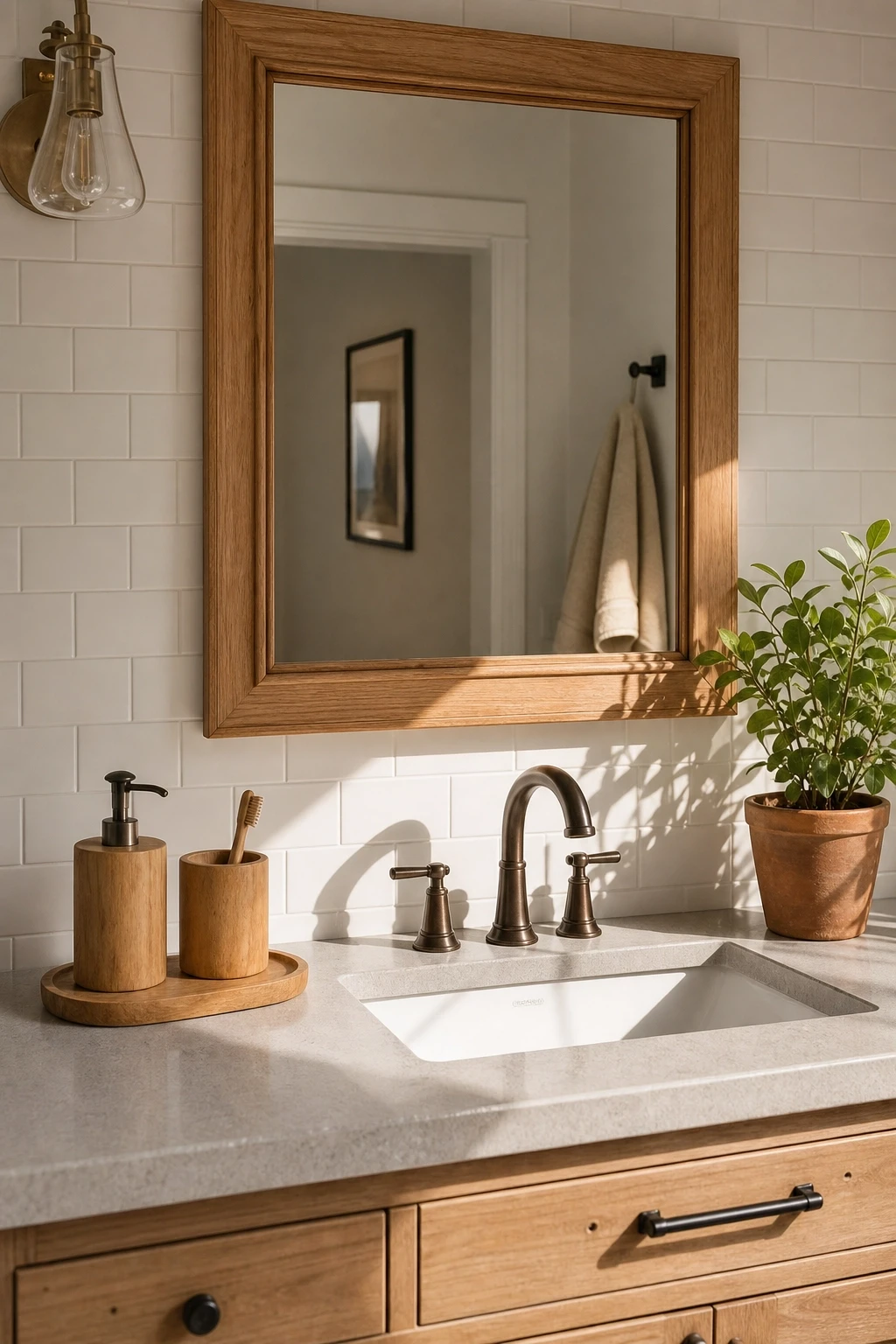
12. Add Warmth with Wood Details
Tile and stone are cold materials, visually and physically. A spa balances those hard, cool surfaces with warmer elements, and wood does this better than almost anything else. It does not take much. A wood-framed mirror, a teak shelf, a wooden soap pump, or a natural wood vanity brings a visual warmth that softens the whole room and makes it feel less clinical and more like somewhere you actually want to spend time.
Teak, bamboo, and FSC-certified oak are all good choices for humid bathroom environments. Avoid untreated pine or particle board, which warp and degrade quickly in high-moisture settings. If you are not ready to commit to a furniture piece, start with accessories. A set of wooden bathroom accessories, toothbrush holder, soap dish, cup, and small tray, costs very little and makes an immediate visual difference. Layer them with natural stone and a few plants and the room starts to feel organic and grounded in a way that purely tiled surfaces never do.
Designer Tip: Choose wood tones that are slightly warm, honey, walnut, or natural teak, rather than very grey driftwood finishes. Warmer tones read as cozier in a bathroom context.
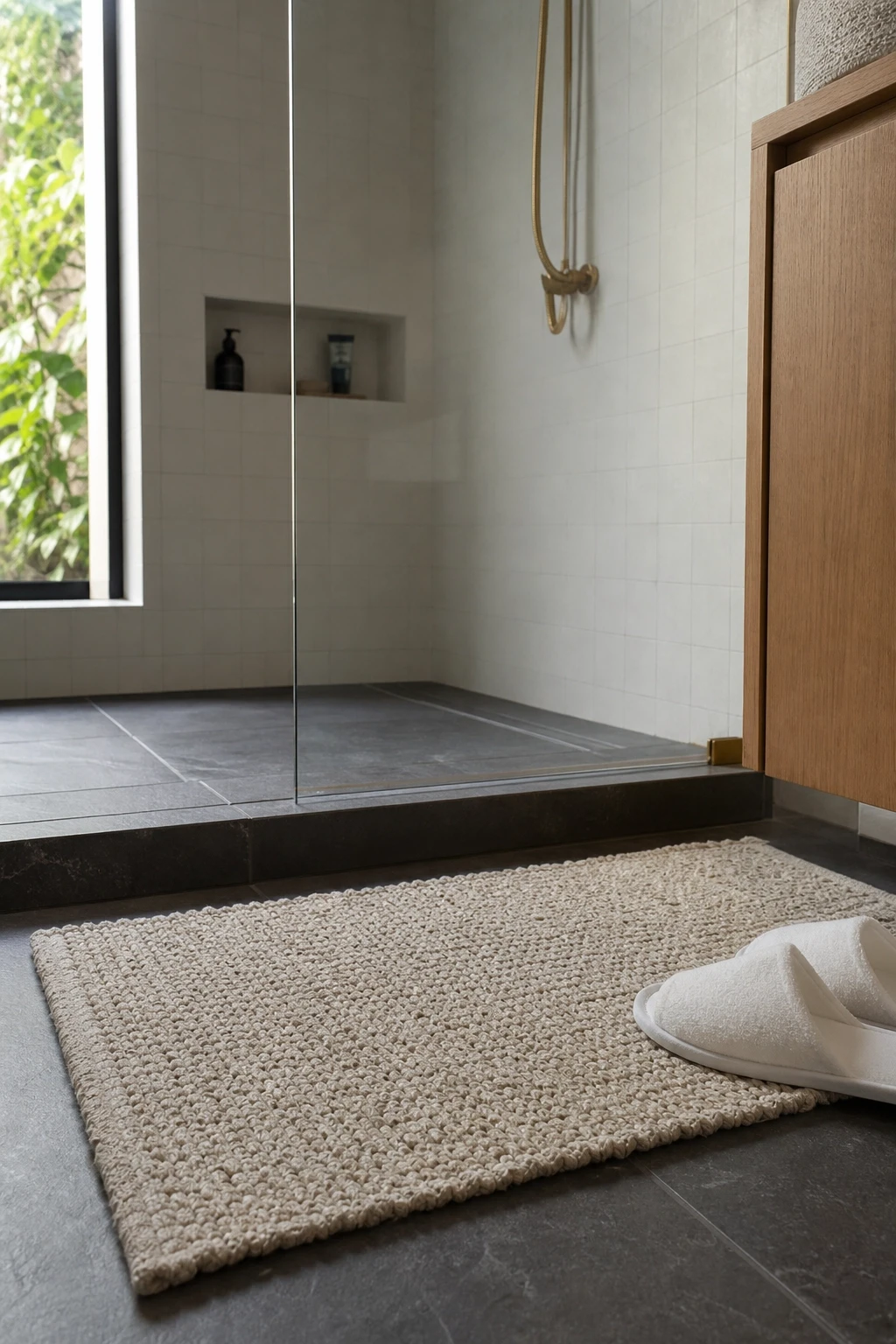
13. Lay a Natural Fiber Bath Mat
The bath mat might be the most underrated element in a bathroom. Most people buy whatever is on sale without thinking about it, and end up with a cheap synthetic mat that soaks through in one use, takes forever to dry, and curls at the corners within a few months. Upgrading to a quality bath mat is one of the best bang-for-your-buck improvements you can make.
Woven cotton mats with a tight weave, stone-washed Turkish cotton mats, and natural linen bath mats all dry faster than standard terry mats, hold their shape better, and look significantly more elevated. Teak bath mats that sit on the floor of the shower or just outside it have a built-in drainage design that works beautifully in wet environments. Natural jute mats work well in low-splash areas like in front of the vanity. Choose a mat that coordinates with your towels so the floor and the hanging textiles feel like part of the same considered palette.
Designer Tip: Hang your bath mat on the towel rail or over the tub edge after use rather than leaving it flat on the floor. It dries faster, smells better, and stays cleaner between washes.
Lighting and Ambiance
Lighting in a spa is never harsh or bright unless it is intentional, like makeup lighting at a dedicated vanity. Otherwise it is soft, layered, and warm. Most bathrooms rely on a single overhead fixture that is far too bright and far too cold for a relaxing experience. These ideas fix that.
14. Install a Dimmer Switch
This is the single most impactful lighting change you can make in a bathroom, and it is inexpensive enough that there is almost no reason not to do it. A dimmer switch gives you the ability to dial your lighting to whatever level the moment calls for. Bright in the morning when you need to see what you are doing. Soft in the evening when you are winding down. Very low for a bath by candlelight.
Most dimmer switches are compatible with standard LED bulbs, though it is worth checking that your existing bulbs are dimmable before installing. The switch swap itself is a straightforward DIY project or a twenty-minute job for an electrician. Once it is in, you will use it every day. Pair the dimmer with warm bulbs in the 2700 to 3000 Kelvin range for the most spa-like quality of light. Cool white or daylight bulbs at 4000K and above kill the atmosphere no matter how much you dim them.
Designer Tip: Set your dimmer to about 30 percent for evening baths. At that level, the room is lit enough to be safe but dark enough to feel genuinely calming rather than just dimly lit.

15. Layer Your Lighting with Candles
Candles do something that artificial light simply cannot. The slight flicker, the warmth, the way the light moves rather than stays static, these things tell your nervous system that it is okay to stop being alert. That is why every good spa uses candles or candlelight as part of the atmosphere, even in rooms that also have electric lighting. The two work together in a way that neither achieves alone.
Invest in a few good quality candles rather than many cheap ones. Soy or coconut wax candles burn cleaner and longer than paraffin options, and high-quality fragrance oils in small amounts add to the scent atmosphere without overpowering it. Place them on the vanity, the edge of the tub, and on any shelves at varying heights so the candlelight comes from multiple levels. A three-wick candle in a wide vessel creates a lot of light without burning through quickly. Trim the wick to about a quarter inch before each use for a cleaner, steadier burn.
Designer Tip: Choose unscented candles for the shower or tub area if you are already running a diffuser. Layering too many scented elements in a small enclosed space becomes overwhelming quickly.

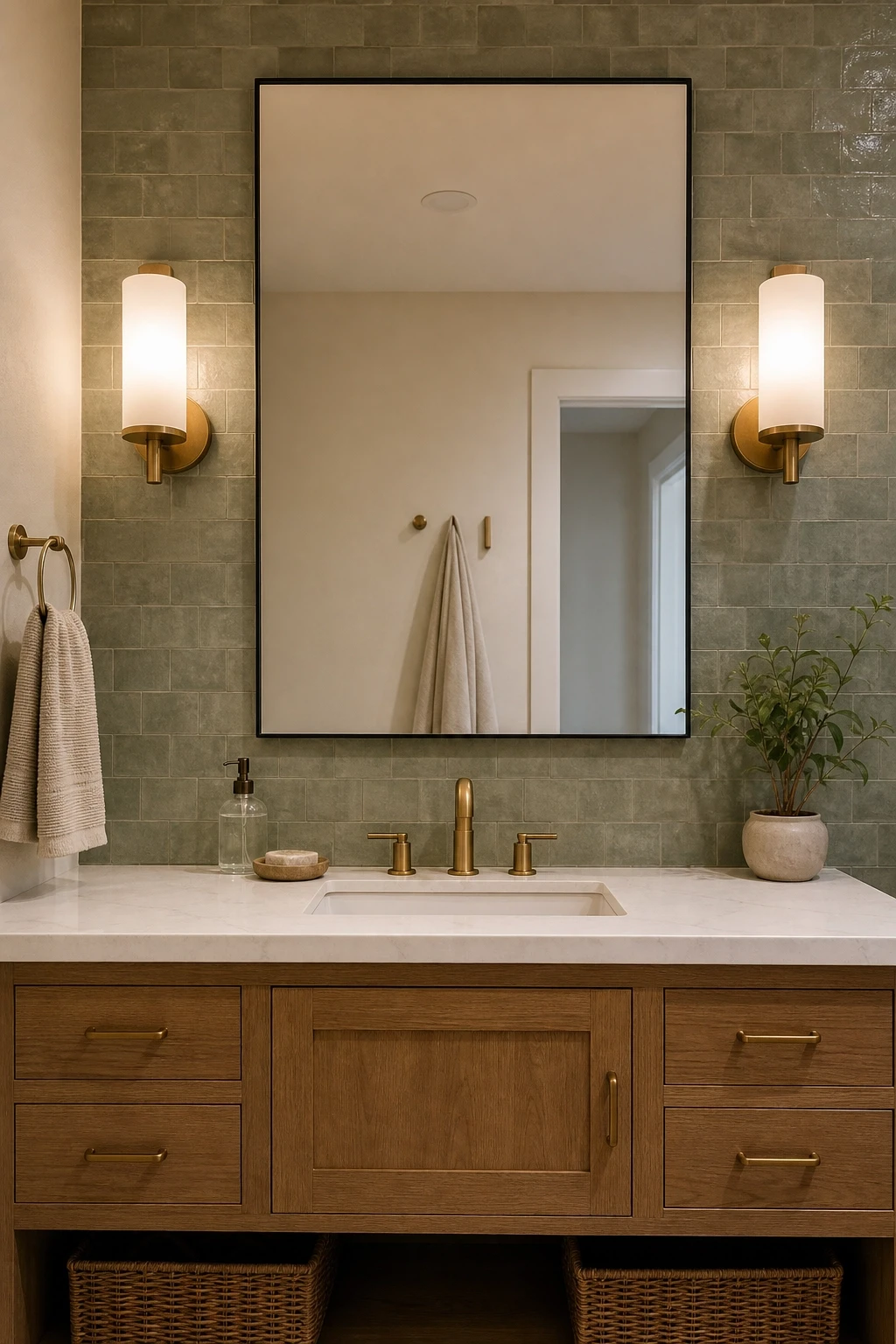
16. Add Wall Sconces Beside the Mirror
Overhead lighting above a mirror creates unflattering shadows on the face and a harshness that feels more like a hospital than a spa. Wall sconces mounted at eye level on either side of the mirror provide even, flattering light that eliminates shadows and makes the whole mirror area feel more considered and intentional. This is a standard feature in higher-end hotels and spas for exactly this reason.
You do not need to run new electrical lines in every case. There are hardwired options that replace your existing light bar above the mirror, and there are also plug-in sconces that work well if the placement allows for a discreetly run cord. Choose sconces with a warm white bulb in a simple shade, frosted glass, linen, or matte ceramic all work well in a spa-adjacent aesthetic. Keep the scale appropriate to the mirror size. A large, bold sconce on either side of a small bathroom mirror feels out of proportion and does more harm than good.
Designer Tip: If you use the mirror for skincare application, keep a separate strong overhead light on its own switch so you can have bright functional light when you need it without committing the whole room to it.
17. Try Backlit or LED Mirror Panels
Backlit mirrors have become one of the most requested bathroom upgrades in the last few years, and once you understand the effect they create it is easy to see why. The soft glow of light around the edges of a mirror adds a warm, luminous quality to the whole room that is difficult to achieve any other way. It is a single piece of hardware that functions simultaneously as lighting, a mirror, and a design statement.
Most LED mirror panels are wired into the wall like a standard fixture, though many newer models come with simple plugin connections that are much easier to install. Look for options with adjustable color temperature so you can shift between a warmer 2700K glow in the evening and a cooler 4000K light when you need clearer visibility. Anti-fog LED mirrors add a layer of practicality that is genuinely useful in a steamy bathroom, no more wiping down the mirror every time you shower. Sizes from 24 to 48 inches work well in most bathrooms.
Designer Tip: Mount a backlit mirror slightly higher than eye level so the glow illuminates downward across the face rather than creating an upward cast that can feel unflattering.

Organization and Calm
One of the most overlooked reasons a bathroom fails to feel relaxing is clutter. You cannot settle into a space that looks chaotic, no matter how good the lighting or the towels. Spas are immaculate not by accident but because the people who design them know that visual noise prevents the brain from shifting into a calmer mode. These ideas help you get there.
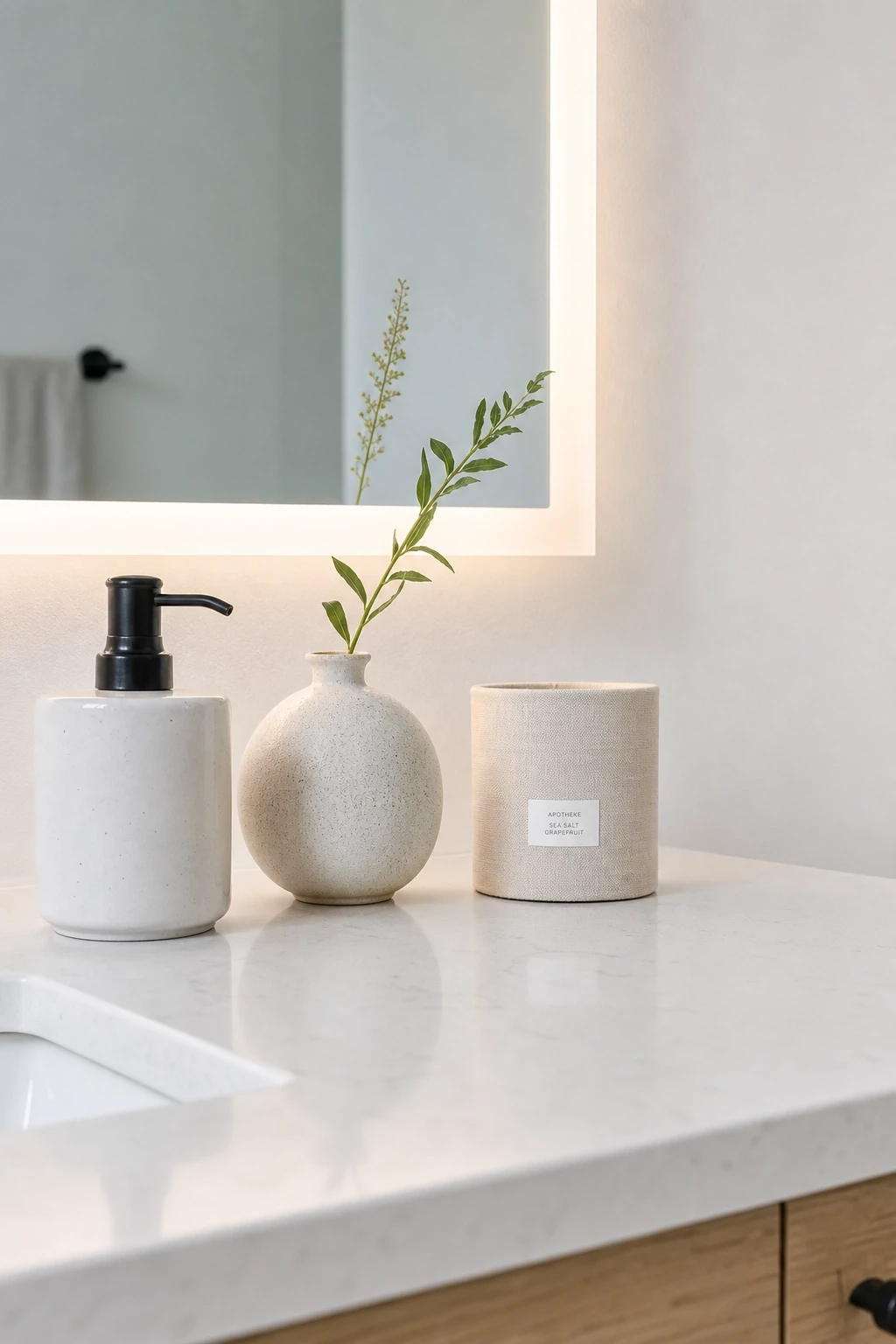
18. Clear the Counters Completely
Most bathroom counters are covered in things that could easily live somewhere else. Half-empty shampoo bottles that migrated out of the shower, cotton pads, hair ties, six different moisturizers, a hair dryer that is almost never used but always in the way. Start by taking everything off the counter entirely. Then add back only the things you use every single day. Everything else goes in a drawer, a cabinet, or a labeled basket under the sink.
What you put back on the counter matters as much as how much you put back. A single beautiful soap dispenser. A small plant. One candle. A tray holding your three daily skincare products. That is a spa counter. It looks purposeful because it is. The discipline of keeping it that way takes about a week to build into a habit, and after that it becomes almost automatic because an uncluttered counter is genuinely more pleasant to use than a cluttered one.
Designer Tip: Use a coordinated set of glass or ceramic containers for cotton rounds, cotton swabs, and any small items that need to be visible. Matching containers on a small tray look intentional rather than messy.
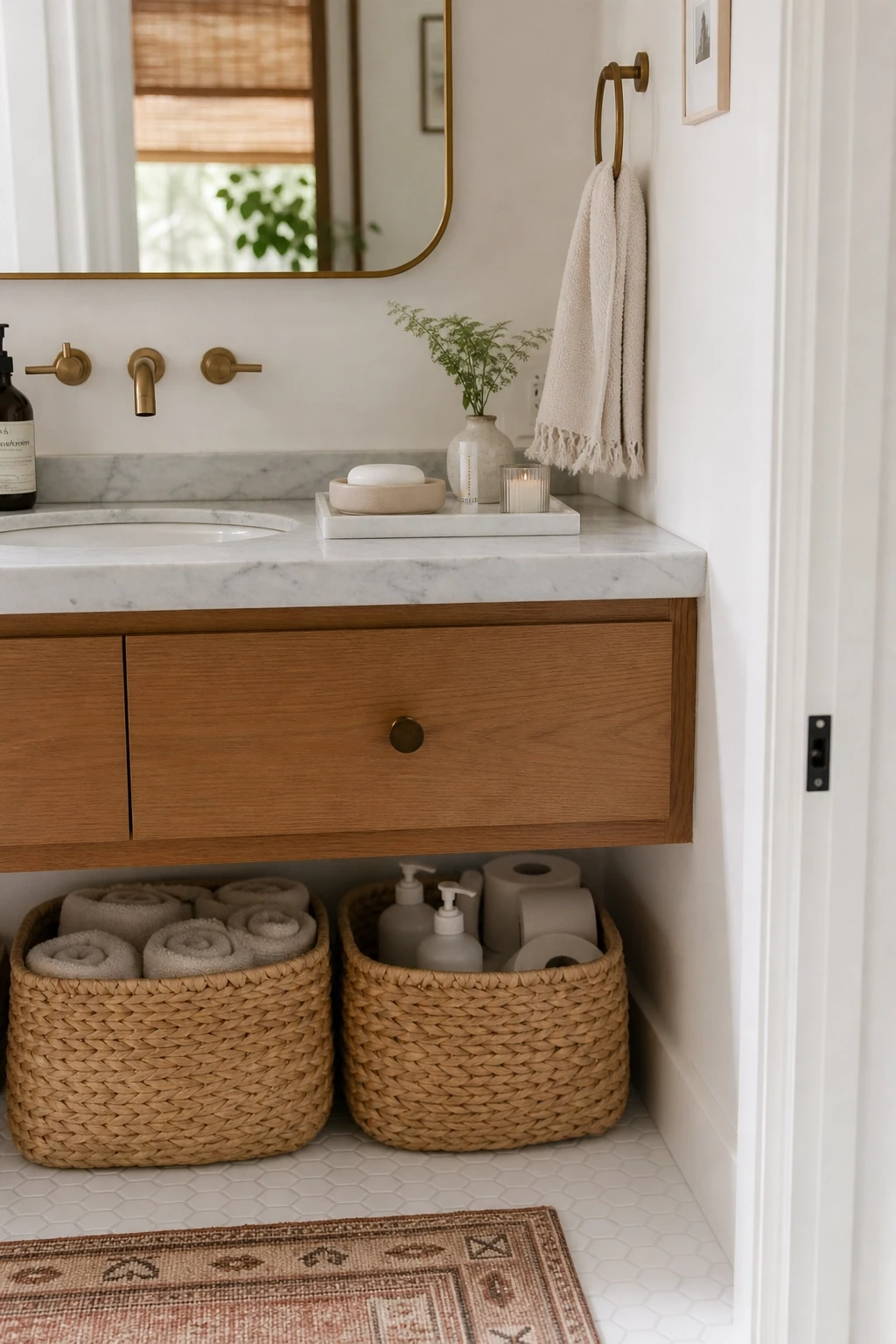
19. Use Baskets and Trays for Smart Storage
Baskets and trays perform two functions simultaneously. They contain items so they do not spread across every available surface, and they add texture and warmth to a room that might otherwise feel sterile. A small woven seagrass basket under the vanity holds extra toilet paper without looking utilitarian. A linen-lined basket on a shelf stores rolled hand towels in a way that looks deliberately styled rather than just stored.
The key is choosing containers in materials that feel considered rather than cheap. Woven water hyacinth, rattan, natural linen, and raw cotton all work well in a bathroom context. Lacquered or resin baskets feel plasticky and undermine the organic calm you are going for. Trays on the vanity are especially useful because they create a visual boundary that keeps items from spreading. Anything on the tray reads as a display. Anything off the tray reads as clutter. It is a surprisingly simple visual rule that makes a big difference.
Designer Tip: Roll your hand towels and arrange them upright in a basket rather than folding them flat. It takes thirty seconds and makes even a basic stack of towels look like a boutique hotel setup.
20. Install Floating Shelves for Display and Function
Floating shelves do what no cabinet can quite replicate. They let you display items in an open, considered way that feels curated rather than hidden or jumbled. A pair of narrow floating shelves on one wall of the bathroom gives you space for plants, candles, a small art print, folded washcloths, and a few well-chosen accessories without making the room feel smaller. Because nothing is enclosed, the shelf contents become part of the room’s atmosphere rather than just storage.
Choose shelves in a material that fits your overall palette. Light oak or white-washed wood works well in a Scandinavian or minimal spa aesthetic. Dark walnut or black iron brackets feel more sophisticated and editorial. Keep the shelves lightly loaded, no more than three to five items per shelf, and vary the heights of objects to create visual interest. A plant, a candle at a different height, and a small stone dish are often all you need on a single shelf to make it look intentional and well-composed.
Designer Tip: Place a small plant on the highest shelf so it trails downward slightly. The organic movement of a trailing plant adds life and softness to a wall that would otherwise feel flat.

Finishing Touches
The last category is where a bathroom goes from good to genuinely spa-worthy. These are the details that are easy to overlook but impossible to ignore once you have them. They add personality, intention, and the feeling that someone thought carefully about this space.
21. Introduce Live Plants
Plants do something to a room that no piece of decor can replicate. They are alive, they move slightly in the air, they grow and change, and they filter the air in a way that makes the whole room smell and feel cleaner. In a bathroom with decent light and regular humidity from showers, many plants actually thrive with very little attention. Snake plants, pothos, peace lilies, and ferns are all exceptionally well-suited to bathroom conditions.
A single large plant in the corner of the bathroom can shift the entire atmosphere of the room. A trailing pothos on a high shelf that drapes down a white-tiled wall looks genuinely beautiful and costs almost nothing. Small air plants in stone holders near the sink need no soil and almost no care. The key is choosing plants that fit the light level in your specific bathroom. A north-facing bathroom with minimal natural light needs shade-tolerant varieties. A south-facing room with a window can handle almost anything.
Designer Tip: Hang a bundle of fresh eucalyptus from the showerhead and replace it monthly, but also keep a permanent pothos on the shelf above. The combination of fresh and established greenery makes the space feel genuinely lush.

22. Choose a Calming, Cohesive Color Palette
Color is the fastest design decision that shapes how a room feels. Spa bathrooms gravitate toward specific palettes for a reason: soft greens, warm whites, sandy beiges, cool greys, and earthy terracottas all have a visual quietness that supports relaxation. Bold patterns and high-contrast combinations are stimulating by nature, and stimulation is the opposite of what a spa bathroom should deliver.
You do not need to repaint to benefit from this principle. If your walls are already a neutral, look at whether your towels, accessories, and containers are cohesive or competing. A bathroom with white walls, a pink rug, orange containers, and bright blue towels is working against itself no matter how good each individual element is. Pull everything into a three-color palette. Choose one main neutral, one soft supporting color, and one accent tone that appears in small doses. Keep that palette consistent across every textile, container, and accessory in the room.
Designer Tip: Soft sage green paired with warm white and natural wood tones is one of the most consistently calming combinations in spa-adjacent design. It works in almost every size of bathroom and across most lighting conditions.

23. Hang a Single Piece of Artwork or a Print
Bathrooms are frequently the most neglected room in a home when it comes to art, which is a shame because a single well-chosen print or small canvas can completely change the personality of the space. A large-scale botanical print in a simple frame, a black-and-white photograph of water, or a small abstract in calming tones adds a finishing layer that makes the room feel considered and personal rather than generic.
Choose artwork that connects thematically to what you are going for. Nature-inspired prints, minimal abstract pieces, and anything with a soft, limited palette all work well. Keep the frame simple, thin black metal, raw wood, or white all let the image speak rather than the frame. In a smaller bathroom, one medium-sized piece centered on a wall does more than several small pieces scattered around. Scale is everything. A print that is too small reads as an afterthought, while one that is appropriately large reads as deliberate.
Designer Tip: Choose prints on paper rather than canvas for bathroom environments. Paper behind glass is better protected from steam and humidity than exposed canvas, which can warp or develop mold over time.

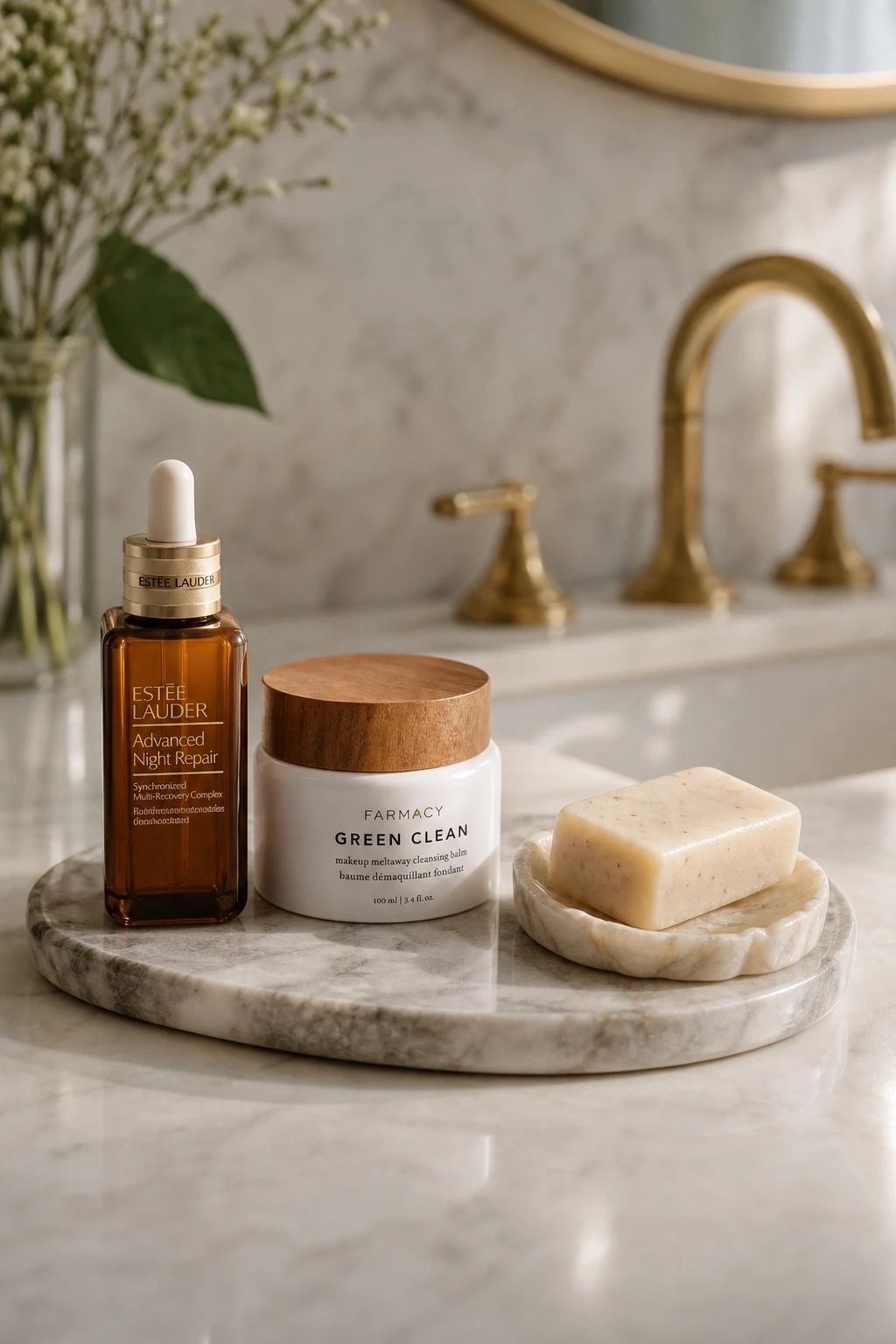
24. Keep a Small Curated Product Display
Part of what makes a spa experience feel special is seeing quality products displayed in a way that communicates care. Your bathroom can do the same thing. Choose two or three skincare or body care products that you genuinely love and display them on a small tray rather than keeping everything hidden away. A beautiful glass serum bottle, a ceramic pot of moisturizer, and a carved stone soap dish arranged on a marble tray costs nothing beyond what you already own but reads as incredibly intentional.
The discipline here is keeping it edited. A product display works when there are three to five items maximum. More than that and it starts to look like overflow rather than a curated moment. Store everything else, and rotate products onto the tray only when you are ready to use them. This approach also prevents the counter clutter that builds up when everything is left out all at once, and it gives you a built-in reason to keep the vanity surface clean because a tray sitting on a messy counter defeats the whole purpose.
Designer Tip: Decan your everyday soaps and lotions into beautiful amber glass or ceramic containers. Retail packaging is designed to sell a product, not to look beautiful on a vanity. Decanted products look polished with almost no extra effort.
25. Set a No-Phone Rule in the Bathroom
This one costs nothing and might be the hardest change on this entire list. The phone is possibly the single biggest obstacle between you and a genuinely restorative bathroom experience. It pulls you back into notifications, news, and social media in the moments when your brain is finally starting to decompress. Real spas work precisely because they are removed from all of that. Your bathroom can be that place too, but only if you are deliberate about it.
Leave the phone in the bedroom when you shower or bath. Put it face down on the other side of the room when you are doing a skincare routine. Give yourself that window of time as a genuine break from the screen. You will almost certainly notice a difference within the first week. Showers feel longer and more restorative. Baths actually work. Your skin routine becomes something you do mindfully rather than something you multitask through. The physical space can be perfect, but the mental space is what finally makes it feel like a spa.
Designer Tip: Get a small battery-operated candle or a simple diffuser with a timer to turn on automatically before your usual shower time. It creates the atmosphere without requiring you to set anything up, which removes the last obstacle between you and a genuinely spa-like routine.

Bringing It All Together
You do not need to do all twenty-five of these things at once. You do not need to spend a lot of money or live through a renovation. What you need is a handful of deliberate changes that work together to shift how your bathroom feels, not just how it looks. Start with the things that address your biggest irritations. If the lighting is too harsh, that is your first fix. If the clutter is the main problem, clear the counters this weekend. If you never use the tub, set it up properly and try it once before you write it off.
A spa-quality bathroom is built in layers. Each change you make reinforces the ones around it, and over time the whole room starts to function differently. It stops being a place you pass through and starts being somewhere you actually go to feel better. That is worth a little attention and a little investment. Your daily routine is the frame around your entire day, and it deserves a setting that helps you begin and end well.
Frequently Asked Questions
Do I need a big budget to make my bathroom feel like a spa?
Not at all. Many of the most effective changes cost very little or nothing. Clearing the counter clutter, hanging eucalyptus in the shower, switching to a calming playlist, and setting a no-phone rule are all free. Even the upgrades like a new showerhead, a bath tray, or a set of quality towels tend to be under fifty dollars per item. You can build toward the bigger changes over time.
What is the most important change I can make first?
Start with lighting. Installing a dimmer switch is affordable, requires very little skill or time, and immediately changes the entire mood of the bathroom. Once you experience the difference between harsh overhead light and a softly dimmed room with warm-toned bulbs, every other change you make will feel more impactful because the foundation is right.
What plants work best in a bathroom with low natural light?
Snake plants, pothos, peace lilies, and ZZ plants all handle low light conditions exceptionally well. They also tend to appreciate the extra humidity from regular showers. Avoid succulents in low-light bathrooms since they need significantly more sun to stay healthy. If your bathroom has a small window with indirect light, a Boston fern or a monstera will also do well with minimal care.
How do I keep my bathroom smelling good naturally without synthetic air fresheners?
A combination of a small diffuser with essential oils, a eucalyptus bundle in the shower, and regular ventilation goes a long way. Make sure your bathroom fan runs for at least fifteen minutes after every shower to prevent mildew smells from developing. Changing towels every three to four uses also helps more than people realize. Baking soda in a small open container under the sink absorbs odors passively and costs almost nothing.
Can a small bathroom really feel like a spa?
Absolutely. A small bathroom that is well-organized, softly lit, and thoughtfully accessorized will always feel more luxurious than a large bathroom that is cluttered and poorly lit. In many ways a smaller space is easier to get right because there is less room for things to go wrong. Focus on keeping surfaces clear, choosing materials that feel good, and getting the lighting right. Those three things alone will change a small bathroom dramatically.
How often should I refresh my spa bathroom accessories?
Do a small edit every month. Replace any candles that have burned down, freshen the eucalyptus bundle, check that products on the vanity tray are current and not expired, and rotate towels so they stay in good condition. A full refresh of your textiles, towels, bath mats, and any fabric accessories, every six to twelve months keeps the room feeling clean and new. Seasonal changes, swapping a sage-toned palette in spring for warmer, earthier tones in autumn, are a low-cost way to keep the space feeling considered rather than static.