Nordic Porch Looks That Are Worth Every Inch of Space
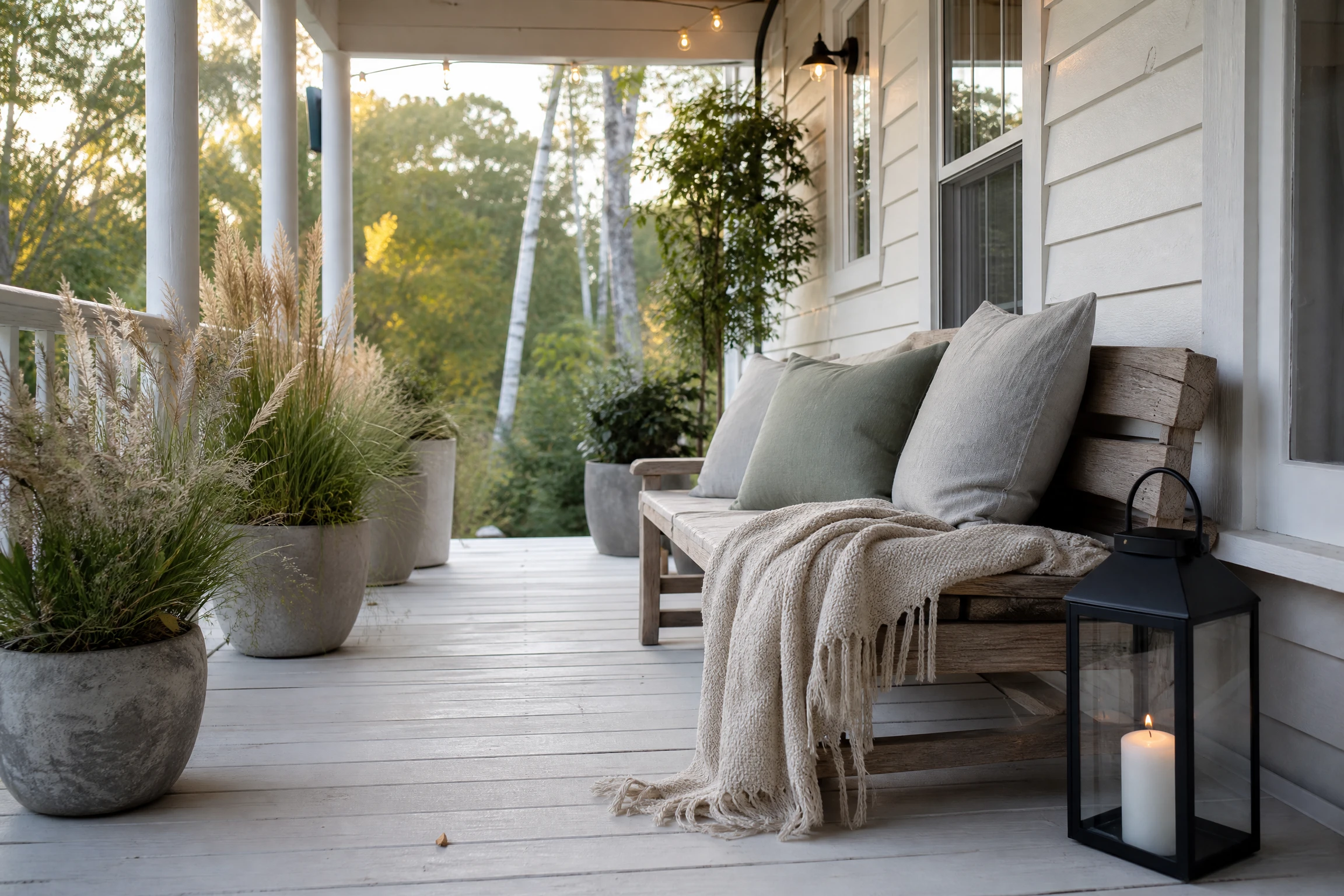
There is something genuinely calming about a Scandinavian porch done well. It does not try to do too much. It does not pile on color or accessories for the sake of filling space. Instead, it works with what is already there, which is usually natural light, honest materials, and a quiet appreciation for the outdoors. If you have been staring at your porch wondering how to make it feel less like a forgotten afterthought and more like a place you actually want to spend time, Nordic design principles give you a clear and very achievable path forward.
What you will find in this guide goes beyond the usual “add a throw blanket and some candles” advice. Each idea here covers the full picture, from the palette and furniture to lighting, texture, and the small details that pull everything together. Whether you are working with a compact front stoop, a screened side porch, or a generous wraparound, there is something here that fits your space and your budget. Some of these ideas lean into the raw, earthy side of Nordic design while others nod to the cleaner, more graphic Scandinavian modern aesthetic. All of them share the same core quality: they feel real, livable, and genuinely beautiful.
The Hygge Foundation: Warmth, Softness, and Slow Living
1. Layered Wool and Linen Textiles with a Reclaimed Wood Bench
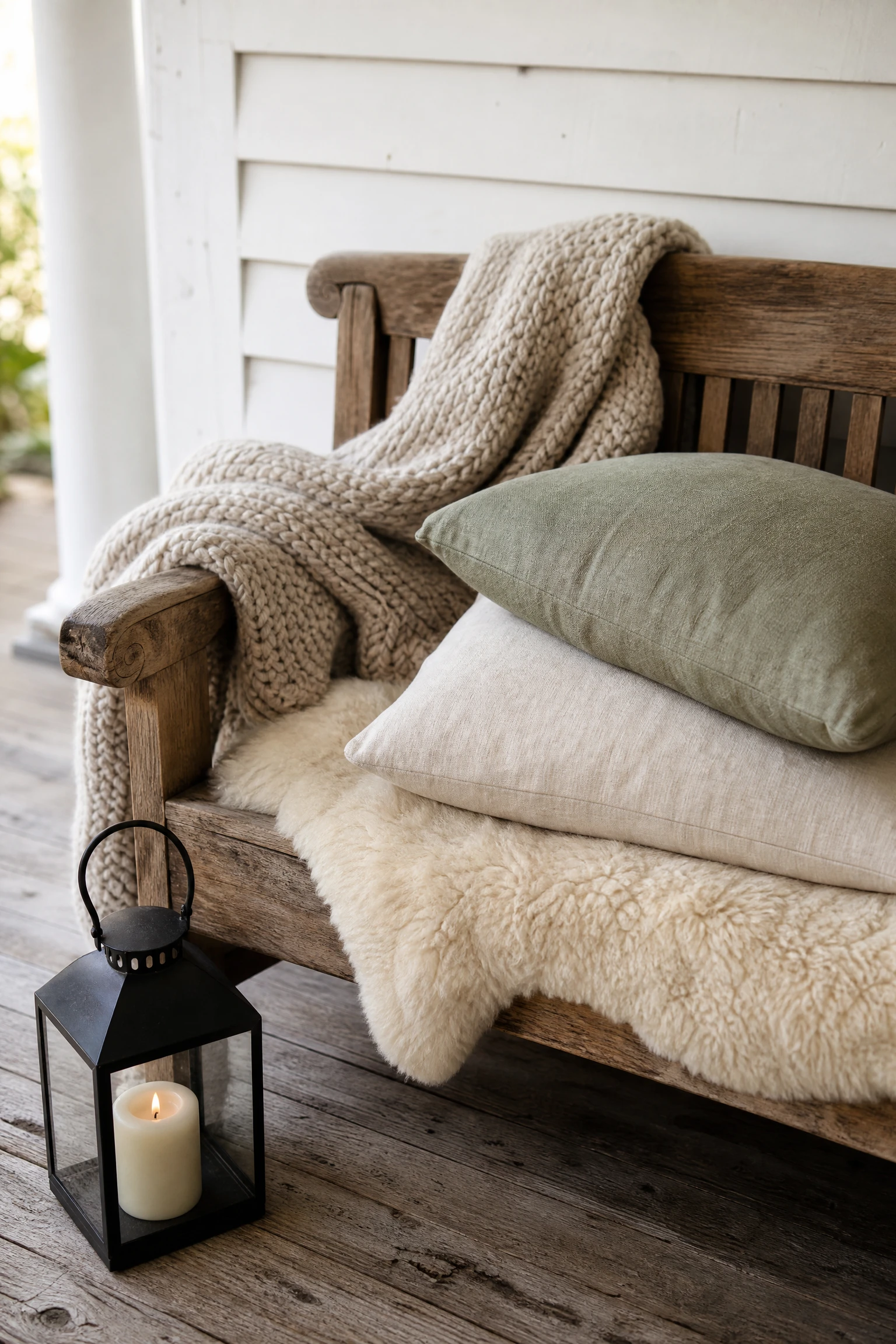
One thing that works really well in this approach is starting with a solid anchor piece rather than decorating outward from the walls. A reclaimed or lightly distressed oak bench, roughly 150 to 180 cm long, becomes the spine of the seating arrangement, and from there you layer. Drape a chunky-knit wool throw in oatmeal or warm grey over one end, stack two or three linen cushions in muted tones like dusty sage, off-white, and faded charcoal, and add a sheepskin over the seat. The color palette stays in the warm neutral range, think undyed wool, ecru, and soft stone, because this is a look that is built on texture contrast rather than color contrast. For lighting, a single black iron lantern with a pillar candle on the floor beside the bench creates the right kind of low, flickering glow for evenings. This setup works beautifully on a small covered front porch and costs very little if you source the bench secondhand. Honest limitation: wool and sheepskin need to come inside when it rains, so factor that in if your porch is exposed.
Designer Note: Vary the weight of your textiles. Chunky knit for visual warmth, smooth linen for contrast, and sheepskin for tactile softness. Using all the same texture flattens the whole look.
2. A Hanging Porch Swing with Undyed Canvas Cushions
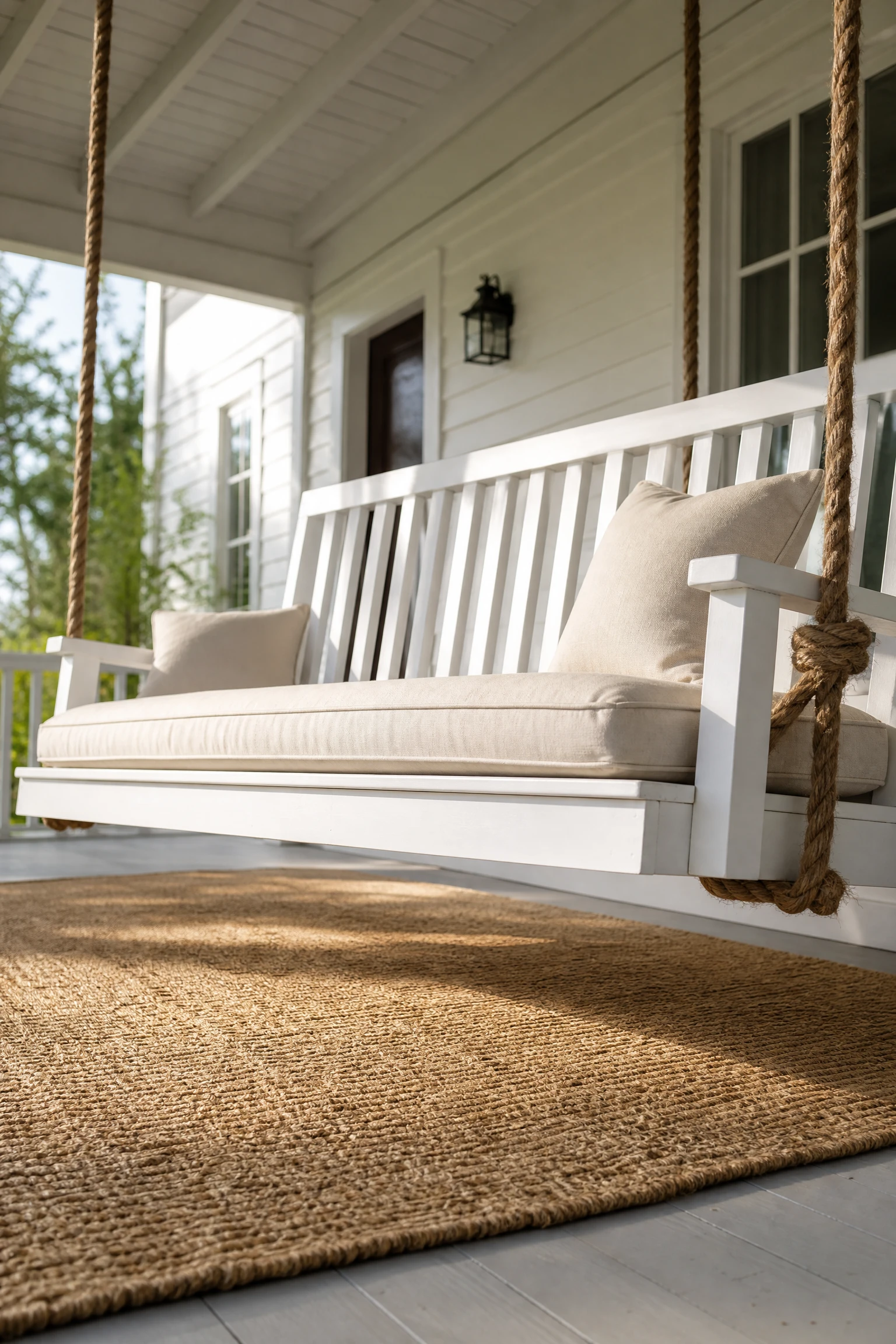
Porch swings read differently in a Scandinavian setting than they do in a traditional Southern or cottage-style home. The key is in the execution. Choose a swing with clean, unfussy joinery, ideally in white-oiled pine or birch with a simple straight back rather than ornate spindles. Hang it with thick natural rope rather than metal chains for a softer, more organic look. Cushions in undyed canvas or washed linen in pale sand keep the palette quiet. Below the swing, a natural jute rug defines the zone without adding visual noise. The beauty of this setup is functional first, which is very much in line with how Scandinavian design actually operates. In practice, this look comes together best when the swing is positioned to catch morning light, making it the natural spot for coffee and a slow start to the day. Budget note: a quality pine swing runs mid-range, but you can replicate the look at a lower price point with a flat-pack version painted in a chalky white and updated hardware.
Designer Note: Rope hangers age beautifully over time and develop a warm patina. If your ceiling beam can handle the load, this is always worth the upgrade from chain.
3. Floor-Level Seating with Stacked Firewood as Decor
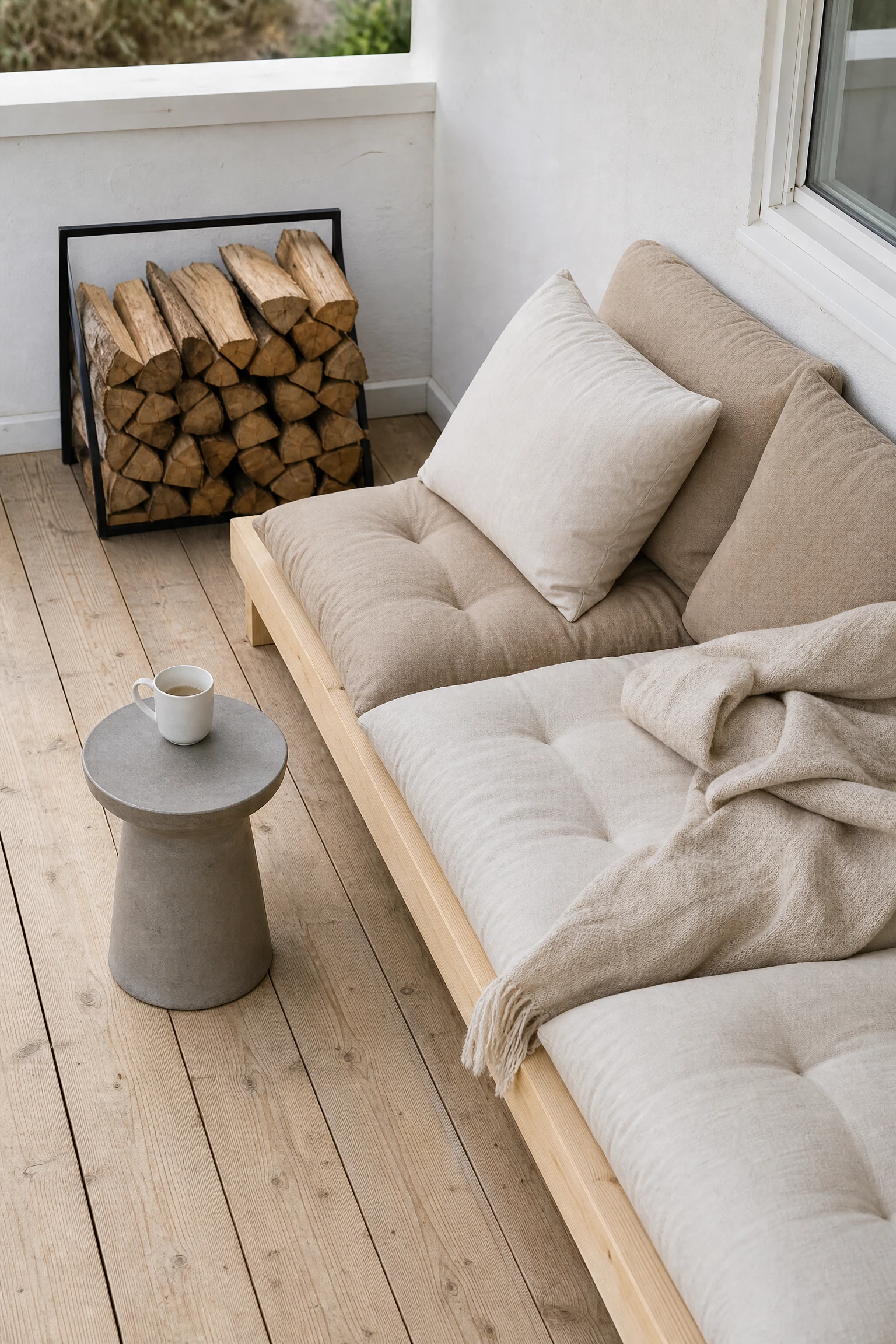
Low seating is underused on porches and it is one of the most distinctively Nordic moves you can make. Think floor cushions in oatmeal and warm sand, a low platform made from rough-sawn pine boards, and cushion covers in a simple natural fabric like hessian or cotton canvas. The layering of heights, some on the floor, some on a low stool, creates a relaxed, unhurried atmosphere that conventional porch furniture rarely achieves. To one side, a neatly stacked row of split firewood against the wall doubles as both a practical storage solution and a deeply textural visual element. The cross-section of cut wood, the grain, the bark edge, all of it adds the kind of organic detail that no accessory from a homeware store can replicate. This works especially well on a covered back porch or a screened porch where weather exposure is limited. Firewood as decor is a functional choice in climates where the porch is used into autumn, but in warmer regions it is purely aesthetic.
Designer Note: Stack firewood in a simple iron log holder to keep it tidy and off the ground. The contrast between the dark metal and the pale wood grain is quietly striking.
Nordic Naturalism: Bringing the Outdoors In
4. Birch Branch Arrangements and Potted Wild Grasses
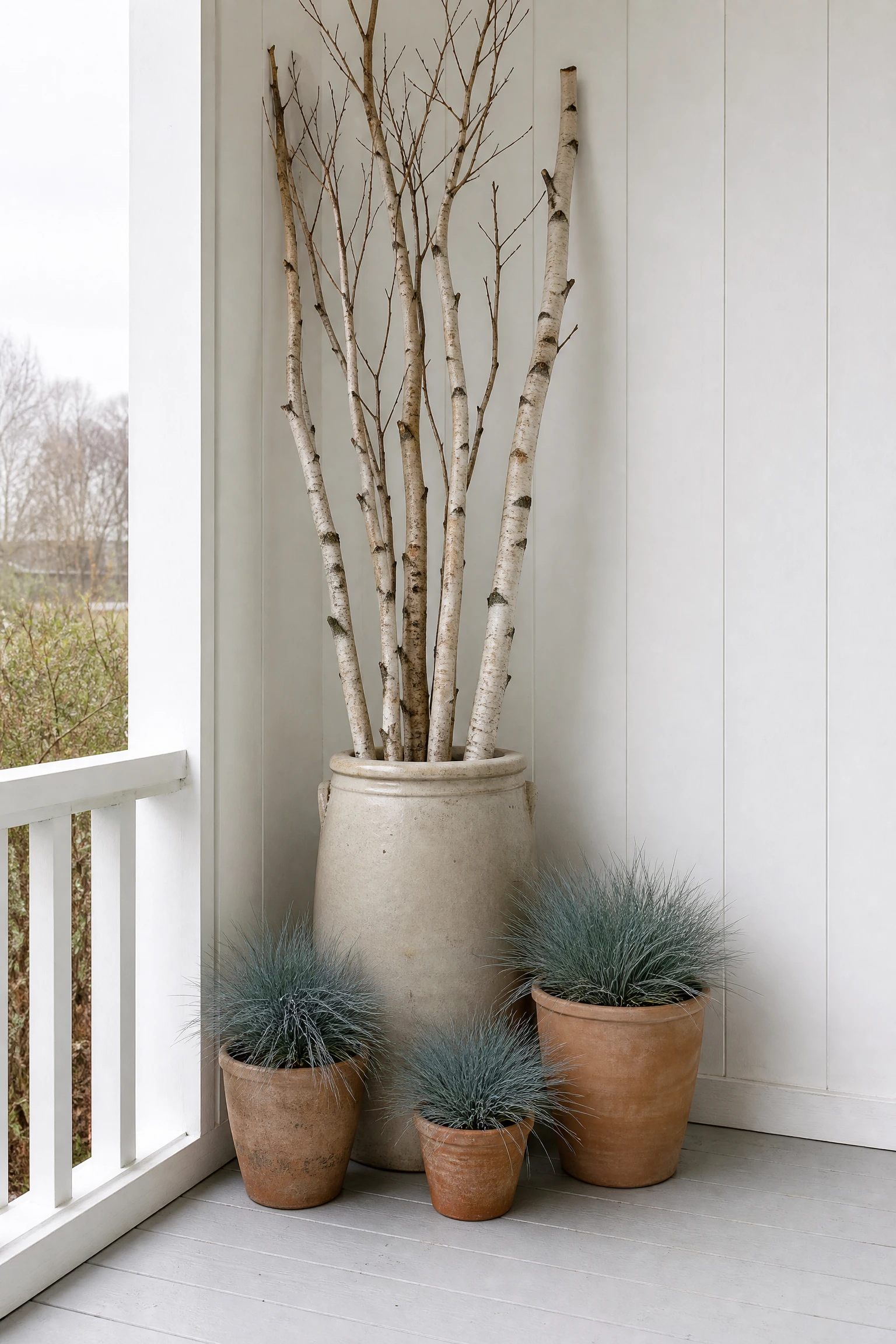
Scandinavian design has a long tradition of treating foraged and found natural materials as legitimate decor, and on a porch, this translates beautifully without costing much. A cluster of tall birch branches with their papery white bark, arranged in a large stoneware crock or a simple terracotta pot, creates an organic focal point that changes with the seasons. Around it, group two or three pots of ornamental grass, feather reed grass or blue fescue both work well, in matte concrete or unpainted terracotta planters. The palette this creates, white, grey, tan, and pale green, is naturally Nordic without any effort. In practice, birch branches hold their shape for several weeks and can be refreshed easily. If foraged branches are not an option, florists and garden centres often carry them affordably. This is a strongly budget-friendly approach that looks far more considered than it is.
Designer Note: Odd numbers work better than even. Three pots, five branches, one crock. Symmetry reads as formal; asymmetry reads as effortlessly Nordic.
5. Vertical Herb Wall with Raw Pine Shelving
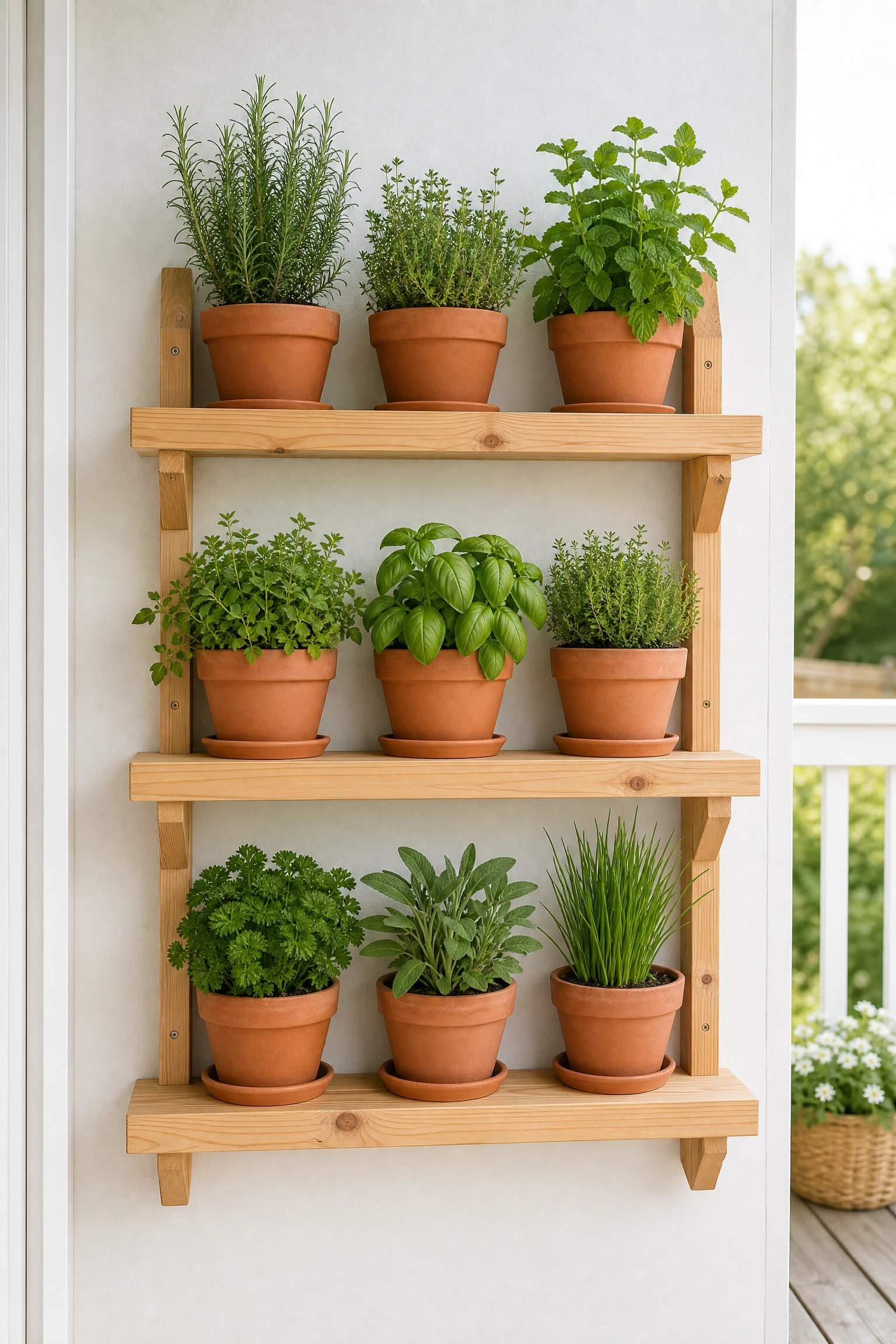
A vertical herb garden on a porch is one of those ideas that sounds complicated but is actually very manageable and incredibly rewarding. In Scandinavian homes, the kitchen and outdoor living areas are treated as connected spaces, so bringing herbs onto the porch is a natural extension of that philosophy. Build or buy a simple raw pine shelving unit, three tiers is usually enough, and fill it with terracotta pots of rosemary, thyme, mint, and basil. The unit should be wall-mounted or leaned against the exterior wall to keep the floor clear. Paint or stain the pine in a chalky pale grey or leave it raw with just a coat of natural linseed oil. The visual effect is structured greenery, which brings life and freshness to the space without the wildness of potted flowers. Honest note: herbs need consistent watering and at least six hours of light, so this works best on a south or east-facing porch.
Designer Note: Use matching pots throughout the shelving unit rather than mixing styles. Cohesion in the vessels makes even a crowded shelf feel organized and intentional.
6. Stone and Gravel Ground Cover with Potted Dwarf Pines
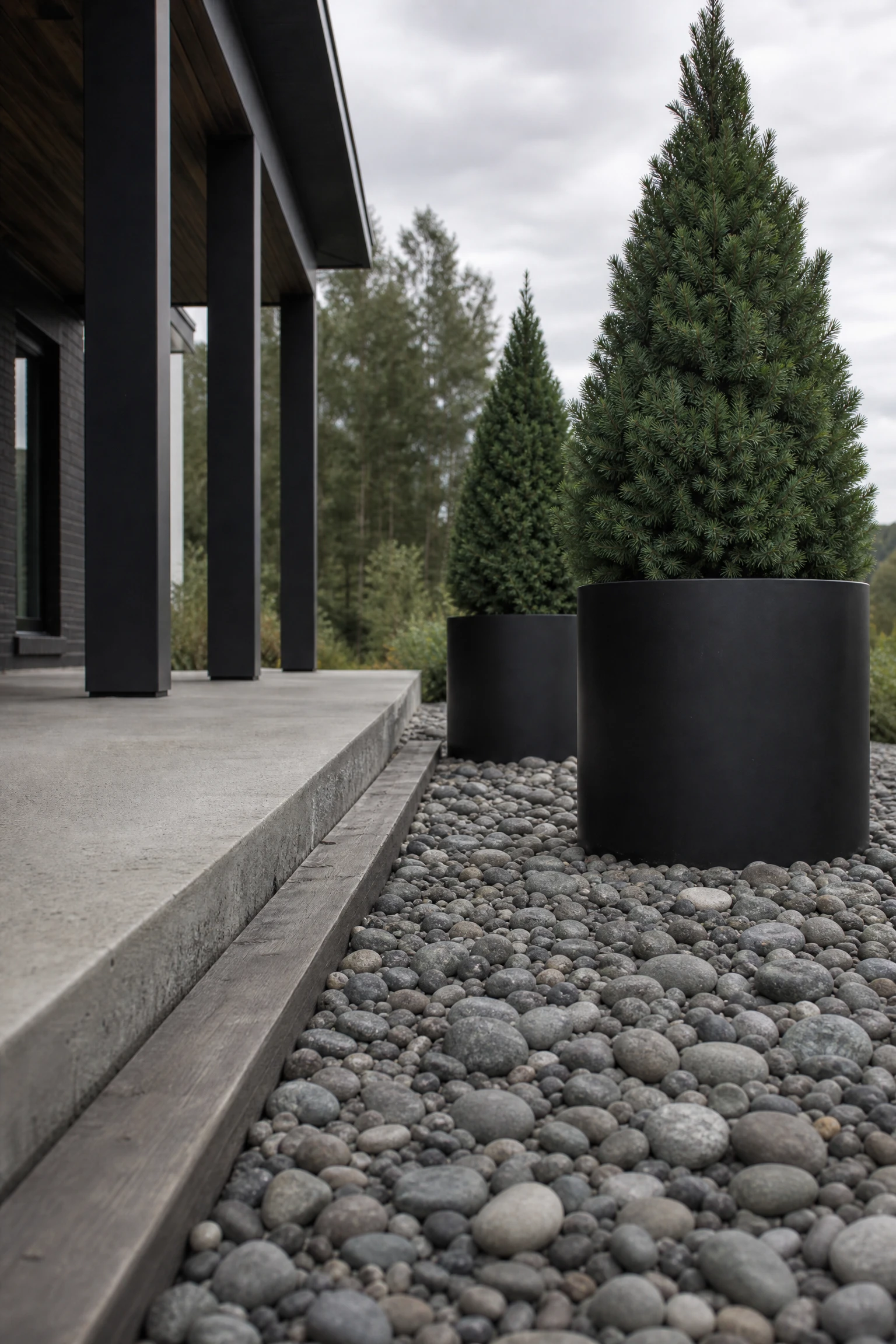
If your porch flows directly into a garden or yard space, one of the most effective things you can do is blur that indoor-outdoor line using ground materials. Laying a section of small river stones or pale gravel along the porch edge, bordered by a simple wooden edging board, creates a transition zone that feels very Northern European in character. Into this gravel bed, place one or two dwarf pine or spruce in simple black metal planters. Dwarf Alberta spruce, for instance, is slow-growing, hardy, and naturally conical, which gives it a clean architectural presence without needing to be shaped. The gravel reflects light upward, which makes the space feel brighter and more open on overcast days. This idea sits at the mid-range to investment end of the budget, depending on how much gravel area you are covering, but the result is a porch that looks completely considered from the street.
Designer Note: Mix stone sizes slightly for a more natural look. One uniform gravel size can look too manicured. A blend of small pebbles and slightly larger stones reads more organic.
7. Hanging Dried Botanicals and a Woven Wall Panel
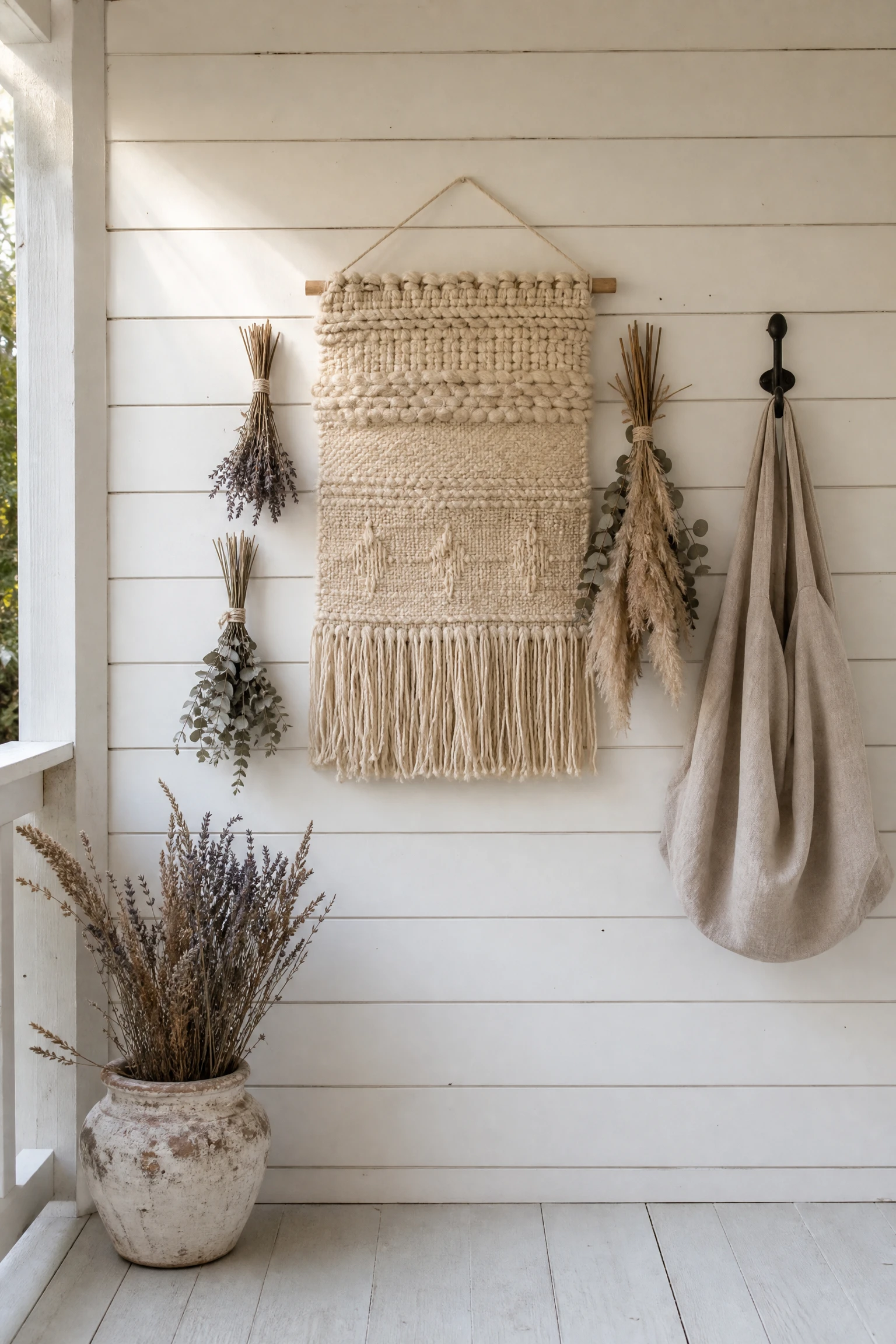
This one draws from the Scandinavian folk craft tradition, which has always incorporated woven textiles and dried plant materials as interior and exterior decoration. On a covered porch, a large woven wall panel in natural undyed wool or cotton, hung flat against the exterior wall, immediately grounds the space and adds acoustic softness. Around and from it, hang small bundles of dried lavender, eucalyptus, or pampas grass using simple twine. The muted tones of dried botanicals, dusty purple, pale silver, warm cream, sit beautifully within a Nordic palette. The woven panel should be at least 60 cm wide to have the right visual weight for a porch wall. This is an affordable approach if you source the panel from a craft market or make it yourself, and dried botanicals are genuinely low-cost. Keep in mind this look is best suited to covered or screened porches where moisture is not a factor, as woven textiles and dried plants do not weather well.
Designer Note: Vary the hanging lengths of your botanical bundles rather than aligning them all at the same height. Staggered lengths create movement and visual interest.
Scandinavian Modern: Clean Lines and Graphic Contrast
8. Black Metal Furniture with White Painted Decking
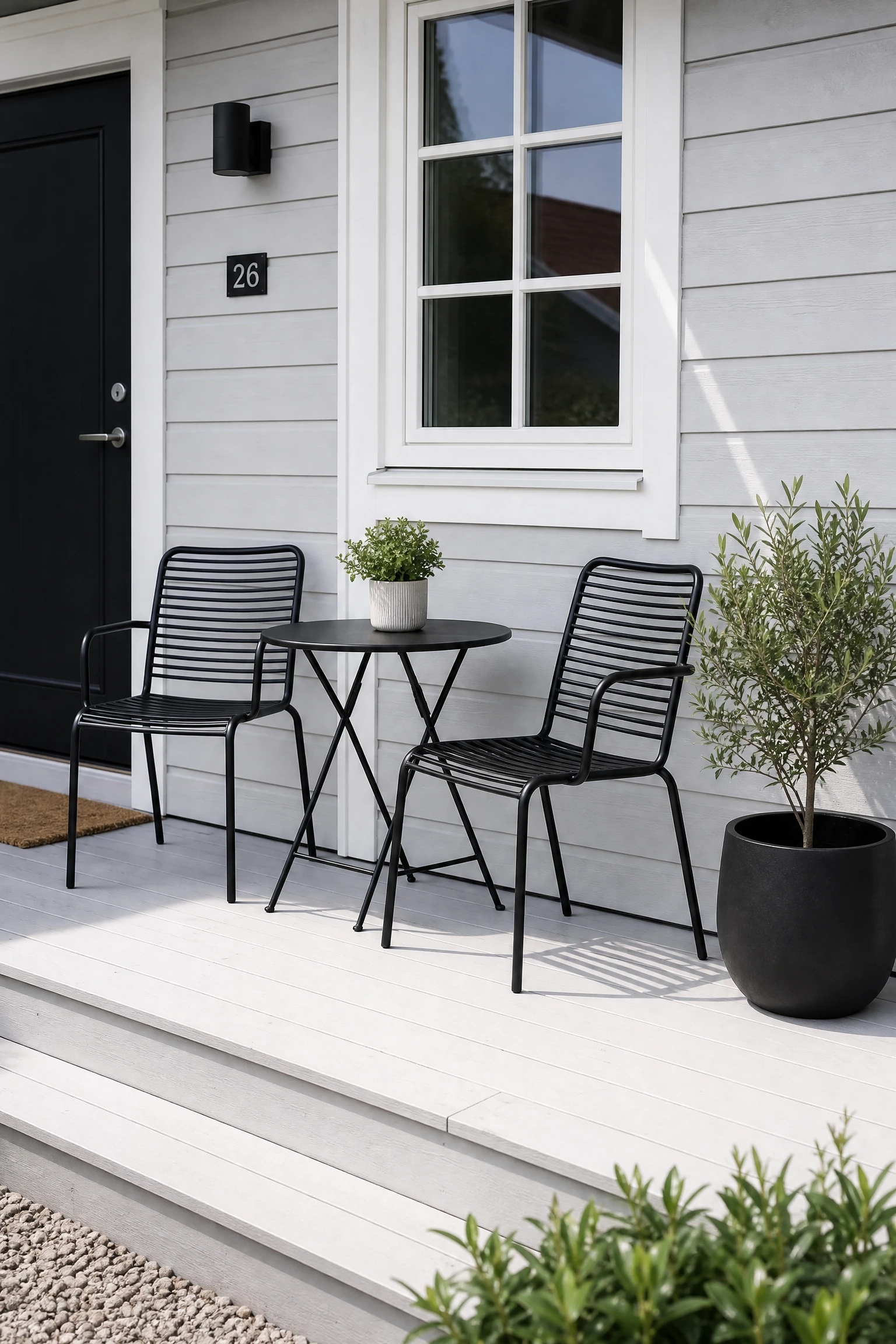
The black-and-white combination is one of the most recognizable moves in Scandinavian modern design, and it translates particularly well to a porch setting. Start with the decking or floor surface: a flat white or very pale grey porch paint immediately lifts the space and reflects available light upward. Against this, black powder-coated metal chairs with a clean, linear profile, think Tolix-style cafe chairs or a simple bistro set, create a strong graphic contrast. The visual weight of the dark furniture against the pale floor is balanced, not heavy, because the lines are so clean. Add a single potted plant in a black matte planter to pull the palette together. This approach works especially well on compact front porches because the high contrast creates strong visual interest without requiring much square footage. It is also a mid-range budget choice, as black powder-coated outdoor furniture is widely available at reasonable price points.
Designer Note: Resist the temptation to add a colorful cushion. The power of this look is in the restraint. A white or charcoal cushion is as far as you should go.
9. Sleek Teak with Concrete Planters and Matte Black Fixtures
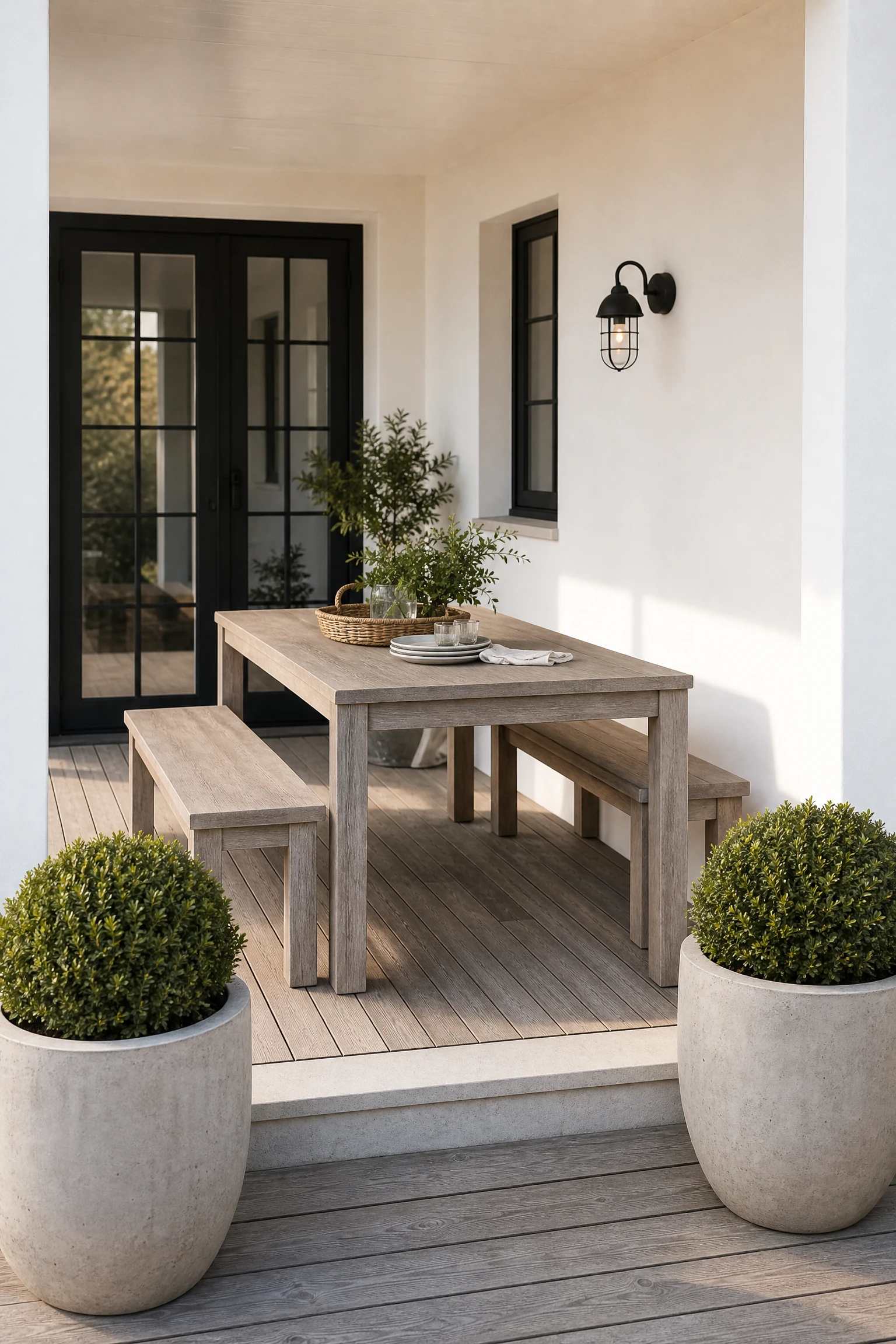
Teak is not a traditional Scandinavian material, but it has been absorbed into the Nordic outdoor aesthetic because of its natural durability and its warm honey-to-silver colour shift over time. A teak bench or dining table with clean straight legs pairs beautifully with heavy concrete planters in a smooth matte finish. The material contrast between warm wood grain and cool grey concrete is a classic Japandi-adjacent move that fits well within the broader Scandinavian modern palette. For fixtures, replace any existing brass or chrome porch lights with simple matte black wall sconces, the kind with a small cage or industrial shade. These are widely available and make a significant difference to how the space reads in the evening. This is a mid-to-investment-range setup, as quality teak furniture carries a higher price, but it lasts for decades outdoors with minimal care.
Designer Note: Let teak go grey naturally rather than oiling it back to its original honey tone. The silver-grey weathered finish looks more sophisticated and requires no maintenance.
10. Minimalist Bar Cart and a Statement Outdoor Mirror
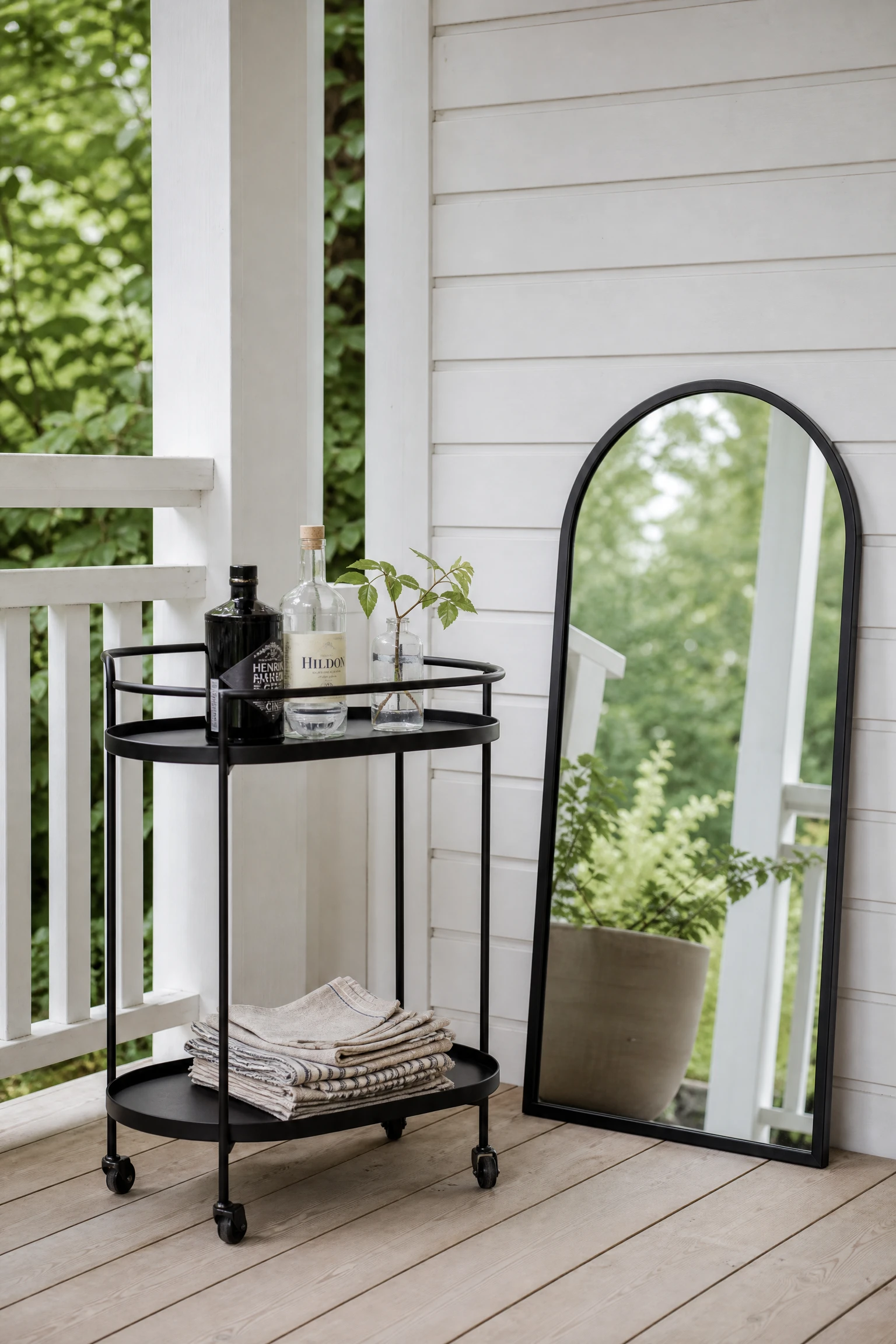
An outdoor bar cart might seem like an unusual Scandinavian choice, but when you strip it back to a simple black or brushed steel two-tier cart with clean geometry, it fits naturally into the Nordic modern aesthetic. On the shelves, keep it edited, two or three bottles, a small plant cutting in a clear bottle, a stack of simple linen napkins. The cart gives the porch a purposeful, social energy without overfurnishing the space. To amplify light and make the porch feel larger than it is, lean a round or arch-top mirror in a black iron frame against one wall. Outdoor-rated mirrors are available at most homewares retailers and they have a significant effect on the perceived size and brightness of a porch. This combination works well for entertaining-oriented porches, particularly when you want the space to feel polished without feeling formal.
Designer Note: Position the mirror so it reflects greenery or sky rather than a wall or fence. The reflection should add to the view, not repeat what is already there.
11. Floating Shelf Display with Neutral Art Objects
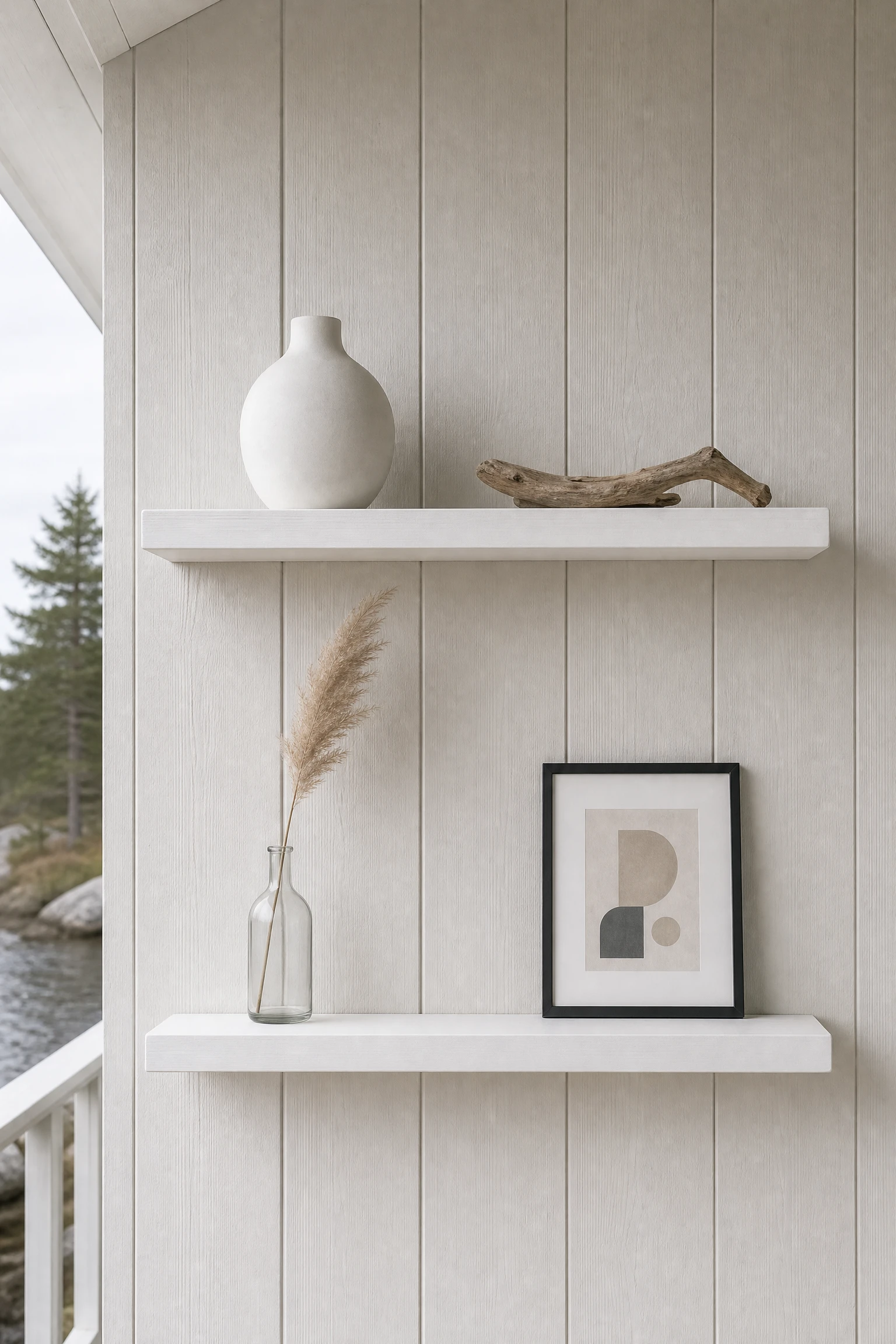
In Scandinavian interiors, the styled shelf is a serious art form, and there is no reason it cannot translate to a covered porch. Install one or two raw pine or white-painted floating shelves on the exterior wall, ideally at eye level, and dress them with a small, carefully chosen collection of objects. Think a smooth white ceramic vase, a chunk of driftwood, a single dried stem in a narrow bottle, and a small abstract print in a plain black frame. The display should feel sparse, not packed. Negative space is as important as the objects themselves. Visually, this approach adds personality and a gallery-like quality to what is often a blank exterior wall. This is a very budget-friendly idea if you already own some of the objects and only need to invest in the shelves and fixings. Covered porches only as shelves and their contents will not survive direct rain exposure.
Designer Note: The rule of three works well here. Group objects in clusters of three at varying heights. One tall, one medium, one small. It almost always looks right.
Fjord-Inspired Textures: Raw, Earthy, and Beautifully Imperfect
12. Rough Stone Flooring with a Hand-Knotted Rug
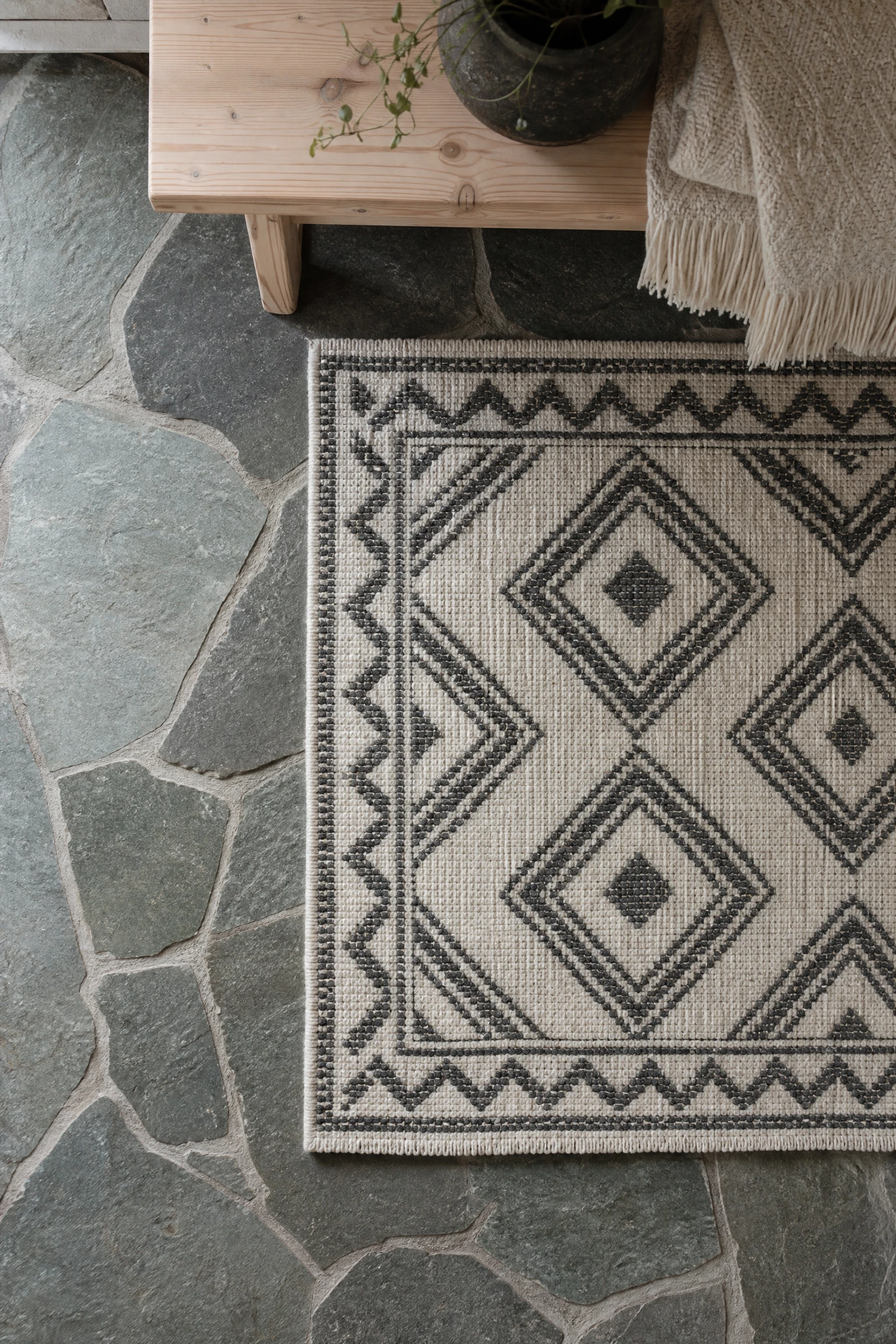
If you are in a position to address your porch flooring, irregular natural stone, such as slate, schist, or rough-cut limestone, is one of the most authentically Nordic choices you can make. The unevenness of natural stone, its colour variation and textural surface, is exactly the kind of imperfection that Scandinavian design, particularly the wabi-sabi-influenced Nordic approach, celebrates rather than hides. On top of the stone, lay a large hand-knotted wool rug in a simple geometric pattern, perhaps a classic Nordic diamond or a plain striped kilim in cream and charcoal. The layering of rough stone beneath a soft textile is a deeply satisfying material contrast that makes the space feel both grounded and comfortable. This is an investment-level flooring choice, but if the porch is a long-term feature of your home it is worth considering seriously.
Designer Note: Seal natural stone with a matte penetrating sealer rather than a glossy topcoat. The glossy finish makes stone look artificial. Matte keeps it looking raw and natural.
13. Whitewashed Brick Wall with Rattan Pendant Lighting
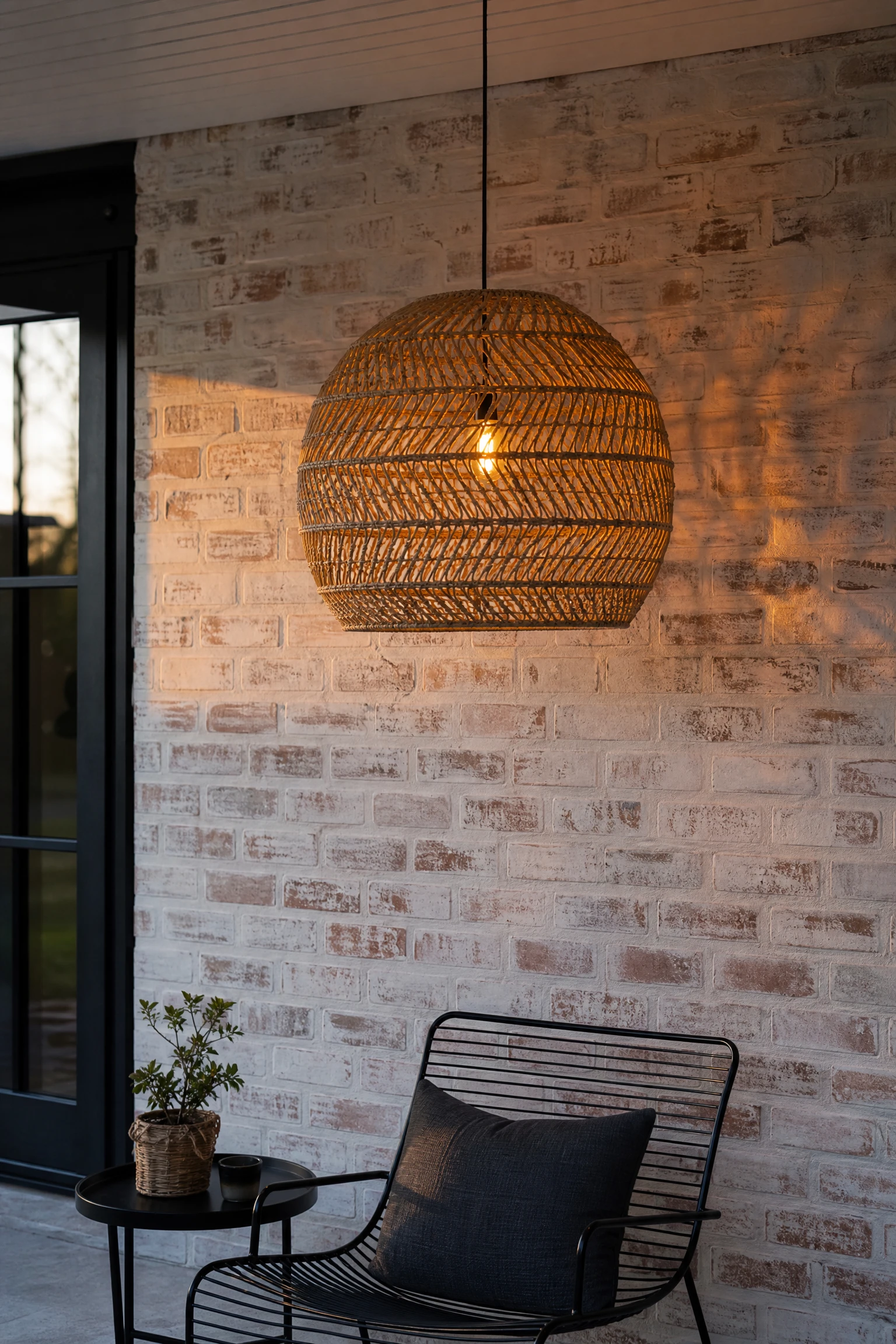
A whitewashed brick exterior wall on a porch is one of those details that photographers love and homeowners often overlook. The whitewash technique, which is different from solid paint because it allows the texture and colour variation of the brick to show through, creates a surface that is simultaneously rustic and refined. It is a look associated with Swedish farmhouses and Danish coastal homes and it makes an immediate impact. Against this backdrop, hang a single large rattan pendant light from the porch ceiling. A round or dome-shaped woven rattan shade casts a warm dappled pattern of light and shadow at night, which adds enormous atmosphere. This is a very budget-friendly combination as whitewash can be made with diluted white exterior paint and rattan pendants are widely available and affordable. It works on both front and back porches.
Designer Note: Mix your whitewash thin, roughly one part paint to two parts water, and apply with a brush using quick, overlapping strokes. The goal is translucency, not coverage.
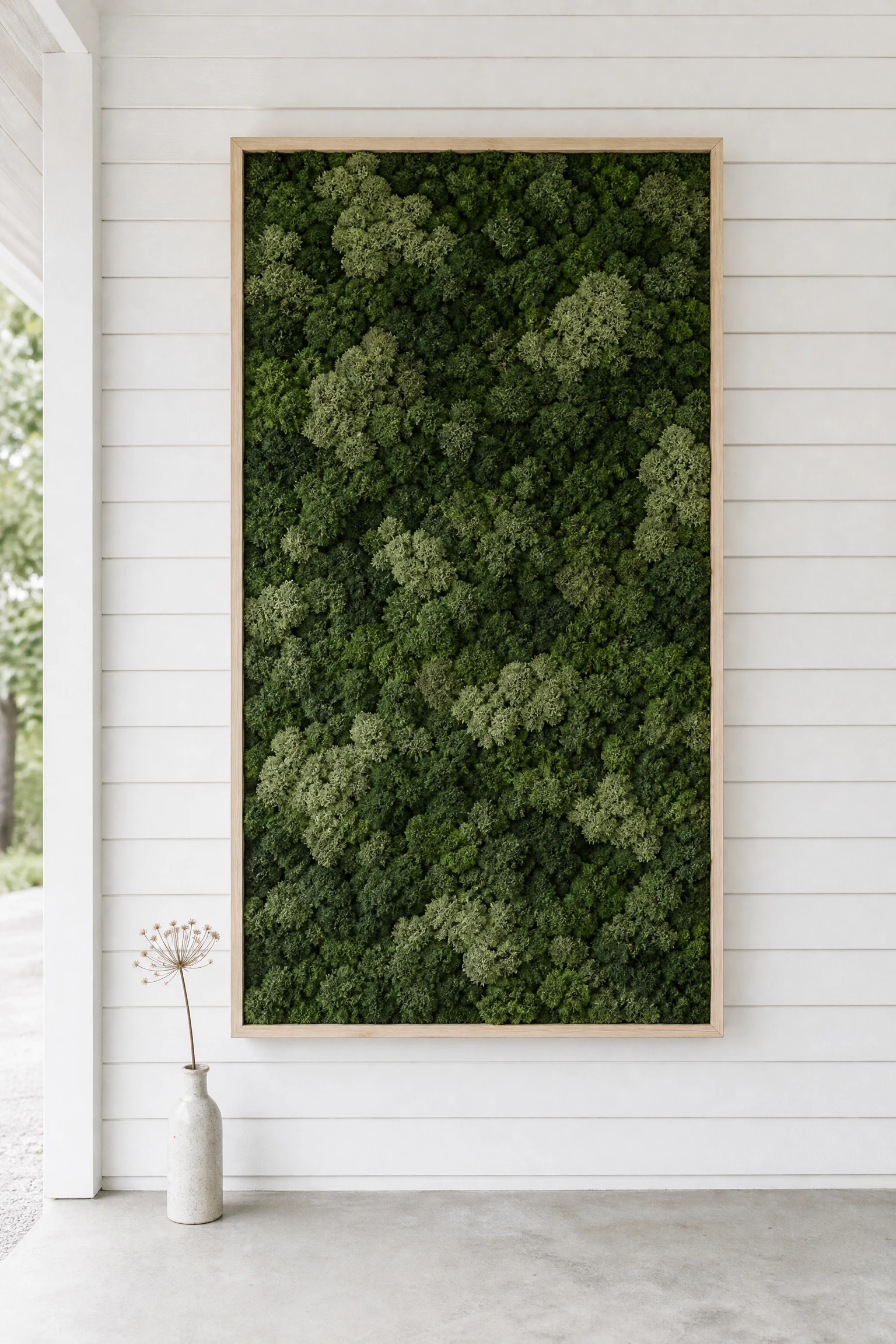
14. Moss Wall Panel as a Living Backdrop
Preserved moss panels are one of the more distinctive and genuinely impactful decor choices for a covered porch wall. Unlike a living vertical garden, preserved reindeer moss requires no water, no soil, and no sunlight, which makes it genuinely low-maintenance. Mounted on a backing board and framed simply in raw pine or black metal, a moss panel can fill a large wall section with rich organic texture in shades ranging from deep forest green to pale sage. The visual effect is significant, it brings the feeling of a Northern forest directly onto your porch without any of the upkeep. This is a mid-range investment depending on the size, but preserved moss panels last for many years indoors and in covered outdoor settings. The limitation is that they should not get wet, so a fully exposed porch is not suitable.
Designer Note: Frame your moss panel the same way you would frame art, with a clean border and deliberate placement. A panel simply glued to the wall without a frame looks unfinished.
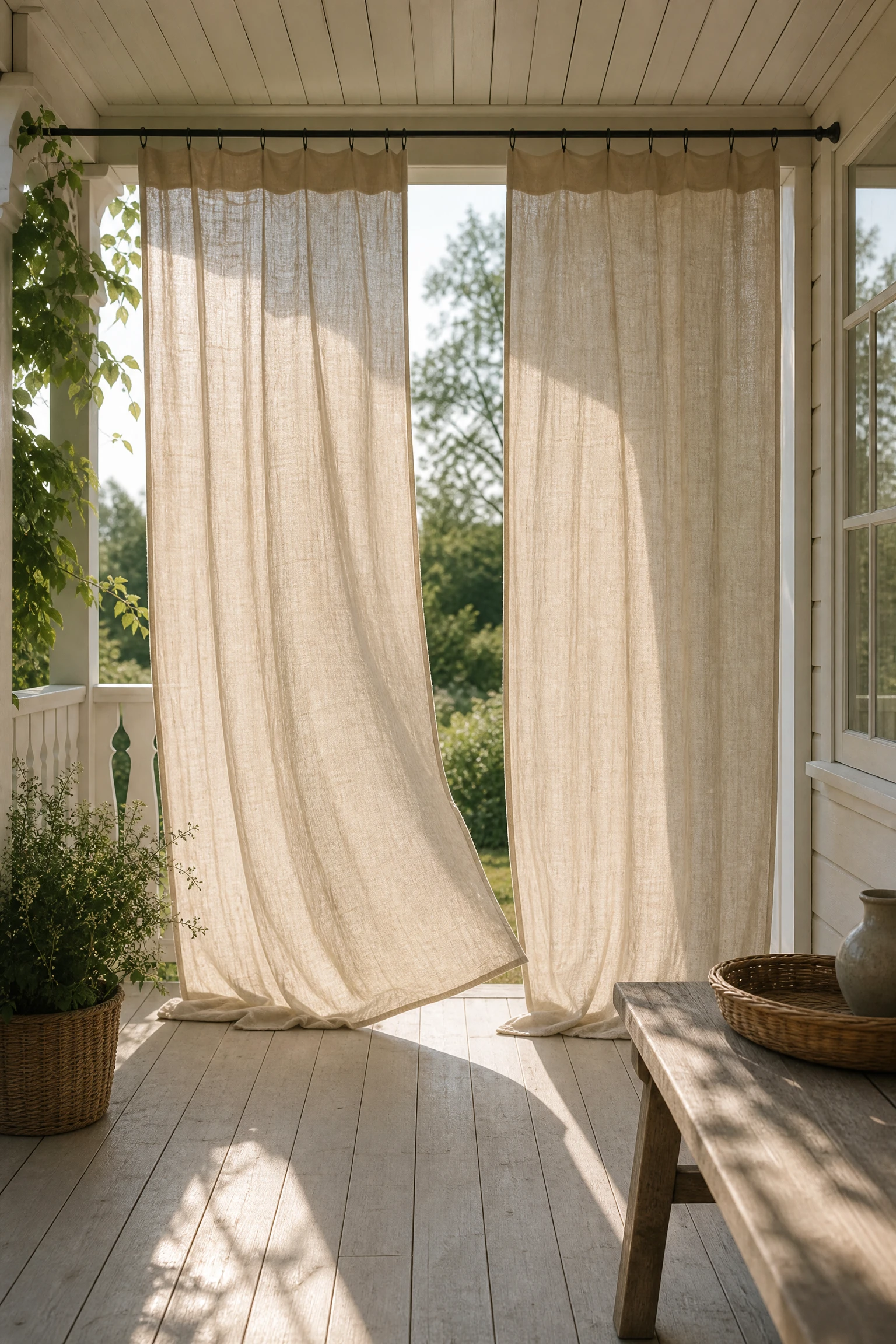
15. Raw Linen Curtains on a Simple Iron Rod
Porch curtains in a Scandinavian setting should feel entirely different from the heavy drapes or colorful outdoor fabrics you might see elsewhere. The choice here is raw, undyed linen in a panel width wide enough to pool slightly on the floor. The natural wrinkle and drape of linen is the whole point, it is not a fabric that needs to look pressed or perfect. Hang the panels on a simple black iron curtain rod using ring clips rather than a track or valance. When the panels catch a breeze, the movement adds life and softness to the porch. Functionally, linen curtains can filter harsh afternoon sun while still allowing plenty of light through. Budget note: linen fabric by the metre from a fabric retailer is considerably more affordable than ready-made outdoor panels and gives you control over the length and weight of the fabric. These panels need to be brought in before rain.
Designer Note: Do not hem linen curtains too short. Let them touch or slightly pool on the floor. The generous length is what gives them their relaxed Nordic quality.
Nordic Lighting: Setting the Right Mood After Dark
16. String Lights Woven Through a Birch Canopy
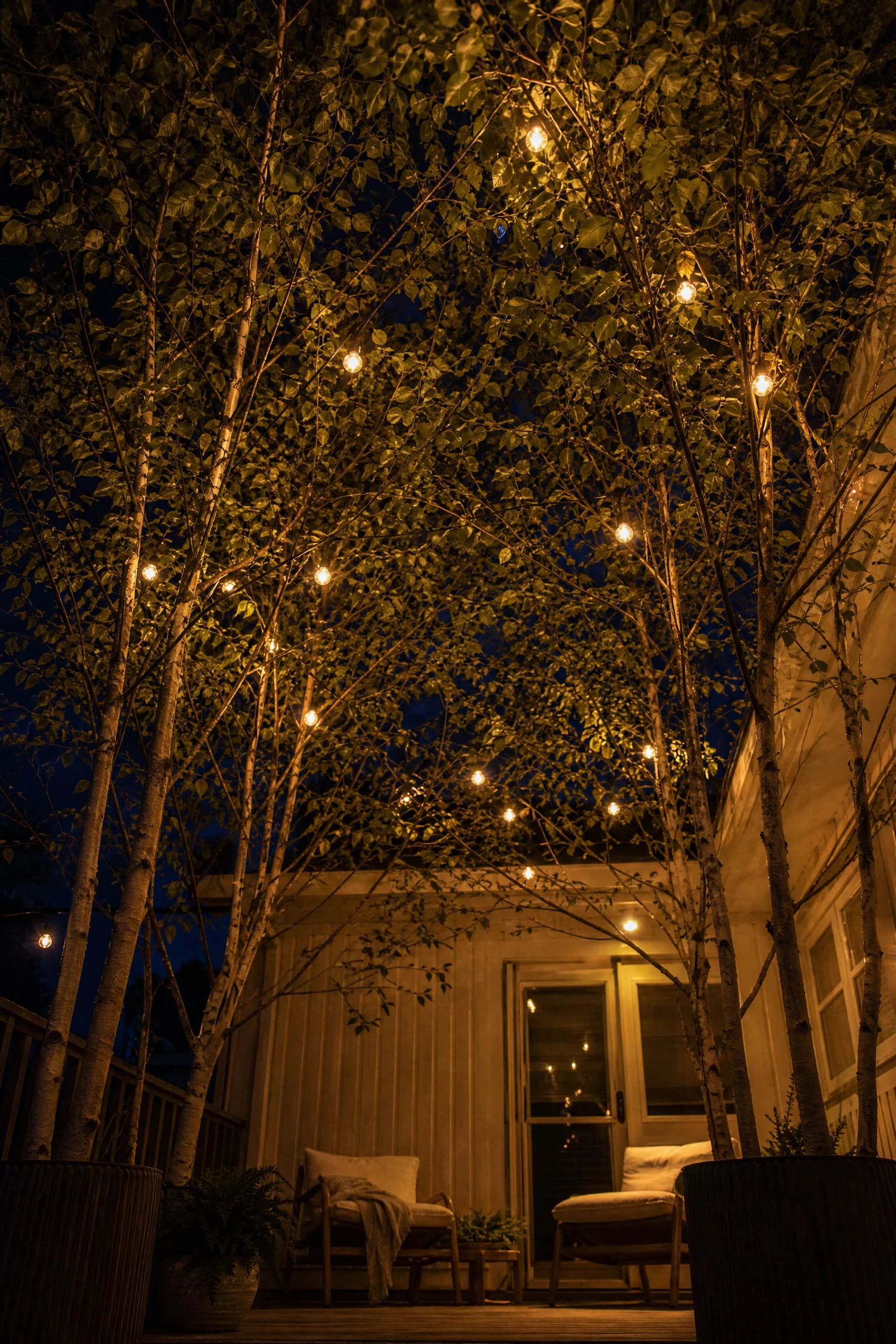
Warm-toned string lights strung through a birch branch canopy overhead is one of those porch lighting ideas that looks almost too simple to work, and then completely delivers. The key is in the branch arrangement. Use three or four tall birch trunks or thick branches in large planters to create a loose overhead frame, then weave Edison-style warm bulb string lights through the branches so that the light appears to come from within the canopy rather than from a fixture on the ceiling. The effect in the evening is extraordinarily beautiful, warm, dappled, and completely organic. Color temperature matters here: choose bulbs in the 2200K to 2700K range (very warm white) for the right glow. This setup sits at a mid-range budget and works particularly well on open porches where there is ceiling height to work with.
Designer Note: Use a timer or smart plug so your string lights come on automatically at dusk. A porch that is always lit at the right moment feels far more intentional than one that is often dark.
17. Clustered Pillar Candles in Black Iron Lanterns
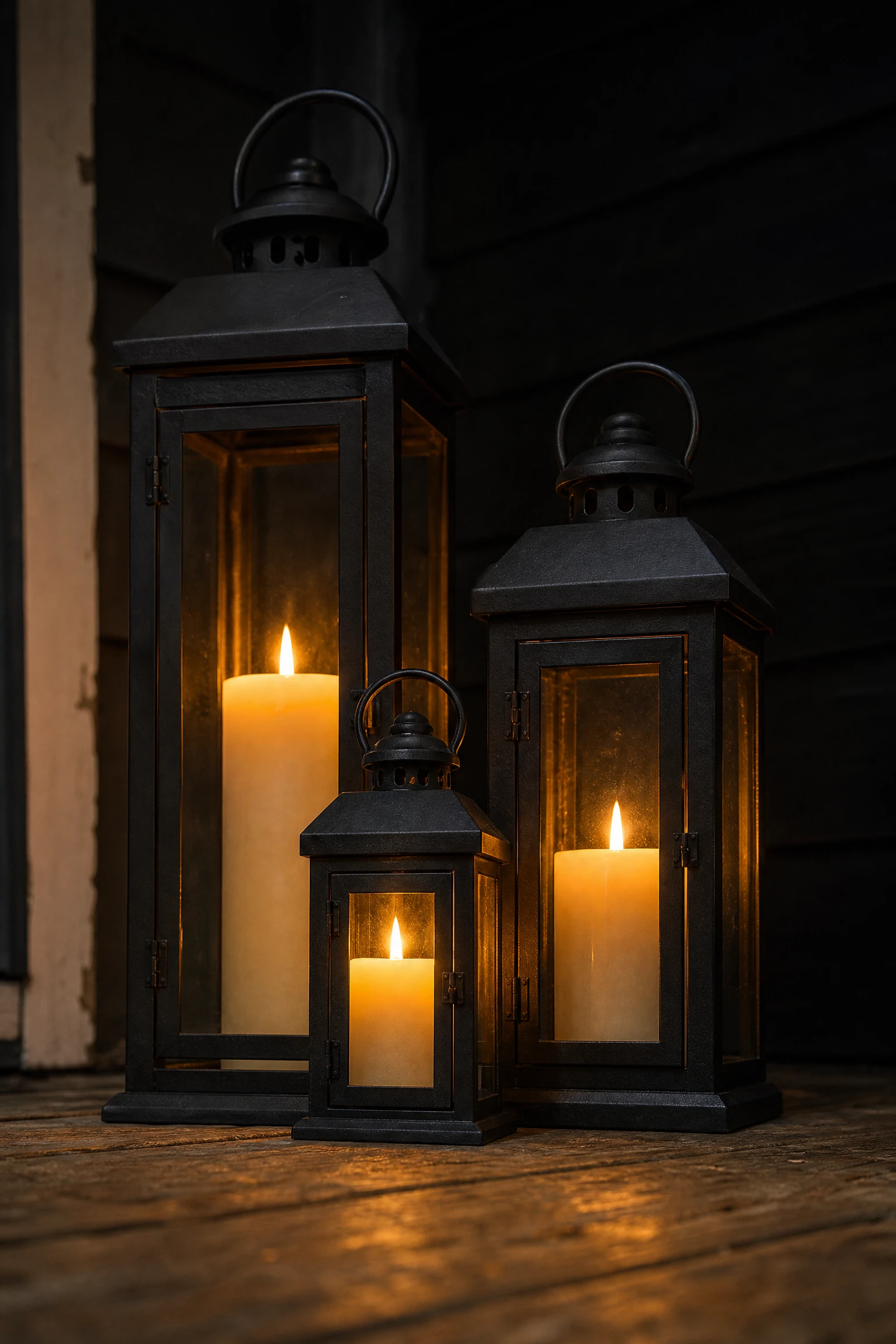
Candlelight is absolutely central to Nordic living, particularly the Danish concept of hygge, and on a porch it is one of the easiest and most affordable ways to create genuine atmosphere. Rather than one statement lantern, group three lanterns of varying heights together in one corner of the porch, each holding a chunky pillar candle in ivory or unbleached beeswax. Black iron lanterns are the right choice here, they have visual weight and a graphic quality that keeps the look grounded rather than fussy. In practice, battery-operated pillar candles are a safer and more practical choice for an outdoor space, and modern versions are genuinely convincing in their flicker. For a covered porch where open flame is manageable, real beeswax candles are the authentic choice and the scent alone is reason enough.
Designer Note: Cluster lanterns on a simple wooden tray or a flat stone slab to anchor them as a grouped display. Lanterns scattered individually around the porch lose the visual impact.
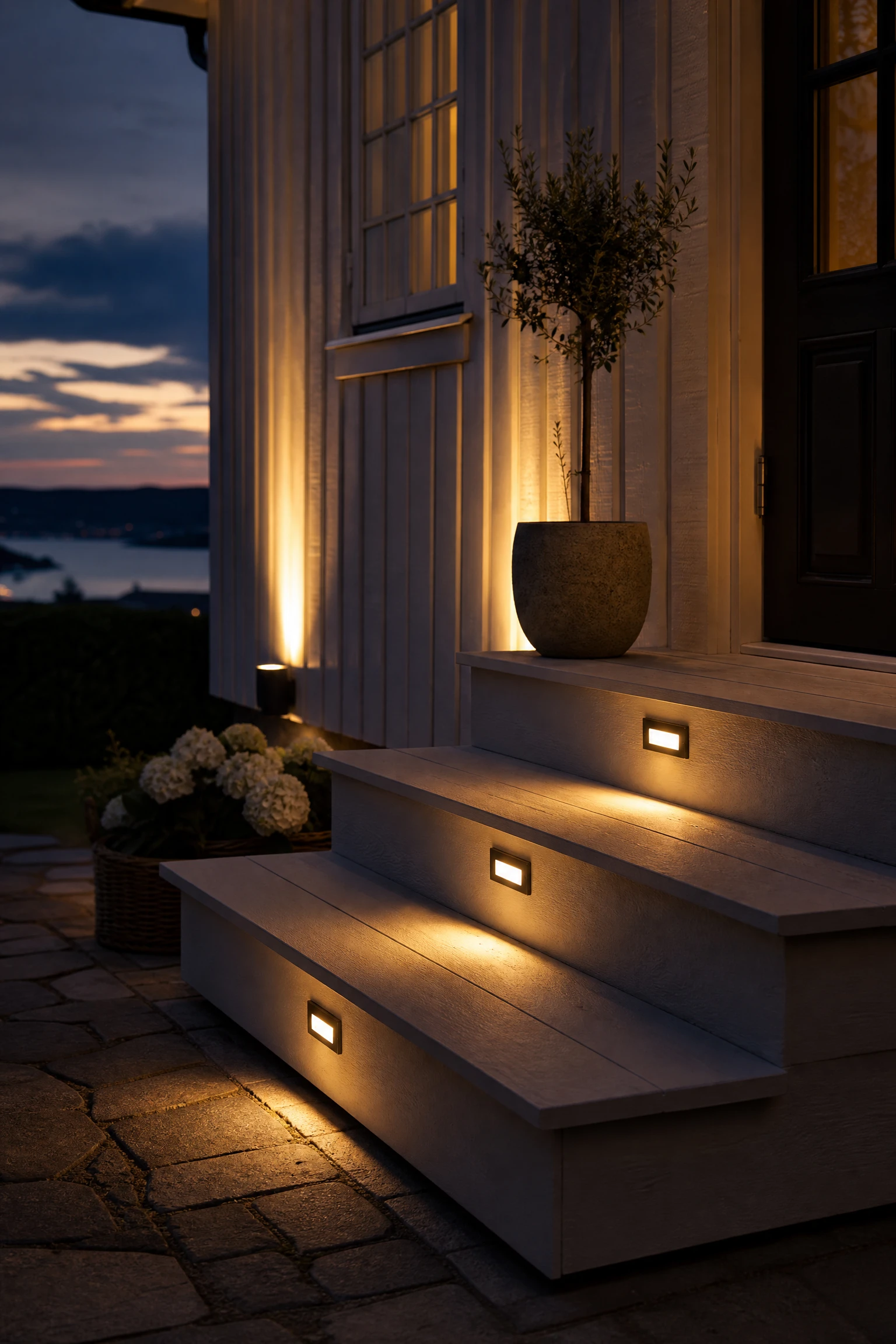
18. Integrated Step Lighting with Recessed Ground Fixtures
This is the idea that is most often skipped because it requires some installation work, but it has one of the biggest impacts on how a porch reads after dark. Recessed LED step lights installed into the risers of porch steps, or along the base of the porch wall, provide a low, warm glow at ground level that is both practical and beautifully atmospheric. In Scandinavian design, layered lighting at multiple heights, ceiling level, eye level, and floor level, is a fundamental principle. Relying on a single overhead bulb is the most common porch lighting mistake. Ground-level lighting changes how the space feels completely. Choose fixtures in a matte black or brushed steel finish to keep the look consistent. This is a mid-to-investment-range addition depending on whether you hire an electrician, but it makes a permanent improvement to the porch.
Designer Note: Warm white LEDs in the 2700K range are the only choice for this application. Cool white (4000K and above) will make your porch feel like a car park rather than a home.
Functional Nordic Porch: Storage, Utility, and Smart Design
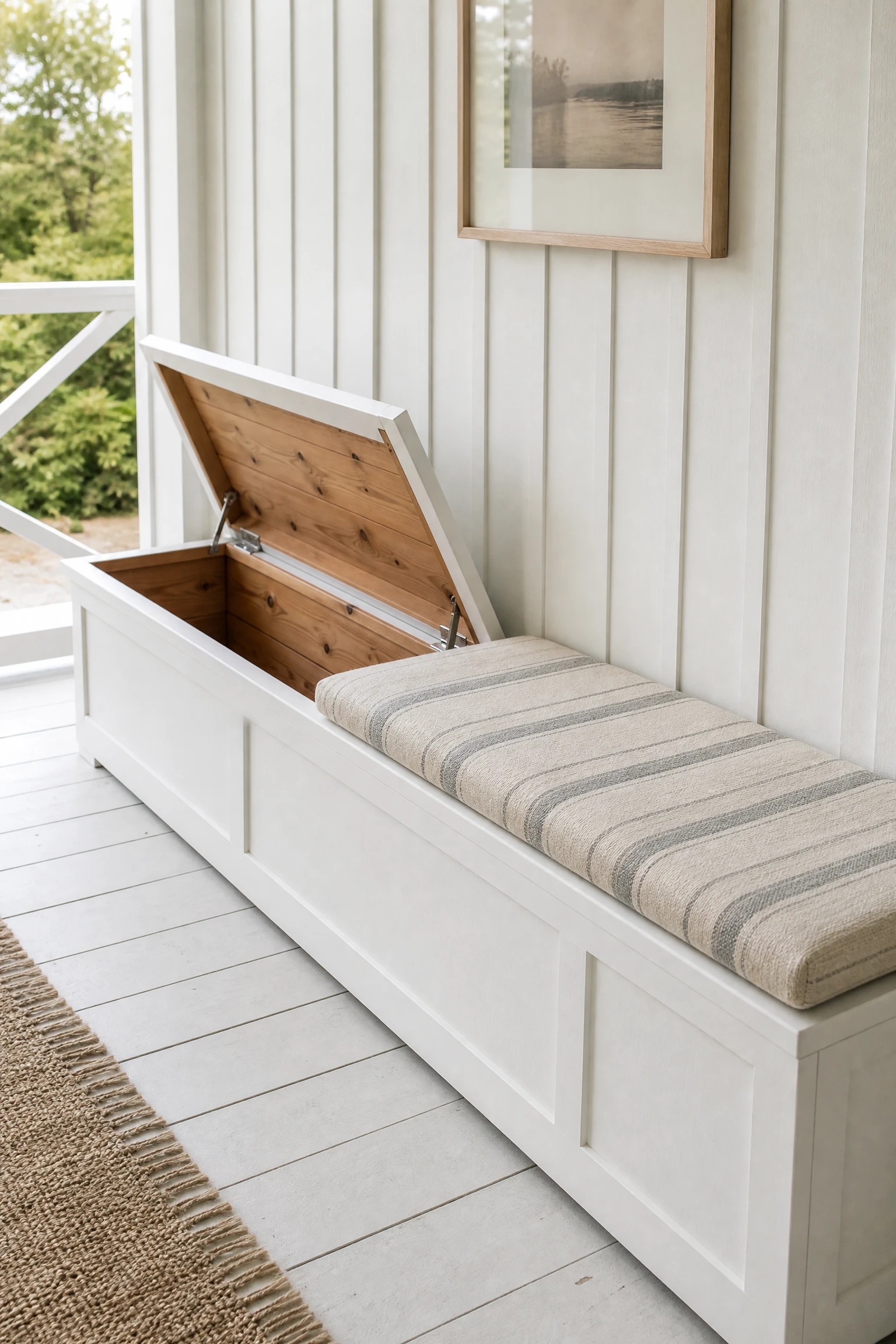
19. Built-In Bench with Hidden Storage Under the Seat
A built-in bench with a hinged lid is one of the most practically Scandinavian things you can add to a porch, because Nordic design absolutely insists that beautiful things should also be useful. Build or commission a simple bench along one porch wall in painted white or natural pine, with a lift-up seat that reveals a storage compartment underneath. Inside, you can store cushions, throws, garden tools, or outdoor toys, all the things that otherwise clutter the porch floor. The bench top cushion should be in a durable outdoor fabric, perhaps a flat-weave cotton in a natural or muted stripe, for a comfortable seating surface. This is a mid-range project if built to measure, or more affordable if you use a kit bench and add a cushion. The result is a porch that feels organized, calm, and genuinely lived-in.
Designer Note: Line the inside of the storage compartment with a simple cedar panel or cedar sachet to keep the contents smelling fresh and to deter insects and moths from settling in.
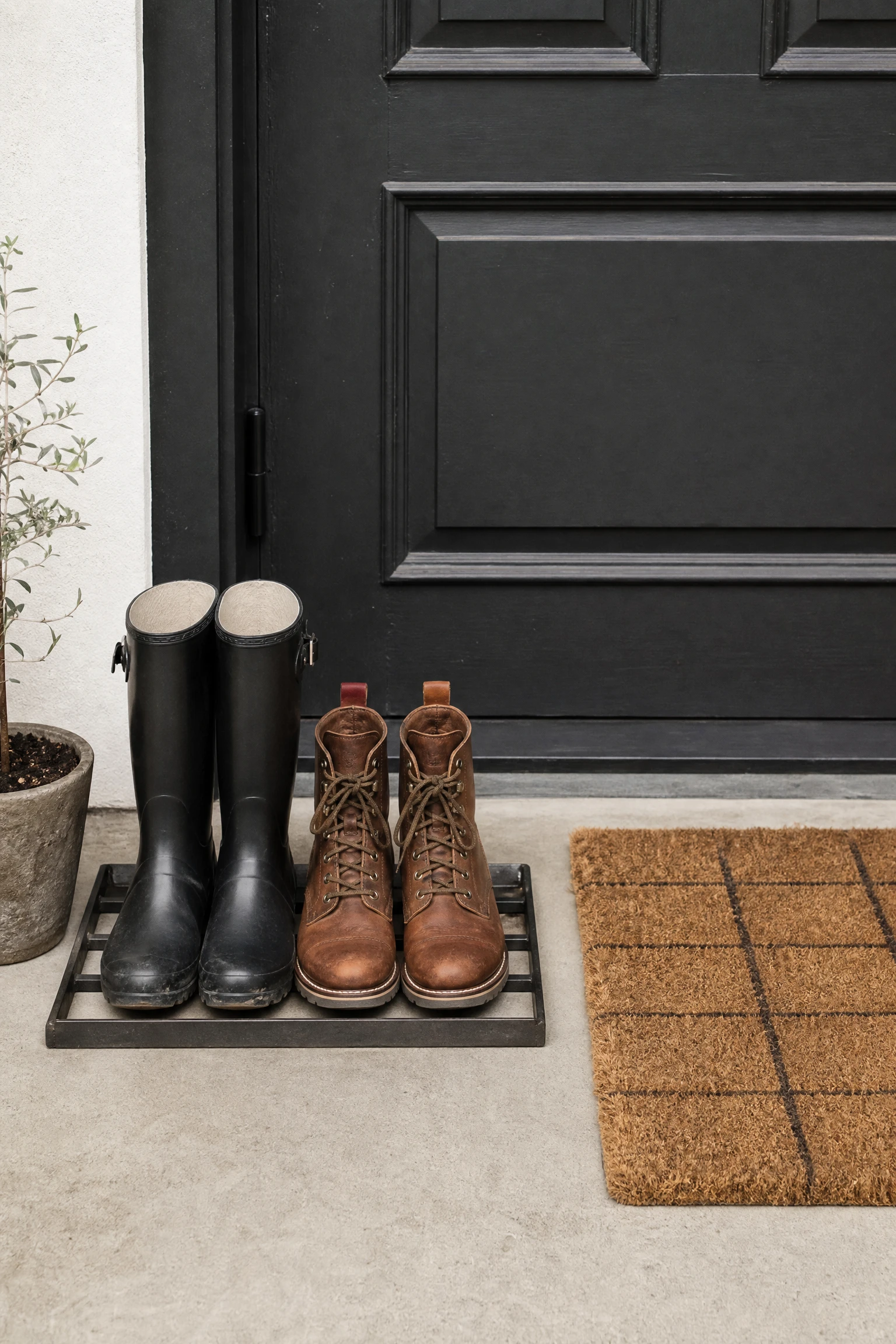
20. A Simple Boot Rack in Raw Iron with a Coir Doormat
The entryway moment on a Scandinavian porch is something Nordics genuinely care about. Shoes come off at the door in Scandinavian culture without exception, which means the porch entry needs to handle footwear with both function and style. A flat raw iron boot rack, the kind with simple horizontal bars at ankle and knee height, keeps footwear organized without taking up much floor space. Beside it, a thick natural coir doormat with a simple graphic, a grid pattern or plain text in a minimal font, sets the right tone immediately. The combination of dark iron and natural coir is textural and honest, it does not try to be decorative, and that is precisely why it works. This is a strongly budget-friendly pairing and one of the highest impact-per-pound changes you can make to a porch entry.
Designer Note: A coir mat with a graphic or word should use a dark print on natural coir rather than a bright color. The contrast keeps it looking sharp and the muted tone stays within the Nordic palette.
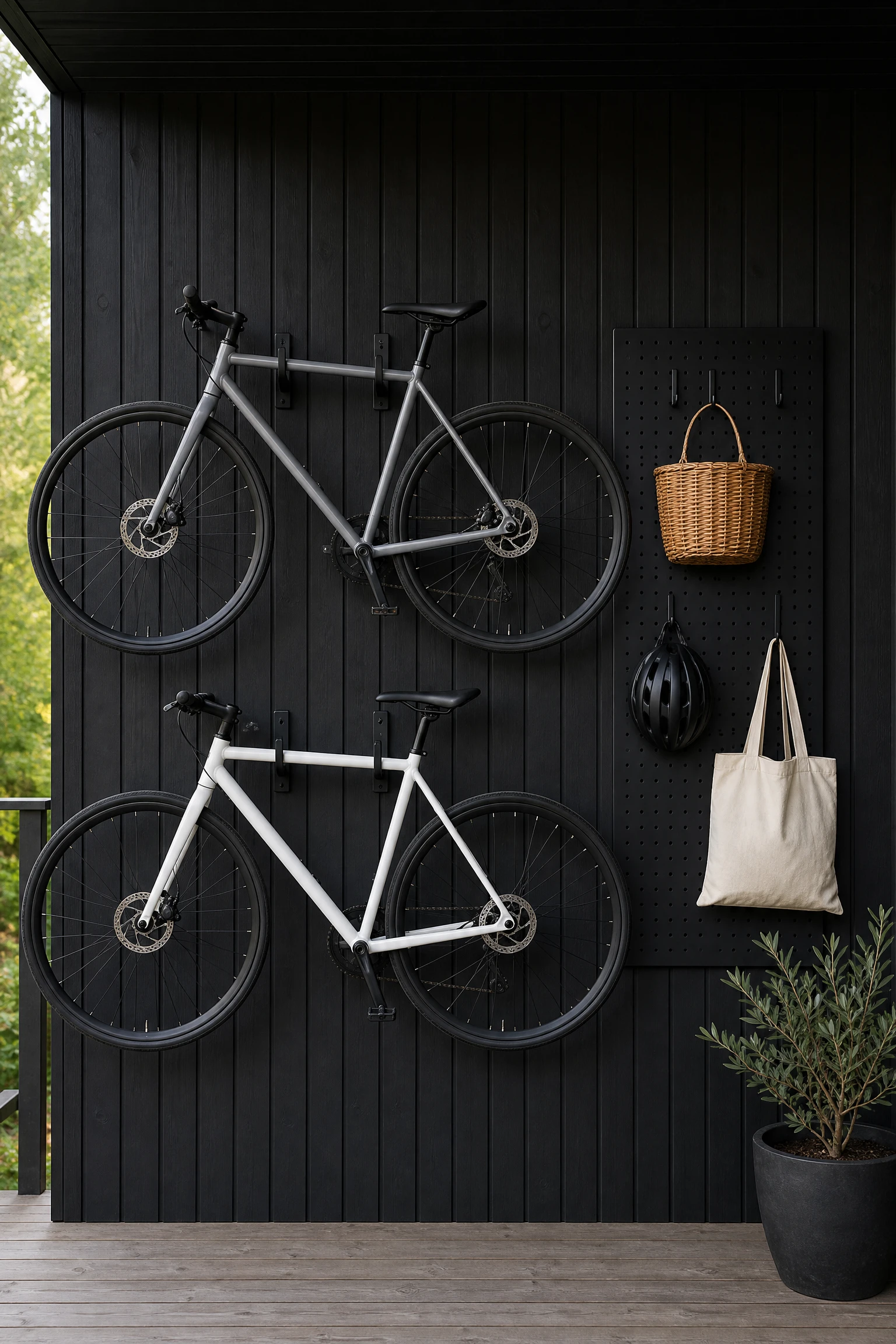
21. Wall-Mounted Bike Hooks with a Functional Pegboard
In Nordic countries, cycling is part of daily life, and porch storage for bikes is treated as a design challenge rather than a practical nuisance. Wall-mounted bike hooks in black powder-coated steel keep one or two bikes off the porch floor and organized against the wall. Alongside the bike hooks, a section of painted pegboard in black or white with simple steel hooks can hold helmets, bags, baskets, and the miscellaneous items that otherwise end up on the floor. When the pegboard is organized well and the hooks are consistent in finish, this kind of functional wall display looks surprisingly intentional and even attractive. It also solves a real problem, which is what good Scandinavian design always does first. This is a very budget-friendly solution and takes up minimal visual space when done neatly.
Designer Note: Paint the pegboard the same color as the wall behind it if you want it to recede visually. Or paint it a contrasting matte black against a white wall to make it a deliberate graphic feature.
Seasonal Nordic Porch: Adapting Through the Year
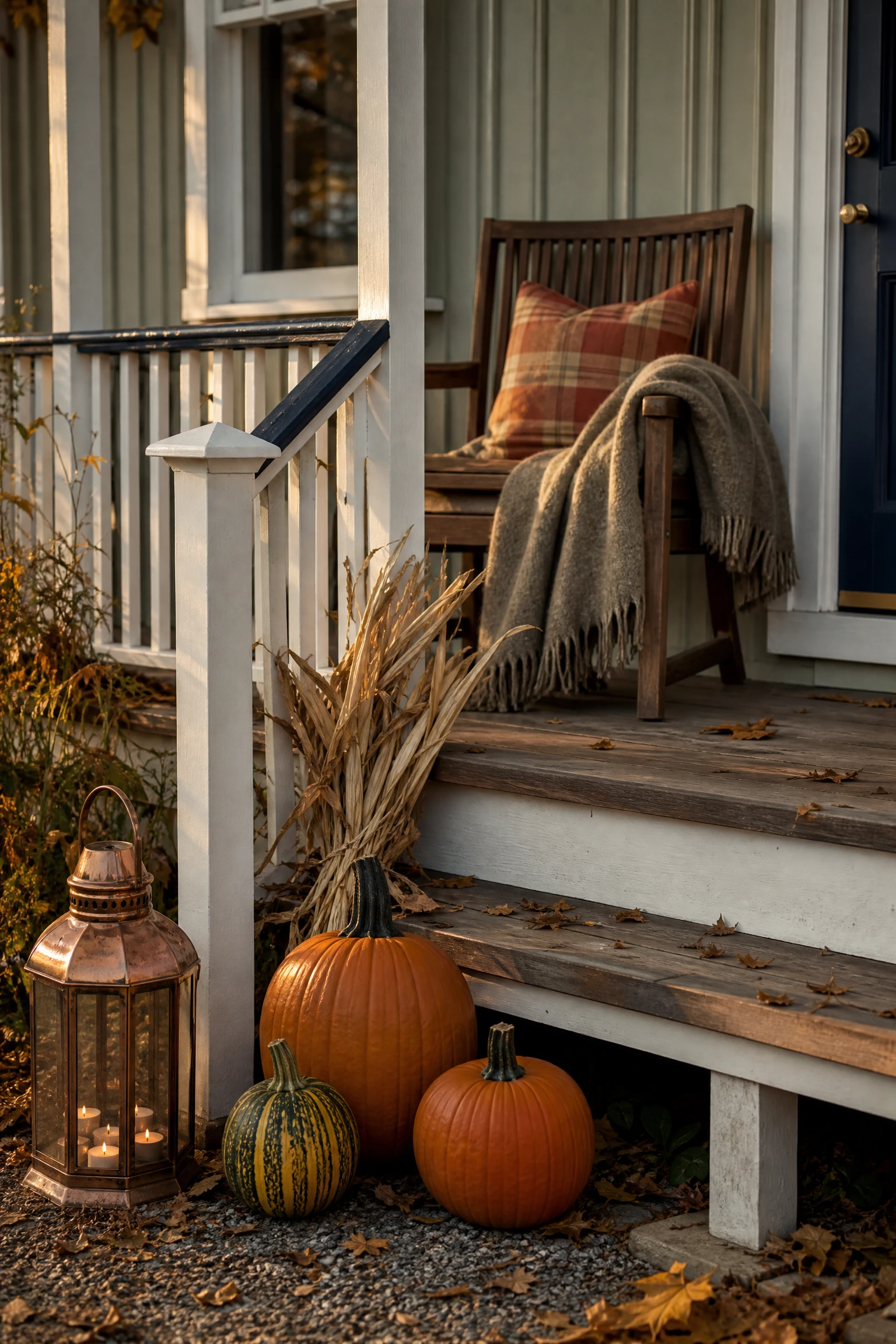
22. Autumn-Ready Porch with Pumpkins, Wool, and Candlelight
Scandinavian autumn decor leans into warmth and natural materials in a way that never veers into kitsch. For a Nordic autumn porch, the base palette shifts to warm amber, burnt sienna, and deep forest green. Group several uncarved pumpkins and gourds in varying sizes at the base of the porch steps or beside the front door, and pair them with a large copper or brass lantern holding several tea lights. Swap out any light linen cushions for wool cushions in a rust or mustard check and add a heavyweight wool blanket draped casually over a chair. A small bundle of dried corn husks or a simple wreath made from eucalyptus and rosehip branches rounds out the look. This is a very budget-friendly seasonal update because it relies on natural materials that are easy to find in autumn and require no long-term commitment.
Designer Note: Restraint is still the rule even in an autumn update. Three pumpkins grouped at different heights is more effective than twenty spread across the porch.
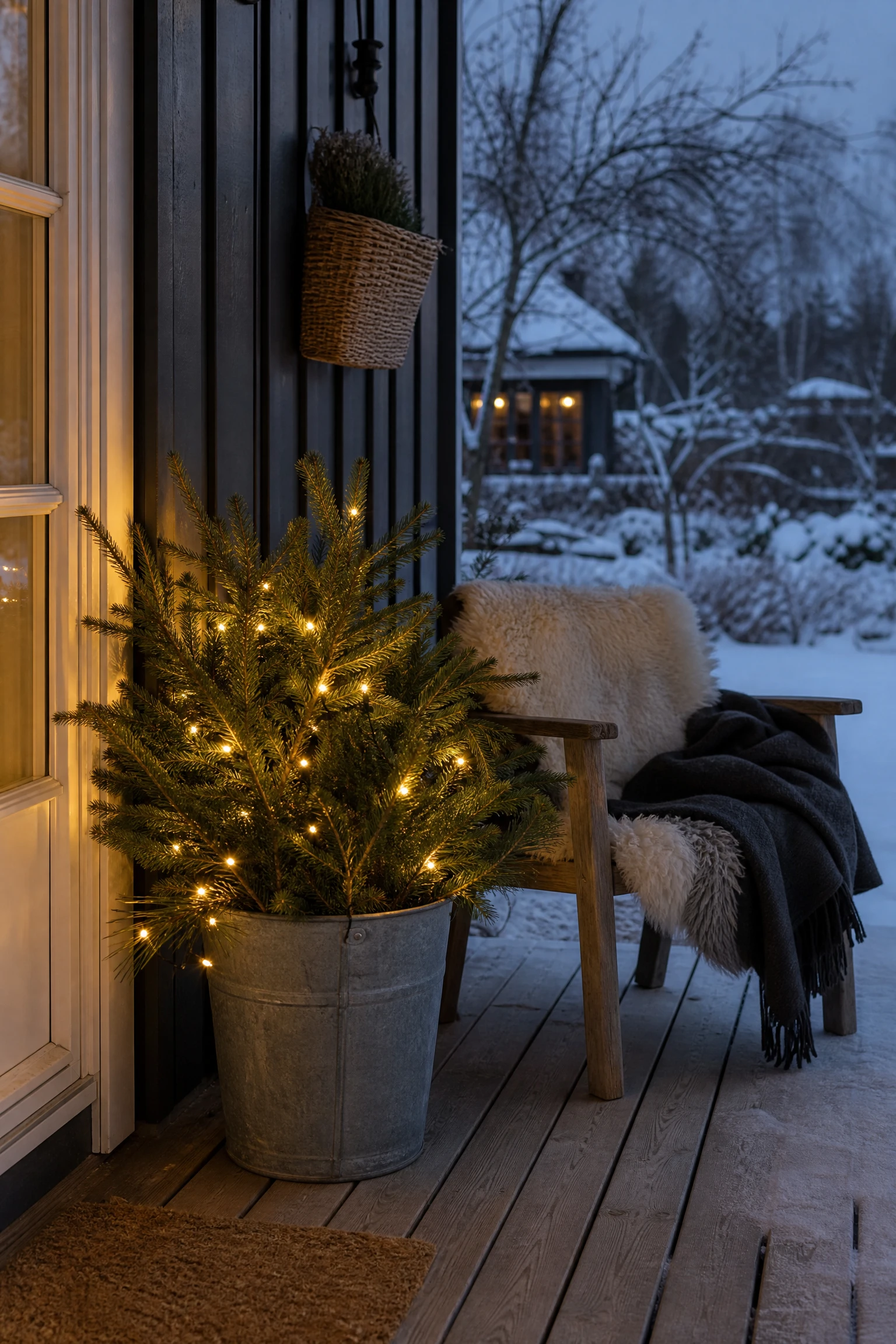
23. Winter Porch with Fir Branches, String Lights, and a Sheepskin
A Nordic winter porch does not shut down with the cold. It leans in. The approach here is simple: gather a few large fir or pine branches and arrange them loosely in a tall stoneware pot or galvanized bucket beside the door. The dark green of the branches against snow, pale paint, or natural wood reads as strikingly beautiful in its simplicity. Wrap a short string of warm Edison bulbs around the branches for evening light. On any seating, layer a sheepskin rug and a heavyweight wool blanket. The visual effect is completely Nordic, think Christmas in a Swedish farmhouse, without being explicitly festive in a way that dates quickly. A small cast-iron fire pit on a large non-combustible stone slab can extend the usability of the porch well into winter evenings in milder climates, though local fire codes should always be checked first.
Designer Note: Fir branches are usually free if you ask a local tree surgeon or Christmas tree seller for offcuts. They last well in cold temperatures and smell extraordinary.
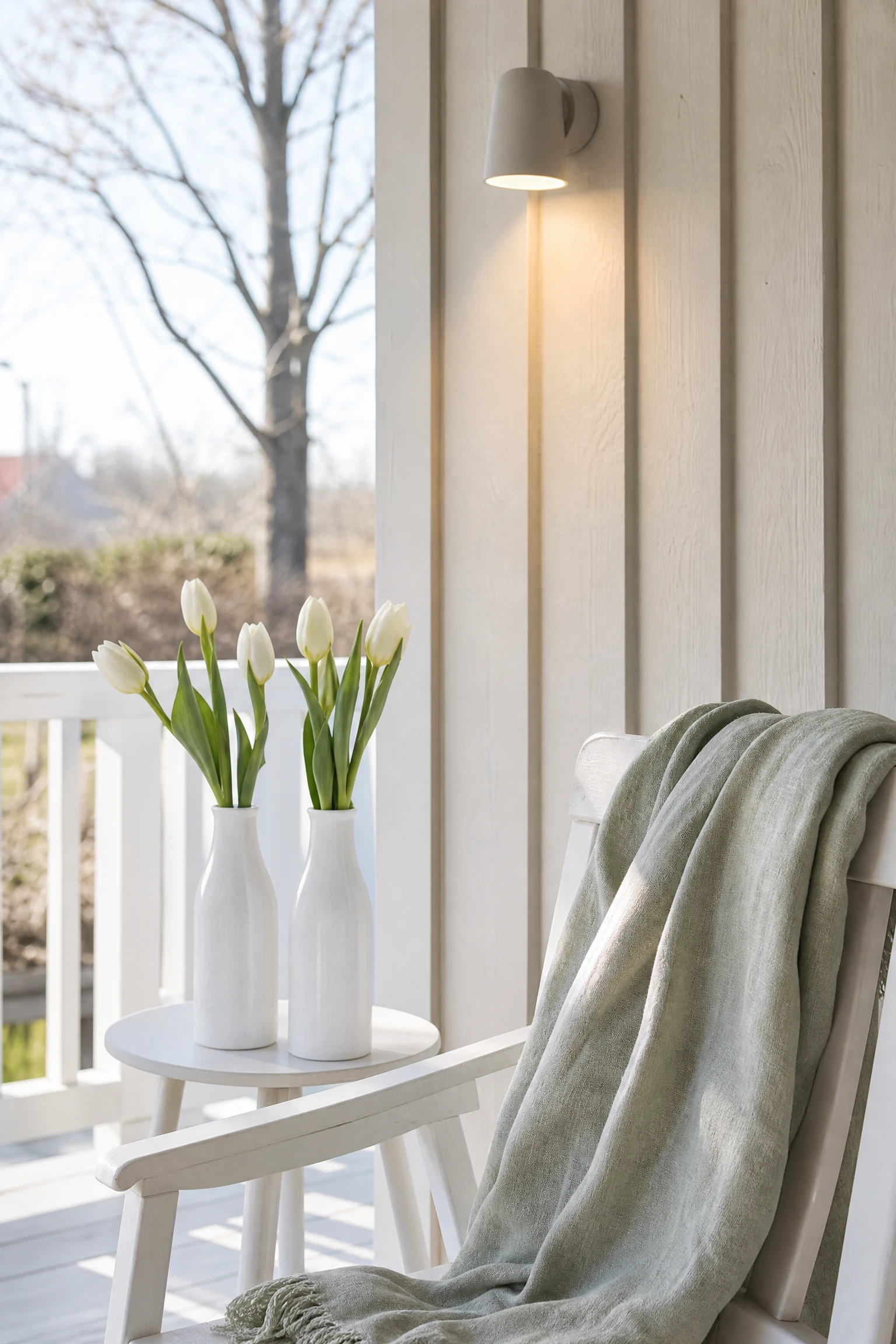
24. Spring Refresh with White Tulips, Clean Linen, and New Light
Spring on a Nordic porch is about opening up after the closed-in months of winter. The update is deliberately light-handed. Swap heavy wool throws for washed linen in pale sage or soft white. Replace winter botanicals with simple white tulips in a cluster of matching narrow vases on the porch rail or a small side table. If the porch has been a dark winter space, this is a good moment to look at adding a second light source, perhaps a simple outdoor sconce on the wall, to prepare for longer spring evenings. White and pale green together in this setting is a very Scandinavian spring pairing, fresh and honest without being showy. The cost of a spring porch refresh done this way is genuinely minimal, a bunch of tulips and a linen throw are all you really need if the bones of the porch are already well set up.
Designer Note: Buy tulips in tight bud and let them open on the porch. There is something quietly satisfying about watching them unfurl over a few days, and tight buds last longer.
Bringing It All Together
What all of these ideas share is a fundamental honesty about materials, purpose, and space. Scandinavian porch design does not ask you to spend a great deal of money or to fill every corner with something. It asks you to be deliberate about what you choose and to make sure that whatever you put on your porch earns its place, either by being beautiful, useful, or both. The ideas in this guide range from free and affordable to mid-range investments, which means there is a genuine entry point regardless of your budget.
The most common mistake people make with porch design is trying to do everything at once. A better approach is to start with the largest surface, whether that is the floor, the main wall, or the primary seating, and get that right before adding anything else. From there, each layer, textiles, lighting, plants, and accessories, builds on a solid foundation rather than competing for attention.
Nordic design principles also give you permission to change things seasonally, which keeps the porch feeling current and alive throughout the year without requiring a complete overhaul each time. A well-chosen porch is one that you genuinely want to sit on, in all seasons and all weather. That is the goal, and it is a very achievable one.
Frequently Asked Questions
What colors work best for a Scandinavian porch?
The foundation of a Nordic palette is warm neutrals, think white, off-white, pale grey, warm sand, and stone. These are not cold or clinical but genuinely warm when paired with natural wood tones and soft textiles. Accent colors can include dusty sage, muted forest green, rust, and charcoal. Avoid bright or saturated colors as they conflict with the quiet, understated quality that defines this style.
Can I create a Scandinavian porch on a tight budget?
Absolutely. Many of the most characteristic Nordic porch features are inexpensive or even free. Foraged branches, a secondhand bench, a painted coir mat, grouped candle lanterns, layered throws from a charity shop, all of these are budget-friendly and genuinely effective. The aesthetic rewards restraint, so spending less and choosing well is actually more aligned with the style than spending freely.
What furniture materials are most authentic to Scandinavian porch design?
Light-toned woods are the most authentic choice, particularly pine, birch, and oak in their natural or white-oiled finishes. Rattan and natural rope add organic texture and are widely used in Nordic outdoor spaces. Black powder-coated metal is the go-to for a more modern Scandinavian look. Avoid synthetic wicker in brown tones as it pulls the palette in a completely different direction.
How do I keep a Scandinavian porch looking good in wet or cold weather?
Covered porches make this much easier, as most natural materials need protection from direct rain. For exposed porches, invest in a good quality storage chest to bring cushions, throws, and botanicals inside when the weather turns. Choose furniture in materials that weather gracefully, teak, powder-coated metal, and natural stone all improve with age and require minimal maintenance.
How many plants should I use on a Scandinavian porch?
Less than you think. A Nordic porch is not trying to replicate a jungle or a cottage garden. Two or three well-chosen plants in cohesive planters will look far more intentional than a crowded collection. Prioritize plants with clean architectural shapes, ornamental grasses, dwarf pines, ferns, and simple herbs, over busy flowering plants, unless you are doing a deliberate seasonal update.
Is Scandinavian porch design only for cooler climates?
Not at all, though you may need to adapt some elements. In warmer climates, lean into the lighter, airier aspects of Nordic design, pale colors, natural linen, clean-lined furniture, and minimal accessories. Swap the heavy wool throws and fireside elements for sheer linen curtains and simple white ceramic planters. The underlying design principles, restraint, natural materials, and considered negative space, work in any climate.