Small Laundry Room Looks That Actually Work
Let’s be honest: the laundry room is usually the last space anyone thinks about when it comes to decorating. It’s tucked behind a door, shoved into a closet, or crammed into a corner of the hallway, and most people are just happy it functions at all. But here’s the thing, a small laundry room can actually be one of the most satisfying spaces to fix up because the results are so immediate and practical. When it works well, you notice it every single day.
The challenge with small laundry rooms isn’t really about square footage. It’s about figuring out how to fit everything you need, keep it organized, and still make the space feel decent to be in. Nobody wants to stand in a gloomy, chaotic little room for twenty minutes sorting darks from lights. A few smart choices around storage, layout, lighting, and color can change the whole experience, and you don’t need a big renovation budget to make it happen.
This article takes a real-life approach, thinking through actual problems people face in small laundry spaces and offering solutions that go beyond “add a shelf.” Whether you’re working with a narrow closet, a shared mudroom setup, an under-stairs nook, or a tiny dedicated room, there’s something here for your situation. The ideas cover a mix of styles, budgets, and layouts, so you can pick what fits your home and your life, not just what looks good in a photo.
1. Stack Your Machines and Build Up, Not Out
If your laundry room is so narrow that you can barely open the washer door without bumping the opposite wall, stacking your washer and dryer is the single best thing you can do. Going vertical frees up the entire floor footprint that a side-by-side setup would use, and that reclaimed space is where the real magic happens. Suddenly you have room for a tall cabinet, a folding counter, or even a small sink.
Once the machines are stacked, the space beside and above them is yours to design intentionally. A floor-to-ceiling open shelving unit on one wall can hold everything from laundry supplies to extra towels to cleaning products. Use uniform baskets or bins on each shelf so everything looks tidy even when it isn’t. Label them if you want to keep things really organized, but even unlabeled, a consistent container style reads as clean and deliberate.
For the wall above the stacked units, install a fixed wooden shelf at about shoulder height. This gives you a landing spot for things you’re actively using, a bottle of detergent, dryer sheets, a fabric softener ball, without having to reach up to a high shelf every time. Paint the walls a soft warm white or a very pale greige to keep the space from feeling like a utility closet. Adding a small framed print or a little potted succulent on the shelf costs almost nothing and makes the room feel intentional instead of ignored.

2. Turn a Closet Into a Concealed Laundry Station
A lot of apartments and smaller homes have laundry hookups inside a regular closet, and most people just shove the machines in, hang a curtain or close the doors, and try not to think about it. But a laundry closet that’s been actually designed to work is a completely different experience. It becomes efficient, easy to use, and when the doors are closed, it disappears entirely into the rest of your home.
Start by measuring carefully, because the difference between a tight fit and an impossible one is sometimes just a few inches. Stackable front-loading machines are usually the best bet for closets because they allow you to use the top as a mini folding surface if the ceiling height allows. If your closet is deep enough, add a pull-out drawer unit beside the machines for supplies. These slim rolling carts, sometimes called laundry towers or utility carts, fit in gaps as narrow as 6 inches and hold a surprising amount.
For the doors, bifold doors are the classic choice but they can feel clunky. Barn-style sliding doors look much more polished and don’t require any floor clearance in front. If your closet has double doors that swing out, consider replacing them with louvered sliding panels, which also allow air circulation so moisture doesn’t build up around the machines. Inside the closet, paint the back wall a contrasting deep color, a navy or forest green works really well, so the inside looks purposeful rather than like an afterthought when the doors are open.

3. Add a Fold-Down Ironing Board to Reclaim Counter Space
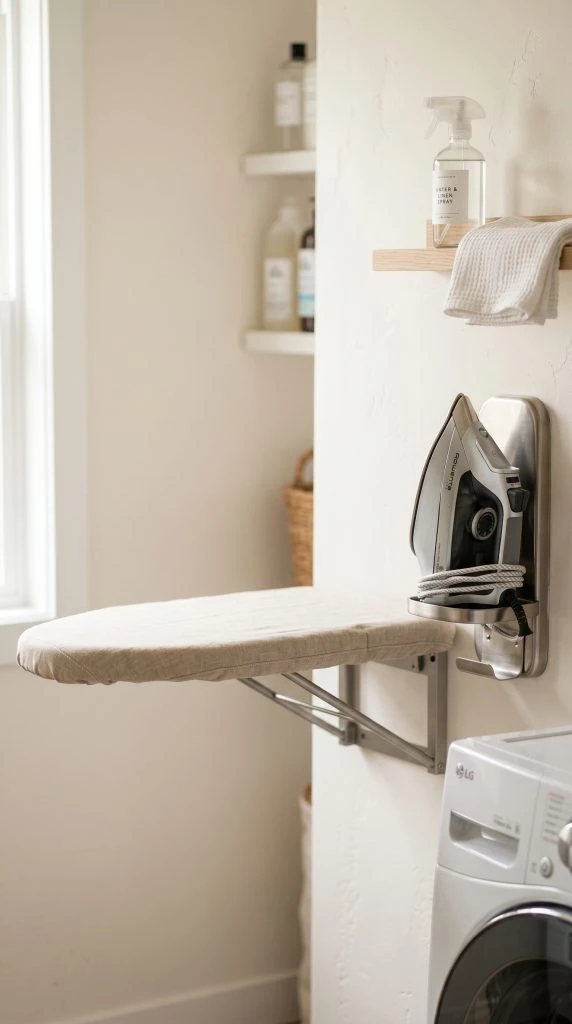
One of the biggest space hogs in a small laundry room isn’t the machines, it’s the ironing board. A standard ironing board takes up an enormous amount of floor space when it’s out, and even when it’s folded and leaning against the wall, it’s awkward and annoying. A wall-mounted fold-down ironing board solves this completely. It folds flat against the wall when not in use, taking up less than four inches of depth, and unfolds to a full-size ironing surface in seconds.
These units are available at most home improvement stores and online for anywhere between $80 and $250, depending on whether you want a simple swing-out style or a cabinet model that hides the board behind a door. The cabinet versions are particularly nice because you can use the exterior door as a small mirror or a chalkboard surface for notes and reminders. Installation is straightforward if you’re mounting into studs, and the payoff in reclaimed floor space is immediate.
Pair the fold-down board with a wall-mounted iron holder right beside it so both items live together in one spot. This prevents the iron from wandering to the counter or getting left somewhere random. When everything has a designated home on the wall, the room stays cleaner and the counter or folding surface stays free for actual laundry work. If your walls are already pretty full, look for a model that mounts behind a door instead, several brands make over-the-door versions that are nearly as functional.
4. Use Peel-and-Stick Wallpaper to Make It Feel Finished
There is something about a patterned wall that signals “this room was decorated on purpose,” and in a small laundry room, that matters more than you’d think. When a space is tiny, people expect it to be functional but dull, so adding a bold or interesting wallpaper pattern immediately changes the whole feeling. The room stops being a utility closet and starts being a room. Peel-and-stick wallpaper makes this achievable without a big commitment or a messy installation process.
For a small laundry room, a small-scale repeat pattern tends to work better than a very large motif that gets cut off awkwardly at the ceiling or beside the machines. Think small florals, thin geometric stripes, delicate tile patterns, or a classic check. Stick to two or three colors and choose at least one that you can pull into the rest of the room through accessories, a matching basket, a hand towel, or the color of your cabinet hardware. This creates a sense of cohesion even in a very small space.
If you’re hesitant to paper the whole room, do just one accent wall behind the machines or behind open shelving. This way the pattern becomes a backdrop that you see through the shelves, which looks really intentional and layered. Avoid putting wallpaper behind the machines if there’s any chance of a leak or high humidity without proper ventilation, since even peel-and-stick paper can bubble and peel in damp conditions. Stick to the dry walls and keep the paper away from the immediate machine area if your room runs humid.

5. Install a Hanging Rod for Air-Dry Items
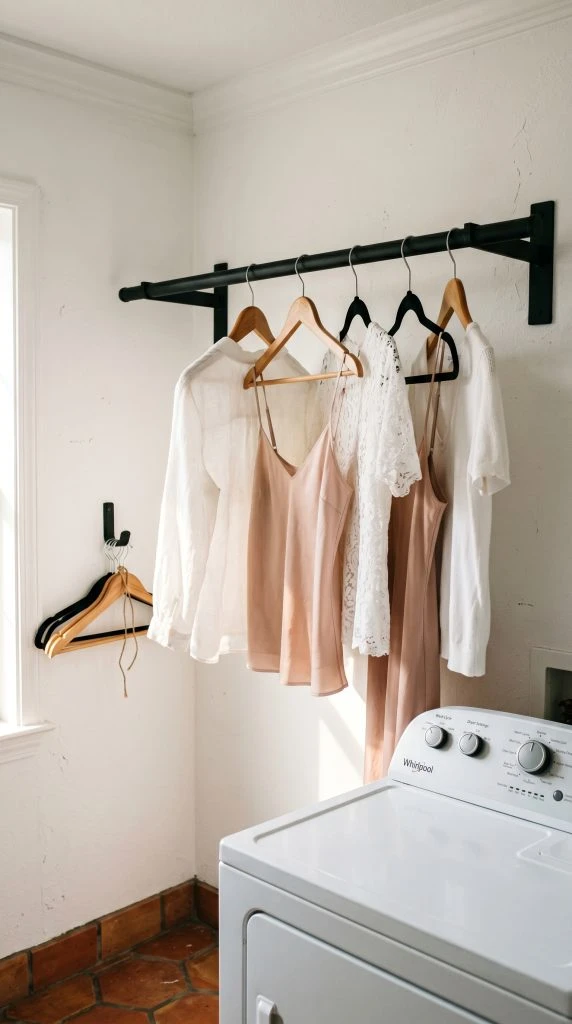
If you regularly air-dry delicates, workout gear, or clothes that can’t go in the dryer, you know the chaos that comes with it. Things end up draped over door frames, hung from cabinet knobs, or piled on every available surface while they dry. A dedicated hanging rod in the laundry room solves this without requiring any significant renovation or budget. It’s one of those additions that, once you have it, you wonder how you ever managed without it.
The best placement for a hanging rod in a small laundry room is above the machines or across a short wall near the door. If you have a stackable unit, the space above it, up near the ceiling, is often completely wasted. A ceiling-mounted hanging rod or a wall-mounted rod with strong brackets can occupy that vertical space perfectly. Look for an extendable rod so you can adjust the length to fit the exact span you have. If ceiling height allows, you can even install two rods at different heights, one for longer items like dresses and one for shorter pieces like shirts.
Choose a rod in a finish that matches or complements your other hardware. Matte black rods look especially sharp against white walls or white cabinetry, and brushed brass gives a warmer, more finished feel. Keep a small basket or hook nearby for the wooden or velvet hangers you use for air-drying so they’re always ready when you need them. One final tip: if your room has no good wall for a rod, a retractable clothesline mounted between two walls is a fantastic alternative. It pulls out to full length when needed and retracts completely when you’re done.
6. Go Dark With the Cabinetry for a More Dramatic Look
Most laundry room advice will tell you to keep things light and bright to make the space feel bigger. And that advice isn’t wrong, but it’s also not the only option, and it tends to produce laundry rooms that all look exactly the same. If you’re willing to lean into the small size of the room rather than fight it, dark cabinetry can create a space that feels moody, intentional, and genuinely cool. Small spaces can handle bold choices because there’s just less surface area to worry about.
Deep navy, forest green, charcoal, and even black work beautifully in small laundry rooms when balanced correctly. The key is to keep the countertop and walls light so there’s contrast. A white marble-look countertop against dark navy lower cabinets, for example, is a really satisfying combination that feels elevated without being fussy. Keep the upper portion of the room, above the countertop or open shelves, in a lighter tone so the ceiling feels further away than it is.
Hardware makes a significant difference with dark cabinetry. Brushed gold or unlacquered brass pulls and knobs warm up the look considerably and prevent it from feeling cold or industrial. If your machines are white, they’ll actually pop beautifully against dark cabinet faces and become part of the design rather than something you’re trying to hide. Add a small pendant light or a wall sconce if your overhead lighting is weak. Dark rooms need layered lighting, not just one overhead fixture, to look properly finished rather than just dim.

7. Build a Countertop Over a Front-Loading Washer and Dryer
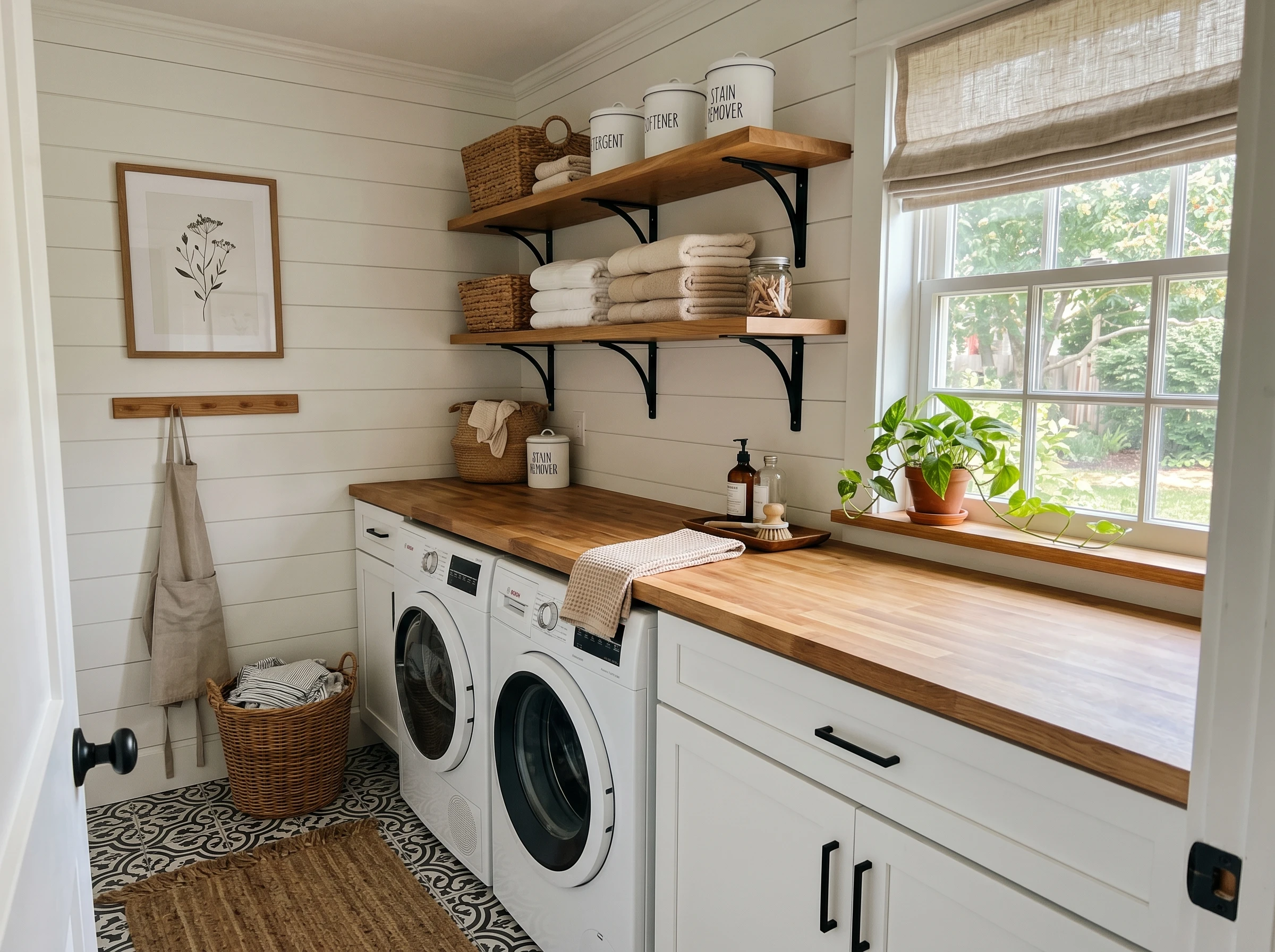
Side-by-side front-loading machines are actually one of the best setups for a small laundry room because the top of the machines becomes prime real estate. A countertop installed over both units, spanning the full width, creates a dedicated folding surface that you just don’t have in most small laundry rooms. Folding on top of the machines works fine in theory, but a proper countertop that’s level, smooth, and the right height makes the whole task feel less like a hassle.
The countertop material matters in a laundry room because it needs to handle moisture, cleaning products, and regular use. Laminate in a wood grain or solid color is the most budget-friendly option and is actually quite durable in this context. Butcher block adds warmth and looks beautiful, but it needs to be properly sealed and kept dry. Quartz or a quartz-look laminate is the most durable choice and easiest to keep clean, though it costs more. Whatever you choose, make sure there’s enough overhang at the front to give you a proper workspace.
Add cabinets or shelves above the countertop to complete the built-in feel. Upper cabinets with doors keep everything hidden and create a very clean, streamlined look. Open floating shelves feel more casual and are easier to access quickly. You can also do a combination, closed cabinets on one side for things you want hidden and an open shelf or two on the other side for frequently used items. The whole setup, countertop plus storage above, turns the wall behind your machines into a fully functional laundry station rather than just a place where machines happen to live.

8. Use a Pegboard Wall for Flexible, Visible Storage
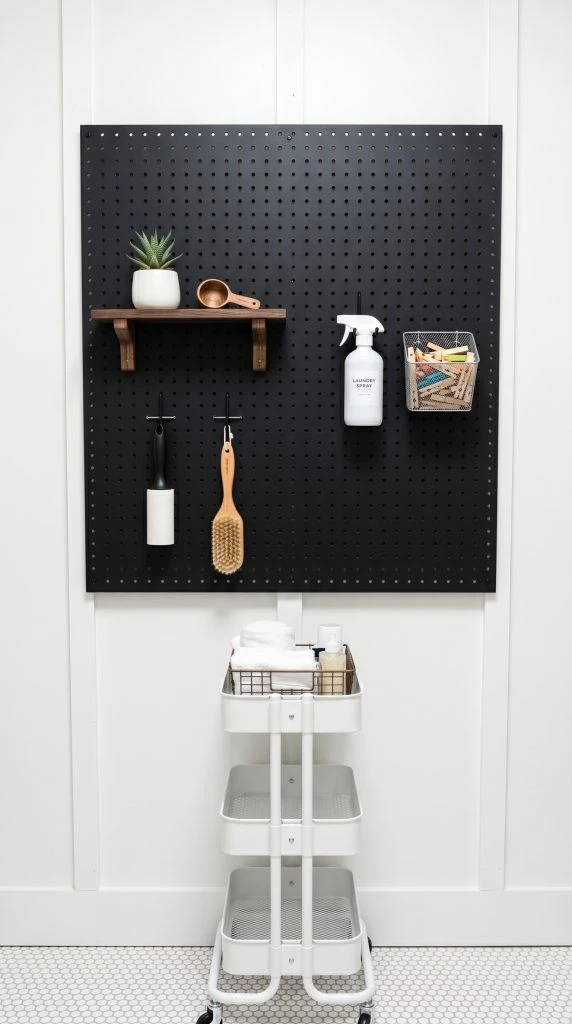
Pegboards are having a real moment in kitchen and craft room design, and they work just as well in a small laundry room. The beauty of a pegboard is that everything is visible and accessible, no digging through cabinets, no forgetting what you have. You can hang hooks for lint rollers, spray bottles, and measuring scoops; add small shelves for detergent pods or dryer balls; and clip in bins for loose items like clothespins or safety pins. And if your needs change, you just move things around.
A painted pegboard looks far more intentional than a raw one. Paint it the same color as your walls for a tonal, built-in look, or go a contrasting color to make it a feature. White pegboard on a white wall disappears nicely while still providing loads of storage. Black pegboard on a light wall reads as a graphic design element. Either approach elevates the look past “garage wall” into something that actually fits the room. You can also find pegboard panels in wood tones now, which are a bit warmer and more finished-looking than the standard pressed-board version.
Install your pegboard at a height that works for daily use, somewhere between countertop level and about six inches above your head. Going too high means you’ll be reaching for things awkwardly; too low means it feels cramped. A standard 24×48 inch panel is usually enough for a small laundry room, but you can string two or three together for a full-wall effect if you have the space. Mount the pegboard on standoffs, small wooden or metal spacers that hold it about an inch off the wall, so the hooks can slide in from the back properly. This is a common DIY mistake that makes the hooks difficult to use.
9. Combine the Laundry Room and Mudroom Functions
If your laundry room is near a back door or garage entry, combining it with mudroom functions is one of the smartest things you can do. Think about it: mudrooms deal with coats, boots, backpacks, and sports gear coming in from outside, and laundry rooms deal with dirty clothes. These two functions overlap almost entirely, and separating them into two small rooms usually just means both rooms feel cramped and disorganized. Merging them into one well-designed space makes the whole entry area work harder.
The key to making a combined laundry-mudroom feel cohesive is giving every item a specific zone. The machines stay in one area, ideally tucked to one side or in a closet within the room. The mudroom zone, usually along the back wall or near the door, gets a bench with cubbies underneath for shoes, hooks above for coats and bags, and ideally a small shelf at the top for hats and seasonal items. A wall of built-in lockers, even just a couple of them, can anchor the mudroom zone while providing serious storage.
Durable materials are non-negotiable in a combined space. The floor takes a beating from muddy boots and wet laundry, so a porcelain tile or luxury vinyl plank in a darker tone or a busy pattern will hide a lot of everyday mess. Keep the color palette consistent between the two zones so the room reads as one space rather than two mismatched areas crammed together. A neutral base with a consistent accent color, say pale greige walls with forest green cabinet fronts and brass hardware, threads through both zones and makes the whole room feel designed rather than just functional.

10. Bring In Natural Light With a Window Refresh
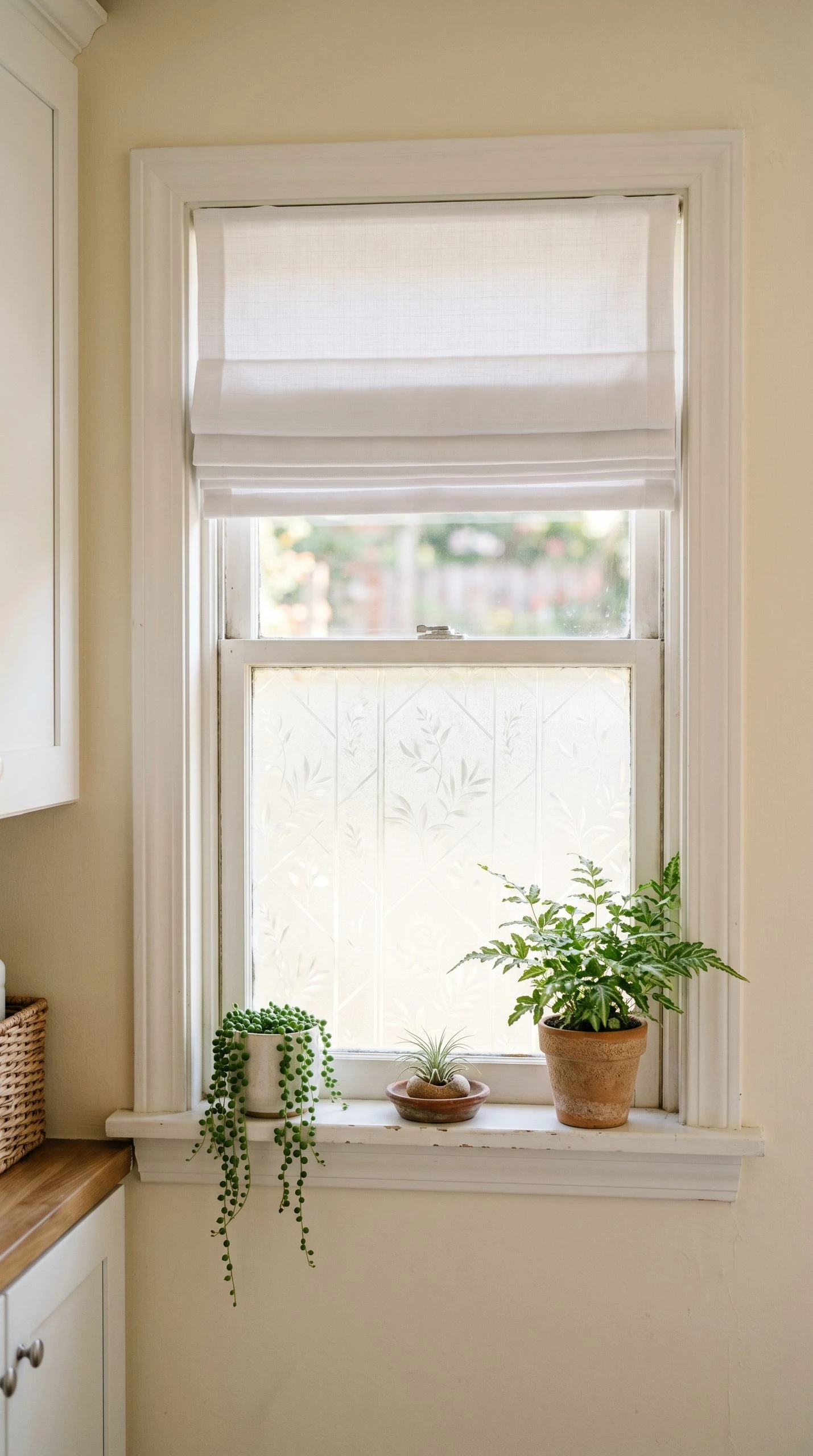
Natural light can change a small laundry room from a space you avoid to one that’s actually pleasant to work in. If your laundry room has a window but you’ve been covering it with a heavy curtain for privacy, it’s worth rethinking the treatment. A window that lets in natural light, even filtered light through a frosted or textured glass film, will make the room feel bigger, cleaner, and less claustrophobic. Light doing the work of making a small space feel open is one of those things that no amount of clever storage can fully replicate.
If your window faces a neighbor or a busy area, frosted window film is a great solution. It lets in plenty of light while blocking the view from outside, costs almost nothing to apply, and can be removed cleanly if you move. You can also find decorative frosted films with subtle patterns, a linen texture, a honeycomb grid, or a simple frosted border around clear center glass, which add a little design detail while serving the privacy function. These are far better-looking than those semi-transparent white plastic blinds that end up in most laundry rooms by default.
For a window treatment that still provides some privacy while looking intentional, a Roman shade in a linen or cotton fabric is a lovely choice. Pull it up when you’re in the room and pull it down partway when you need privacy. Choose a fabric in a neutral tone that complements your wall color, and keep the hardware simple. If your window is very small, skip the curtain entirely and use the window sill as a little display spot for a few small plants, which thrive in the humidity of a laundry room and add a lived-in, happy feeling that’s hard to achieve otherwise.
11. Add Pull-Out Laundry Hampers Inside the Cabinet
One of the messiest parts of any laundry situation is the dirty clothes themselves. A pile of laundry on the floor, overflowing baskets shoved under a shelf, bags hanging from a hook and spilling over, none of it looks good and all of it makes the room feel chaotic. Pull-out hampers mounted inside a base cabinet solve this beautifully. They keep the dirty laundry completely out of sight, pull forward easily when you’re loading the machine, and keep the floor completely clear so the room stays visually tidy.
You can buy pull-out hamper hardware kits that fit inside standard cabinet widths, or have a cabinet maker build a custom solution. The kits usually include a tilt-out mechanism or a slide-out rail system that holds either a canvas laundry bag or a hard bin. Two pull-out hampers side by side in a wider base cabinet are ideal if you sort lights and darks before washing, which most people do but rarely have a good system for. Label each hamper interior so other household members use the right one.
If you don’t have base cabinets, a slim rolling hamper cart with sorting compartments is the next best thing. These roll out when you’re doing laundry and tuck behind the machines or under a counter when you’re not. Look for a version with wheels that lock so it doesn’t slide around on a tile or vinyl floor. A woven wicker hamper is also a beautiful option for a more decorative approach, just make sure it has a removable liner so you can actually carry the laundry to the machine without hauling the whole basket.

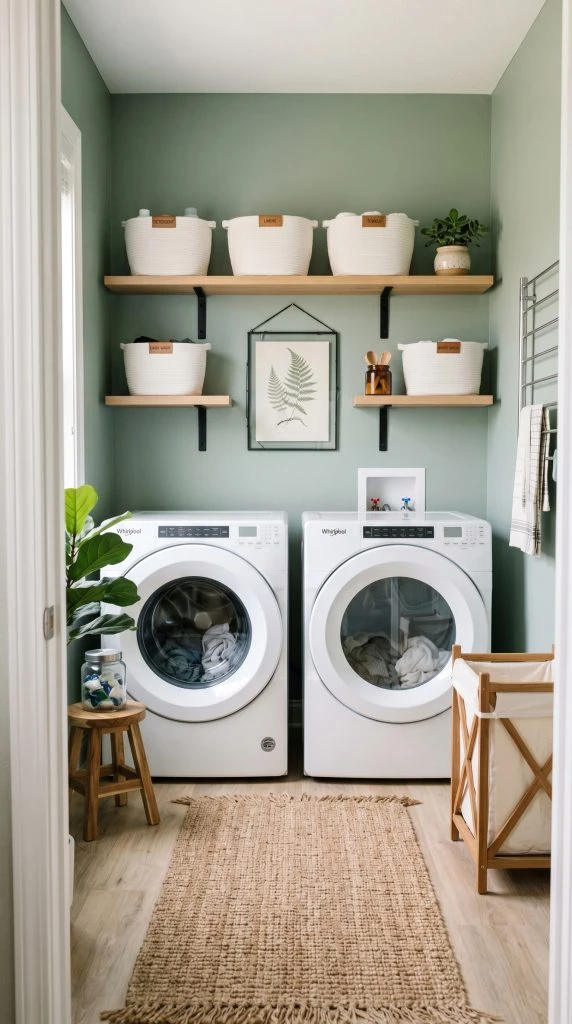
12. Try a Sage Green Color Scheme for a Calm, Fresh Feel
If you want the laundry room to feel calm and pleasant rather than just functional, color choice matters a lot. Sage green is one of the best options for a small laundry room because it reads as fresh and clean without being harsh or cold. It has warm undertones that stop it from feeling clinical, and it pairs naturally with white, cream, natural wood tones, and warm metal hardware. Sage is also forgiving in different light conditions, it looks pretty in natural daylight and stays warm and inviting under artificial light in the evenings.
You don’t have to paint all four walls sage to get the effect. Painting just the lower cabinets or a single accent wall creates plenty of impact. If your room has open shelving, sage shelves against a white or cream wall is a particularly nice combination. Add white cotton storage baskets on the shelves, a few small white ceramic containers for detergent pods and clothespins, and a simple wooden step stool if needed, and the whole room feels put-together without much effort.
For accessories, lean into natural textures to complement the sage. A jute mat or runner on the floor, a small rattan basket for odds and ends, and a cotton hand towel near a utility sink all work beautifully with a sage color scheme. Matte black hardware is one popular pairing, but honestly brushed nickel or unlacquered brass are both warmer choices that work even better with sage’s natural undertones. Keep the ceiling white, always, since a colored ceiling in a small room tends to make it feel lower and more closed-in than it already is.
13. Install Under-Cabinet Lighting for a Big Practical Upgrade
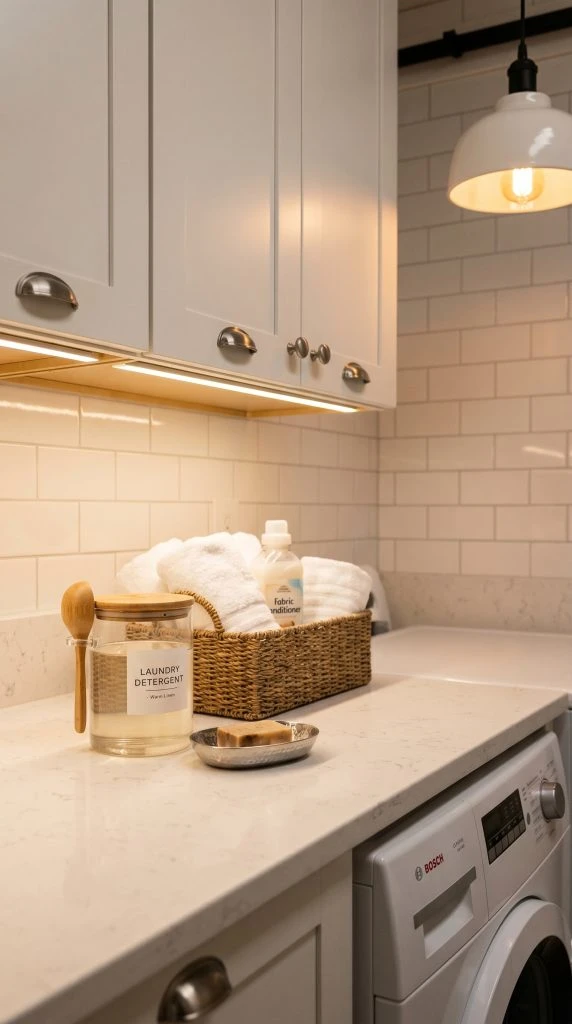
Laundry rooms are notoriously poorly lit. Most of them have a single overhead flush-mount fixture that casts flat, shadowless light that makes the room feel dull and makes it genuinely hard to see what you’re doing. If you’re trying to check whether a stain has come out or read the care label on a shirt, bad lighting is a real problem. Under-cabinet LED strip lighting is the fastest and most affordable way to fix this, and it makes a significant difference in how the room looks and functions.
LED strip lights are now available with plug-in options, which means no electrician required. You simply run the strip along the underside of your upper cabinets, connect them with the small clip connectors, and plug the whole run into a nearby outlet. Many kits come with a dimmer or even a color temperature switch so you can choose between a bright white task light for when you’re actively working and a warmer tone for when you just want the room to feel cozy. The difference in the feel of the room is immediate and noticeable.
While you’re thinking about lighting, consider swapping out that overhead flush-mount for something with a bit more character. A simple white globe pendant or a small flush-mount with a frosted glass shade adds a lot more visual interest than the standard builder-grade disc fixture. If your laundry room has low ceilings, a flush-mount with a subtle design is the way to go. The combination of a nicer overhead light plus under-cabinet LEDs makes the room feel layered and thoughtfully designed rather than like a forgotten utility space.
14. Use an Under-Stairs Nook as a Laundry Room
If you have an under-stairs area in your home, this is often one of the best possible spots for a compact laundry setup. The angled ceiling and tight footprint that make under-stairs spaces feel awkward for other uses are actually fine for a laundry setup because the machines themselves are the tallest things in the space, and they usually fit comfortably under the higher end of the stairs. The key is planning the layout carefully so the door, the machines, and any shelving all work together within the unusual shape.
Stackable machines are usually the best choice here because they occupy one narrow footprint. Place them at the deepest, tallest end of the space where the ceiling height is greatest. Fill the angled portion along the wall with custom-cut shelving that follows the slope of the staircase, this is usually a carpenter job but doesn’t need to be expensive. These angled shelves are perfect for laundry supplies, which come in all shapes and sizes and don’t need to stand very tall. A shallow ledge across the front of the opening can serve as the folding surface.
Enclose the whole setup behind a door or a set of doors to keep it tidy when not in use. A single hinged door works well if the opening is narrow, or a pair of bifold doors if it’s wider. Inside, a good light is essential since under-stairs spaces tend to be quite dark. A battery-operated puck light or a hardwired LED fixture mounted to the ceiling inside the nook is the practical solution. Paint the interior of the nook a light color, even if you go dark elsewhere in your home, to help bounce what little light there is around the space.

15. Keep It Minimal With Open Shelving and Matching Containers
There’s a certain kind of laundry room that feels calm and effortlessly organized, and it almost always has two things in common: open shelving and matching containers. When you can see everything and it all looks uniform, the room instantly reads as intentional rather than cluttered. This approach works especially well in small rooms because it keeps the visual weight light. Heavy closed cabinets can make a small laundry room feel boxy and compressed; open shelves feel lighter and more open even though they hold just as much.
The containers you choose matter more than most people realize. Matching white or cream canisters with simple labels are the classic approach and they work because they’re neutral and easy to live with. But you could also go with clear glass jars for a more clean and contemporary feel, or natural rattan baskets for a warmer, more organic aesthetic. Whatever you choose, commit to it. One type of container throughout the whole room creates a sense of calm that no amount of trendy wallpaper or new hardware can replicate.
The shelves themselves should be strong enough to hold the weight of detergent bottles and stacks of folded towels. Solid wood brackets or floating shelf hardware rated for at least 50 pounds per shelf are worth investing in. Space the shelves generously rather than cramming them in, since overcrowded shelves defeat the whole purpose of the minimal look. Leave a little breathing room at the top of each shelf between the container and the shelf above. A few small plants, a little air plant in a ceramic pot or a trailing pothos in a simple terracotta planter, add life and color without requiring much effort or space.

16. Add a Small Utility Sink Even in a Tiny Space
A utility sink in the laundry room is one of those things that, once you have it, you genuinely cannot imagine going without. It’s where you hand-wash delicates, rinse out muddy things before they go in the machine, fill buckets, soak stained items, and do a hundred other small tasks that would otherwise happen awkwardly in a bathroom or kitchen sink. In a small laundry room, the concern is always space, but a well-chosen compact utility sink takes up far less room than you’d expect.
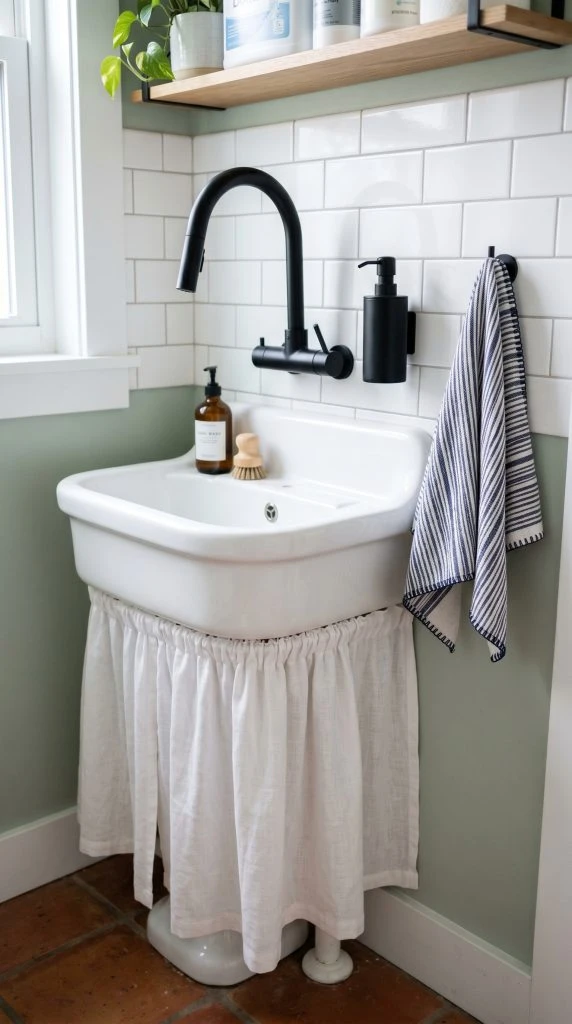
Look for a wall-mounted utility sink if floor space is tight. Wall-mounted sinks have no cabinet underneath, which means the floor stays clear and the room feels more open. A shallow rectangular sink in white ceramic or stainless steel works great in this context. If you want cabinet storage below the sink, a pedestal sink with a small curtain skirt in front is a charming option that hides cleaning supplies without requiring a full base cabinet installation. The curtain adds a soft textile element that warms up what could otherwise feel like a cold utility space.
The faucet you choose for a utility sink makes more of a design difference than you might expect. A simple single-handle gooseneck faucet in matte black or brushed nickel looks modern and clean, and the higher neck is genuinely useful for filling larger items. Add a small wall-mounted soap dispenser or a simple dish for a bar of soap directly beside the sink so the area stays organized. A small hook on the side of the cabinet or on the wall beside the sink for a hand towel completes the setup without requiring any extra counter space.
17. Try Shiplap or Beadboard for Texture on the Walls
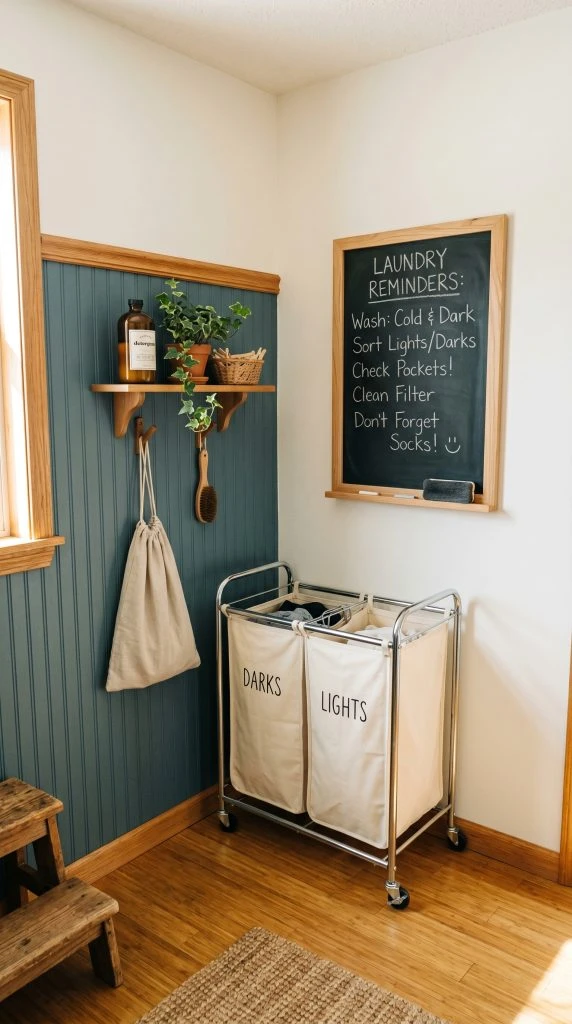
Paint alone on the walls of a small laundry room can feel a little blank, especially if the room doesn’t have much natural detail or architectural interest. Adding shiplap or beadboard to one or all of the walls is a relatively easy upgrade that adds texture, character, and a finished quality that paint can’t quite achieve on its own. Both options are available in lightweight pre-finished panels that go up quickly, and neither requires any special carpentry skill if you’re comfortable with a nail gun and a level.
Shiplap, with its horizontal planks and subtle shadow lines, suits a more modern or coastal aesthetic. Beadboard, with its vertical channels and traditional feel, leans toward a cottage or farmhouse look. Both can be painted any color, so the style you’re going for matters more than the panel type. A full wall of painted white shiplap behind open shelving looks clean and crisp. Dark green beadboard used as wainscoting, stopping halfway up the wall with white paint above, has a really classic and intentional quality.
If you’re on a budget, peel-and-stick shiplap panels are now available and look surprisingly convincing when painted properly. They won’t fool anyone up close, but in a small utility space where you’re not scrutinizing the walls, they do the job and cost a fraction of real tongue-and-groove boards. Just make sure your walls are smooth and clean before application since peel-and-stick panels show every bump and imperfection in the substrate beneath them. Use a brayer or a credit card to press out air bubbles as you go, and paint with a roller rather than a brush for the most seamless finish.
18. Decant Your Detergent Into Matching Dispensers
This is a small change that makes a noticeable difference to how the laundry room looks and feels. Laundry detergent, fabric softener, and stain removers almost always come in brightly colored, logo-heavy plastic bottles that don’t look great sitting on a shelf. Decanting them into clear glass dispensers with pump tops or into matching ceramic canisters immediately removes a lot of visual noise. The shelf goes from looking like a drugstore aisle to looking like a properly styled room.
Pump dispensers work particularly well for liquid detergent and fabric softener because they make measuring easier and less messy. A clear glass or amber glass bottle with a stainless steel pump looks great, doesn’t rust, and holds a decent amount. Add a small printed or handwritten label with a piece of leather cord or a luggage tag clip for a slightly more finished look. For powder detergent, a wide-mouth glass jar with a wooden lid and a small wooden scoop inside keeps everything contained and easy to measure.
Keep the containers on a simple tray, a small wooden tray, a marble slab, or even a piece of slate, so they feel grouped and intentional rather than just randomly placed on a shelf. The tray also protects the shelf from drips, which are inevitable with detergent dispensers, and makes it easy to pull the whole set forward when you need to refill or clean underneath. Place a small folded towel or a cloth napkin on the tray beside the dispensers to wipe up drips immediately, keeping the whole setup looking clean and put together.

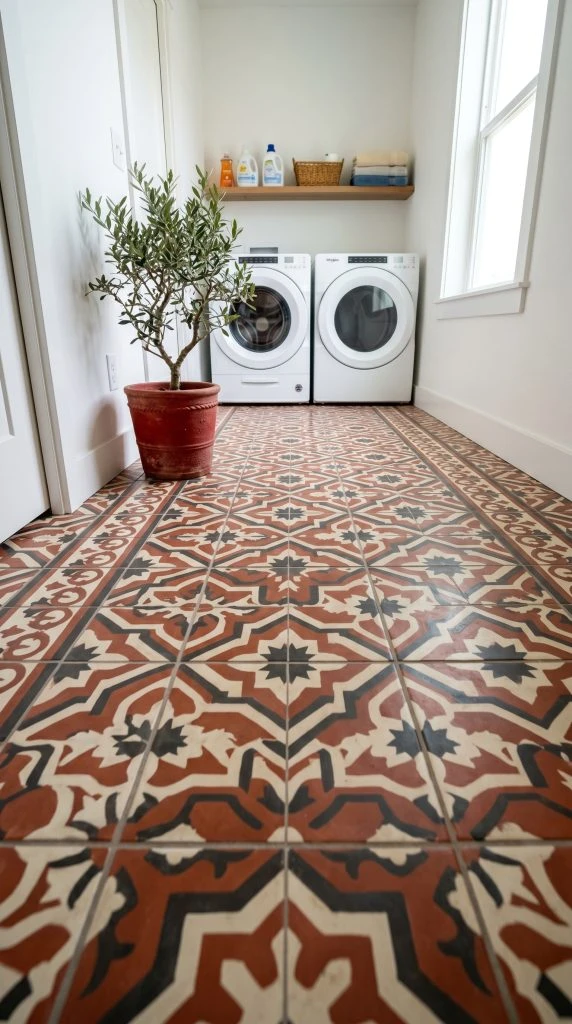
19. Use Bold Floor Tile to Make the Room Feel Intentional
The floor in a laundry room takes a lot of abuse, wet laundry, detergent spills, muddy shoes, and heavy traffic. Most people opt for the most practical, least interesting flooring they can find, which usually means a plain white tile or a generic sheet vinyl. But the floor is actually a great place to add personality in a small laundry room because it’s one of the largest uninterrupted surfaces in the space, and a bold pattern or unexpected color can make the whole room feel designed rather than just functional.
Encaustic-style cement-look tiles in a geometric pattern are an excellent choice. Black and white checkerboard floors have a classic, timeless appeal and look sharp in both modern and traditional laundry rooms. Moroccan-inspired mosaic tiles add color and pattern in a way that feels genuinely interesting. Hexagon tiles in a pale blue or terracotta add a subtle pop of color while still being practical. All of these are available in porcelain, which is the most durable option for a wet room, and many are available in a matte finish which hides dust and footprints better than a glossy surface.
If you can’t replace the floor, a large woven mat or a runner in a complementary pattern can do a lot of the same work for a fraction of the cost. Look for a mat with a rubber-backed or anti-slip backing since laundry rooms can get slippery when wet. Choose a pattern that doesn’t compete with whatever’s happening on the walls, if the walls are busy, keep the mat simple, and if the walls are plain, you have more freedom to go bold on the floor. Wash the mat regularly since it’ll absorb detergent spills and foot traffic dirt quickly.
20. Create a Lost-Sock Wall With a Corkboard or Clipboard Rail
Every laundry room needs a system for the perpetual mystery of single socks. Whether you believe socks actually disappear in the dryer or you’re convinced there’s a logical explanation somewhere, the practical reality is that you end up with a pile of unmatched socks that you don’t know what to do with. A dedicated spot for lone socks, something visible and organized, means they actually get reunited with their partner instead of accumulating in a drawer somewhere and eventually getting thrown out.
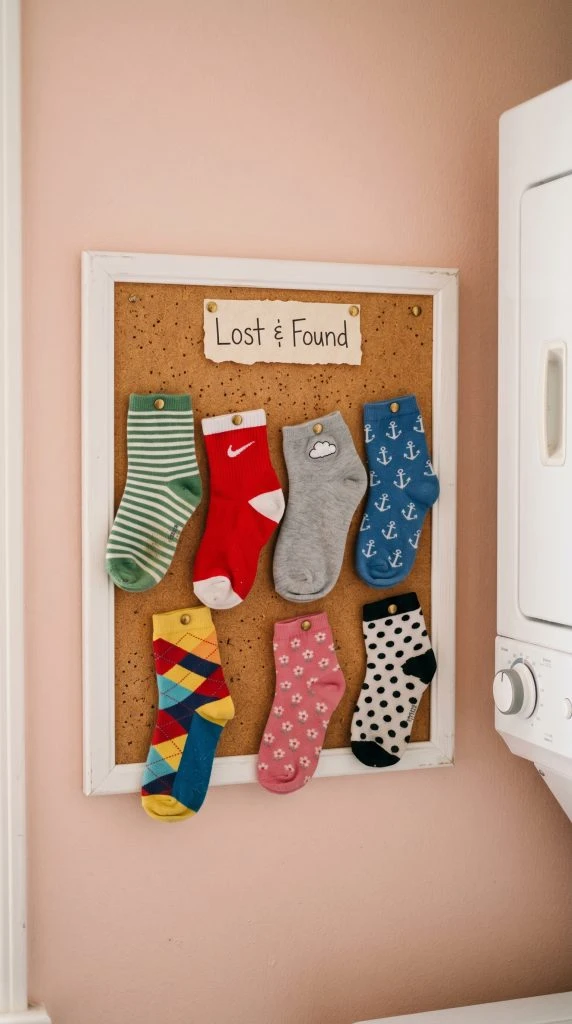
A small corkboard mounted at eye level near the dryer is the simplest solution. Pin the lone sock up and when its partner eventually appears, they get reunited and sent on their way. It sounds very basic but it genuinely works, and it adds a bit of character to the room that feels human and real. You can also use a row of small binder clips mounted on a wooden board, each clip holding one sock, which looks slightly more intentional and design-forward than a corkboard full of pins.
If you want to make the sock wall a bit of a feature, frame the corkboard with a simple wood frame painted to match your cabinet color and add a small handwritten label that says something like “Waiting for a Match” or “Lost & Found.” It’s a small touch of personality that makes the laundry room feel like a real room where real people live, rather than a perfectly staged photo. This kind of functional charm is actually what separates a laundry room that people enjoy being in from one that’s just a place to get through a chore.
Making the Most of a Small Laundry Room
A small laundry room doesn’t have to feel like a compromise. As you’ve seen in this list, the size of the space has very little to do with how well it functions or how good it looks. The rooms that work best are the ones where every decision, from the way the machines are positioned to the color on the walls to the containers on the shelves, was made on purpose rather than by default. That intentionality is what makes the difference between a room you dread entering and one you don’t mind spending time in.
The best starting point is usually to pick one or two ideas that address your biggest frustrations first. If the clutter is the problem, start with storage. If the room feels dark and oppressive, start with lighting and color. If you’re constantly lacking a folding surface, build one. Small improvements that solve real daily problems will make the room feel dramatically better, faster than any decorative change alone.
From there, you can layer in the more aesthetic touches, the wallpaper, the matching containers, the plants on the windowsill, the personality. You don’t have to do everything at once. In fact, a laundry room that gets better gradually, one good decision at a time, tends to end up feeling more personal and more right than one that was overhauled all at once.
Frequently Asked Questions
What is the best layout for a very small laundry room?
For a very small laundry room, stacking your washer and dryer vertically is usually the best move because it frees up floor space and allows you to use the remaining wall space for shelving and storage. If you can’t stack, side-by-side machines with a countertop built over them is the next best layout since the counter doubles as a folding station. The goal in any small laundry room is to reduce the machines’ footprint as much as possible so the surrounding space can work harder.
What colors make a small laundry room feel bigger?
Light colors, especially white, soft cream, pale gray, and light sage green, tend to make small rooms feel more open because they reflect more light around the space. Keeping the ceiling white regardless of your wall color is important since a colored ceiling in a small room tends to feel like it’s pressing down. That said, don’t be afraid of a darker color if you love it. A bold choice done well is far more interesting than a timid one done by default, and very small rooms can sometimes benefit from the cozy, intentional feel of a deeper shade.
How do I add storage to a tiny laundry room with no cabinets?
Wall-mounted floating shelves are the fastest and most affordable solution. A few shelves above the machines can hold detergent, dryer sheets, baskets, and other supplies without using any floor space. A pegboard is another great option since it offers completely flexible storage you can rearrange anytime. Over-the-door organizers work well if you have a door with unused space on the back. And a slim rolling utility cart that fits in a narrow gap beside the machines is one of the most practical additions you can make to a storage-challenged laundry room.
Can I have a laundry room in a hallway or closet?
Yes, absolutely. Many homes have laundry setups in hallway closets, and they can work very well with the right planning. The keys are ventilation, proper hookups, and choosing machines that fit the space. Stackable front-loading machines are almost always the right choice for a closet laundry because they take up the smallest footprint and allow a countertop on top if the ceiling height allows. Make sure the closet has adequate ventilation for the dryer exhaust and that the door you choose allows enough airflow to prevent moisture buildup around the machines.
What flooring works best in a small laundry room?
Porcelain tile is the best choice for a laundry room floor because it’s completely waterproof, very durable, and available in a wide range of styles including patterns that can add real character to the space. Luxury vinyl plank is the next best option, especially if you want a wood look, since it’s also waterproof and much easier to install yourself. Avoid real hardwood or laminate since both can warp and swell with moisture exposure over time. Whatever you choose, make sure the surface has enough texture to be slip-resistant when wet.
How do I make a laundry room smell better?
Good ventilation is the foundation of a laundry room that smells fresh. Make sure your dryer is properly vented to the outside and that the room has some form of air circulation, either a window that opens or a small fan. Clean the lint trap after every load and clean the inside of the washing machine drum monthly with a washing machine cleaner tablet. Leave the washing machine door open between uses to prevent mildew buildup. For ongoing freshness, a small reed diffuser, a sachet of dried lavender, or a natural beeswax candle on the shelf adds a gentle scent without being overpowering.