Laundry Room Storage Looks That Actually Make the Space Work
Introduction
Let’s be completely honest about something: the laundry room is probably the most ignored space in most homes. It gets a washer, a dryer, maybe a bare wire shelf bolted to the wall, and then everybody just kind of moves on. Nobody’s pinning it on Pinterest or showing it off during a home tour. And yet, it’s one of the rooms that gets used almost every single day, by every single person in the household. That disconnect between how often we use it and how little thought we put into it is exactly why so many laundry rooms end up chaotic, cramped, and genuinely unpleasant to be in.
The good news is that fixing a laundry room doesn’t have to mean a full renovation or a massive budget. More often than not, the problem isn’t the size of the room. It’s the storage setup. When there’s nowhere logical to put things, everything just piles up. Detergent bottles crowd the top of the machine, dryer sheets scatter everywhere, clean clothes sit in baskets for three days because there’s no folding space, and the whole room feels like one big ongoing mess. The right storage changes all of that.
The ideas in this article are grouped by function because that’s how real organization works. You don’t just need more shelves, you need the right kind of storage in the right place. Whether you’re working with a dedicated laundry room, a closet-sized nook, or a combined utility space, there’s something here that will genuinely help. These are storage solutions that real homeowners and interior designers actually use, and they’re broken down in a way that makes it easy to figure out exactly what your space needs most.
Wall and Vertical Storage
When floor space is tight, the walls become your best asset. Most laundry rooms have a surprising amount of vertical space that goes completely unused. These ideas are all about getting things up off the machines and counters and onto the walls, where they’re still accessible but no longer creating visual clutter.
1. Floating Shelves Above the Washer and Dryer
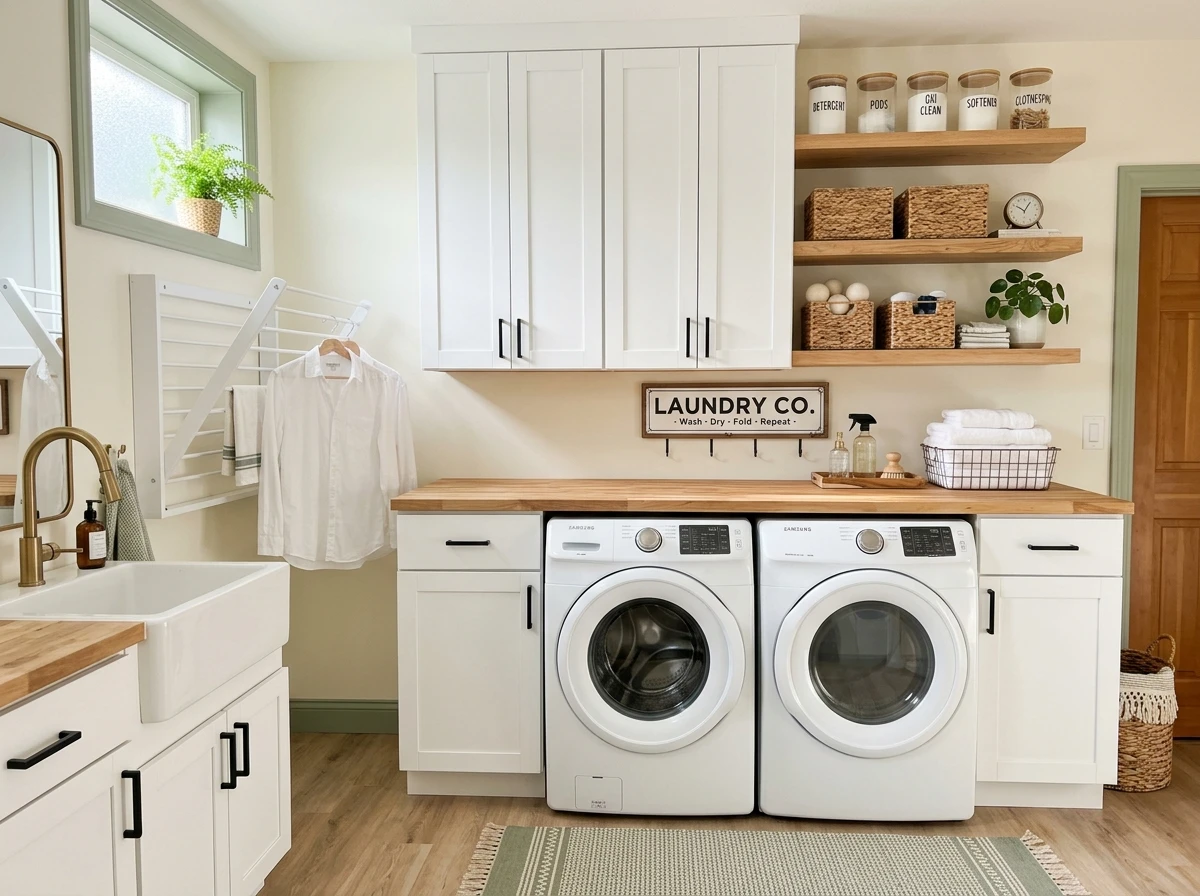
If you’ve got a side-by-side washer and dryer setup, the wall space directly above those machines is prime real estate. Installing two or three floating shelves in that zone gives you an instant home for everything you actually reach for during laundry day: detergent, fabric softener, dryer sheets, stain remover sticks, and color-catching sheets. The key is to keep the lowest shelf at a comfortable arm height so you’re not straining to grab things mid-cycle. White or light-painted shelves work beautifully if the room is small because they reflect light and don’t add visual weight. For a slightly warmer feel, natural wood shelves in oak or pine add a lot of personality without competing with the machines.
Style-wise, decant your detergent into matching ceramic or glass dispensers to keep the shelves looking intentional rather than cluttered. A small potted plant at the end of the top shelf adds life to the space without taking up much room. Pair the shelves with small woven or rattan baskets for items you want out of sight but still within easy reach.
Designer Tip: Use a shelf with a small lip or a tension rod across the front to keep bottles from vibrating off during a spin cycle. It’s a small detail that saves a lot of frustration.

2. Pegboard Wall Panel for Tools and Small Supplies
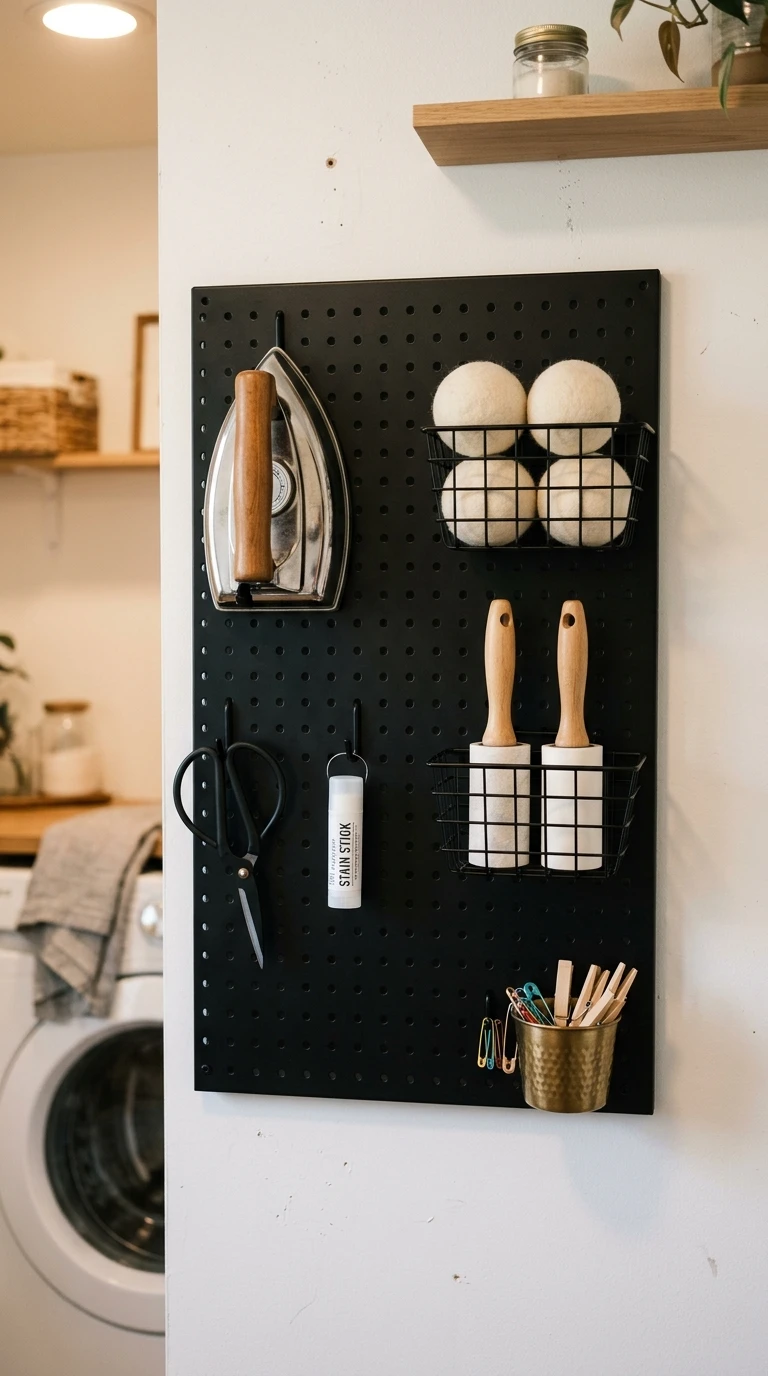
Pegboards aren’t just for garages. A painted pegboard panel mounted on one wall of your laundry room gives you a completely customizable and flexible storage surface that can hold almost anything. Hang small wire baskets for dryer balls, hooks for reusable grocery totes that need airing out, a built-in spot for your iron, a scissors holder for cutting open packaging, even a small shelf attachment for a jar of clothespins. The beauty of pegboard is that it adapts as your needs change. Nothing is permanent. You can rearrange hooks and baskets in minutes as your routine shifts.
Paint the pegboard the same color as your walls for a clean, built-in look, or go slightly contrasting for a bit of visual interest. Black pegboard with white hooks has become a popular choice for laundry rooms going for a modern, slightly industrial aesthetic. For a softer, more cottage-style vibe, a white pegboard with natural wood accessories looks lovely. The pegboard itself is inexpensive, usually under $30 for a good-sized panel, making this one of the most affordable storage upgrades in the room.
Designer Tip: Mount your pegboard with a small gap between it and the wall using standoffs. This makes it much easier to insert and remove hooks without fighting against the wall.
3. Wall-Mounted Drying Rack That Folds Flat
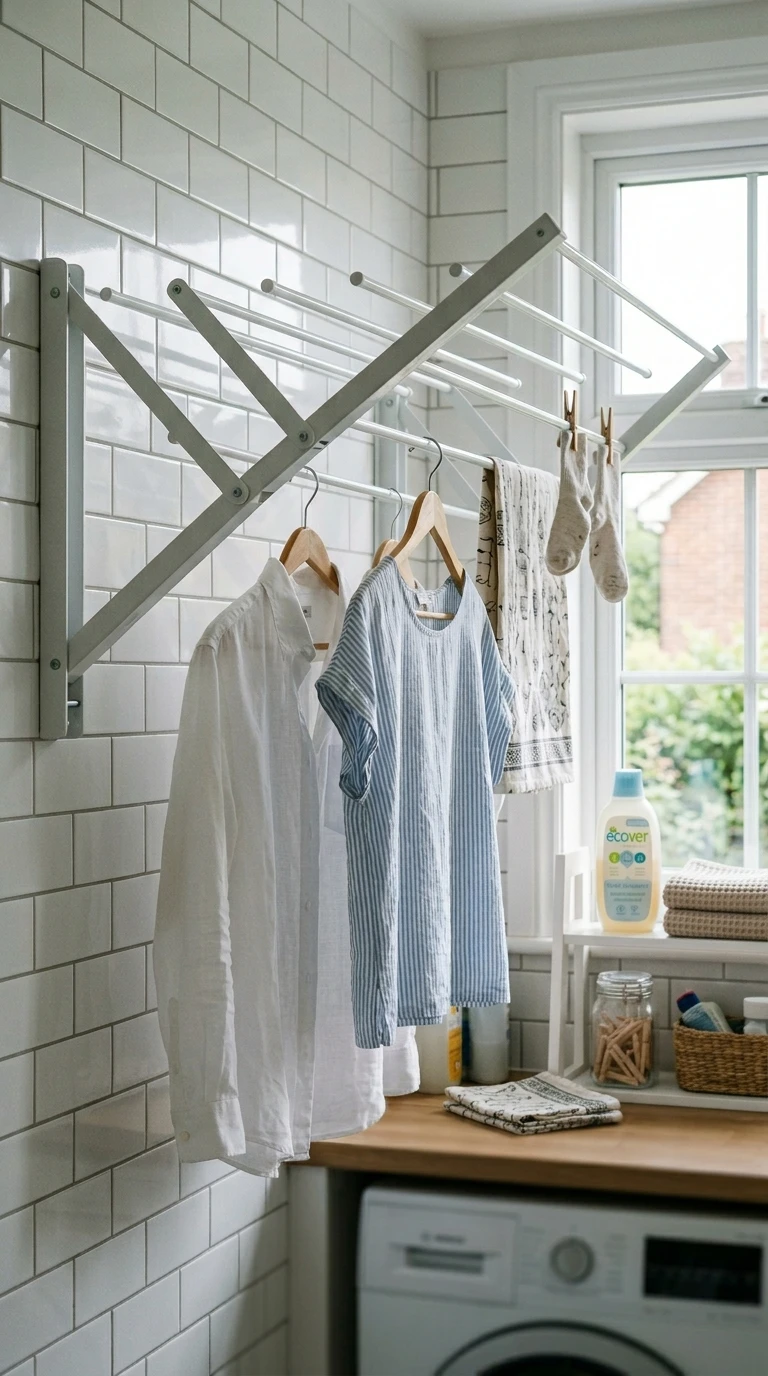
A wall-mounted folding drying rack is one of those storage ideas that genuinely changes how you do laundry. Instead of a freestanding rack that takes up floor space and gets in the way when you’re not using it, this version mounts directly to the wall and folds completely flat when the arms are closed. When you need it, you pull it open and hang your delicates, sweaters, dress shirts, or anything else that can’t go in the dryer. When you’re done, it tucks back against the wall and disappears.
Look for versions with multiple horizontal bars that extend outward, giving you a good amount of hanging space without taking up a massive footprint. Stainless steel options are durable and moisture-resistant, which matters in a room with regular humidity from running machines. For a more decorative touch, some versions come in matte black or brushed brass finishes that actually look quite good against tiled or shiplap walls. Mount it near a window if possible so airflow helps things dry faster without any musty smell.
Designer Tip: Mount the rack slightly higher than you think you need, leaving clearance for longer garments like pants and dresses to hang freely without touching the floor or a counter below.
4. Open Corner Shelving
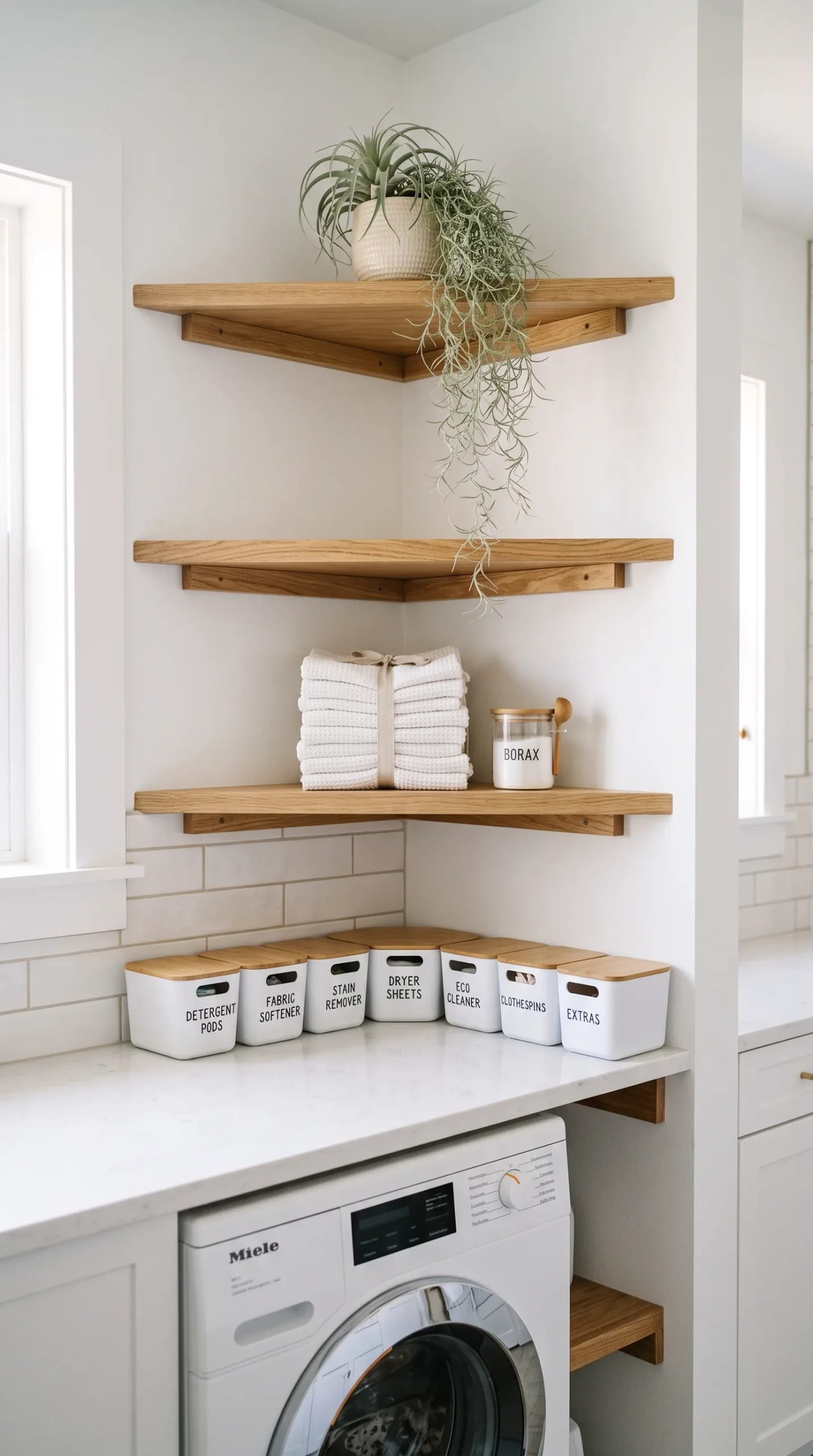
Corners are some of the most underused spots in any laundry room, and a set of corner shelves can fix that without taking up any additional floor space. Floating corner shelves stack vertically, making use of vertical height while fitting snugly into a spot that’s otherwise just empty wall. They work especially well in small laundry rooms or laundry closets where even an inch of extra counter space matters. Use the lower shelves for frequently used supplies and the upper shelves for things you reach for less often, like backup detergent, extra dryer sheets, or cleaning supplies.
From a design standpoint, corner shelves look best when they’re styled with some intention. A mix of matching baskets, a small decorative item, and a neatly labeled jar or two makes the corner feel purposeful rather than just stuffed with overflow. If your laundry room has a neutral color palette, dark-stained wood corner shelves add depth and warmth. If the room is already a bit dark, lighter shelving keeps things feeling open and airy.
Designer Tip: Use a corner shelf at exactly counter height to create a pseudo countertop in that corner for folding smaller items. It’s a practical trick that maximizes an awkward space.
5. Magnetic Strip or Magnetic Board for Small Metal Items
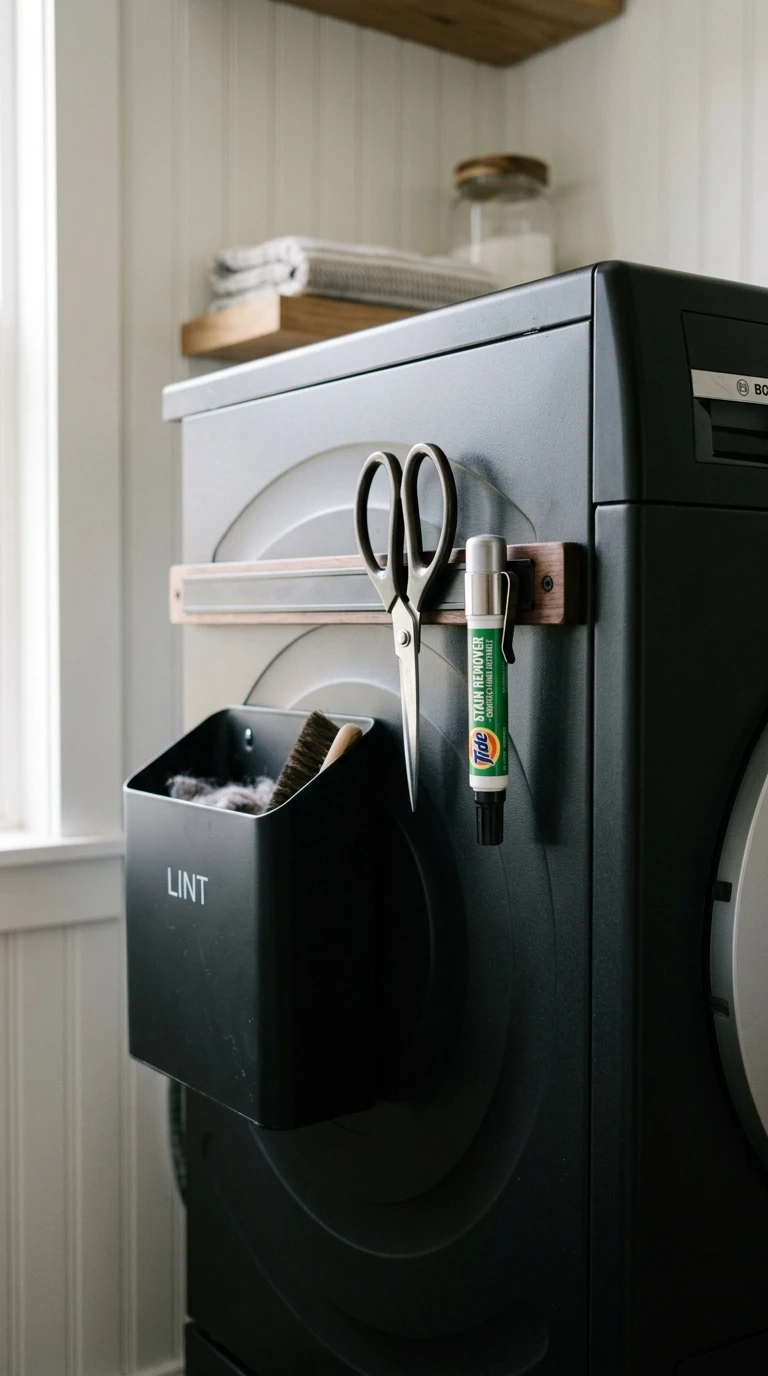
A magnetic strip or a magnetic board mounted inside a cabinet or on a small section of wall is a surprisingly practical laundry room addition. You can use it to hold a magnetic lint bin that sticks right to the side of the dryer, small scissors, safety pins, seam rippers for removing tags, or any other metal tools that usually get buried at the bottom of a drawer. It keeps those small items visible and accessible without requiring any drawer or shelf space at all.
Some homeowners mount a chalkboard painted with magnetic primer, which gives them both a writable surface for notes and a magnetic holding zone all in one. This works particularly well if the laundry room is near a mudroom or entry area and serves double duty as a household communication hub. The magnetic strip approach is budget-friendly and installation is simple, usually just a few screws or even strong adhesive strips for lighter-weight versions.
Designer Tip: Stick a magnetic lint bin directly to the side of your dryer so you can clean the lint trap and drop it straight in without walking across the room to find a trash can.
Cabinet and Built-In Solutions
Cabinets bring a level of polish and concealment that open shelving can’t match. Whether you go fully custom or use freestanding pieces cleverly, cabinet-based storage makes a laundry room feel significantly more finished and organized.
6. Upper and Lower Cabinet Combination
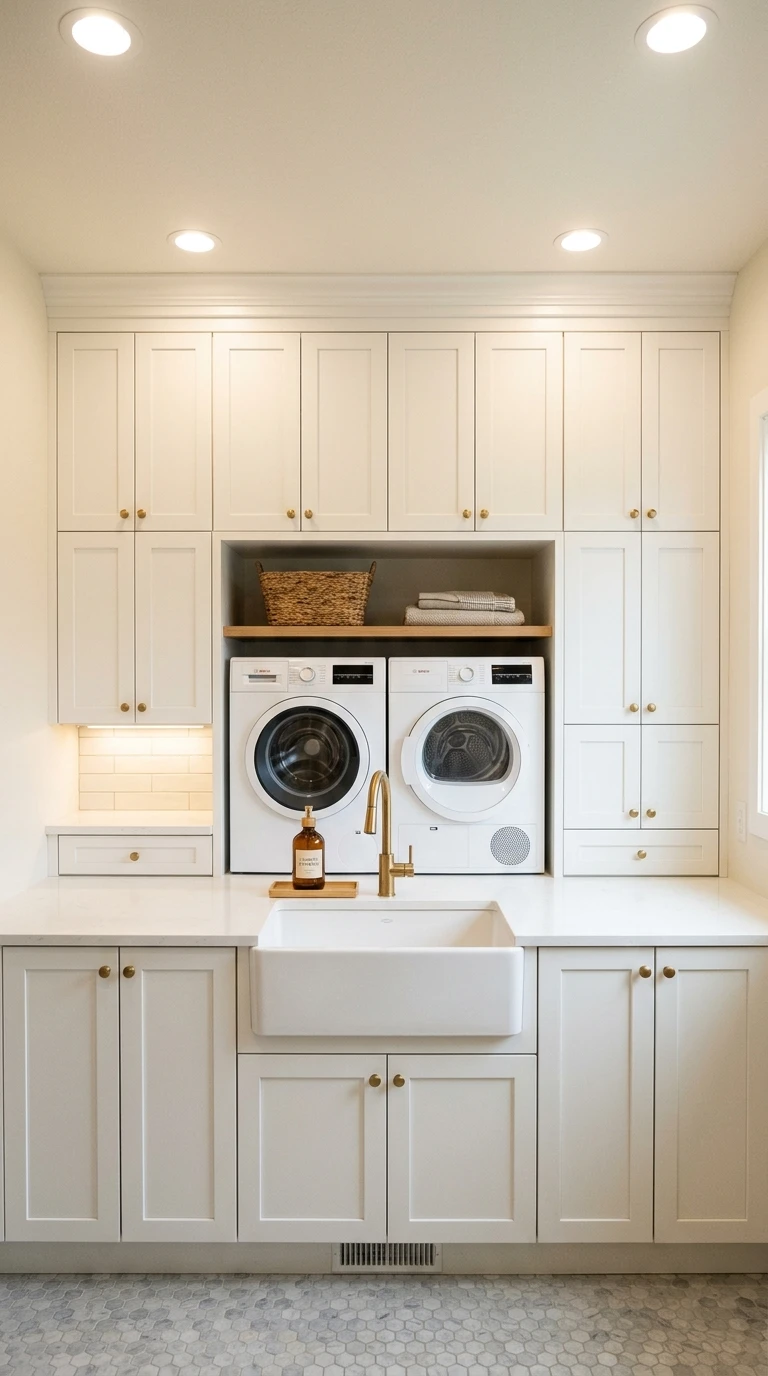
The most complete laundry room storage setup is a combination of upper and lower cabinets running along at least one wall. Upper cabinets handle everything that needs to be stored but not necessarily accessed daily: backup cleaning supplies, extra sponges, seasonal stain treatments, spare hangers. Lower cabinets work perfectly for a built-in hamper drawer, under-counter pull-out bins, or a base for a folding countertop. When the two levels are combined with a stretch of countertop between them, you get a laundry room that functions almost like a proper room rather than an afterthought.
This setup doesn’t have to be custom cabinetry. IKEA’s SEKTION system or Home Depot’s stock cabinets can be configured to work beautifully in a laundry room at a fraction of the cost. Paint them a color that feels intentional, white for a clean modern look, sage green for something with personality, navy for something dramatic, and add updated hardware to make them look finished. A simple shaker-style door keeps things looking timeless and easy to clean.
Designer Tip: Leave a small open section between upper and lower cabinets rather than running them all the way to the floor. This creates a perfect spot for your washer and dryer while keeping the room looking designed rather than purely utilitarian.
7. Freestanding Utility Armoire
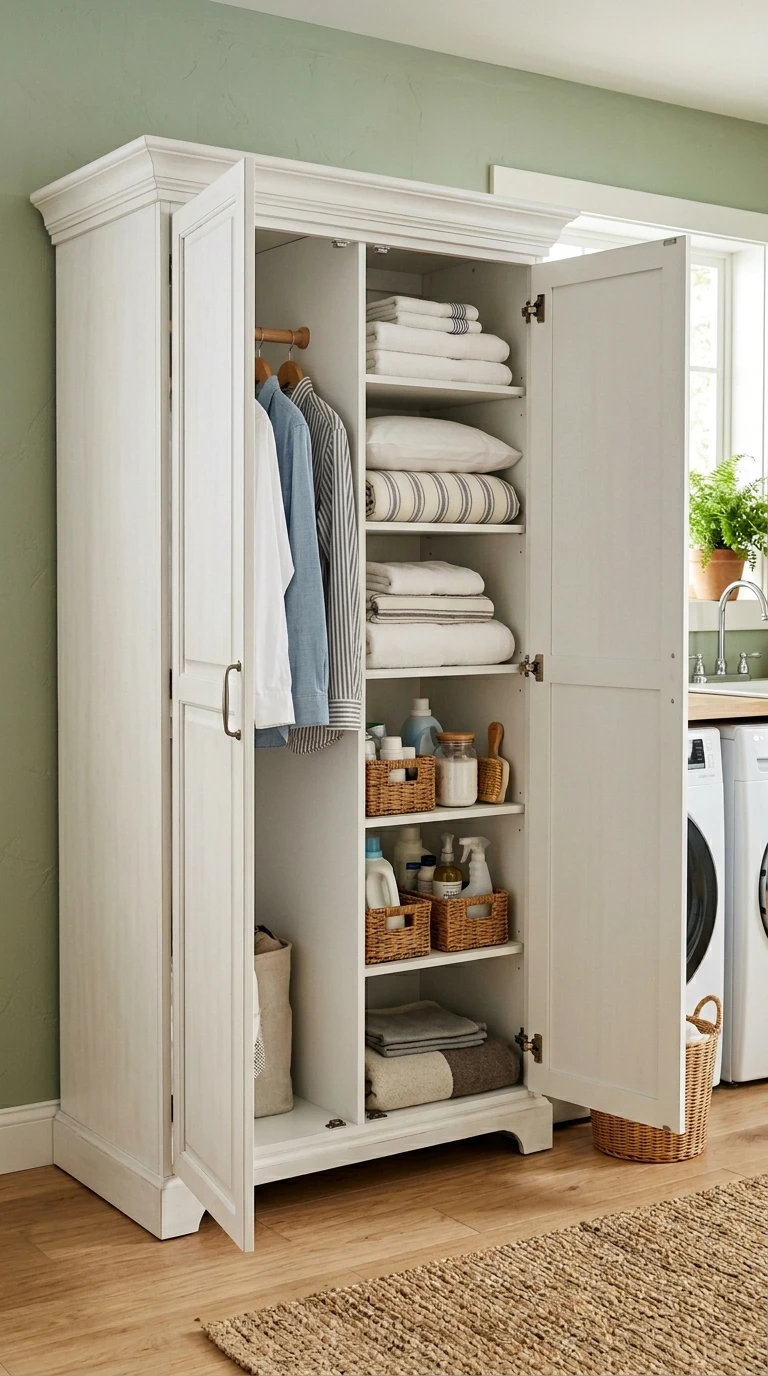
Not everyone has the budget or the wall space for a full cabinet installation, and that’s where a freestanding armoire or utility cabinet becomes a really smart solution. A tall armoire can hold a remarkable amount of stuff: shelves for supplies, a hanging rod for garments that come out of the dryer and need to go directly on a hanger, a built-in hamper section, or even a spot to tuck away a small ironing board. The best part is that it requires no installation whatsoever and can move with you if you ever relocate.
Thrift stores and online resale platforms regularly have armoires at very low prices, and a fresh coat of paint completely transforms them. A vintage wooden armoire painted in a soft white or light gray with new knobs looks like something from a high-end laundry room design feature. For a more modern look, a metal industrial-style cabinet in matte black or gunmetal gray adds a purposeful, functional feel. Measure carefully before buying, both the cabinet itself and your laundry room doorway to make sure it can actually get in.
Designer Tip: Add a small corkboard or a magnetic panel to the inside of the armoire door for a hidden spot to keep a laundry schedule, stain-removal cheat sheet, or care label guide.
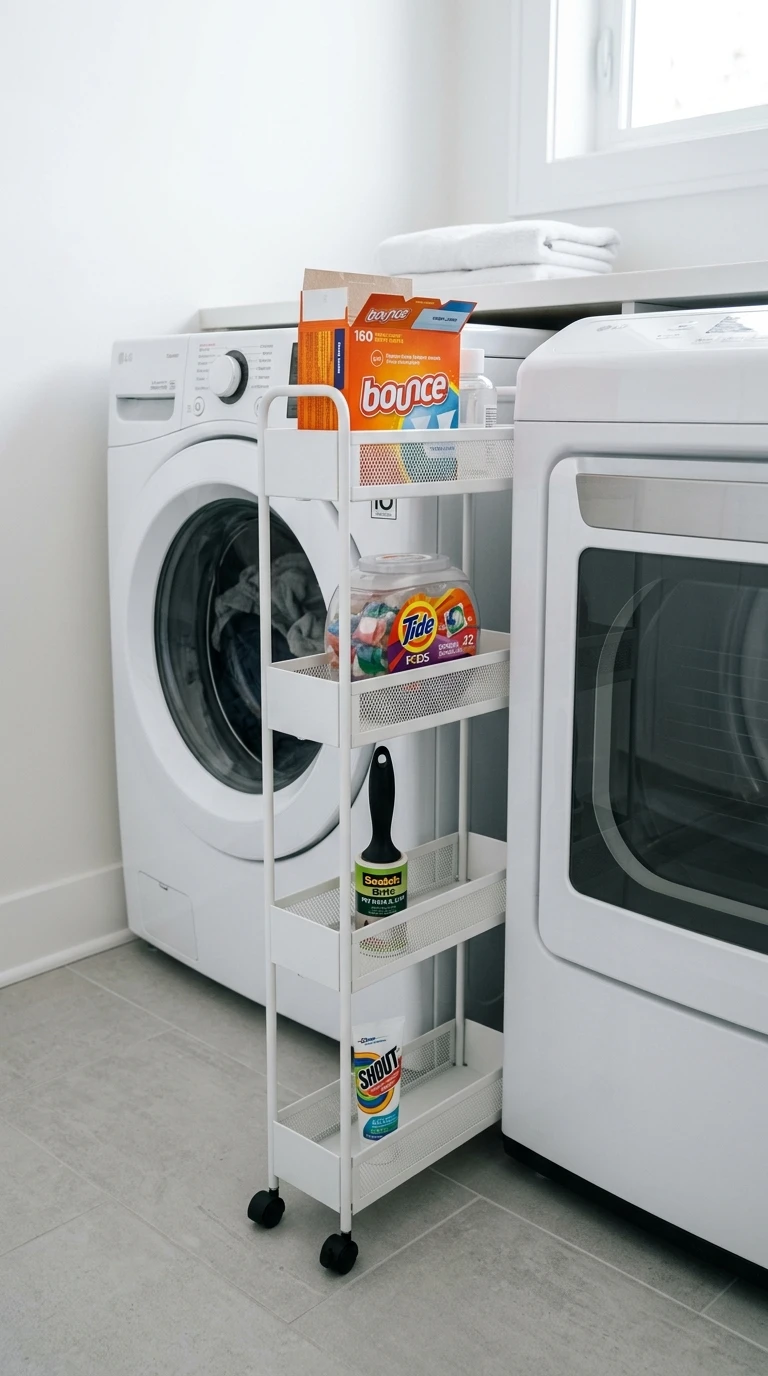
8. Pull-Out Drawer Between the Washer and Dryer
The gap between a side-by-side washer and dryer, or between one of the machines and the wall, is usually wasted space. A slim pull-out storage tower designed to fit in that narrow gap is one of the most satisfying laundry room upgrades you can make. These rolling towers typically have several tiers of shelving that slide in and out of the gap, holding detergent pods, dryer sheets, stain sticks, lint rollers, and anything else you want close at hand while doing laundry. When not in use, it rolls flush and disappears.
You can find dedicated laundry gap fillers at most home goods stores, or build a simple one with thin plywood and casters if you’re comfortable with basic DIY. The key dimension to measure is the exact gap width, since these vary by a few inches depending on your machines. Most standard versions are either 4 inches or 6 inches wide. For a more polished look, match the finish of the pull-out to your cabinetry or go for a neutral white or gray that blends with the machines.
Designer Tip: Add a small magnetic hook or clip to the front of the pull-out tower so you can hang a damp cloth or a small bag for stray items that come out of pockets during laundry.
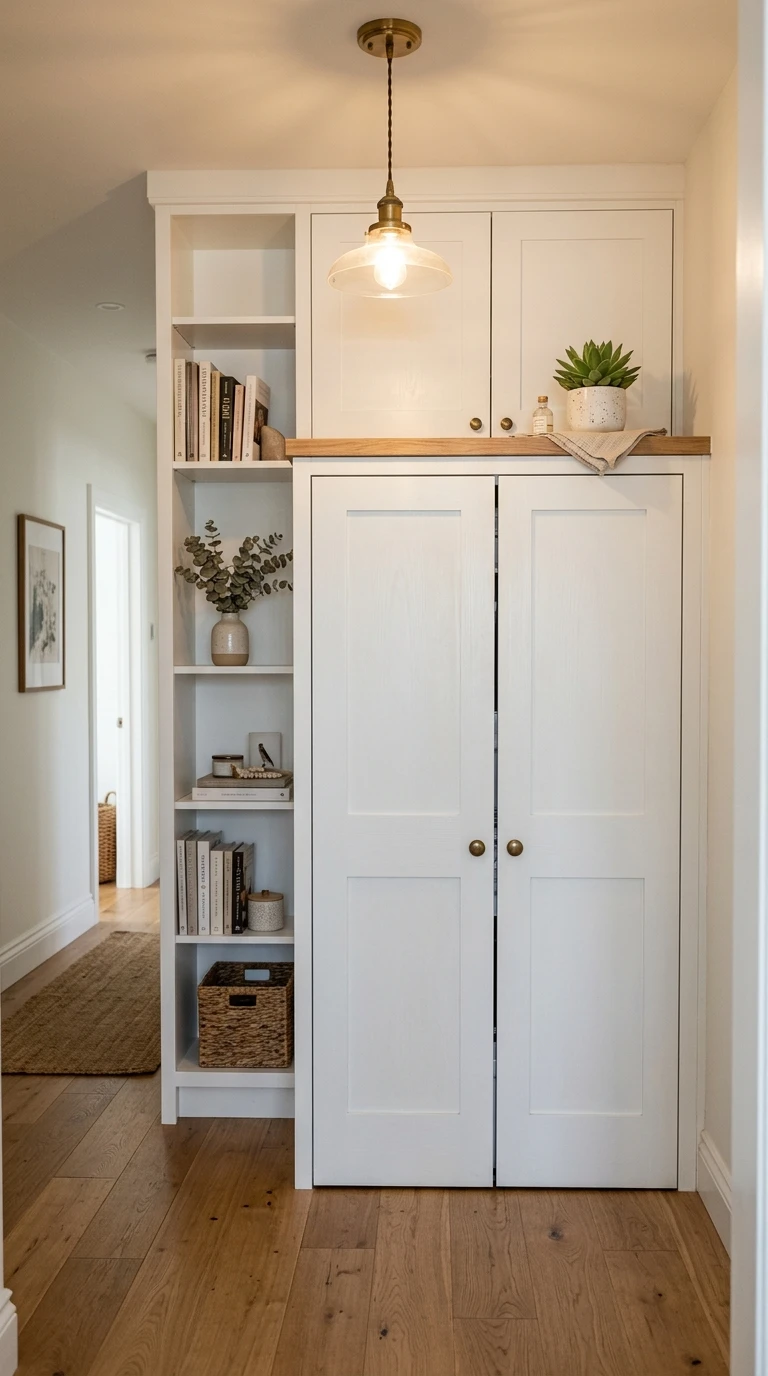
9. Cabinets That Conceal the Washer and Dryer
If your laundry machines are in a space that’s visible from other rooms, like a hallway laundry closet or an open utility area adjacent to the kitchen, consider surrounding them with cabinets and a full-length door so they’re completely out of sight when not in use. This works especially well for stacked washer and dryer units that fit neatly into a tall column. Frame them with cabinetry on either side and above, add a set of bifold doors or sliding barn doors, and suddenly the laundry area looks like built-in cabinetry rather than an appliance zone.
This setup is popular in apartments and smaller homes where the laundry is visible from main living areas. It keeps the home feeling cleaner and more cohesive without requiring a dedicated room. Inside the cabinet surround, you still have room for shelving on the sides for supplies, a retractable hamper, or a small folding station that tucks away with the doors closed. The overall effect is a significant upgrade in how the space feels, even without actually changing the size of the room.
Designer Tip: Choose sliding barn doors rather than bifold doors if space is tight in front of the machines. Bifold doors require clearance to swing open, which can be awkward in smaller laundry alcoves.
Sorting and Hamper Systems
One of the biggest sources of laundry room chaos is the absence of a clear system for sorting and storing dirty clothes. These ideas address that directly, making the sorting process easier and keeping the hamper situation under control.
10. Built-In Hamper Drawers
Built-in hamper drawers are one of those storage ideas that look like they belong in a magazine but are actually very practical to live with. The concept is simple: deep pull-out drawers built into lower cabinetry, lined with canvas or fabric bags that lift out for easy transport to the washer. From the outside, they look like regular cabinet drawers. From the inside, they’re a sorted laundry system that keeps dirty clothes completely out of sight. You can label each drawer for different categories: darks, lights, delicates, and linens.
This works best when the hamper drawers are positioned right next to the washing machine so the handoff from drawer to machine is as short as possible. It sounds like a small thing, but reducing the friction of laundry tasks genuinely makes the whole routine feel less like a chore. The fabric liners inside each drawer can be removed, taken to the machine, and the whole bag can go right in if you use mesh ones. A good carpenter or even a handy DIYer can build these into existing cabinetry for a relatively modest cost.
Designer Tip: Label each hamper drawer with a small engraved or printed tag on the drawer front rather than a removable label. It looks intentional and stays put through years of daily use.

11. Three-Section Sorting Hamper on Wheels
For those who aren’t ready for a built-in solution, a three-section rolling hamper is the next best thing. These hampers have three separate compartments for sorting laundry by type, and because they’re on wheels, you can roll the whole thing right up to the washing machine when it’s time to do a load. No lifting, no carrying, just sort as you go and wheel it over when it’s full. The rolling feature also means you can tuck it under a counter or shelf when it’s not needed.
Look for hampers with removable bags in each section so you can carry just the bag to the machine rather than the whole unit. Woven rattan versions look beautiful if aesthetics matter to you in the laundry room, though canvas and linen options are lighter and easier to clean. Some versions come with a pull-out ironing board on top, which is a nice bonus if you’re trying to consolidate functions in a small space. This is a very budget-friendly option that still significantly improves daily laundry workflow.
Designer Tip: Assign each section a color-coded tag or ribbon so family members can sort their own laundry correctly without needing to read labels. Kids especially find the color system easier to follow consistently.

12. Wall-Hung Laundry Bags on a Rail
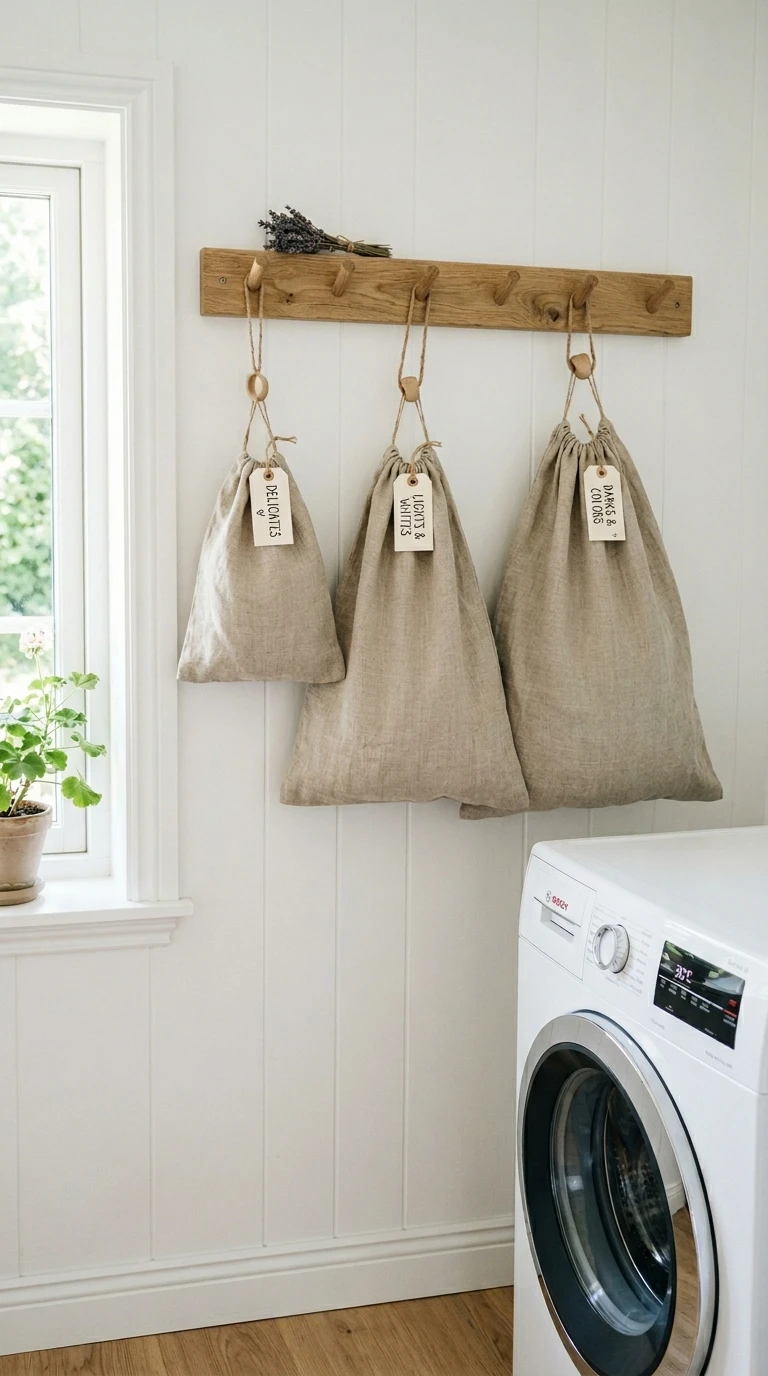
A horizontal rail mounted above the washer with two or three canvas bags hanging from it is a deceptively effective sorting system for small laundry rooms that can’t accommodate a floor-standing hamper. Each bag gets designated for a category: one for darks, one for lights, one for delicates. The bags hang at a convenient height for dropping clothes in, and when a bag is full, you lift it off the rail, carry it to the machine, and hang it back up. This system works particularly well in laundry closets where floor space is extremely limited.
The bags themselves should be made of breathable fabric so damp or sweaty clothes don’t develop a smell between wash days. Linen and open-weave canvas are both good choices. For the rail, a simple curtain tension rod can work in a closet setting, or a wall-mounted coat rail with multiple hooks gives you the option to vary how many bags you’re hanging at any given time. This is one of the most affordable storage systems on this list, and it works without requiring any tools beyond a drill for mounting the rail.
Designer Tip: Hang a small damp bag on one end of the rail specifically for items that need to be hand-washed or treated before going in the machine. It keeps those pieces separate and visible so they don’t get forgotten.
13. Under-Counter Rolling Basket Cart
A rolling cart with open basket shelves is one of the most versatile pieces of storage furniture you can add to a laundry room. Positioned under a counter or next to the machines, it gives you visible, accessible storage at multiple heights. The lower baskets can hold laundry in progress: clothes that have been washed but need to be folded, or items that have come out of the dryer and need to be sorted by person. The upper baskets can hold supplies, clean rags, or a small collection of frequently used items.
These carts are widely available in metal wire, white wood, and mixed material versions. The wire versions are breathable, which is helpful when holding damp or recently washed items. Wooden versions look warmer and more built-in. Because they roll, they can be moved out of the way during larger laundry days when you need more floor space, or tucked under a counter when everything is put away. For a cohesive look, match the cart material to other storage elements in the room.
Designer Tip: Use a cart with locking wheels so it doesn’t roll when you’re loading baskets from a height. The locking mechanism is a small thing but makes a real difference in day-to-day stability.

Folding and Counter Space Solutions
Folding laundry with nowhere to put it while you work is one of the most universally frustrating parts of doing laundry. These storage ideas create dedicated space for folding and finishing so clothes go from dryer to folded in one smooth step.
14. Countertop Over the Washer and Dryer
One of the highest-impact laundry room upgrades you can make is installing a countertop over a side-by-side washer and dryer. Suddenly you have a full-width work surface for folding, sorting, and staging clothes before they get put away. The countertop can be made from a variety of materials depending on your budget and aesthetic. A butcher block top adds warmth and texture and tends to work well with farmhouse or cottage laundry room styles. Laminate countertop in a solid color or stone look is an affordable option that’s durable and easy to clean. Quartz or granite gives a more polished, high-end result.
The countertop can simply rest on top of the machines with small rubber feet to prevent slipping, which requires no installation at all. For a more permanent and finished look, it can be supported by side panels or built-in cabinetry that run the full height of the machines. The difference this makes in daily laundry flow is genuinely significant. Clothes come out of the dryer, land on the counter, and get folded right there before they have a chance to sit in a wrinkled pile somewhere else in the house.
Designer Tip: Add a tension rod under the countertop edge to hang a few hangers within easy reach. You can pull a hanger, drape a shirt straight from the dryer, and hang it immediately without it ever touching a surface.

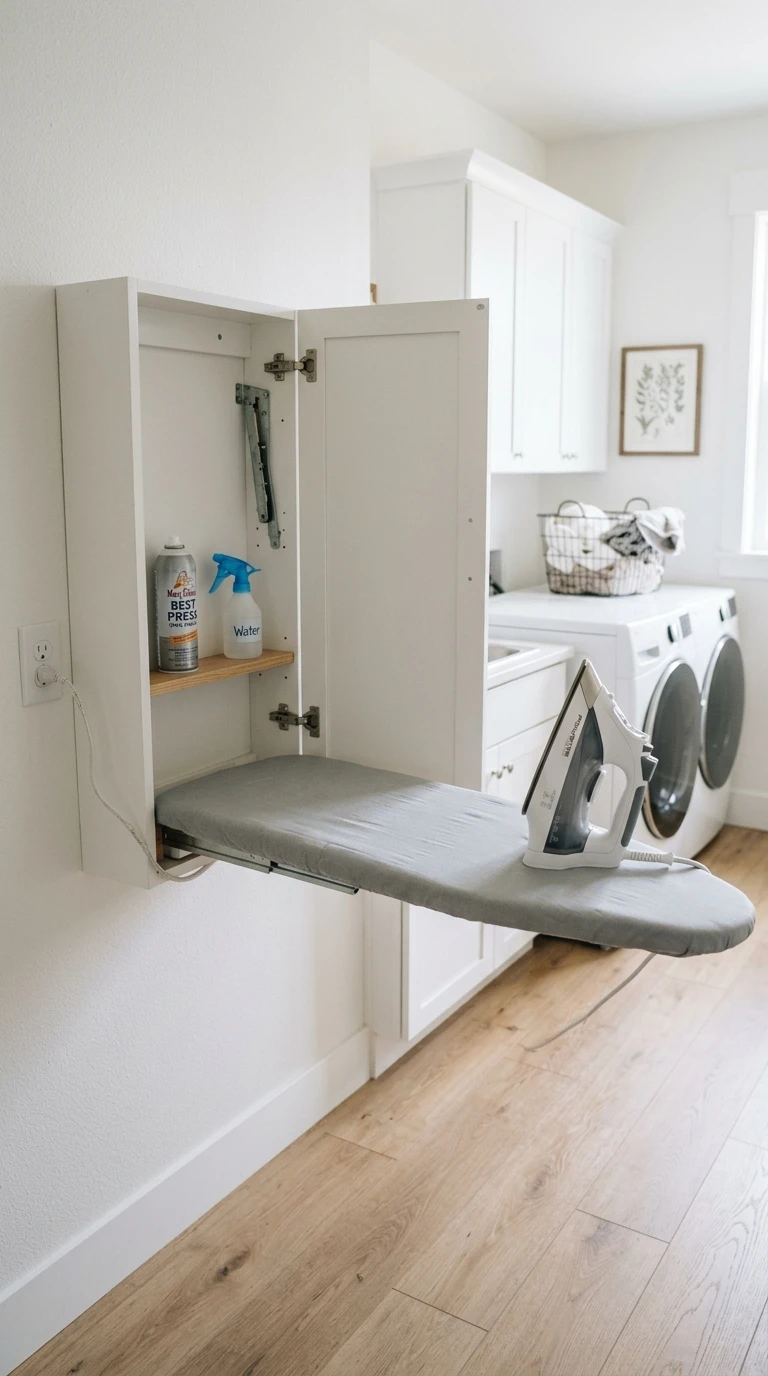
15. Fold-Down Wall Ironing Board
A fold-down ironing board mounted to the wall is one of the most space-efficient additions a laundry room can have. Traditional freestanding ironing boards are bulky and awkward to store. They lean against walls, fall over, and take up a corner that could be used for something else. A wall-mounted fold-down version pulls out when you need it and lies completely flat against the wall when you don’t. When fully closed, the board looks like a simple cabinet door or a framed panel. When open, it functions exactly like a standard ironing board.
These wall-mounted boards typically come with a storage section inside the cabinet portion for the iron itself, and sometimes include a small hook or shelf for spray starch and a water spray bottle. They’re available in widths that accommodate both full-sized ironing and small touch-ups, and the board surface itself is usually padded and heat-resistant just like any standard board. For small laundry rooms, this is an excellent way to incorporate ironing capability without sacrificing any floor space whatsoever.
Designer Tip: Look for a version with a built-in electrical outlet inside the cabinet section so your iron can store plugged in and ready to heat up. It removes the step of hunting for a nearby outlet every time you want to iron.
16. Stackable Storage Bins Under the Counter
The space under a laundry room counter, whether that’s under a folding station or under a utility sink, is often underused. Stackable storage bins or cube-shaped baskets in that area give you a whole additional tier of organized storage without adding anything to the walls or countertops. These bins work especially well for items that need to be sorted by person or by laundry type: each family member gets a bin, and when laundry is folded it goes straight into the right bin to be carried to the right room.
Look for bins with an open front or a label slot so you can identify what’s inside at a glance. Fabric-covered bins look neat and can be color-coded by family member. Wire bins are more breathable and easier to see into. The key is to choose a bin size that actually fits the under-counter space with a comfortable amount of clearance. Bins that are too tight become frustrating to pull in and out, which means they don’t get used properly over time.
Designer Tip: Pull out the bins completely when putting laundry away rather than trying to stack folded clothes into them in place. It takes two more seconds but results in a much neater bin that doesn’t overflow.

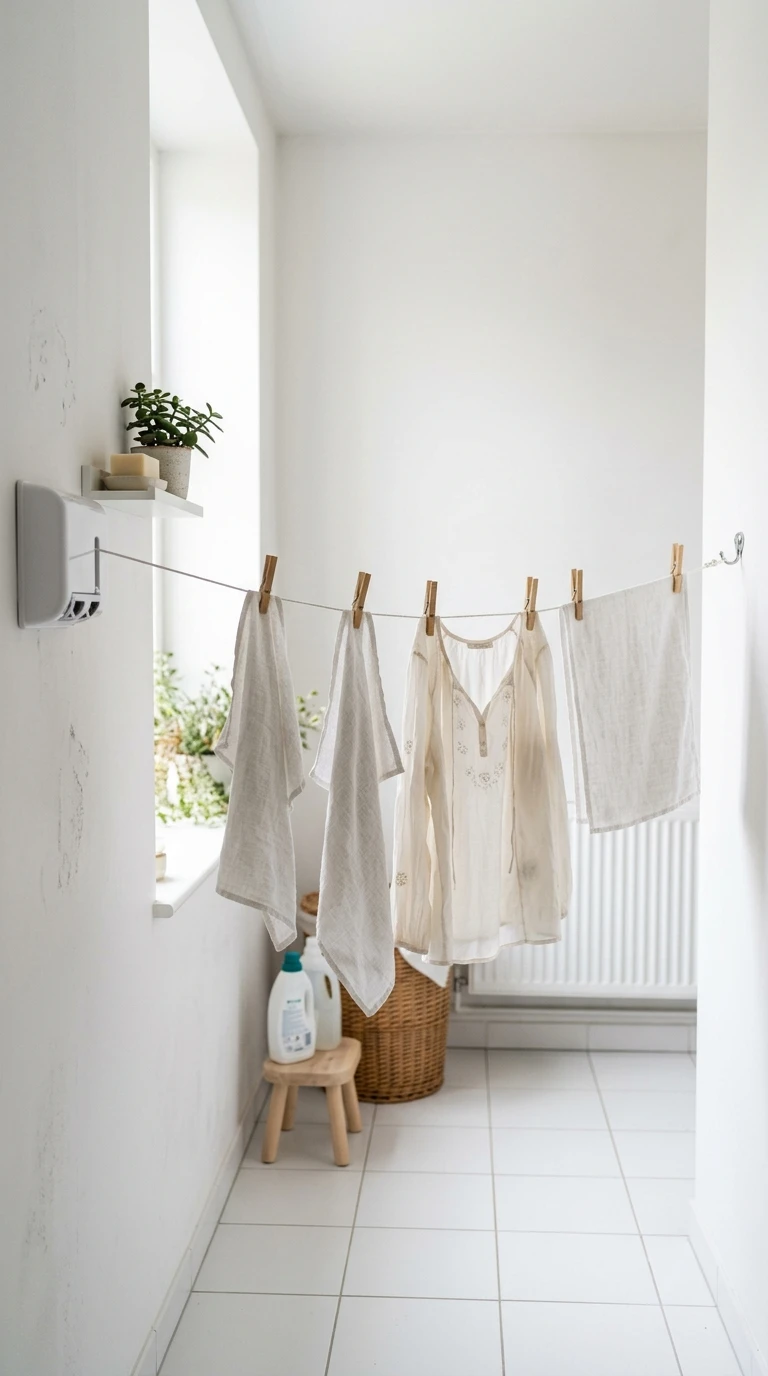
17. Retractable Clothesline Across the Room
A retractable clothesline is one of those laundry room additions that looks simple but earns its place quickly. Mounted at one end of the room with a latch hook at the other end, it pulls across the full width of the room to create a long horizontal line for air-drying larger items: sheets, tablecloths, sweaters laid flat over the line on a towel, or anything delicate that needs to dry slowly. When you’re not using it, it retracts completely back into its wall mount and the room is clear.
These lines are available in single, double, or triple-strand versions for varying amounts of drying capacity. The triple-strand version is ideal if you regularly air-dry a significant portion of your laundry, as it holds a full load. The hardware is minimal and installation is typically just a few screws at each end. For a particularly clean look, mount it at the height of the door frame so it’s visually in line with the room’s architectural elements. Some versions come in matte black hardware for a modern aesthetic that looks intentional rather than utilitarian.
Designer Tip: Mount the retractable line higher than you might initially think necessary. If it’s too low, larger items drag on the floor. A height of around 6.5 to 7 feet works for most households.
Hidden and Clever Hacks
Some of the best laundry room storage comes from thinking slightly outside the obvious. These ideas use overlooked spaces and unexpected approaches to create storage that feels almost invisible until you need it.
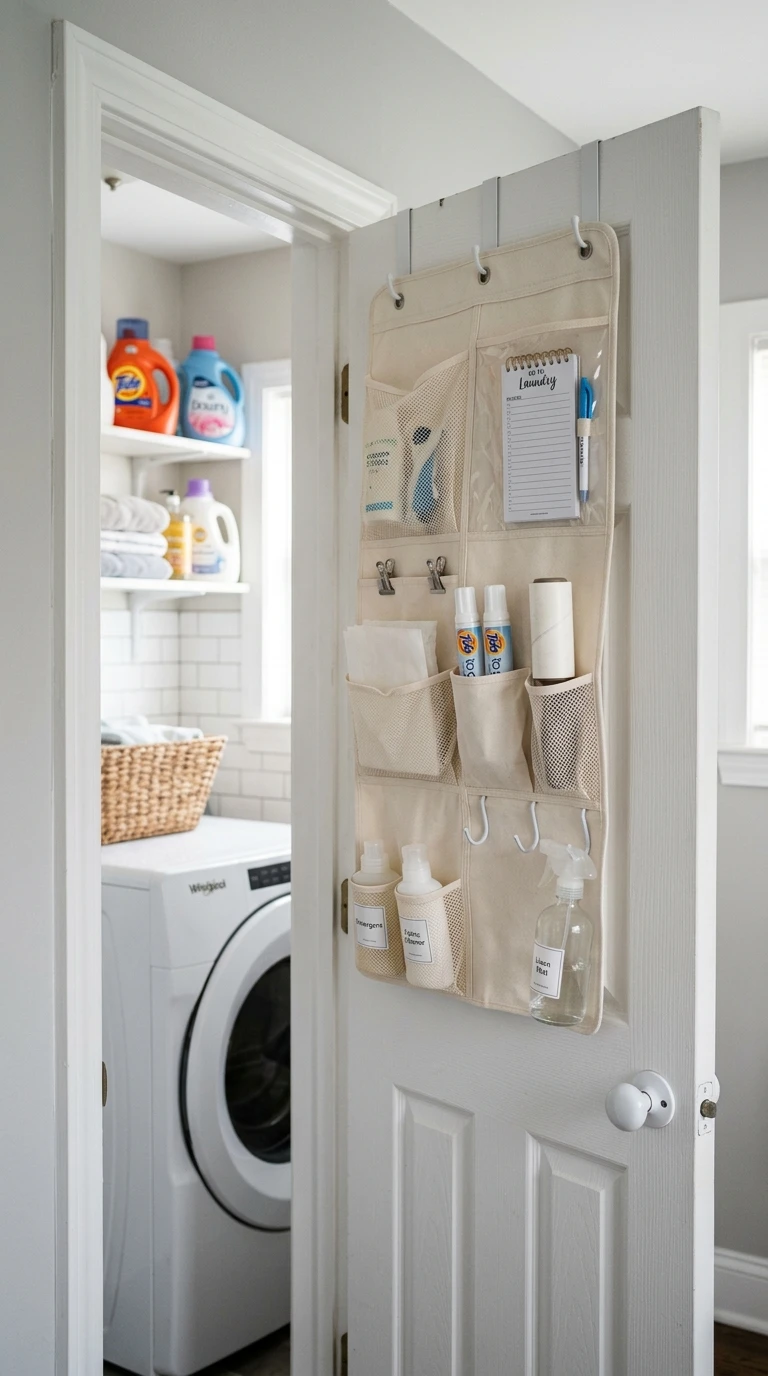
18. Behind-the-Door Organizer
The back of the laundry room door is a reliable but frequently ignored storage surface. An over-the-door organizer, either a fabric pocket version or a metal rack with hooks and shelves, can hold a remarkable amount without taking up any room space at all. This is the perfect spot for a dryer ball collection, stain remover sticks, small sewing kits for emergency repairs, clothespins, lint rollers, and any other small supplies that tend to rattle around in drawers or get lost on shelves. Because it’s behind the door, it stays out of sight unless you actively look for it.
Choose an organizer that’s sized for the door height and doesn’t interfere with the door swing. Clear pocket organizers are helpful because you can see everything at a glance. For a more polished look, a narrow metal rack with a few hooks and a small shelf at the bottom looks more intentional and is easier to load and unload. If the laundry room door has decorative panels, make sure the hook bracket at the top accommodates the panel thickness so it hangs flat and secure.
Designer Tip: Hang a small dry-erase board or a notepad holder on the back of the door for a quick running list of laundry supplies that need restocking. You see it every time you reach for something, so the list actually gets used.
19. Mason Jar or Canister Display on a Shelf
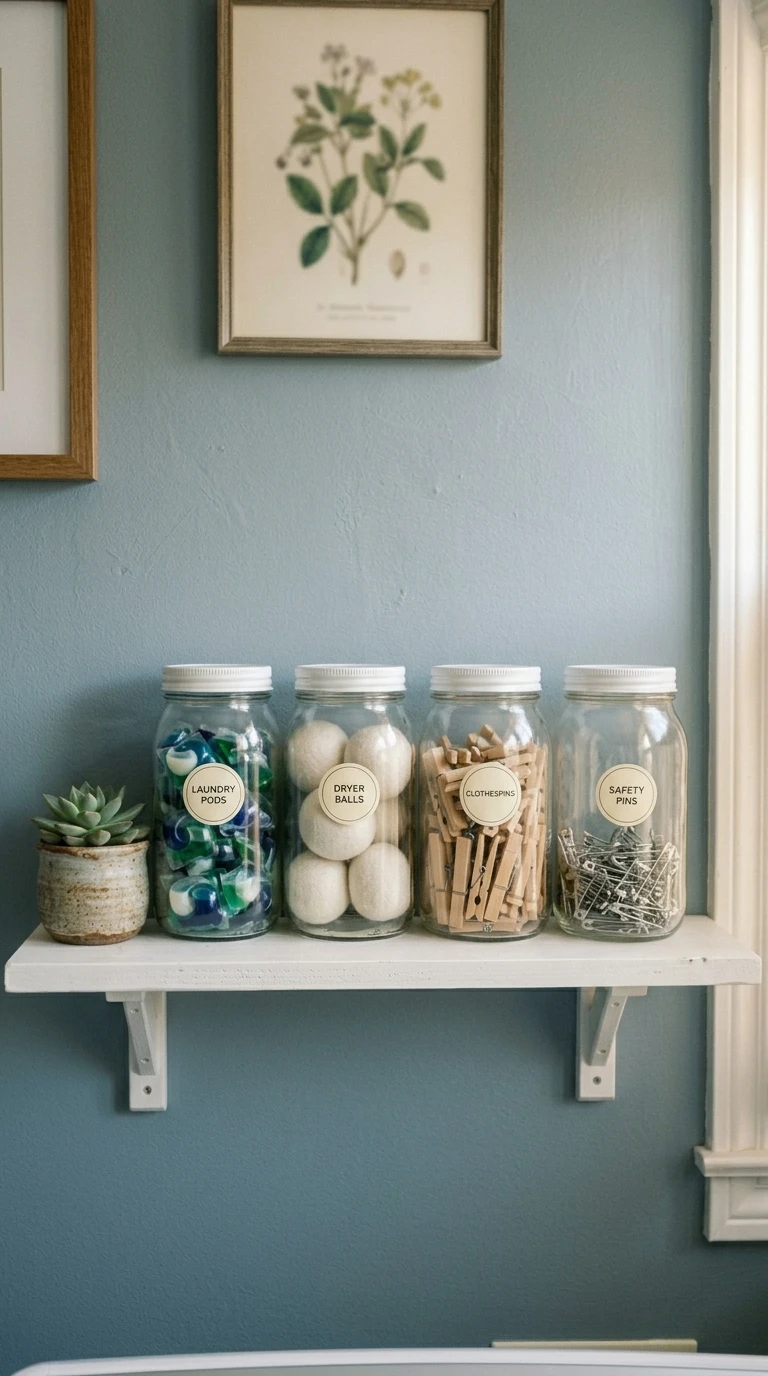
Decanting your loose laundry supplies into matching glass or ceramic canisters is a storage idea that’s equal parts functional and visually satisfying. Instead of bulky cardboard boxes and plastic jugs crowding your shelves, you have a clean row of matching containers holding detergent pods, dryer balls, clothespins, safety pins, and anything else that comes in an inconvenient package. The original boxes get stored out of sight in a cabinet, and only what you need day to day is visible.
Mason jars work particularly well for this because they’re inexpensive, widely available, and they let you see exactly how much of a supply you have left. Matte ceramic canisters with simple labels look more polished and work well in laundry rooms that lean toward a modern or minimalist style. Whatever containers you choose, make sure the openings are wide enough to access the contents comfortably, especially for detergent pods which tend to clump if you’re fishing around in a narrow jar.
Designer Tip: Print small waterproof labels for each canister so anyone in the household knows exactly what goes where. Waterproof labels hold up against the moisture and steam a laundry room generates better than regular paper labels.
20. Slim Rolling Cart for the Utility Sink Area
If your laundry room has a utility sink, the area beside or below it is often underused. A slim rolling cart that fits next to the sink gives you immediate storage for hand-washing supplies, spot treatments, gentle detergents for delicates, and any other products that live near the sink during hand-washing tasks. Because it rolls, it can be tucked under the sink cabinet or pulled out when you’re actively working at the sink. Most standard slim carts are about 12 inches wide, which fits beside most utility sinks without blocking access.
Look for a cart with at least three or four shelves to maximize the vertical storage potential in a small footprint. Stainless steel carts are rust-resistant, which matters near a sink. White powder-coated metal or bamboo carts look more finished and warm if the laundry room has a more designed aesthetic. Add a small hook to the side of the cart for a hand towel or a small mesh bag for delicate items that are waiting to be hand-washed.
Designer Tip: Line the top of the cart with a small silicone mat so bottles and jars don’t slide around when the cart is rolling. It’s an inexpensive addition that keeps things neat and prevents spills during movement.

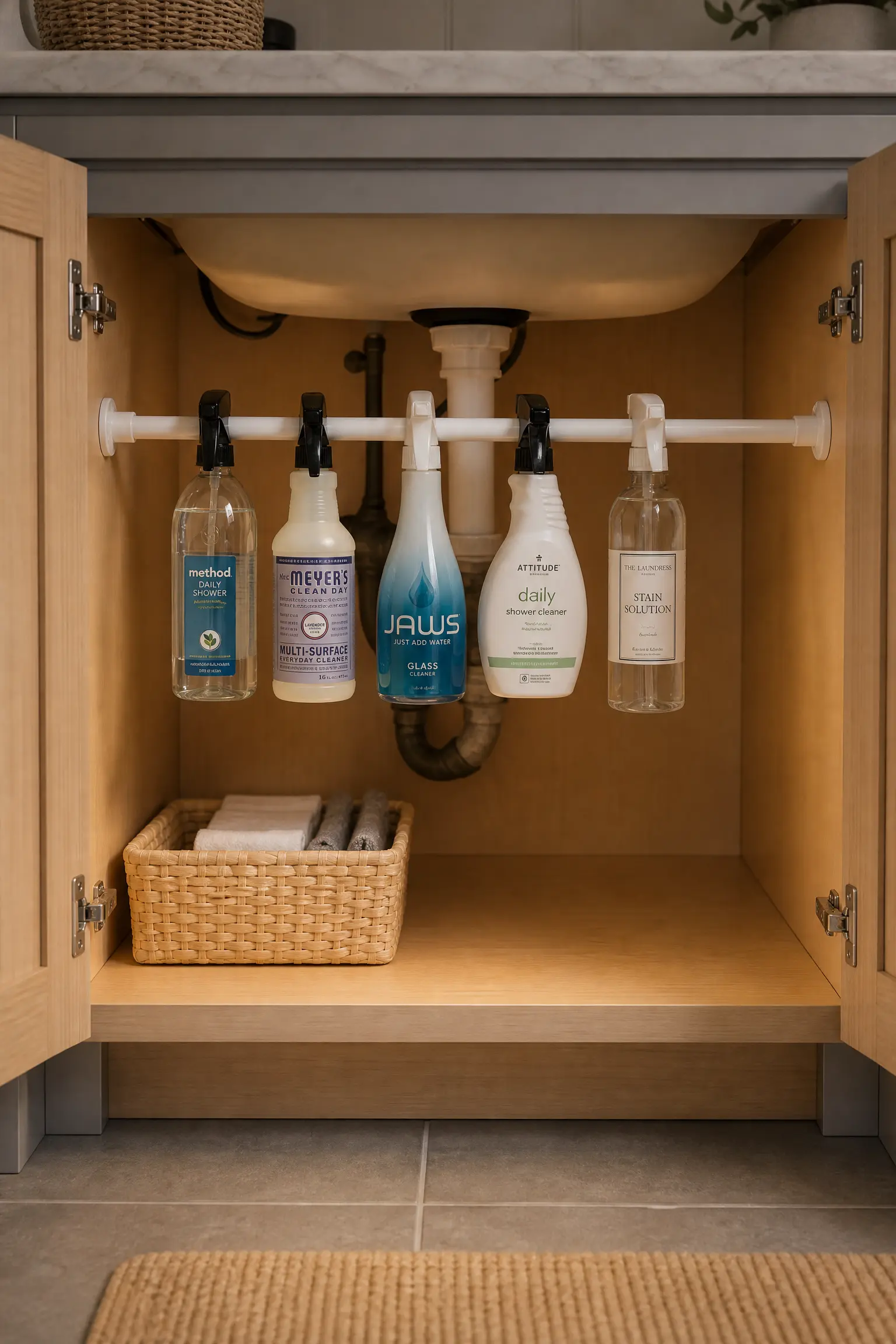
21. Tension Rod Under the Sink for Spray Bottles
A tension rod installed horizontally under the utility sink or inside a lower cabinet can hold spray bottles by hanging them upside down from the trigger. This frees up the entire bottom of the cabinet or the area under the sink for baskets, bins, or other storage, while keeping all your spray bottles accessible and visible from above. It’s one of those ideas that costs almost nothing, takes about three minutes to implement, and immediately clears up a frustrating area that tends to become cluttered with bottles falling over each other.
This trick works best for spray bottles that are used regularly, like stain removers, fabric fresheners, and all-purpose cleaners that pull double duty in the laundry room. The bottles hang neatly in a row, you can grab the one you want without disturbing the others, and when they’re empty the whole row is clearly visible so you know what needs replacing. Make sure the tension rod is sized correctly for the cabinet or sink cabinet width, and choose one rated to hold some weight so it stays in place reliably.
Designer Tip: Use a second tension rod a few inches below the first if you have a collection of both tall and short spray bottles. Stagger them so each bottle is easy to reach without the rows interfering with each other.
Decor-Forward Storage
A laundry room can be organized and visually appealing at the same time. These ideas bring some design attention to the space without sacrificing practicality, so the room feels genuinely pleasant to be in rather than just functional.
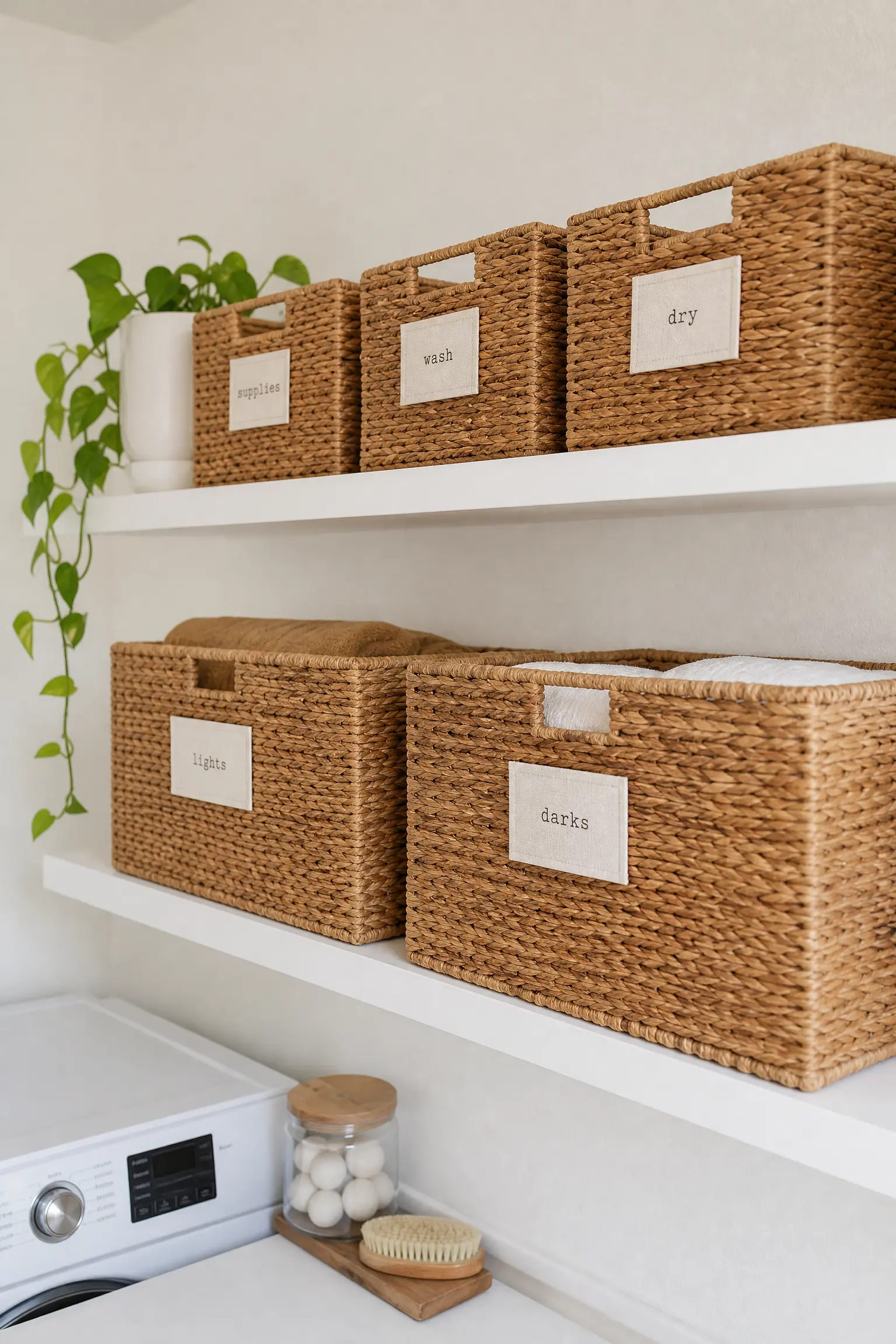
22. Woven Basket Collection on Open Shelving
A set of matching woven baskets on open shelves is one of the easiest ways to make a laundry room look like it belongs in a home decor magazine without spending a lot of money. The baskets bring texture, warmth, and a natural element into a space that’s usually dominated by appliances and synthetic materials. Use them for holding clean laundry waiting to be put away, for dirty clothes that have been pre-sorted, for storing extra rolls of paper towels, or for grouping miscellaneous supplies that don’t have a dedicated home.
The key to making a basket wall look good is consistency. Pick a single style or very similar styles and stick with them throughout the room. A mix of too many different basket shapes and weaves looks chaotic rather than curated. Seagrass baskets have a beautiful natural color and hold their shape well. Water hyacinth has a tighter, more refined weave that looks more polished. For a uniform look, choose one material and one color family and use it throughout. Label each basket with a small tag or a printed label attached to the front.
Designer Tip: Choose baskets with handles so they’re genuinely easy to lift on and off the shelf. A beautiful basket that’s awkward to grab quickly loses its appeal in the middle of a busy laundry routine.
23. Accent Wall Behind the Machines
The wall directly behind the washer and dryer is usually painted the same color as everything else in the room and then completely ignored. Using that wall as an opportunity for a little visual interest makes the whole room feel more considered. A peel-and-stick wallpaper in a simple geometric or botanical print, a painted pattern like vertical stripes or a soft color block, or a section of shiplap or beadboard paneling all add character to the back wall without requiring a major renovation. Because the machines are in front of most of the wall, you only see the upper portion, which means the wallpaper installation is much simpler than covering an entire room.
This idea pairs especially well with floating shelves above the machines. The accent wall becomes the backdrop for the shelf display, making even a simple row of matching canisters look styled and deliberate. From a color perspective, a soft botanical print or a muted geometric in warm tones works well with natural wood shelving and woven baskets. For a more modern look, a graphic black and white tile print or a deep toned wallpaper creates a strong focal point that makes the whole room feel more finished.
Designer Tip: Use removable peel-and-stick wallpaper if you’re renting or if you want the flexibility to change the look easily. Today’s peel-and-stick options are high quality and look nearly identical to traditional wallpaper from a normal viewing distance.

24. Labeled Glass Dispensers with a Wood Tray
A small wooden tray holding two or three labeled glass dispensers for liquid detergent and fabric softener is the laundry room version of a styled bathroom counter display. The tray corrals the bottles so they don’t spread across the shelf, and the glass containers look clean and intentional next to the industrial appliances. This setup looks especially good on a countertop above the machines or on a shelf directly at eye level. It turns what is normally a purely functional area into something that actually looks nice.
You can find glass dispensers with pump tops specifically designed for laundry detergent, which makes dispensing both easy and mess-free. The wood tray can be natural, stained, or painted to match the room’s color palette. Add a small air plant or succulent to the tray for a bit of life and freshness. The whole display takes up only a small amount of counter space but has an outsized effect on how polished the room looks overall. It’s the kind of detail that makes a laundry room feel like someone actually cared about it.
Designer Tip: Use a tray with raised edges or a slight lip rather than a flat board. It keeps the dispensers from sliding off during spin cycles and gives the arrangement a bit more visual structure.

25. A Dedicated Lost Socks Station
Every household has the lost sock problem, and it’s one of those small irritants that adds up over time. A dedicated lost sock station turns this universal laundry frustration into an organized system. The concept is simple: mount a small wire basket, a decorative bowl, or a labeled bin somewhere visible in the laundry room specifically for socks that come out of the dryer without a match. When a pair reunites, it gets pulled out and folded together. When socks have been waiting too long with no match, they get repurposed as cleaning rags or discarded.
The station works best when it’s in a spot that everyone in the household can interact with easily, at eye level near the dryer or at the end of the folding counter. A small chalkboard label that says something like ‘Missing Partners’ or ‘Sock Waiting Room’ adds a bit of personality and actually makes people smile when they see it. The psychology of having a designated spot for this common problem means it stops being an unresolved annoyance and becomes a manageable part of the laundry routine.
Designer Tip: Check the lost sock station before buying new socks. Most households will find that a significant portion of their ‘lost’ socks are actually just waiting for their pair, and the station makes the reunification process much faster.

Wrapping It Up
The laundry room will always be a working space, but working spaces don’t have to be messy, frustrating, or completely devoid of personality. Every idea in this list comes down to the same core principle: when things have a clear, logical home, they go back where they belong. And when they go back where they belong, the room stays organized without requiring constant effort to maintain.
You don’t need to implement all 25 ideas to see a real difference. Start with one or two that address your biggest pain points, whether that’s nowhere to fold, no clear sorting system, or shelves that never seem to be enough. Small, intentional changes add up quickly in a room this size. A few well-chosen baskets, a countertop over the machines, and a wall-mounted drying rack can completely change how the room functions in a single weekend.
Give the laundry room the same consideration you’d give any other room in the house. It earns it every single week.
Frequently Asked Questions
What is the most important storage item for a small laundry room?
Vertical storage is the single most impactful upgrade in a small laundry room. When floor space is limited, the walls have to do more work. Floating shelves above the washer and dryer, a wall-mounted drying rack, and a pegboard panel can collectively provide a significant amount of organized storage without using any floor space at all. If you can only do one thing, add shelving directly above your machines.
How do I organize a laundry room with no cabinets?
Start with floating shelves for supplies, a freestanding armoire or utility cabinet for larger storage needs, and over-the-door organizers for small items. A rolling cart that slides under a temporary countertop adds both surface space and additional shelved storage. Woven baskets on open shelves give you organized storage with visual warmth that compensates for the absence of cabinet doors.
What’s the best way to sort laundry without taking up too much space?
Wall-hung canvas bags on a rail system take up almost no floor space and do the sorting job effectively. If you have slightly more room, a three-section rolling hamper does the same job and adds the convenience of rolling directly to the machine. Built-in hamper drawers in cabinetry are the most seamless solution if you’re doing a larger renovation.
How can I make a laundry room look nicer without spending a lot?
Decant supplies into matching glass or ceramic containers, add a set of matching woven baskets to open shelves, and use peel-and-stick wallpaper on the accent wall behind the machines. These three changes together cost very little but have a significant visual effect. Updating hardware on any existing cabinets is another inexpensive step that immediately makes the room feel more finished.
Is a countertop over the washer and dryer worth the investment?
Absolutely, and it doesn’t have to be expensive. A simple butcher block panel or a cut piece of laminate countertop resting on top of the machines costs relatively little and transforms how the room functions. Having a dedicated surface for folding means clothes go from the dryer to folded and put away in a single smooth process instead of sitting in a pile waiting for somewhere to go.
What flooring works best in a laundry room?
Waterproof or water-resistant flooring is the top priority in a laundry room since moisture from the machines and occasional leaks or spills are part of the territory. Luxury vinyl plank, ceramic tile, and porcelain tile all perform well. From a storage perspective, choosing a floor that’s easy to clean around the base of your furniture and storage pieces makes maintenance simpler. Light-colored floors also make a small laundry room feel larger and brighter.