Small Bathroom Shower Curtain Ideas Worth Stealing Right Now

If you have ever stood in a small bathroom and felt like the walls were closing in, there is a good chance the shower curtain had something to do with it. Most people treat it as an afterthought, grabbing whatever is on sale and calling it done. But the shower curtain covers more visible surface area than almost anything else in the room, which means choosing it badly is one of the fastest ways to make a small bathroom feel smaller, darker, and less intentional than it actually is.
The good news is that fixing it costs almost nothing compared to a renovation. A new curtain can go up in twenty minutes and completely change how the room reads. The right choice can make ceilings feel taller, walls feel farther apart, and the whole space feel like someone actually thought about it. The wrong choice does the opposite, and it does it loudly.
This article covers 22 different shower curtain ideas, all of them chosen specifically because they do something useful for a small bathroom. Some work by bouncing light around the room. Some create the illusion of height or width. Some just bring in a personality and warmth that a plain builder-grade curtain never could. Every idea is different from the last, and every one comes with real, practical advice on how to make it work in your space.
Whether you are working with a tight budget or willing to invest a little more for something special, there is something in here that will work for your bathroom. Take a look through and pick the one that matches your space, your style, and what you actually need the curtain to do.
1. Ceiling-Mounted White Linen for Maximum Height
The single most effective thing you can do in a small bathroom is hang your shower curtain from the ceiling instead of at standard rod height. When the curtain runs from ceiling to floor, your eye follows the full vertical length of the room and the space instantly feels taller. A white or off-white linen fabric makes this even more effective because it is soft, airy, and lets light filter through without blocking it.
Linen has a natural texture that reads as warm and organic rather than sterile, which matters in a small bathroom where cold, flat surfaces can feel unwelcoming. The fabric also wrinkles in a way that looks intentional rather than neglected, so you do not need to iron it perfectly every time you wash it. Hang it with a ceiling-mounted matte black or unlacquered brass rod to make the hardware feel like a deliberate design choice.
Always pair a linen curtain with a separate waterproof liner hung on an inner rod. The linen stays dry and purely decorative, while the liner does the actual work of keeping water in the tub. This setup protects the fabric and extends its life significantly.
Quick Tip: Buy a curtain that is at least 84 inches long, ideally 96 inches, so it can run from ceiling to floor without looking like it falls short. Measure your ceiling height before ordering.

2. Sheer Ivory Curtain with Oversized Brass Hardware
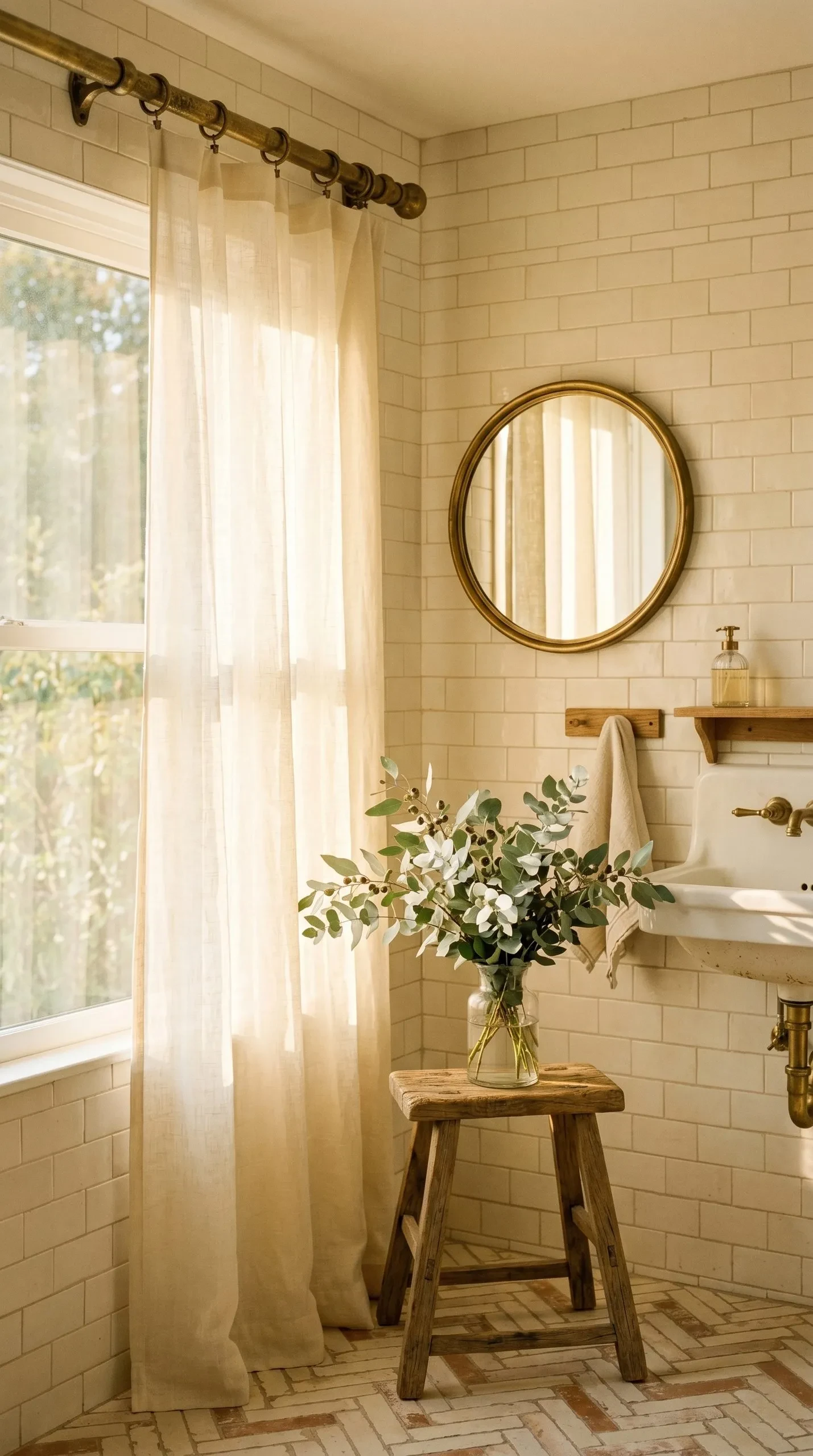
A sheer ivory or cream curtain is one of the best tools for keeping a small bathroom feeling open and light-filled. Because the fabric is translucent, it does not create a visual wall the way a heavy opaque curtain does. Instead it softens the shower area while still allowing light to pass through, which makes the whole room feel more connected and spacious.
The secret to making this look designed rather than plain is the hardware. Choose an oversized rod in unlacquered brass, antique bronze, or brushed gold, something with genuine visual weight and presence. When the curtain itself is quiet and understated, the hardware becomes the design statement. A thick, well-made rod in a warm metal finish immediately elevates the whole setup and gives the bathroom a boutique quality.
This idea works especially well in bathrooms that get natural light from a window. The sheer fabric diffuses the light gently rather than blocking it, creating a warm, glowing effect that feels genuinely beautiful rather than accidental. Keep the rest of the accessories simple and let the light do most of the decorating.
Quick Tip: Use a tension rod as a secondary support in the middle of a long sheer curtain. Sheer fabrics are lightweight but can sag over time without adequate support, especially on rods over 60 inches wide.
3. Navy and White Vertical Stripe for Visual Height
Vertical stripes are one of the most reliable tricks in interior design for making a room feel taller, and they work just as well on a shower curtain as they do on wallpaper or upholstery. A navy and white vertical stripe curtain draws the eye straight up and creates a strong sense of height that a solid or horizontally patterned curtain simply cannot match. The effect is most dramatic when the curtain is hung high, close to the ceiling, so the stripes run as long as possible.
Navy and white is a particularly good color combination for this because it is crisp, clean, and classic without feeling trendy. It works in modern bathrooms, transitional spaces, coastal-inspired rooms, and even more traditional settings. The contrast is strong enough to read clearly in any lighting condition, which means it looks just as good on a gloomy morning as it does in bright afternoon light.
For the stripe width, thinner stripes tend to feel more refined and hotel-like in a small bathroom, while wider stripes feel more graphic and casual. Choose based on the overall mood you want. Either way, make sure the stripes run perfectly vertical in the finished curtain, as even a slight off-angle will read as crooked and undo the whole effect.
Quick Tip: Mount the rod as close to the ceiling as possible and choose a curtain long enough to nearly reach the floor. The longer the stripe runs without interruption, the more dramatic the height illusion becomes.

4. Tonal Color Match with the Wall Paint
One of the cleverest tricks for making a small bathroom feel larger is choosing a shower curtain in the same color family as your wall paint. When the curtain blends with the wall rather than contrasting against it, the eye does not register a hard visual boundary where the curtain begins. The whole wall plane reads as one continuous surface, which makes the room feel significantly wider and more open than it actually is.
It does not need to be an exact color match. A curtain in a slightly different shade or texture of the same color family works just as well, and actually adds more depth than a perfect match would. A soft sage green curtain against sage green walls, or a dusty blue curtain against pale blue-gray plaster, creates a layered, sophisticated look that feels genuinely designed rather than accidental.
This approach works best with light to medium value colors. Very dark tones can feel cave-like in a small space even with a tonal treatment. Dusty lilac, warm taupe, muted terracotta, and soft sage are all excellent options that read as refined and intentional without darkening the room. Add a contrasting accent through towels or accessories to give the space some visual interest without breaking the expansive feel.
Quick Tip: If you cannot repaint, identify the undertone in your existing tile or grout and find a curtain that picks up that same undertone. The harmony between the curtain and the fixed surfaces creates a similar effect.

5. Bold Botanical Print on a White Background
A bold botanical print curtain is one of the fastest ways to give a small bathroom a distinct personality without touching a single tile. The key is choosing a print that has a generous white or light background behind the foliage so the curtain does not feel heavy or overwhelming. Large tropical leaves, oversized ferns, or illustrated garden botanicals all work beautifully when the background remains light and airy.
Botanical prints bring a natural, organic quality into the bathroom that feels relaxing and genuinely pleasant to be around. They pair naturally with live houseplants, dried eucalyptus, and wooden accessories, all of which reinforce the green, growing quality of the print. A small pothos trailing from a shelf or a hanging bunch of eucalyptus tied near the showerhead costs almost nothing and makes the botanical theme feel immersive rather than surface-level.
Keep everything else in the room very simple when working with a bold print. White towels, a plain bath mat, and minimal counter accessories let the curtain breathe and remain the clear focal point. Layering multiple patterns or too many colors in a small bathroom almost always tips from curated into chaotic.
Quick Tip: Look for a botanical print that includes a color already present somewhere in your bathroom, whether in the grout, the tile, or an accessory. This visual connection makes the curtain feel integrated rather than dropped in from another room.
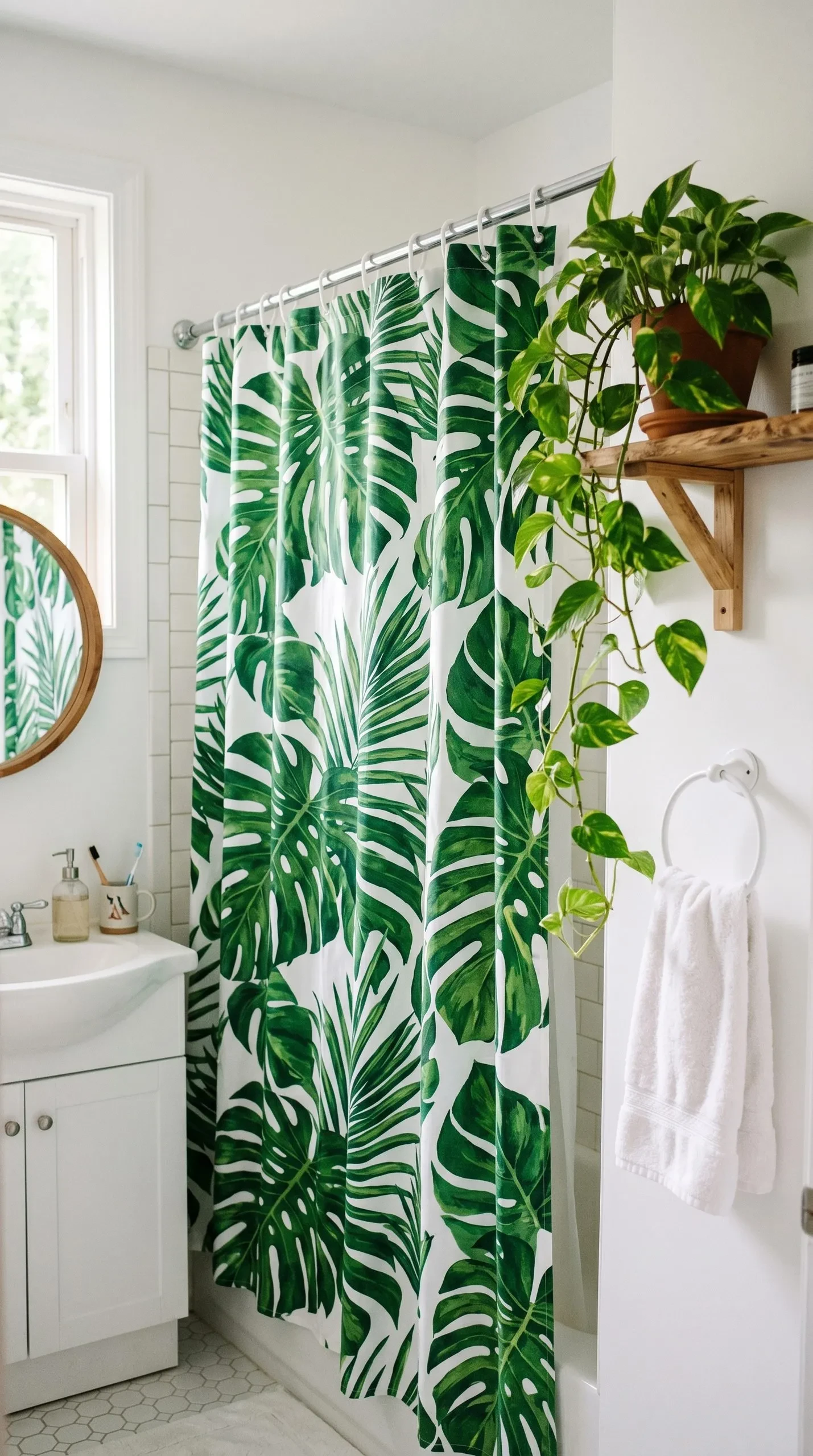
6. Waffle-Weave Cotton in Natural White
Texture is one of the most underused tools in bathroom design, and a waffle-weave cotton curtain is one of the easiest ways to bring it in. The waffle grid pattern creates a subtle three-dimensional surface that catches light differently throughout the day, giving the room a sense of depth and richness that a flat-printed curtain simply cannot deliver. In natural white or warm ivory, it reads as clean and spa-like without feeling clinical.
Waffle weave is a practical choice as well as a beautiful one. The open construction of the weave allows air to circulate through the fabric, which means it dries faster than denser fabrics and is significantly less prone to mildew. It is also a heavier fabric that hangs with real weight and moves with a satisfying drape, which looks far more considered than a thin, flimsy curtain fluttering in every draft.
This style pairs beautifully with warm wood accessories, a woven seagrass bath mat, and matte ceramic soap dispensers. The combination reads as quiet luxury, the kind of bathroom that looks expensive without having been expensive. If your existing fixtures are chrome, consider swapping just the towel ring and toilet paper holder for brushed nickel or matte black to complete the warm, considered aesthetic.
Quick Tip: Pre-wash your waffle-weave curtain before hanging it. Cotton waffle weave can shrink slightly in the first wash, and doing this before it goes up ensures the finished length is exactly what you expect.

7. Deep Forest Green as a Moody Statement
Going dark in a small bathroom feels counterintuitive, but a deep forest green shower curtain can be one of the most striking and successful choices you make in the room. Rather than trying to visually expand the space, this approach leans into the intimacy of a small bathroom and makes it feel intentional, cozy, and genuinely designed. The key is making sure everything else in the room reads light so the green curtain becomes a backdrop rather than a burden.
White subway tile, bright white walls, and light grout all do the heavy lifting of keeping the room airy even with a dark curtain in it. Good lighting is non-negotiable here. A well-lit vanity mirror and ideally some natural light from a window or skylight ensure the green reads as rich and verdant rather than dim and draining. Matte black fixtures and hardware tie the curtain into the room and make the overall palette feel cohesive.
Forest green works particularly well because it carries a natural, organic quality that feels at home in a bathroom context. It references plants, nature, and the outdoors, which is exactly the kind of association that makes a bathroom feel like a pleasant place to be rather than a purely functional one. Add a small plant on the windowsill or a wooden shelf to reinforce the connection.
Quick Tip: Add one or two warm amber candles or a plug-in sconce on the shower side of the room. Warm light softens the drama of a dark curtain and keeps the space feeling intentional rather than gloomy.

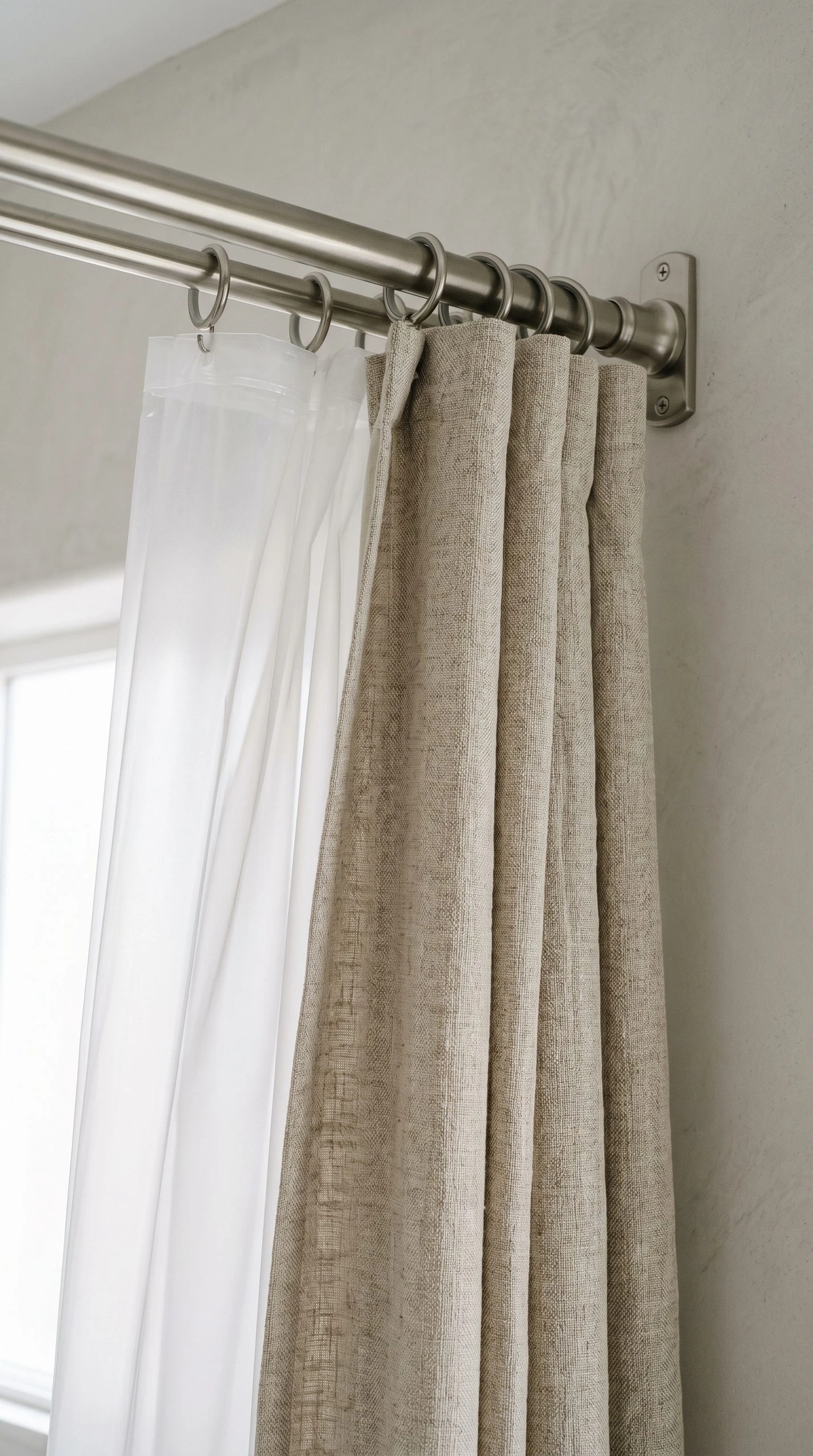
8. Double Rod with Linen Outer and Clear Inner Liner
A double curtain rod setup solves one of the most persistent frustrations in bathroom design: how to have a beautiful fabric curtain without getting it wet and ruined. The inner rod holds a plain clear waterproof liner that does the actual water-blocking work. The outer rod holds a gorgeous linen, cotton, or textured fabric curtain that never touches water and stays completely dry and decorative. You get the practical performance of a liner and the design value of a beautiful curtain at the same time.
This setup also gives you flexibility that a single curtain cannot. On a bright morning when you want maximum light in the bathroom, push the decorative curtain entirely to one side and let only the clear liner hang. In the evening when you want a softer, more finished look, draw the linen curtain closed over the liner. The layered effect also adds genuine visual depth to the shower wall, which is useful in a small room where every surface needs to contribute something.
Double curtain rods are widely available and straightforward to install. Look for one where both rods adjust independently so you can fine-tune the spacing and overlap. For the outer curtain, a natural linen in warm white, oatmeal, or soft gray is versatile enough to work with almost any bathroom color palette without requiring anything else to change.
Quick Tip: Make the decorative outer curtain about four to six inches longer than the liner so it just grazes the floor. This small difference in length makes the layered setup look intentional and polished rather than mismatched.
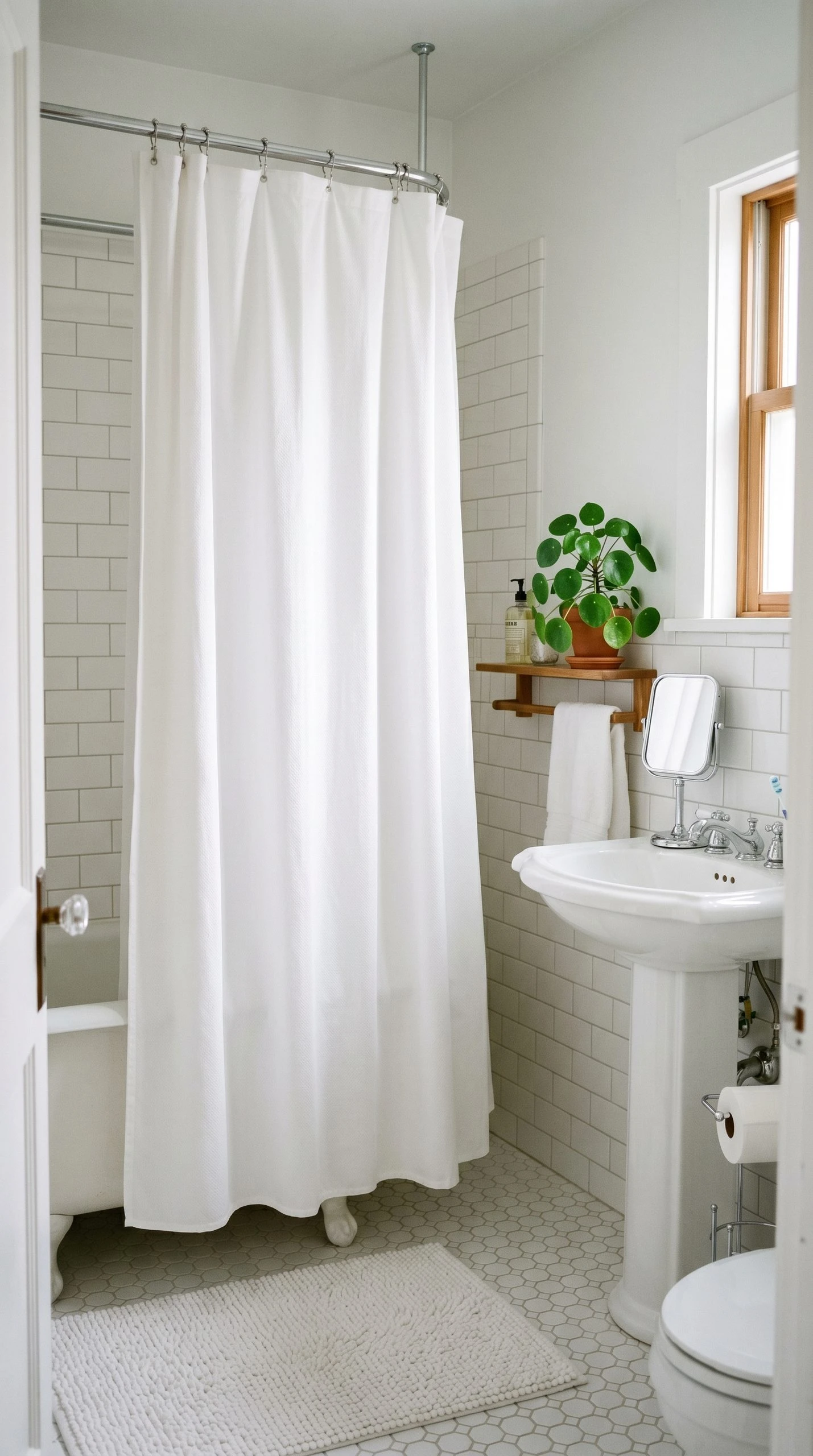
9. Crisp Bright White Cotton for a Timeless Clean Look
There is a reason bright white remains the most popular shower curtain choice in well-designed bathrooms: it works everywhere, every time, without fail. White reflects light, minimizes visual weight, and provides a clean neutral backdrop that allows everything else in the room, tile, fixtures, accessories, to stand out and do their job. In a small bathroom especially, white keeps the space feeling open and uncrowded in a way that almost no other color can.
The difference between a white curtain that looks cheap and one that looks considered is entirely in the fabric quality. A thin, flimsy polyester curtain will look flat and begin to yellow within a few washes. A good quality 100% cotton curtain, particularly one with a subtle woven texture like a simple grid or a fine ribbed weave, maintains its brightness wash after wash and hangs with a weight and dignity that cheaper fabrics simply cannot match.
White curtains are also the most versatile choice if you enjoy changing up your bathroom accessories seasonally. Swap in warm rust towels in autumn, coastal blue ones in summer, or soft blush ones in spring, and the white curtain works with all of them without clashing. It is the rare choice that requires zero compromise.
Quick Tip: Wash your white cotton curtain with a half cup of white vinegar added to the rinse cycle. It brightens the white, softens the fabric, and prevents any musty smell from developing, all without any harsh chemicals.
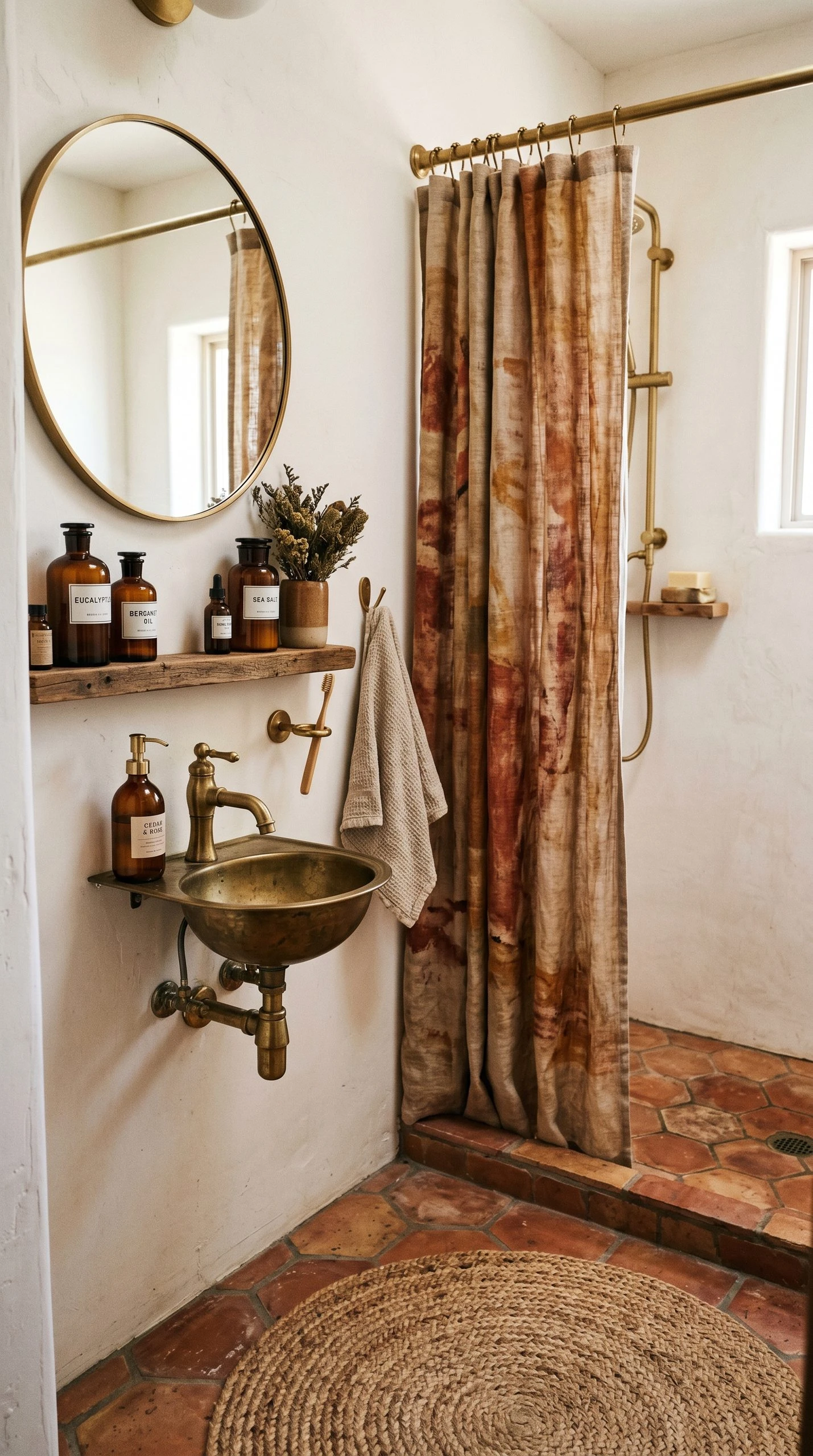
10. Terracotta and Rust Tones for Earthy Warmth
Terracotta, rust, and warm brick tones have earned a permanent place in interior design because they bring something that cooler, more neutral palettes often cannot: genuine warmth. A shower curtain in a faded terracotta or deep rust color immediately makes a small bathroom feel cozy and lived-in without any additional effort. These colors read as earthy, organic, and inviting, which is exactly how a good bathroom should feel.
Warm amber tones also happen to be very forgiving in a high-use bathroom. Soap scum, water spots, and the slight discoloration that comes with regular use are all far less visible on a warm terracotta than on a bright white curtain. This is a practical advantage that does not get mentioned often enough. Terracotta also ages gracefully, developing a slightly softer, more faded quality over time that actually looks better rather than worse.
Pair a terracotta curtain with warm brass fixtures, wooden accessories, and a jute or sisal bath mat to carry the earthy palette all the way to the floor. A round brass mirror above the sink, some amber glass bottles on the counter, and a small terracotta pot with a succulent or a trailing plant complete the look. The result feels deliberately designed and richly textured without requiring expensive renovations.
Quick Tip: Terracotta fabrics can fade slightly with repeated washing. Always wash on a cool or gentle cycle and line dry when possible to preserve the depth and richness of the color.
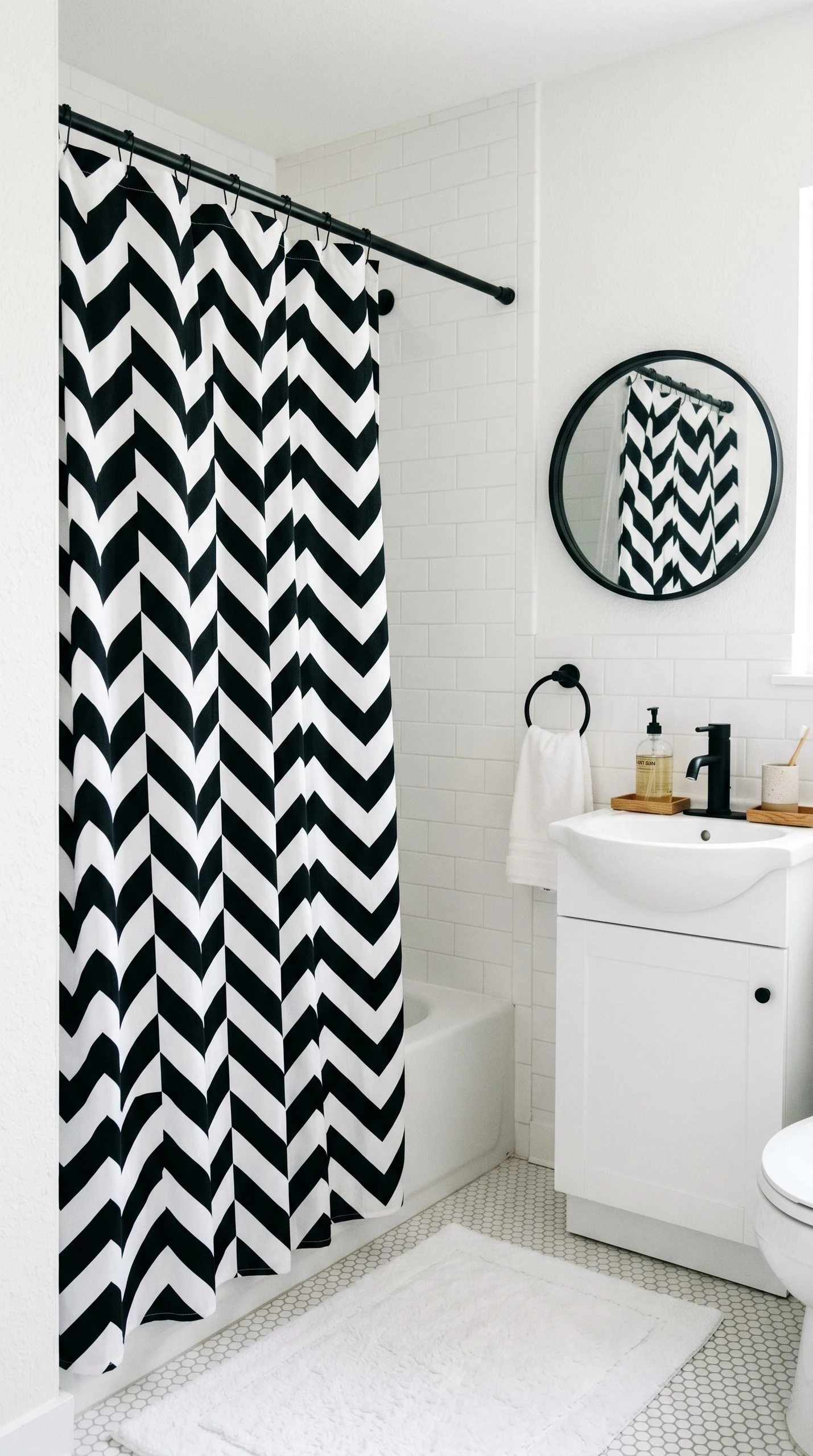
11. Geometric Black and White Print for a Graphic Statement
A graphic black and white geometric shower curtain brings a bold, editorial quality to a small bathroom that almost nothing else can match at the same price point. High contrast patterns read clearly in any lighting condition, photograph sharply, and pair with nearly any fixture color or tile style. The graphic quality of a well-chosen geometric print makes the bathroom feel intentional and considered without requiring any additional investment elsewhere.
The key in a small bathroom is choosing a geometric pattern with enough open white space that it does not feel visually overwhelming. A pattern that is roughly half white and half black will balance well in most compact spaces. Patterns that are mostly black with thin white lines can start to feel heavy and dark. Conversely, a mostly white pattern with black line work stays light and graphic without closing in the room.
Keep everything else very simple when going graphic. White walls, white fixtures, and a plain white bath mat let the curtain own the visual space. Pull black into one or two hardware details, the towel ring, the faucet, or the mirror frame, to make the black in the curtain feel like part of the broader room palette rather than an isolated element.
Quick Tip: Bold geometric patterns can make a small bathroom feel slightly smaller if the scale of the repeat is very large. Look for patterns with a medium to small repeat size, roughly 4 to 8 inches per motif, for the best result in a compact space.
12. Soft Sage Green for a Calm Organic Feel
Sage green is one of those rare colors that almost universally reads as calming, pleasant, and easy to live with in a bathroom context. It references nature without being loud about it, sits comfortably in the middle range of value where it is neither too light nor too dark, and coordinates with an enormous range of other tones, from warm brass to cool chrome to natural wood. A soft sage green shower curtain can single-handedly shift the mood of a small bathroom from generic to genuinely enjoyable.
The undertone of your sage matters more than most people realize. Warmer sages with a hint of gray or olive pair well with warm white walls, brass fixtures, and light wood accessories. Cooler sages with more gray in them coordinate better with white tile, chrome fixtures, and cooler neutrals. Hold fabric samples in your actual bathroom before committing, because the lighting in your space will shift the perceived undertone significantly.
Sage pairs naturally with dried and fresh eucalyptus, rattan, bamboo, seagrass, and linen, all materials that reinforce the organic, nature-connected quality of the color. A small hanging eucalyptus bundle tied near the showerhead, a rattan basket holding rolled towels, and a wooden shelf with a candle complete the look without any additional investment.
Quick Tip: A sage curtain in a linen fabric rather than a flat printed cotton adds texture that gives the color more depth and interest. The combination of the muted green and the natural linen texture reads as genuinely sophisticated rather than simply pleasant.

13. Extra-Wide Curtain for a Luxurious Full Drape
One of the most common mistakes people make with shower curtains is buying one that is exactly as wide as the tub and hanging it flat. A curtain hung flat with no gather looks thin, cheap, and institutional regardless of how expensive the fabric actually is. The fix is simple: use a curtain that is at least one and a half times the width of your tub opening so it hangs with generous folds and fullness rather than stretching taut from ring to ring.
An extra-wide curtain, or two panels hung side by side on a wide rod, creates the kind of lush, gathered drape you see in high-end hotels and design magazines. The abundant fabric reads as generous and considered, and the gathered folds add real visual texture to the shower wall. In a small bathroom, this richness actually works in your favor by making the curtain feel like a proper design element rather than a functional afterthought.
For this approach, simple solid-color fabrics in linen, cotton, or waffle weave work best because the fullness of the drape becomes the feature. A solid white, oatmeal, or warm gray extra-wide curtain hung high and gathered generously can transform a small bathroom more effectively than almost any patterned option at the same price point.
Quick Tip: Use curtain clip rings spaced evenly across the full width of the rod to keep the gathers uniform and neat. Unevenly spaced rings cause the fabric to bunch irregularly, which undoes the polished look you are going for.
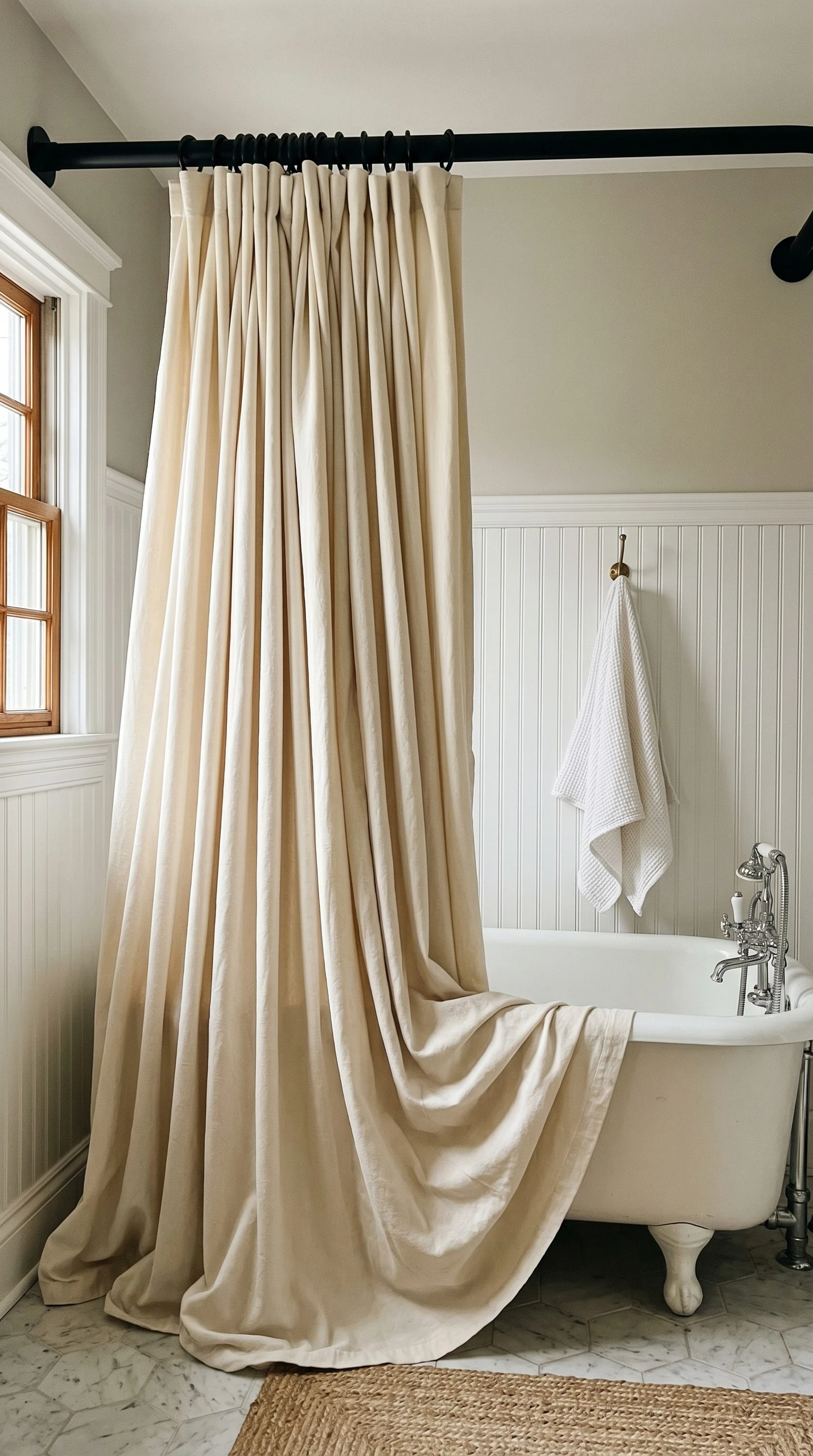
14. Ruffled White Cotton for Romantic Cottage Charm
In a bathroom that leans romantic, vintage, or cottage-inspired, a ruffled white cotton shower curtain is exactly the right choice. The soft, gathered ruffles cascading from the top add dimension and movement that no plain curtain can match, and the overall effect is warm, personal, and genuinely charming. This is not a look that tries to feel minimal or modern, it leans fully into softness and femininity and does it beautifully.
Ruffled curtains work especially well alongside traditional bathroom fixtures: pedestal sinks, clawfoot tubs, vintage-style faucets in chrome or brushed nickel, and beadboard paneling on the lower walls. If your bathroom already has one or two of these traditional elements, a ruffled curtain will feel completely at home rather than out of place. The combination reads as cohesive and intentional rather than mismatched.
Beyond white, ruffled curtains are also available in soft blush, pale lavender, and dusty mauve, all of which add a romantic color note on top of the romantic texture. A ruffled curtain in dusty rose with a dried flower arrangement and warm brass fixtures creates a bathroom that feels genuinely personal and considered rather than assembled from a catalog.
Quick Tip: Ruffled curtains wrinkle more than plain ones because of the layered fabric. Hang yours directly from the dryer while still slightly damp, or give it a quick pass with a handheld steamer before guests arrive to keep the ruffles full and fresh.

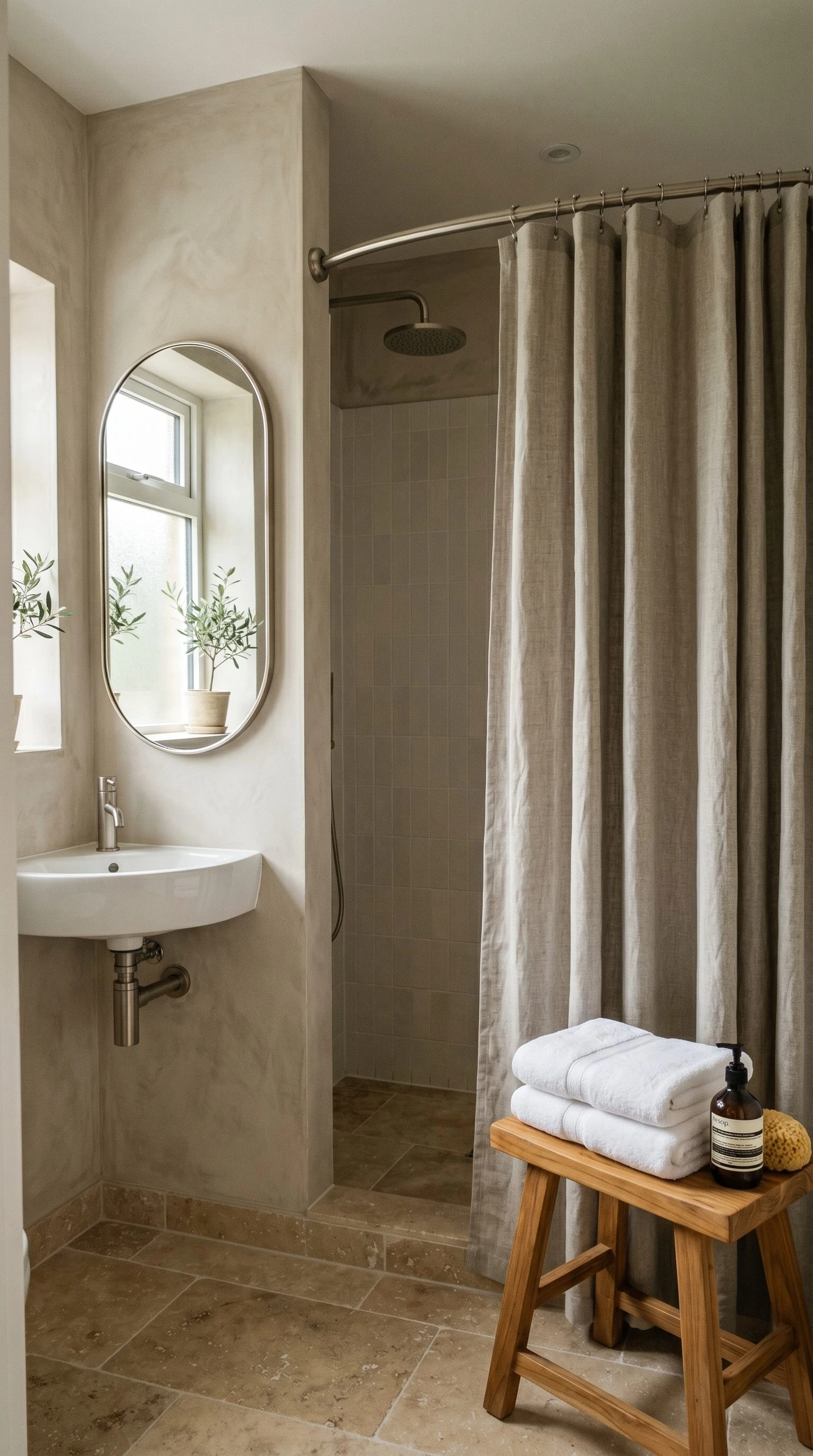
15. Greige Linen for Understated Modern Warmth
Greige, the warm midpoint between gray and beige, has become one of the most reliable neutral tones in contemporary interior design because it manages to be both warm and sophisticated at the same time. A greige linen shower curtain reads as quietly elegant without trying too hard, and it coordinates with an exceptionally wide range of bathroom palettes. It is the kind of choice that looks considered without being obvious about it.
In a small bathroom, greige works particularly well because it does not create strong contrast with white or light walls, which means it does not visually chop the room up the way a bolder color might. At the same time it adds more warmth and personality than a plain white curtain. It occupies a useful middle ground between neutral and interesting, which is valuable in a space with limited room for experimentation.
Greige linen pairs beautifully with warm wood accessories, brushed nickel or matte black hardware, natural stone textures, and woven textiles. It sits comfortably in both Scandinavian-inspired bathrooms with clean lines and warmer, more rustic spaces with natural materials. The fabric texture of linen adds enough visual interest that the curtain never feels flat or boring even without a pattern.
Quick Tip: Match the undertone of your greige to the undertone of your existing tile and grout. Cool-undertone tile calls for a grayer greige; warm-undertone tile calls for a more beige-leaning greige. Getting this right makes the whole bathroom feel harmonious.
16. Pom-Pom Trim Curtain for Playful Personality
If your bathroom needs personality and fun without a full redesign, a shower curtain with pom-pom trim along the bottom or side edges delivers that immediately. These curtains are typically simple in fabric, often solid white or a single light color, but the handcrafted-looking trim adds a bohemian, artisanal quality that no plain curtain can come close to. They are especially well-suited to guest bathrooms, vacation homes, kids’ bathrooms, and any space where a lighter, more playful mood is the goal.
The scale and color of the pom-poms determine how bold the final look reads. Small, tight pom-poms in white or cream along the bottom edge feel whimsical but controlled. Larger, multicolored pom-poms feel maximally festive and fun. Neutral tone-on-tone pom-poms, white pom-poms on a white curtain, feel subtle and textural rather than overtly playful. Choose based on how much personality you want the curtain to bring.
This style pairs well with a woven bath mat, open wooden shelving, rattan baskets, and colorful hand towels. The overall feel is casual, collected, and personal, qualities that make a small bathroom feel welcoming and genuinely lived-in rather than sterile and generic. It is also one of the most budget-friendly ways to add real character to a bathroom.
Quick Tip: If you cannot find a pom-pom curtain you love, buy a plain white cotton one and sew or carefully hot-glue a pom-pom trim along the bottom yourself. Fabric trim is inexpensive and available at any craft store, and the result looks completely custom.

17. Dusty Blue for a Soft Coastal Calm
Dusty blue is one of the most flattering and universally appealing colors you can bring into a bathroom. It references water, sky, and the seaside without being heavy-handed about it, and it has enough gray in it to feel sophisticated rather than childishly literal. A dusty blue shower curtain brings a sense of calm and ease into a small bathroom that reads as genuinely restful rather than just decorative.
The tone works across a range of bathroom styles. In a coastal or beach-inspired bathroom it feels completely at home. In a more modern or Scandinavian space it reads as a soft, considered accent color. In a transitional bathroom with traditional fixtures it adds a fresh, updated quality without clashing with anything. The versatility of dusty blue is one of its greatest strengths.
Dusty blue pairs naturally with white, warm wood, natural rope, and weathered textures. It also works beautifully with soft coral or terracotta as a complementary accent, a combination that feels simultaneously warm and cool in a way that is genuinely pleasing. White towels, a wooden bath tray, and a small piece of driftwood or a coastal-inspired print on the wall complete the look effortlessly.
Quick Tip: Choose a dusty blue with clearly gray undertones rather than a bright or saturated blue. The grayed-down version reads as sophisticated and calm in a small space, while a more saturated blue can feel overwhelming in a compact bathroom.

18. Abstract Watercolor Print for an Artistic Touch
An abstract watercolor print shower curtain brings an artistic, gallery-quality quality to a small bathroom without requiring actual artwork on the walls. Soft brushstroke patterns in two or three harmonious colors, think muted blues and greens, soft terracotta and blush, or warm grays and gold, feel expressive and original without being visually demanding. The abstract nature of the pattern means there is no risk of it looking too literal or themed.
Watercolor prints work especially well in bathrooms that are otherwise very simple and neutral, because the softness of the print adds interest without adding visual weight. Unlike a graphic geometric or a bold botanical, a watercolor print is quiet enough to live alongside simple accessories and fixtures without competing for attention. It adds color and personality while remaining gentle and easy to be around every day.
The most successful watercolor curtains are those where the background remains mostly white or light and the color is concentrated in the brushstroke marks. This keeps the curtain from reading as heavy in a small space. Look for prints where the color washes and bleeds naturally rather than being sharp and defined, as the soft edge quality is what gives watercolor its relaxed, painterly appeal.
Quick Tip: Pull one color from the watercolor print and repeat it in a small accessory elsewhere in the bathroom, a hand towel, a soap dish, or a small plant pot. This simple connection makes the curtain feel integrated into the room rather than like a standalone element.

19. Black Curtain with White Fixtures for High Contrast Drama
A true black shower curtain is one of the most dramatic choices you can make in a small bathroom, and when executed correctly it is also one of the most striking. The trick is committing fully to the contrast: bright white walls, white tile, white fixtures, and then a black curtain as the single bold counterpoint. When the supporting elements are this clean and light, the black curtain becomes a powerful focal point rather than a dark weight dragging the room down.
Black curtains pair naturally with black hardware, making them an excellent choice for bathrooms that already have matte black faucets, towel bars, or mirror frames. The black curtain essentially ties those hardware accents together into a cohesive palette, making the whole room feel like it was planned from the start rather than assembled over time with mismatched elements.
Lighting is critical here. A well-lit vanity mirror, ideally with lights on both sides or across the top rather than just overhead, keeps the room feeling bright and fresh even with a dark curtain taking up significant visual space. If the bathroom has any natural light, position the mirror or any reflective surfaces to bounce it as widely as possible.
Quick Tip: Add one warm-toned element to a black and white bathroom to prevent it from feeling too cold or severe. A small wooden tray, a warm amber diffuser, or a terracotta soap dish all do this job perfectly without disrupting the palette.

20. Burnout Velvet or Semi-Sheer Patterned Fabric
For something genuinely unexpected in a small bathroom, a burnout velvet or semi-sheer patterned fabric curtain brings a level of texture and visual interest that most people have never considered. Burnout velvet features a pattern created by chemically removing fiber from parts of the fabric, leaving a design that alternates between opaque velvet pile and sheer, transparent areas. The result is dimensional, intricate, and completely unlike anything a flat-printed curtain can deliver.
This type of curtain works best in small bathrooms that already have some traditional or eclectic character, rooms with interesting tile, vintage fixtures, or decorative elements that can stand alongside a more elaborate curtain without clashing. In a very minimal or modern bathroom, the richness of the fabric might feel out of place, but in a space with personality it adds exactly the right amount of drama and sophistication.
Semi-sheer patterned fabrics, those with a woven or jacquard design rather than a printed one, are a slightly more subdued version of this idea. They bring texture and pattern without the full drama of velvet, making them more versatile across different bathroom styles. Both options should always be used with a separate waterproof liner to protect the decorative fabric.
Quick Tip: Look for burnout velvet curtains in lighter colorways, soft gold, pale gray, or ivory, if you want the textural effect without darkening the bathroom. Dark burnout velvet can be beautiful but requires excellent lighting to avoid making a small space feel dim.

21. Pastel Stripe in Blush and Cream for Softness
A pastel striped curtain in blush and cream, or soft lavender and white, or pale mint and ivory, brings a gentle, feminine softness to a small bathroom that works beautifully in guest baths, powder rooms, and any space where a light, welcoming mood is the priority. The vertical orientation of the stripe still does the useful work of suggesting height, while the soft pastel palette keeps the room feeling warm and pleasant rather than stark.
Pastel stripes are one of the most approachable choices in this list because they are versatile enough to work across several bathroom styles. In a cottage or farmhouse bathroom they feel completely natural. In a more contemporary space they add a soft color note that prevents the room from feeling cold. In a transitional bathroom with a mix of traditional and modern elements they bridge the gap comfortably.
The blush and cream combination in particular has a timeless quality that photographs beautifully and coordinates with warm brass, chrome, and rose gold hardware equally well. It also pairs naturally with white waffle-weave towels, a simple woven bath mat, and a small vase of dried flowers for a complete look that feels genuinely considered.
Quick Tip: Choose a stripe where the colors are genuinely soft and muted rather than bright or saturated. Pastel tones that have a slightly dusty or faded quality age better in a bathroom and avoid the risk of feeling like a nursery rather than a sophisticated small space.

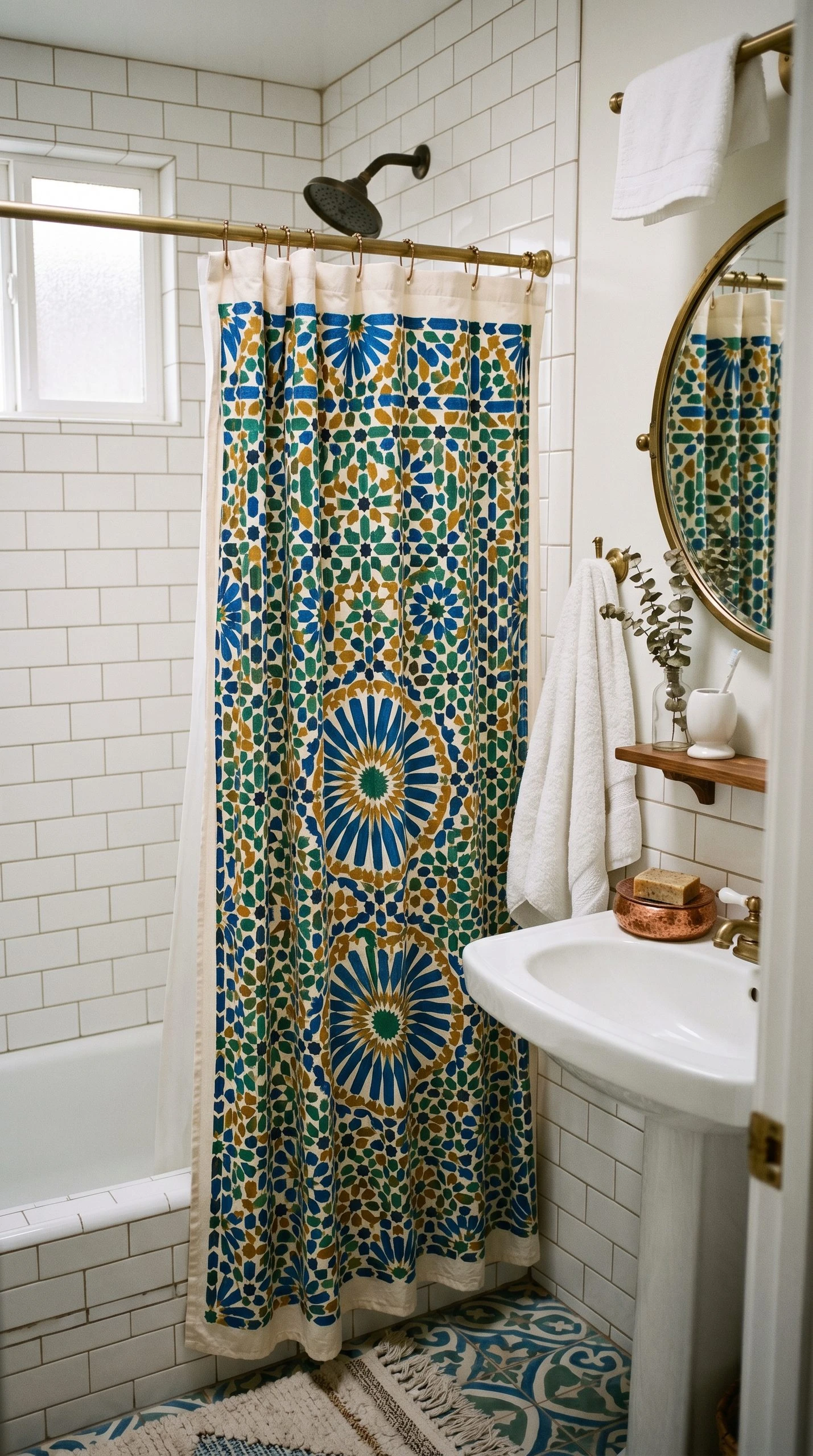
22. Moroccan or Global-Inspired Tile Print for Pattern and Culture
A shower curtain with a Moroccan-inspired tile pattern, or any global-influenced geometric print drawn from Zellige tilework, ikat weaving, or Suzani embroidery, brings a worldly, collected quality to a small bathroom that no plain or simple curtain can achieve. These patterns are rich in color and geometry, and they work particularly well in small spaces because the visual complexity of the pattern draws the eye in and makes the room feel more immersive and interesting than its footprint would suggest.
The best Moroccan-inspired curtains for a small bathroom are those that use a medium-scale repeat with a background color that is not too dark. A creamy white or warm ivory background with a blue, green, and gold geometric pattern will keep the room feeling light even with a complex print. A very dark background, deep navy or charcoal, can work but demands excellent lighting and very minimal other elements to avoid the room feeling cluttered.
Pair this type of curtain with simple white accessories that let the pattern speak. A plain white ceramic soap dispenser, white towels, and a simple woven bath mat are all you need. If you want to reinforce the global theme, a small brass lantern on the shelf or a hammered copper soap dish adds another layer of the Moroccan aesthetic without overcomplicating the space.
Quick Tip: A Moroccan tile print curtain pairs especially well with plain white subway tile because the simplicity of the tile backdrop gives the complex curtain pattern plenty of room to breathe and be appreciated without visual competition.
Conclusion
A shower curtain is one of the most impactful and most affordable design decisions you can make in a small bathroom. It covers more visual real estate than almost anything else in the room, and it can be changed in twenty minutes without tools, permits, or a contractor. That combination of impact and ease makes it the ideal starting point whenever a bathroom feels like it is not working.
The 22 ideas in this article cover the full range of what a shower curtain can do: create height, add warmth, bring personality, bounce light, set a mood, and tie a room together. Some of these ideas cost almost nothing. Others are a slightly bigger investment but still far less than even a minor renovation. All of them will make a noticeable difference.
The most important thing is matching the solution to the actual problem your bathroom has. If it feels short, go vertical. If it feels dark, go light and sheer. If it feels bland and generic, go bold with a print or an unexpected color. Identify the problem first, and then pick the curtain that solves it. You will be surprised how transformative the right piece of fabric can be.
Frequently Asked Questions
What is the best shower curtain length for a small bathroom?
For a small bathroom, longer is almost always better. Standard curtains are 72 inches, but going to 84 or even 96 inches and mounting the rod close to the ceiling creates the illusion of taller walls and a more spacious room. Make sure the curtain hangs to just above the floor or slightly past the tub lip so it looks intentional rather than too short.
Should I use a liner with a fabric shower curtain?
Yes, always. A separate waterproof liner keeps the decorative curtain completely dry so it stays clean, fresh, and undamaged. The liner does the actual water-blocking work while the fabric curtain provides the aesthetic value. Use a clear PEVA liner if you want to keep the look minimal, or a white one if you prefer a cleaner finish.
What shower curtain color makes a small bathroom look bigger?
White and very light neutrals are the most reliably space-expanding choices because they reflect light and minimize visual contrast. A curtain that matches the wall color closely also works extremely well because it eliminates the hard visual boundary where the curtain begins, making the room read as one continuous space rather than a series of competing elements.
How do I stop my shower curtain from going moldy?
Always spread the curtain flat after each shower so both the liner and the decorative curtain can dry fully. Wash both regularly, every two to four weeks for the liner and every four to six weeks for the fabric curtain. Make sure your bathroom has adequate ventilation from an exhaust fan, window, or both. Cotton and linen fabrics dry faster than synthetic ones and are naturally more resistant to mildew.
Can I use two shower curtain panels in a small bathroom?
Absolutely, and it often looks better than a single panel. Two panels hung side by side on a wide rod create a much fuller, more luxurious drape than one flat panel ever can. The extra fullness makes the curtain look intentional and designed rather than functional and plain. Just make sure your rod is long enough to accommodate both panels with enough overlap at the center.
What curtain rod finish works best in a small bathroom?
Matte black and brushed brass are currently the most popular and versatile options because they read as intentional and current rather than generic. Matte black pairs well with modern and minimalist bathrooms. Brushed brass works beautifully in warmer, more traditional or transitional spaces. The key is matching the rod finish to at least one other hardware element in the bathroom, the faucet, towel bar, or mirror frame, so the hardware feels like a cohesive set.