Bohemian Wall Decor Ideas That Will Make Your Walls Feel Alive
There is a particular kind of magic that happens in a room where the walls actually say something. Not in a literal sense, but in the way they hold texture and color and layers of things that mean something to the person who lives there. That is the heart of bohemian wall decor. It is not about following a rulebook or matching every piece to a color swatch. It is about layering pieces together in a way that feels personal, warm, and genuinely interesting.
Boho style has its roots in a way of living that valued art, travel, handmade things, and freedom of expression. Over time it has evolved into one of the most popular interior design directions precisely because it does not demand perfection. You do not need an expensive renovation or a professionally curated collection to pull it off. A woven wall hanging, a set of mismatched plates, a trailing plant, a vintage mirror, and the right lighting can completely change how a room feels.
This article brings together 25 bohemian wall decor ideas drawn from real interior design trends in 2025, when the style has leaned even more toward earthy tones, natural materials, and handmade authenticity. Each idea comes with a real-life scenario you might recognize, followed by practical decorating advice you can actually use. Whether you are starting from scratch with bare walls or trying to pull together a space that already has some personality, there is something here for every room and every budget.
The ideas ahead span textures, colors, materials, and moods. Some are bold and layered. Others are subtle and minimal. What they all share is that distinctly bohemian quality of feeling collected over time rather than bought all at once. Read through, find the ones that speak to you, and make them your own.
1. Large Macrame Wall Hanging as a Focal Point
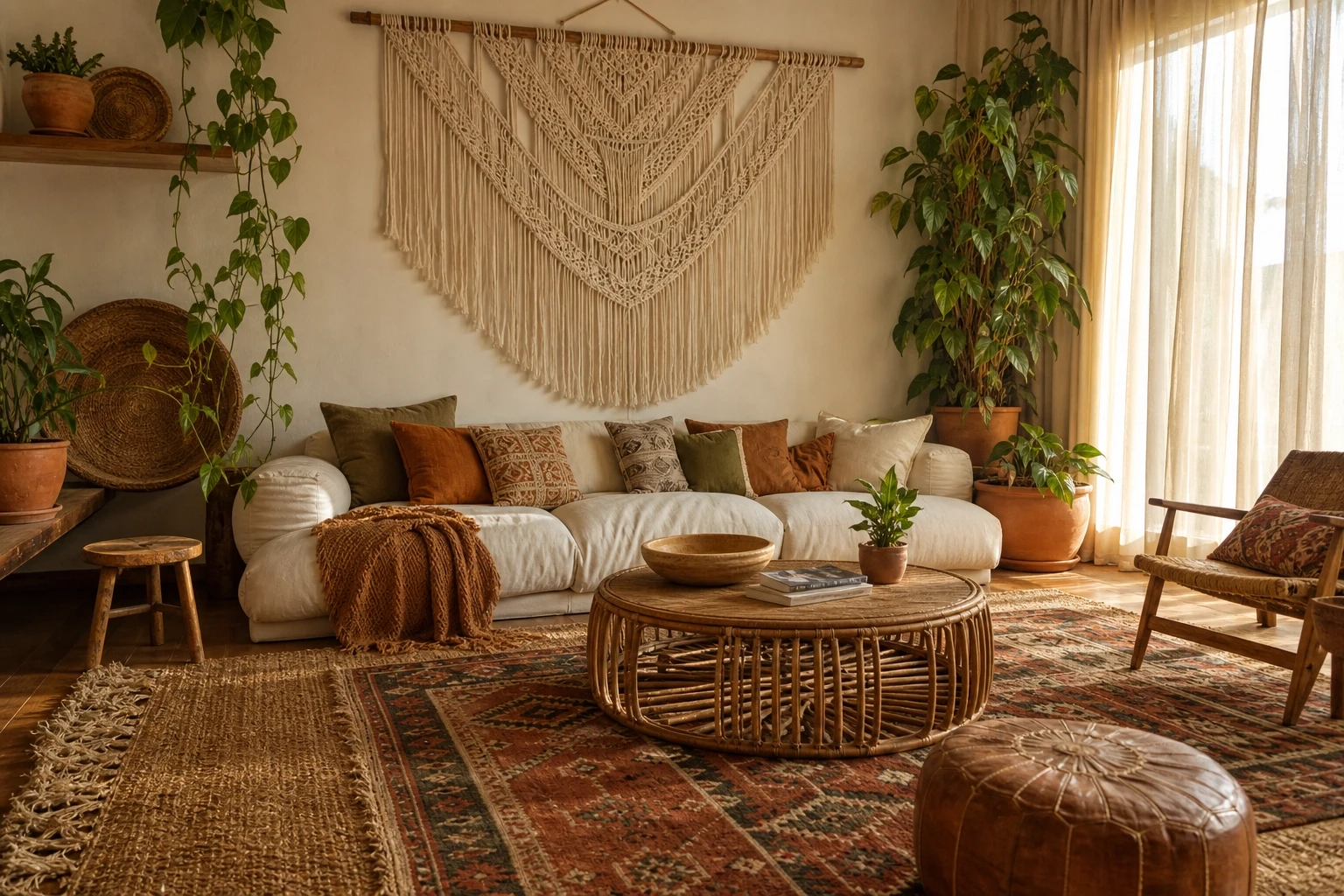
You move the furniture around for the third time and the room still feels like it is missing something. The couch is fine, the rug is nice, but the wall behind it looks like an afterthought. This is exactly the problem a large macrame wall hanging solves in a single move.
A statement macrame piece in natural cotton or jute rope gives the room an anchor point that no framed print can replicate. The knotted texture catches light differently throughout the day, which means the wall actually looks different in the morning versus the evening. For color, stick to warm neutrals like cream, oatmeal, or undyed cotton so the piece works with earthy terracotta tones, olive greens, or desert-inspired palettes without competing. Hang it directly above a sofa, a bed, or a console table so it has context.
When it comes to sizing, go bigger than you think you need to. A piece that is roughly two-thirds the width of the furniture below it looks intentional and proportionate rather than lost. Look for pieces at artisan markets or on handmade goods platforms where you can find work made by independent weavers, which adds to the authenticity. For a bedroom, a piece with fringe or feather details creates a softer, dreamier atmosphere. In a living room, a more geometric pattern in a tighter knot reads as a little more structured without losing the boho character.
Designer Tip: If you want the macrame to look even more intentional, layer a small shelf or a hanging plant in front of it. The depth that creates is far more interesting than a flat wall hanging on its own.

2. A Gallery Wall Built Around Vintage Botanical Prints
You have a stack of framed prints you bought at different times from different places and none of them seem to go together. Sound familiar? The gallery wall is the boho answer to this exact problem, and botanical prints are one of the most forgiving anchors you can use.
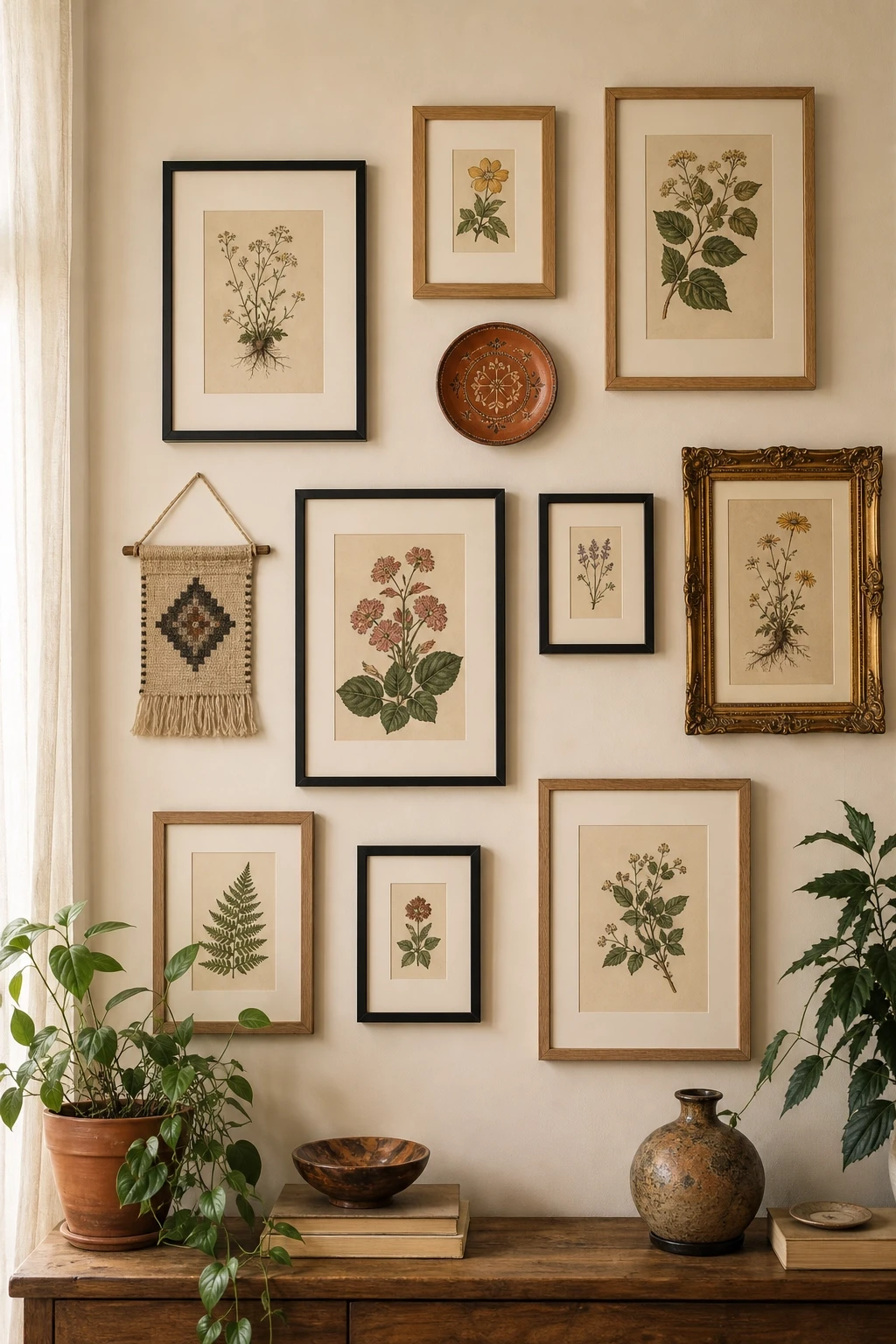
Start by choosing vintage-style botanical illustrations as the backbone of the collection. These can be found at thrift stores, estate sales, or downloaded as public domain prints and framed yourself. Mix the frame styles intentionally, using some thin black frames, some natural wood, and one or two with ornate gold details. The variety keeps it from looking like a store display. Keep the mat colors consistent, white or cream, so the different frames and prints feel like they belong together.
Around the botanicals, layer in a few other elements: a small woven piece, a ceramic plate in terracotta or sage green, a black and white photograph, or a pressed flower in a simple frame. The mix of flat and dimensional pieces gives the wall visual complexity without it feeling chaotic. Use painter’s tape to map out the layout on the floor before you start putting holes in the wall. The arrangement should feel organic, not symmetrical. Odd-numbered groupings usually look more natural than even ones.
Designer Tip: Leave breathing room between frames. Cramming pieces too close together makes a gallery wall look cluttered rather than collected. Aim for about two to three inches of space between each item.
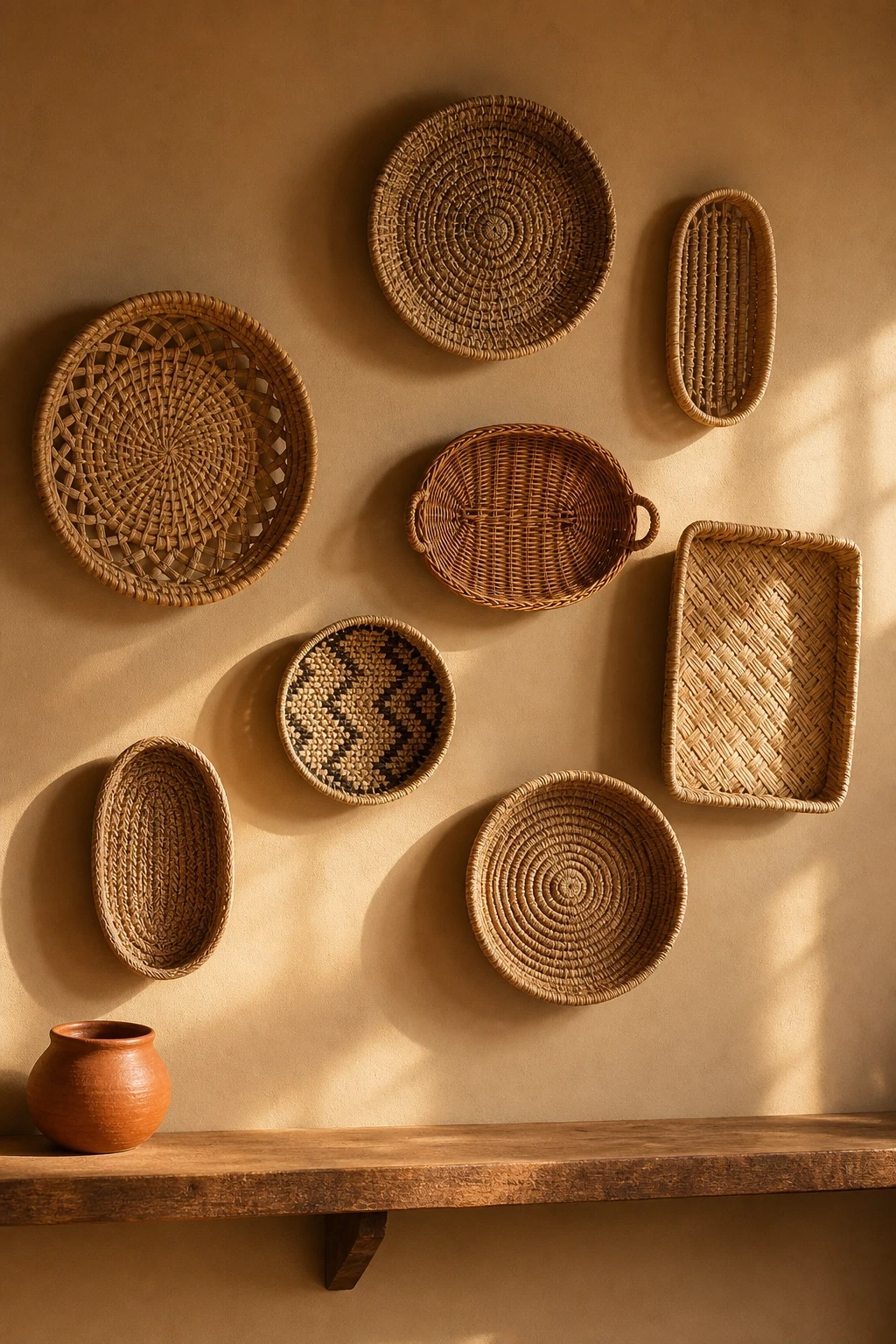
3. Woven Basket Wall Cluster
You walk past a display of handwoven baskets at a market and think they would look great somewhere in the house, but you are not sure where. The answer is almost always the wall, and a cluster of woven baskets is one of the most underrated bohemian wall decor ideas going.
Choose baskets in a variety of sizes, textures, and weave patterns. Seagrass, water hyacinth, rattan, and palm leaf all work beautifully together because they share the same earthy, natural quality even though each material has its own character. Vary the shapes too: round, oval, rectangular, and lidded baskets all hanging together create a rich wall display that almost reads like abstract art. For color, lean into natural tans and browns, but mix in one or two with dark or painted details to add contrast.
The arrangement should feel loose and slightly asymmetrical. Start with your largest basket as the anchor in the center or slightly off-center, then build outward and around it. Leave some negative space in the arrangement so it does not look like you ran out of wall. A cluster that spans roughly two feet wide by two feet tall is enough to fill a narrow wall or a space between windows without overwhelming it. These work in almost any room, from the living room to the bedroom to a wide hallway, and they are lightweight enough that simple picture hooks handle most of them easily.
Designer Tip: Mix a flat woven tray into the cluster alongside the rounded baskets. The unexpected shape keeps the eye moving across the arrangement instead of treating it as one big mass.
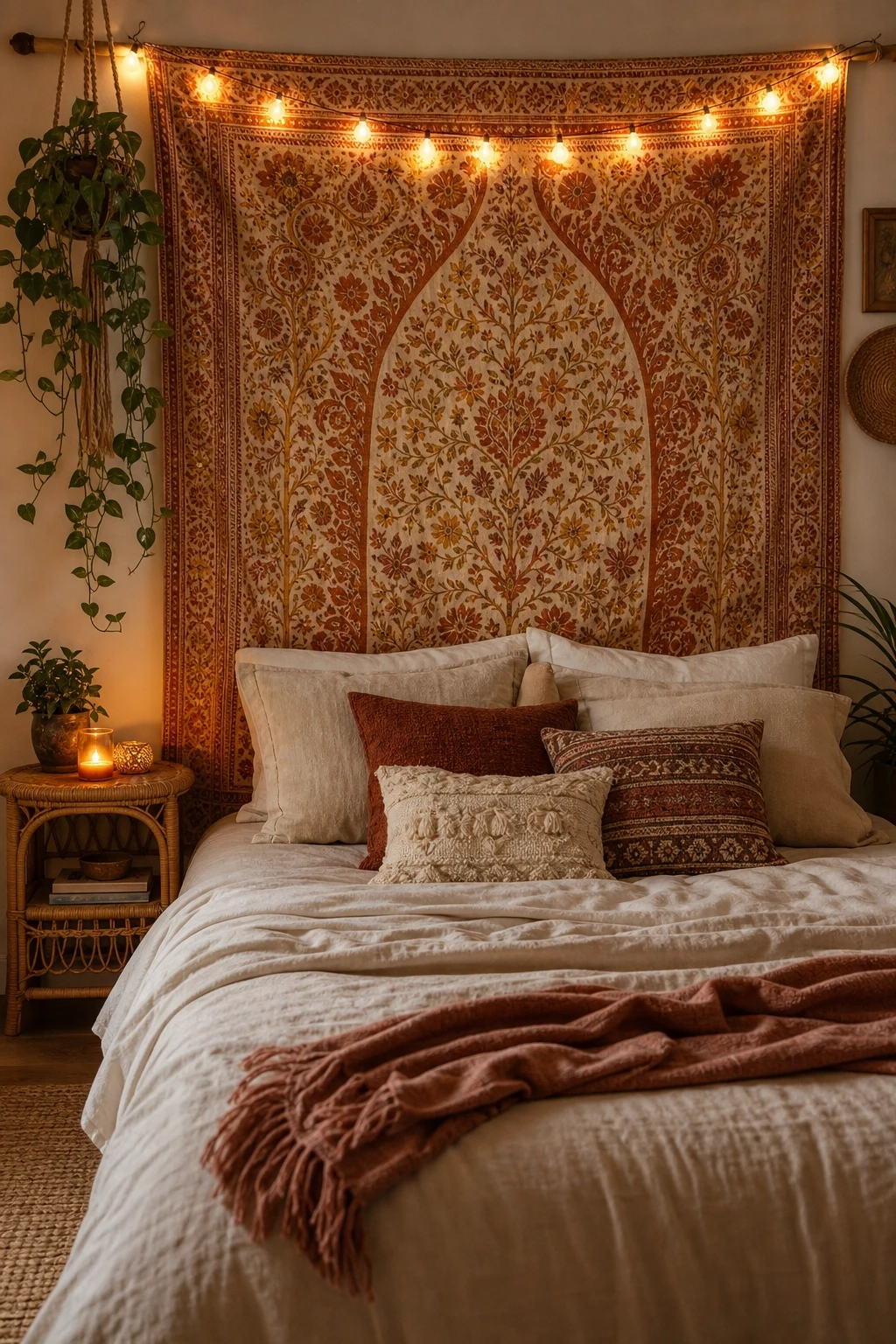
4. Fabric Tapestry as a Headboard Alternative
The bedroom still has no headboard and the bed frame looks bare against a plain wall. Buying an actual headboard feels like a big commitment for a rental, and most options in the right size are expensive. A fabric tapestry hung just above and behind the bed is the smartest workaround.
Choose a tapestry in a bold pattern that works as the room’s focal point. Mandala patterns, block-printed Indian fabrics, Moroccan geometric designs, and tribal weave prints all have strong boho credentials. For a bedroom that leans toward warmer, earthier tones, a tapestry in rust, burnt orange, mustard, and deep brown creates a cozy, cocoon-like feeling. For something cooler and more layered, indigo and cream block prints feel collected and calm. The tapestry should be wide enough to extend at least as far as the bed on each side and tall enough to fill the visual space between the mattress and the ceiling.
Hanging methods matter more than people think. Wooden dowels with leather or jute cord loops look far more intentional than standard curtain rods or nails through the fabric. You can also clamp the tapestry between two pieces of driftwood and hang it that way for an even more organic look. Pair with linen bedding in a complementary neutral, a few textured throw pillows, and a rattan bedside table to complete the atmosphere. Warm-toned string lights draped along the top edge of the tapestry add a soft glow that makes the whole wall feel magical at night.
Designer Tip: If the tapestry pattern is busy, keep the bedding simple. The wall should do the talking, and the rest of the room should give it space to do so.
5. A Terracotta and Sage Green Accent Wall
The room has decent furniture and a few nice pieces, but every wall is still the same builder-grade off-white and the space feels flat. You want color but you are nervous about committing to something that might feel overwhelming. Terracotta paired with sage green is the combination that almost always works.
Paint one wall in a warm terracotta or clay tone. This does not need to be a bright, saturated version of the color. The most liveable terracotta shades sit closer to a warm blush-orange or a dusty clay than to anything that looks like a flowerpot. On that wall, hang decor in complementary tones: unglazed ceramic wall discs, a simple woven hanging in cream and rust, or a few botanical prints in wooden frames. Sage green comes in through the accessories, a plant or two, a ceramic vase on a nearby shelf, a throw in soft green. The two colors have a natural affinity that reads as earthy and collected.
Limewash paint is worth considering here instead of regular latex. It creates an uneven, slightly mottled finish that looks like aged plaster, which suits the bohemian aesthetic far better than a flat, uniform coat of color. The texture it adds catches light in a way that makes the wall feel dimensional even before you hang anything on it. Keep the other three walls in a warm white or soft cream so the accent wall has space to stand on its own without the room feeling cave-like.
Designer Tip: Add a cluster of small unglazed terracotta wall discs in varying sizes near the center of the accent wall. They add dimension without requiring any extra furniture and cost very little.

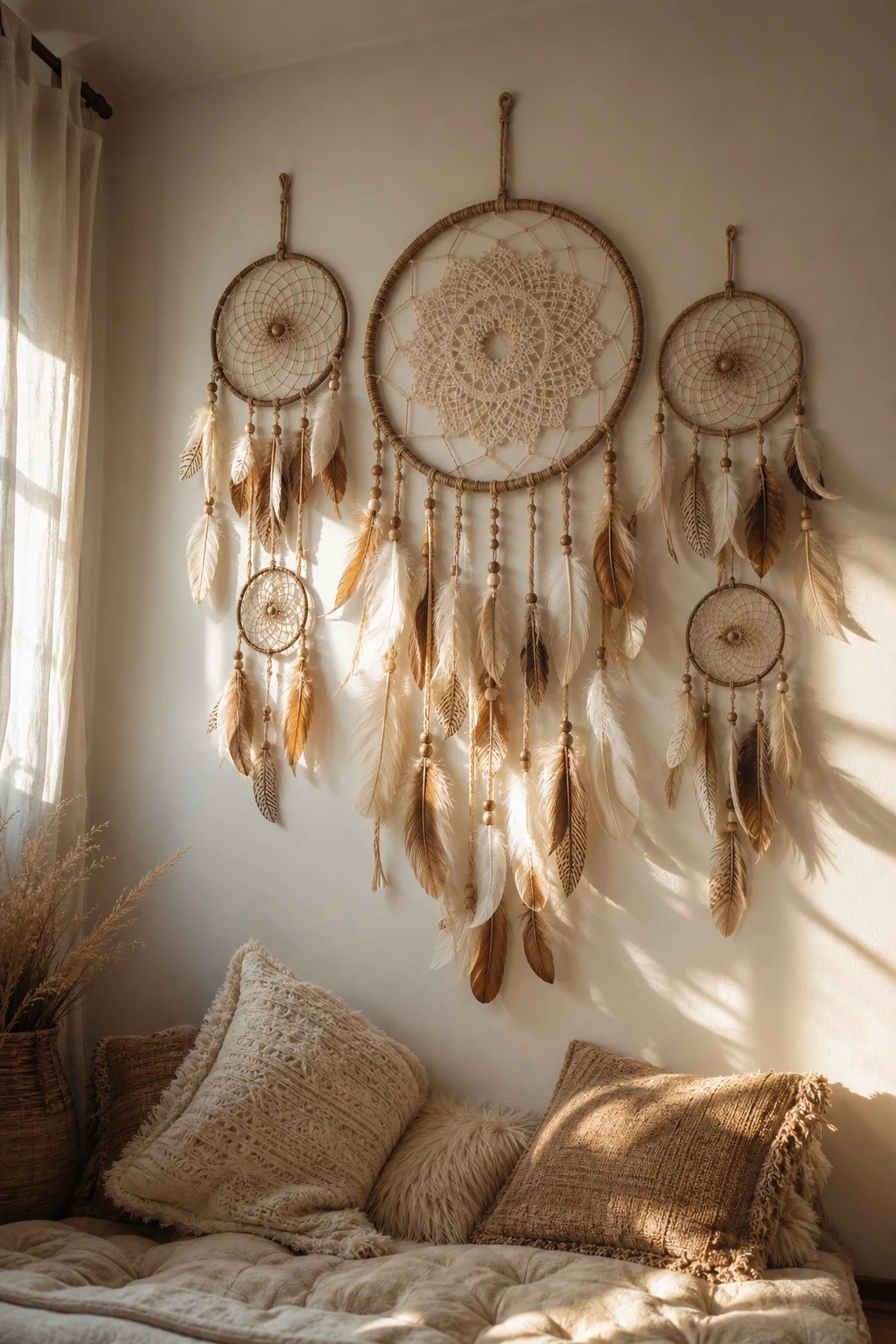
6. Dreamcatcher Collection
You find one beautiful dreamcatcher and love it, then realize a single piece floating in the middle of a wall looks a little lonely. The solution is to stop thinking of dreamcatchers as solo pieces and start treating them as a collection.
Choose three to five dreamcatchers in a range of sizes, from a large statement piece down to small delicate ones. Look for variety in material too. Some with thick woven centers in natural fibers, others with fine thread, some with feathers, some without. Group them on the wall in a loose cluster where the largest hangs highest and the others cascade down and around it at varying heights. The layering of different sizes and shapes gives the display a natural, organic quality rather than a planned, matched look.
For color, stay in a warm neutral palette for the most versatile result, cream, beige, light brown, and white all work beautifully in a bedroom or a meditation corner. If the room already has strong color from furniture or rugs, the neutral dreamcatcher cluster acts as a calm, textural counterpart. Hang them above a reading nook, over a corner floor cushion setup, or along a narrow wall between two windows. They move gently in air currents, which adds a subtle liveliness to the corner.
Designer Tip: If you want to add a bit of color without committing to a full palette change, choose one dreamcatcher with soft rose or dusty lavender thread to introduce a gentle accent tone.
7. Vintage Mirror Gallery
The hallway is dark and feels like a corridor rather than part of the home. You know mirrors would help, but a single large mirror feels too formal and predictable. Hanging several vintage mirrors together creates the light and personality the space is missing.
Collect mirrors with different frame styles: one with a heavily carved dark wood frame, one with a distressed gold finish, one with a simple oval rattan surround, one with intricate Moroccan-style cutout metalwork. The variety of frames is what makes this feel bohemian rather than just functional. Hang them at different heights so the grouping feels like it grew over time rather than being installed all at once. Aim for at least three mirrors for the arrangement to have enough presence, though five or six across a wide wall looks spectacular.
The reflective surfaces multiply the natural light in the space, which is why this works especially well in darker rooms, narrow hallways, or east-facing bedrooms. The variety of frame shapes and finishes also means light bounces back from different angles, creating a much warmer and more interesting quality than a single large mirror ever would. Place a narrow console table beneath the arrangement and add a plant, a candle, and a woven basket as a tray for keys or small items. The whole vignette becomes a destination in the hallway rather than just a passthrough.
Designer Tip: Mixing circular, oval, and rectangular mirrors in the same cluster creates more visual rhythm than sticking to one shape. Do not overthink it. Odd is always more interesting.

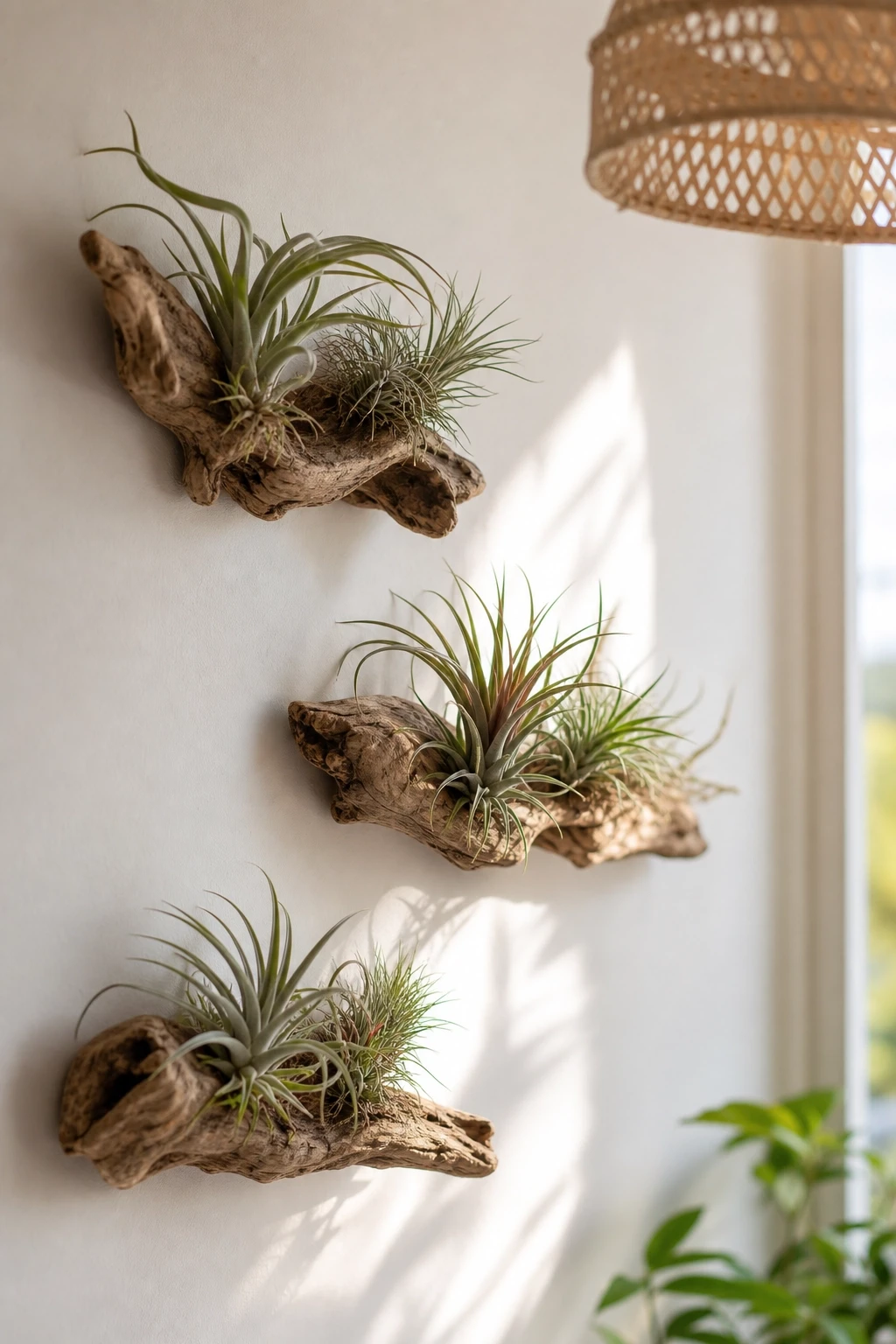
8. Mounted Air Plants and Driftwood Installation
You love plants but every horizontal surface is already taken. Shelves are full, windowsills are crowded, and there is still a bare wall that could really use something living. Air plants mounted on driftwood pieces are the answer, and they require no soil and almost no maintenance.
Source a few pieces of driftwood in different lengths and shapes. These can be found at beach areas, riverbanks, or purchased from craft suppliers. Attach air plants (tillandsia varieties) to the wood using waterproof craft glue or by wedging them naturally into crevices and curves. Mount the driftwood pieces directly to the wall at staggered heights using simple screws or wire loops. The organic, sculptural quality of the driftwood combined with the living plants creates a wall installation that is genuinely one-of-a-kind.
Air plants need to be misted lightly two or three times a week or soaked briefly in water once a week, then allowed to dry thoroughly. This makes them far more practical for wall mounting than any soil-based plant. The variety of tillandsia species means you can mix spiky silver varieties with softer green curved ones, which adds even more visual interest. This kind of living wall installation suits bedrooms, living rooms, and even bathrooms with enough natural light, and it signals a connection to nature that is deeply aligned with the boho spirit.
Designer Tip: Place the driftwood installation near a window where the plants will get bright, indirect light. Air plants do not like harsh direct sun, but they absolutely need light to stay healthy.
9. Patchwork Textile Wall Art
You have a collection of beautiful fabric scraps, vintage scarves, and textile remnants from different travels and you cannot figure out what to do with them. Framing them individually feels too formal, but leaving them folded in a drawer means nobody ever sees them.
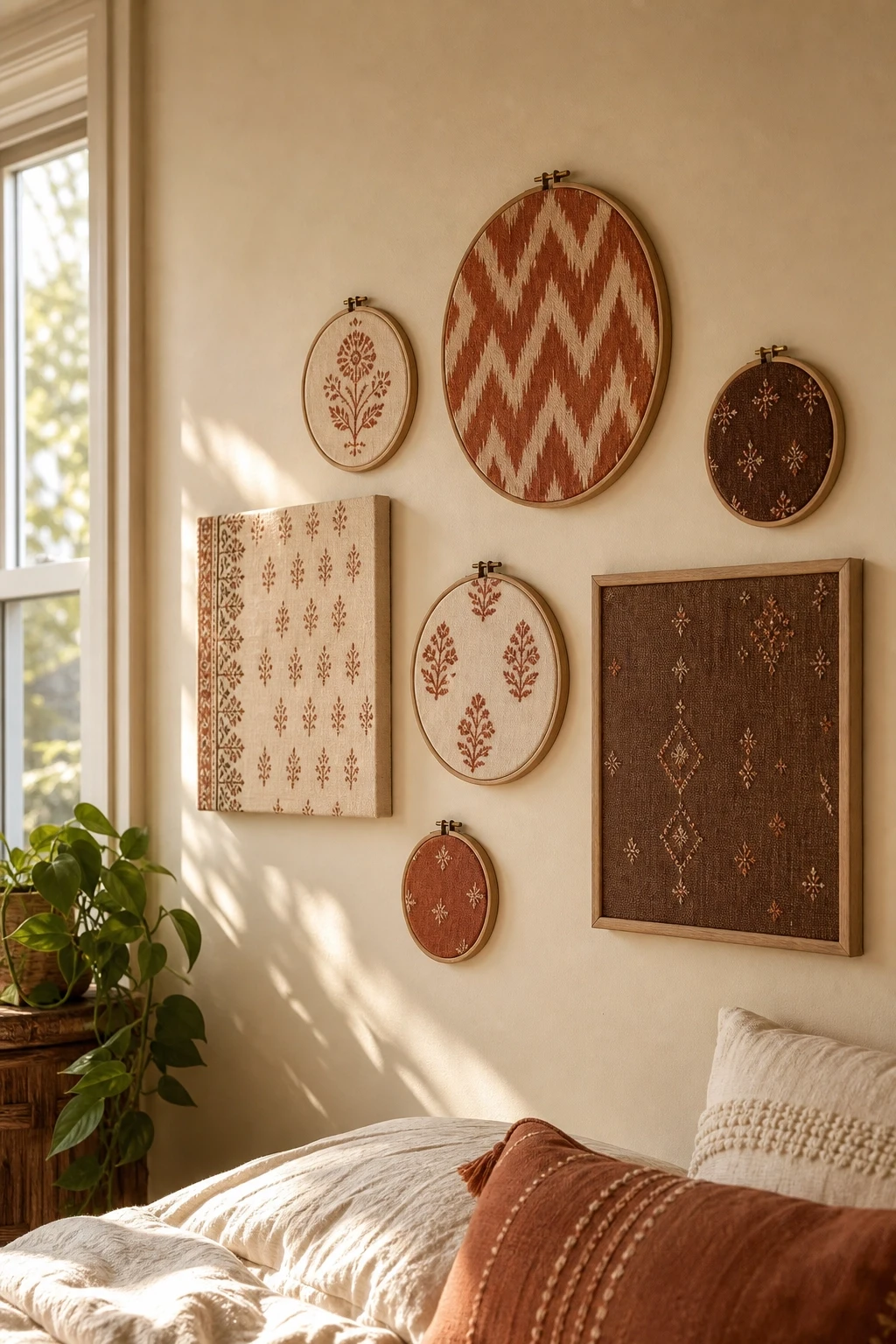
Stretch fabric pieces over canvas frames or wooden hoops to create a set of textile wall art panels that celebrate the materials without requiring any sewing or crafting expertise. A vintage silk scarf stretched over an 18-inch canvas frame and stapled at the back becomes a piece of art instantly. A section of an embroidered Indian dupatta mounted in a large wooden hoop looks equally considered. Group several of these fabric frames together on the wall and the collection reads as a cohesive display rather than a random assortment.
The beauty of this approach is that you can rotate pieces over time as you collect new textiles. It also works beautifully as an affordable art solution since you are repurposing materials you already love rather than buying mass-produced prints. For a cohesive palette, choose fabrics that share one or two recurring colors, even if they come from completely different cultures and pattern traditions. A rust-toned ikat, a cream and terracotta block print, and a mustard and brown embroidered piece will all feel related because of the shared warmth in their color stories.
Designer Tip: Mix embroidery hoops of different sizes with stretched canvas frames in the same arrangement. The variety of shapes and depths makes the wall display far more interesting than matching frames would.
10. Moroccan-Inspired Tile Pattern Decals
You are in a rented apartment with white walls and a strict no-painting policy. Every boho decorating idea you like involves paint or wallpaper and neither is allowed. Removable tile pattern decals give you the pattern and personality of a Moroccan accent wall without a single permanent mark.
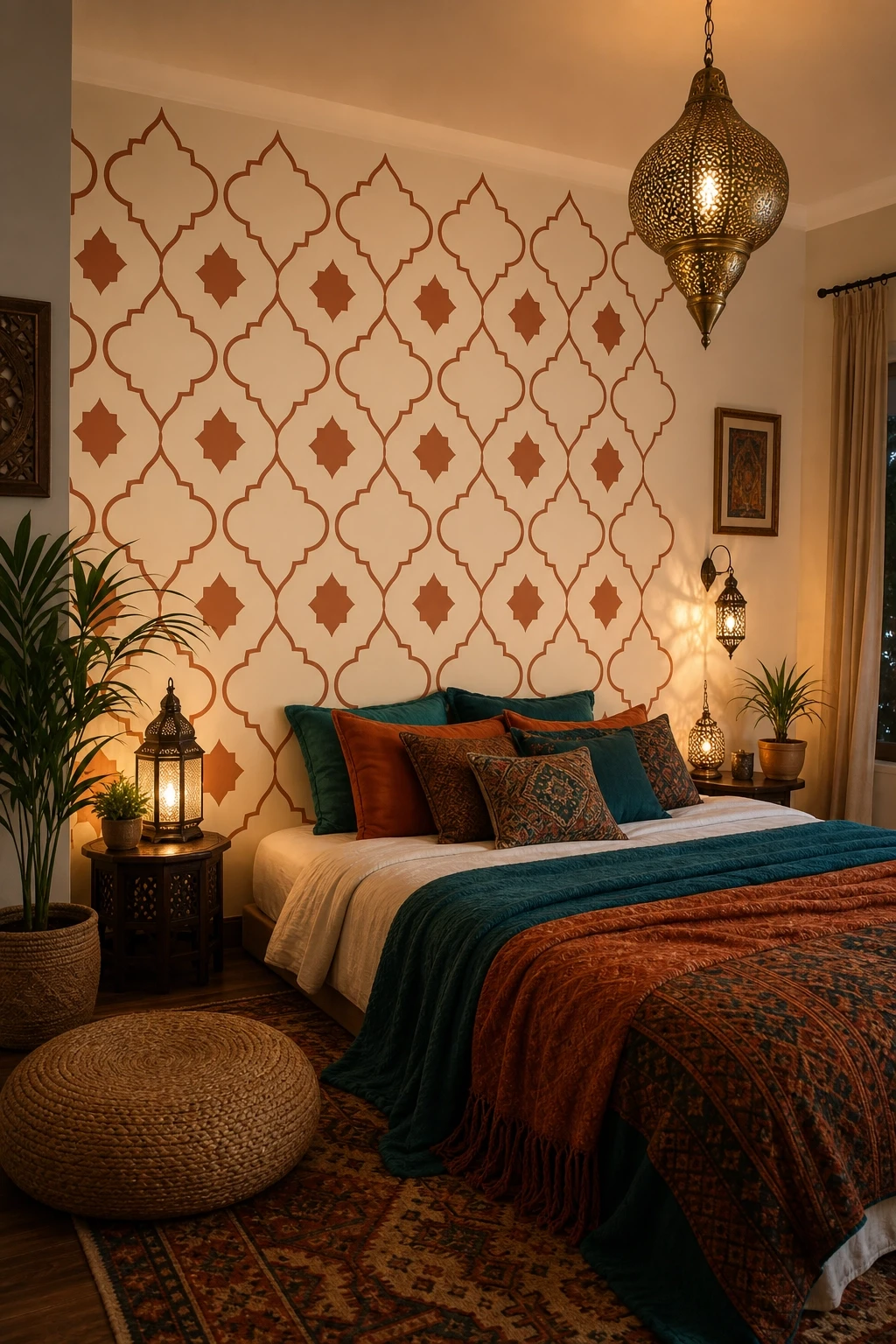
Peel-and-stick wall decals in geometric Moroccan patterns are available in terracotta, cobalt blue, emerald green, and black and white, all of which carry that North African aesthetic beautifully. Apply them to a clean, dry wall in a grid to simulate an accent wall, or use them selectively around a doorframe, along the lower third of a wall as a faux dado, or as a single row of pattern above a headboard. The key is placing them with precision since a slightly crooked pattern reads as a mistake rather than intentional asymmetry.
Pair the decal wall with warm brass hardware and accessories, woven poufs or floor cushions in jewel tones, a lantern-style pendant light, and plenty of layered textiles. The Moroccan pattern becomes the anchor that justifies all those rich, layered accessories. When you move out, the decals come off without damaging the walls. For a more permanent version in a home you own, consider painting the pattern freehand using a stencil kit, which gives you a more handmade finish that suits the boho aesthetic even more naturally.
Designer Tip: Use decals at half the coverage you think you need. A well-placed partial pattern is more sophisticated than wall-to-wall coverage, which can feel busy rather than intentional.
11. Oversized Rattan Sunburst Mirror
The living room wall above the fireplace or the entryway has been bare for months because nothing seems right. Art feels too small and mirrors feel too plain. An oversized rattan sunburst mirror is the single piece that solves this specific problem almost every time.
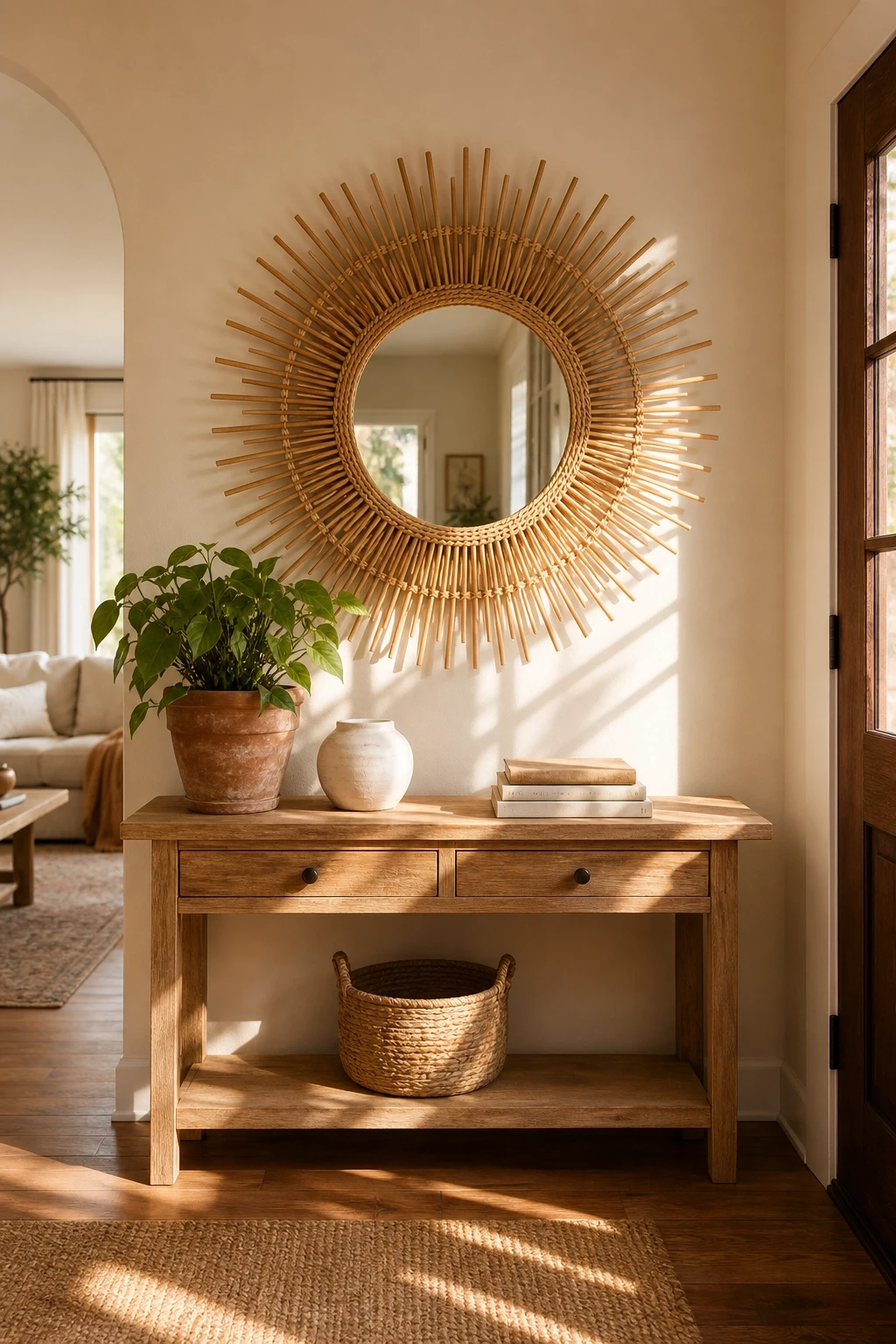
These mirrors, typically ranging from 30 to 48 inches in diameter, feature a round mirror at the center with radiating rattan or woven reed spokes extending outward like sun rays. The natural material warms up the circular form and adds texture that a simple round metal mirror does not have. They work above a fireplace, centered on a wide wall, above a console in an entryway, or even hung flat on a ceiling above a bed for a dramatic and unexpected twist.
Because the piece is textural and organic, it complements almost every color palette. Pair it with warm creamy whites, sandy neutrals, or earthy terracottas and it looks completely at home. Against a deep teal, olive green, or dusty plum wall, the natural rattan becomes an even stronger focal point. Keep the surrounding wall relatively bare so the sunburst shape can be read clearly. If you add anything nearby, keep it small, a single sconce light on either side or one trailing plant on the shelf below.
Designer Tip: The rattan spokes catch and scatter light beautifully, so placing this mirror on a wall that receives afternoon sunlight makes the whole piece come alive in the late hours of the day.
12. Hanging Ceramic Plate Collection
You start admiring the hand-painted ceramic plate displays you keep seeing in design magazines and wonder if your own collection of mismatched dishes from different travels and thrift stores would work the same way. It absolutely would, and the mix-and-match quality is exactly the point.
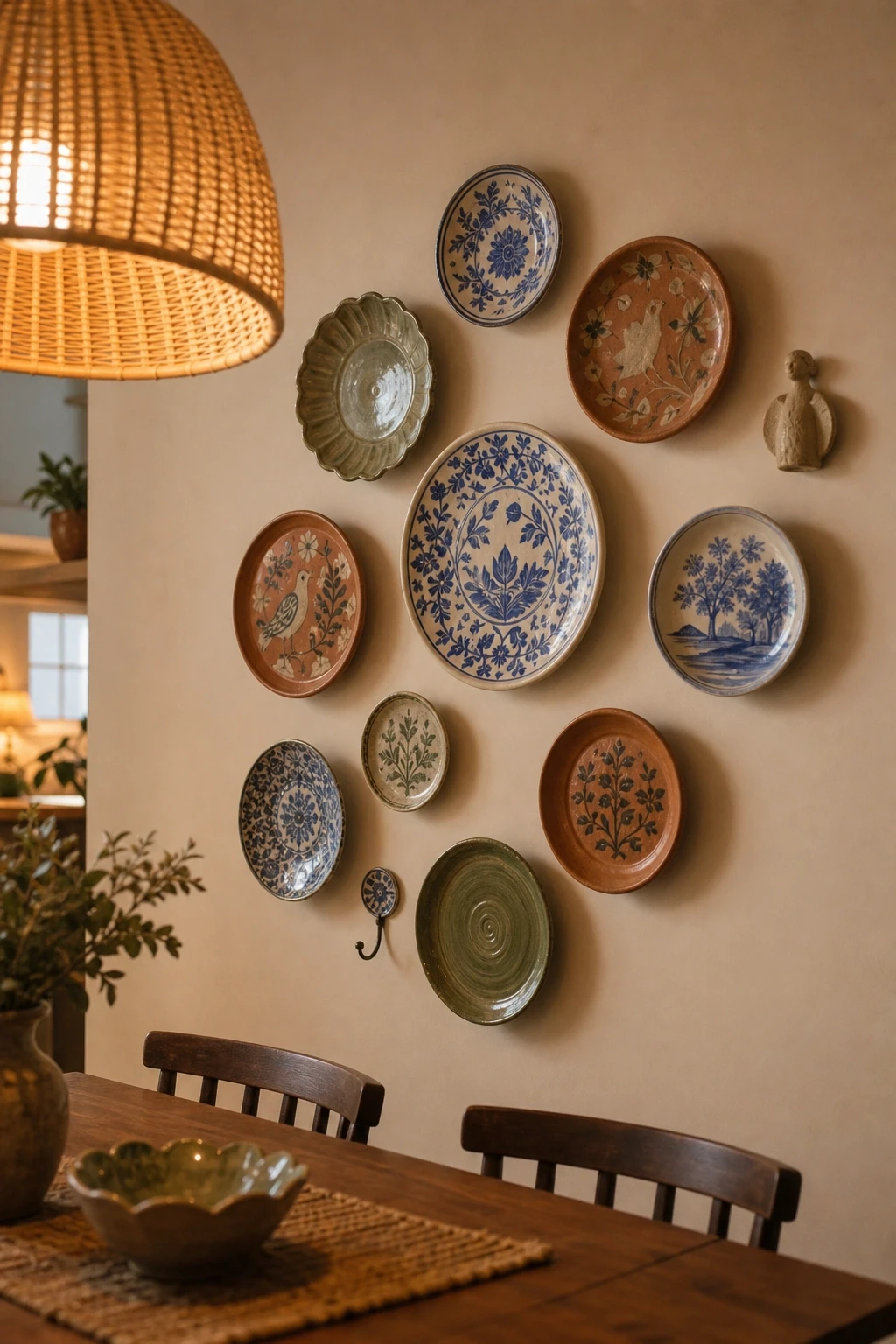
Choose plates with a variety of patterns and sizes but in a related color family to keep the arrangement cohesive. Blue and white pottery, terracotta with hand-painted motifs, sage green glazed ceramics, and cream plates with simple geometric borders can all live together if the tones are harmonious. Use plate hanging hardware from a hardware store to mount them securely on the wall. The hardware is almost invisible from a distance, so the plates appear to float against the wall.
Arrange the plates the same way you would a gallery wall: start with the largest in the center, then build outward with medium and smaller pieces. Allow the sizes and shapes to vary, round, oval, square, and rectangular platters all work together. A mix of convex glazed plates and flat hand-painted ones creates depth. This display suits a dining room or kitchen wall most naturally, but it also works beautifully in a living room or a wide hallway. A warm, ambient sconce light above or beside the arrangement makes the glazed surfaces catch the light and adds a layer of evening atmosphere.
Designer Tip: Add one or two ceramic wall hooks or small sculptural wall-mounted pieces into the plate arrangement to add dimensional variety and make the display feel less like a formal collection.
13. Featherweight Canopy and Sheer Fabric Draping
The bedroom ceiling feels too high and the space above the bed feels disconnected from the rest of the room. You want something soft and romantic but the idea of a full four-poster bed frame is not in the budget or the floor plan. Draping sheer fabric from a ceiling hook creates the canopy effect at a fraction of the cost.
Choose a sheer fabric in a warm ivory, blush, or soft terracotta. Voile, organza, and gauze all drape beautifully and have an airy, romantic quality that suits the boho bedroom perfectly. Attach a decorative ceiling hook above the center of the bed and gather the fabric from it, letting the panels fall to either side of the headboard and pool slightly on the floor. Twist a strand of warm LED fairy lights loosely through the fabric as it falls from the hook and the entire corner of the room becomes a glowing canopy at night.
On the wall inside this canopy space, hang a simple woven piece or a single framed print that feels like it belongs to the private world created by the draping. Keep the fabric relatively loose rather than tightly arranged. The slightly undone, gathered quality is what makes it feel relaxed and intentional rather than staged. Pair the canopy with linen bedding, a jute rug, and a rattan pendant nearby for a cohesive room that feels genuinely dreamy without trying too hard.
Designer Tip: Secure the fabric to the wall on either side with a small decorative hook to stop it from blowing around or tangling. It keeps the draping in place while still looking effortlessly casual.

14. Hand-Painted Mural Corner
You have a corner of the room that always collects clutter because nothing purposeful ever happens there. A hand-painted mural gives that corner an identity, and once the wall has a reason to exist, the furniture and accessories around it fall into place naturally.
Choose a botanical or abstract design that suits your skill level. Simple leaf clusters, trailing vines, a large-scale fern, a moon and stars arrangement, or a loose abstract color field all work as boho murals without requiring professional painting experience. Use chalk paint or matte latex in earthy tones, deep forest green, terracotta, dusty rose, or ochre, and paint directly onto the wall with a wide brush. The slightly uneven, handmade quality of a DIY mural is a feature, not a flaw. It signals that a real person made this rather than a machine.
You do not need to fill the entire wall. A half-wall mural that starts at the floor and blooms upward, or a corner mural that wraps around two joining walls, can be more interesting than a flat rectangular panel. Place a floor lamp, a large plant, and a wicker chair or floor cushion in front of the mural corner to create a reading nook that feels like it has been intentionally designed. The mural becomes the backdrop for a whole corner moment rather than just a decorated wall.
Designer Tip: Practice your design on paper first, then transfer it lightly to the wall in pencil before you commit with paint. The pencil lines disappear under the paint and give you a guide to follow with confidence.

15. Layered String Light and Shadow Box Display
The wall above the desk or the home office corner looks uninspiring and you spend hours looking at it every day. The usual art-above-desk approach feels too formal for the creative, casual energy you want. Layering string lights with a few shadow box displays creates the warm, inspiring backdrop a workspace actually deserves.
Install a strand of warm Edison bulb string lights along the top edge of the wall, letting the cord drop slightly between bulbs for a relaxed, casual look. Below or in front of the lights, hang two or three small shadow box frames containing meaningful objects: a pressed flower, a small map of a place you love, a tiny crystal or stone, a handwritten note or quote on textured paper. The lights make these small, intimate displays feel like they are glowing from within at night.
Add a small floating shelf at desk height and style it with a plant in a terracotta pot, a stack of books with interesting spines, a small candle, and a woven tray for pens and small items. The wall above the desk becomes a curated environment that inspires without distracting. Use warm white or amber bulbs for the string lights rather than cool white, which can feel clinical. The warmth of amber light has a particular quality that makes even an ordinary wall feel like somewhere worth spending time.
Designer Tip: Use a small command strip hook to keep the string light cord running neatly along the wall edge before it drops to the outlet. A messy cord undermines the whole arrangement.

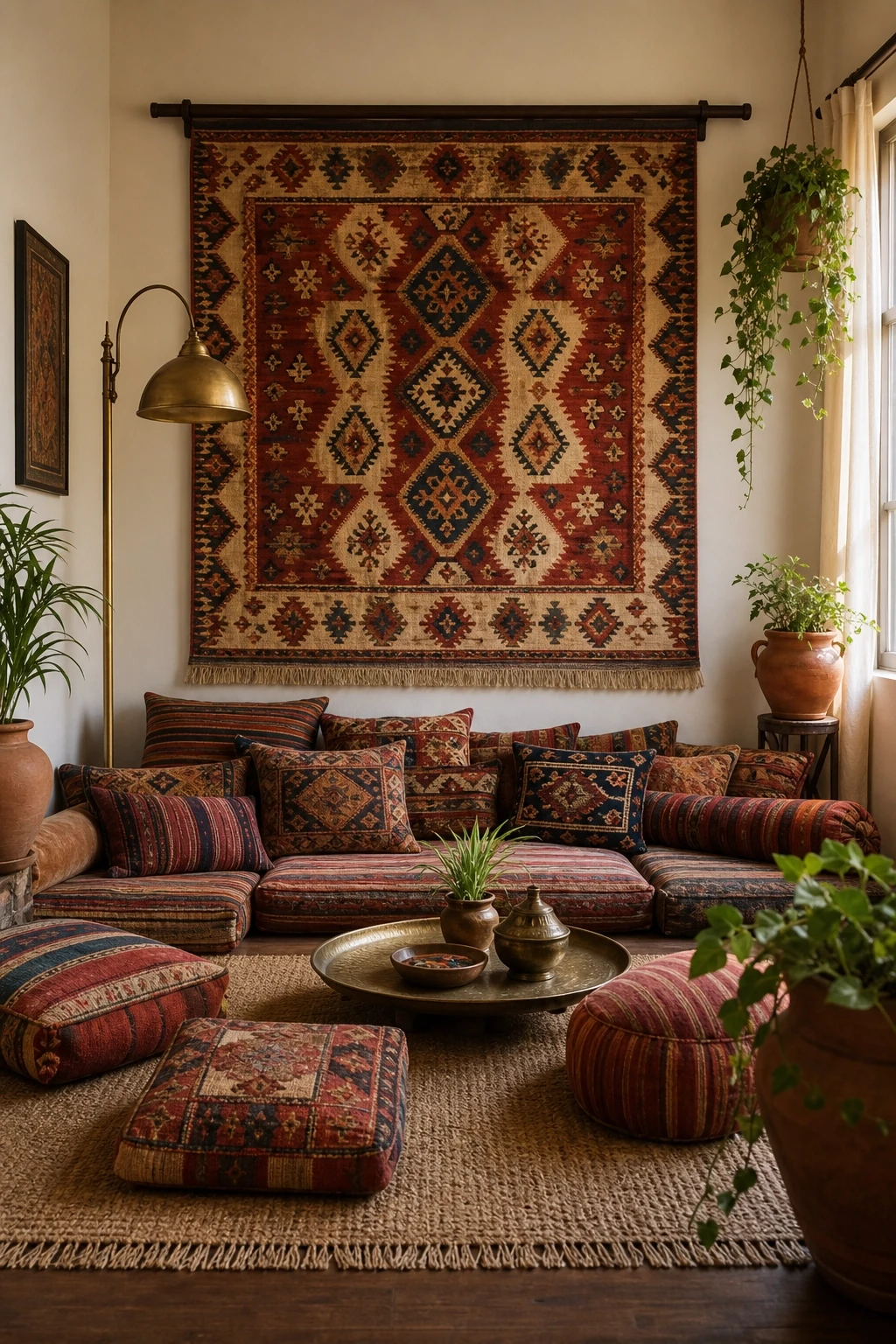
16. Layered Rugs Used as Wall Tapestries
You find a small vintage kilim rug or a beautiful woven textile at a thrift store but the colors and size do not work on the floor. Instead of passing it up, buy it anyway, because a rug hung on a wall becomes one of the most textured and interesting pieces of boho wall art you can own.
Flat-weave kilims, Turkish rugs, Moroccan boucherouite textiles, and Indian dhurries are all lightweight enough to hang on a wall safely. Use a curtain rod in a natural wood or black iron finish and clip the rug to it with simple ring clips, or sew a rod pocket along the top edge for a cleaner look. Hang the rod from two wall-mounted brackets or hooks. The rug becomes a textile tapestry that brings pattern, color, and incredible depth to the wall in one piece.
This approach works particularly well in a bedroom where you want warmth behind the bed, or in a living room where you want a focal point that is unmistakably layered and global in its feel. A geometric Turkish kilim in reds and creams above a low, cushion-heavy seating area instantly creates the kind of rich, traveled atmosphere that defines boho style at its best. The rug’s pile or weave texture adds sound absorption too, which makes the room feel warmer and quieter without any structural changes.
Designer Tip: Choose a rug for the wall that has a design which reads clearly from a distance. Dense, fine patterns can look muddy when hung high up where you view them from across the room.
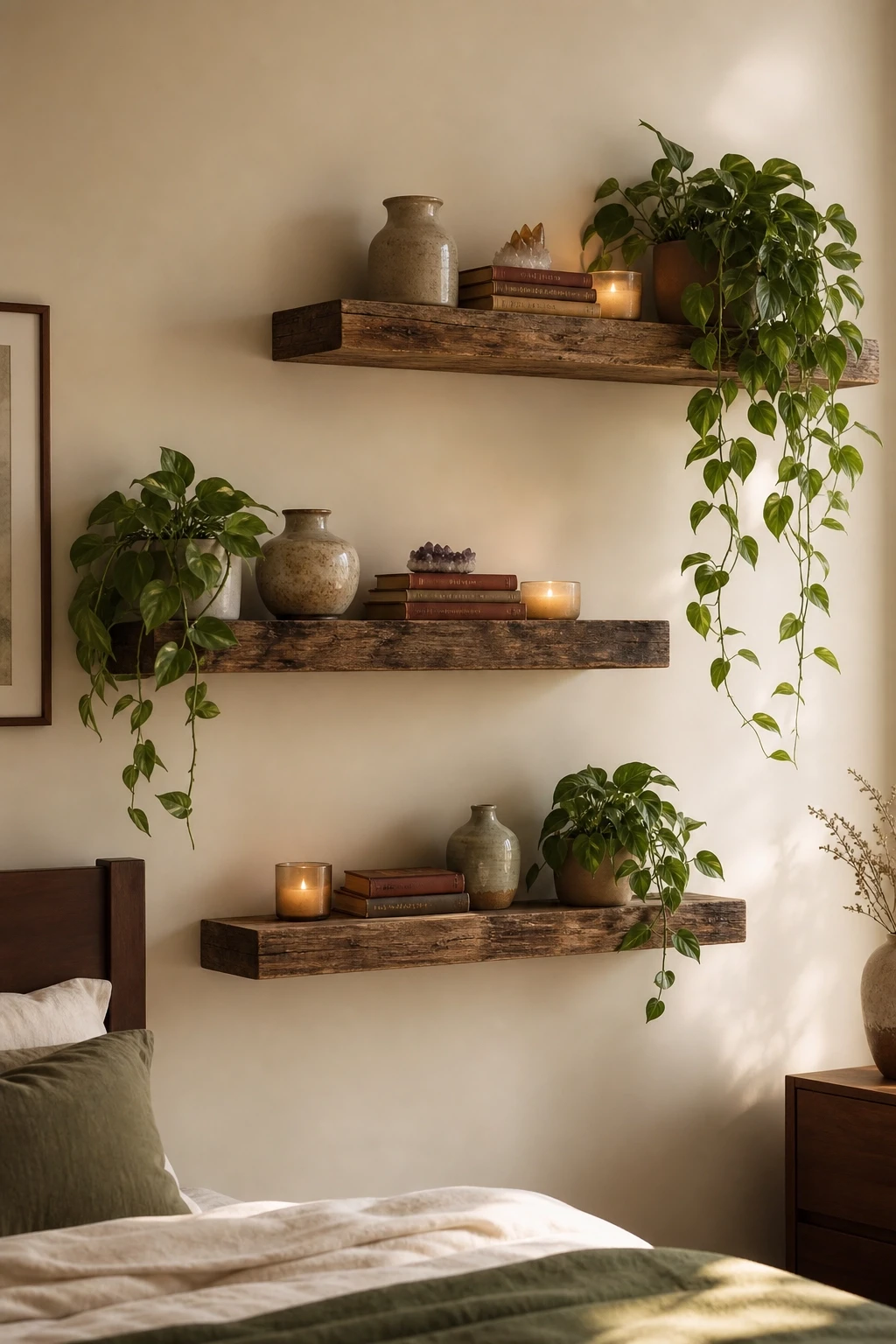
17. Floating Shelves Styled as Living Wall Art
The wall has potential but you want something functional as well as beautiful. Every purely decorative option feels like it takes something away from the room rather than adding to it. Floating shelves styled with intention do both at once.
Install two or three floating shelves in a staggered, slightly asymmetrical arrangement rather than a perfectly straight horizontal line. Natural wood shelves in walnut, pine, or reclaimed timber suit the boho palette best. Style each shelf as its own small world: one shelf might hold a trailing pothos, a stack of earth-toned books, and a small brass candlestick. Another might feature a ceramic vase, a woven coaster, and a small piece of crystal or stone. The third could display a few framed photographs or small prints leaning casually against the wall.
The trick is to keep styling restrained. Three to five items per shelf is enough. More than that starts to look like storage rather than decor. Leave some empty space on each shelf so the items have room to breathe and the eye has somewhere to rest. Add a trailing plant that spills over the edge of the highest shelf so the whole arrangement gains a sense of organic movement. At eye level, the arrangement reads as a carefully considered collection rather than a wall of random objects.
Designer Tip: Place your tallest, most vertical item (a vase, a plant, a candle) at one end of each shelf and let the other items descend in height toward the other end. This creates natural movement across the shelf rather than a flat, static lineup.
18. Indigo-Dyed Fabric Panels
The dining room wall has been bothering you since you moved in. It is too wide for a single art piece but not quite right for a full gallery wall, and every option you try looks either too small or too busy. A pair of large indigo-dyed fabric panels hung side by side fills the space beautifully and brings the kind of depth that paint alone cannot achieve.
Indigo blue is one of the most consistently beautiful colors in textile history, used across West African, Japanese, Indian, and Indonesian weaving traditions. Shibori-dyed fabric, with its irregular, resist-dyed patterns in deep navy and pale blue-white, has an organic, painterly quality that looks extraordinary when stretched over a large canvas frame or mounted on a curtain rod as a panel. Two panels of approximately 24 by 48 inches each, hung side by side with a small gap between them, fill a wide wall without becoming overwhelming.
The cool indigo tone works as a counterpoint to warm earthy furniture and accessories. A dining table in warm walnut, rattan chairs, and terracotta tableware all look more vivid against the cool blue backdrop of the panels. Add a simple ambient light source nearby, a rattan pendant or a wall sconce in aged brass, to balance the cool tones with warm light. The result is a dining space that feels considered, global, and genuinely beautiful.
Designer Tip: Shibori-dyed panels fade slightly and unevenly over time, which only improves them. Do not panic if the color shifts a little. That is the character of the material doing its thing.

19. Black and White Boho Photography Print Collection
The room has a lot of warm color happening between the rugs, cushions, and plants, and something about the richness of it all makes the space feel a little heavy. You want to add to the walls without adding more color. Black and white photography is the counterpoint the room needs.
Choose photographs with boho-relevant subject matter: close-up shots of dried botanicals, sand dunes, hands working with clay or thread, architectural details from Morocco or Bali, still life arrangements of shells and stones, or abstract natural textures. Keep the prints in simple thin black frames or frameless with a clean white mat. The restraint of the black, white, and cream palette creates a calm zone in the room that makes the surrounding color feel even richer by contrast.
Arrange five to seven prints in a loose cluster that leans more horizontal than square. Keep the spacing slightly generous and the layout informal, with prints at slightly different heights rather than perfectly aligned. This kind of display works especially well in a bedroom above a dresser or on the wall beside a reading chair. The monochrome images feel intentional and slightly editorial against the warmth of the surrounding space, which gives the room a layer of sophistication it might otherwise lack.
Designer Tip: If you print your own photographs, use a matte finish rather than gloss. Matte paper has a quality that feels more artisan and less commercial, which suits the boho aesthetic far better.

20. Driftwood and Feather Mobile
The ceiling above the bed is blank and the room feels like it could use something in the upper half of the space. Hanging art on the wall helped the lower portion, but the ceiling zone still feels empty. A ceiling-hung driftwood and feather mobile fills that overlooked vertical space with something genuinely beautiful.
Find a piece of driftwood that is long enough to feel substantial, roughly 18 to 30 inches, and hang it from the ceiling on a single jute or leather cord. From the driftwood, hang multiple strands of cord at varying lengths, each ending in a natural material. Feathers in cream, rust, and grey. Small clusters of dried flowers or pampas grass. Tiny shells or smooth stones with holes drilled through them. Seed pods. The mobile should feel gathered rather than matching, as if each element was found somewhere and brought together.
The light movement of the mobile as air circulates through the room adds a meditative, almost ceremonial quality to the bedroom. It creates a visual focal point above the bed that is completely different from anything you would find in a conventional interior. Hang it at a height where the lowest hanging element is still safely above head level but low enough that the detail of the materials can be appreciated from the pillow. A warm light source below the mobile casts interesting shadows on the ceiling, especially at night.
Designer Tip: Weight the bottom of the longest hanging strand with a small stone or shell so the mobile stays gently settled rather than tangling when the room has air movement.

21. Framed Vintage World Maps and Travel Ephemera
The study or home office has a story to tell, full of places visited, adventures planned, and memories from trips that meant something. But the walls are still generic. Framing vintage maps and travel ephemera turns those stories into actual decor.
Vintage world maps, old city maps, antique star charts, and botanical expedition illustrations all carry the spirit of curiosity and adventure that defines the bohemian mindset. Source them from antique markets, estate sales, or online vintage print shops. Mix large-format maps with smaller items: a postcard from a meaningful trip, a hand-drawn sketched landscape, a vintage airline ticket or postage stamp collection in a small frame. The combination of cartography and personal travel memory gives the wall a deeply specific story that no mass-produced print could replicate.
Frame in a mix of dark wood, weathered brass, and natural bamboo to keep the collection feeling eclectic rather than matched. Arrange them loosely on the wall with a few gaps in the cluster so it reads as growing over time. This is also one of those displays that genuinely improves as you add to it, making it a living, evolving piece of decor rather than something fixed and final. Place a deep green or navy wall behind this display if possible, as the aged tones of vintage paper and cartographic details look extraordinary against a darker backdrop.
Designer Tip: Buy vintage maps slightly larger than your frame so the edges can be trimmed cleanly without losing any of the printed detail. A white mat around the map makes even an inexpensive print look significant.

22. Pampas Grass and Dried Botanicals Wall Arrangement
Every vase arrangement on every surface of the room already has something in it and there is still a blank wall that needs addressing. Taking dried botanicals off the flat surfaces and moving them onto the wall creates a completely different kind of display that brings texture and height to the room.
Bundle dried pampas grass, bunny tail grass, lunaria, honesty plant, cotton stems, and eucalyptus together into loose arrangements and mount them directly on the wall using small nails and jute cord. You can also create individual stems in small bud vases mounted to the wall on small wooden brackets, with each vase holding just one or two dried stems. The arrangement should feel gathered and slightly unruly at the edges, not geometric or tightly controlled.
Dried botanicals have incredible longevity, lasting months or even years with minimal care. They do not need water, they do not drop leaves on the floor, and they add the same organic texture as living plants without any of the maintenance. The neutral, faded tones of dried pampas and honesty pods work beautifully in earthy rooms where the palette is already anchored in warm creams, tans, and dusty roses. Add a small woven or ceramic wall-mounted vessel nearby to hold a single dried stem as a complementary accent.
Designer Tip: Spritz dried pampas grass lightly with hairspray to keep it from shedding fluffy fibers. It is a simple step that makes a significant difference in how tidy the arrangement stays over time.

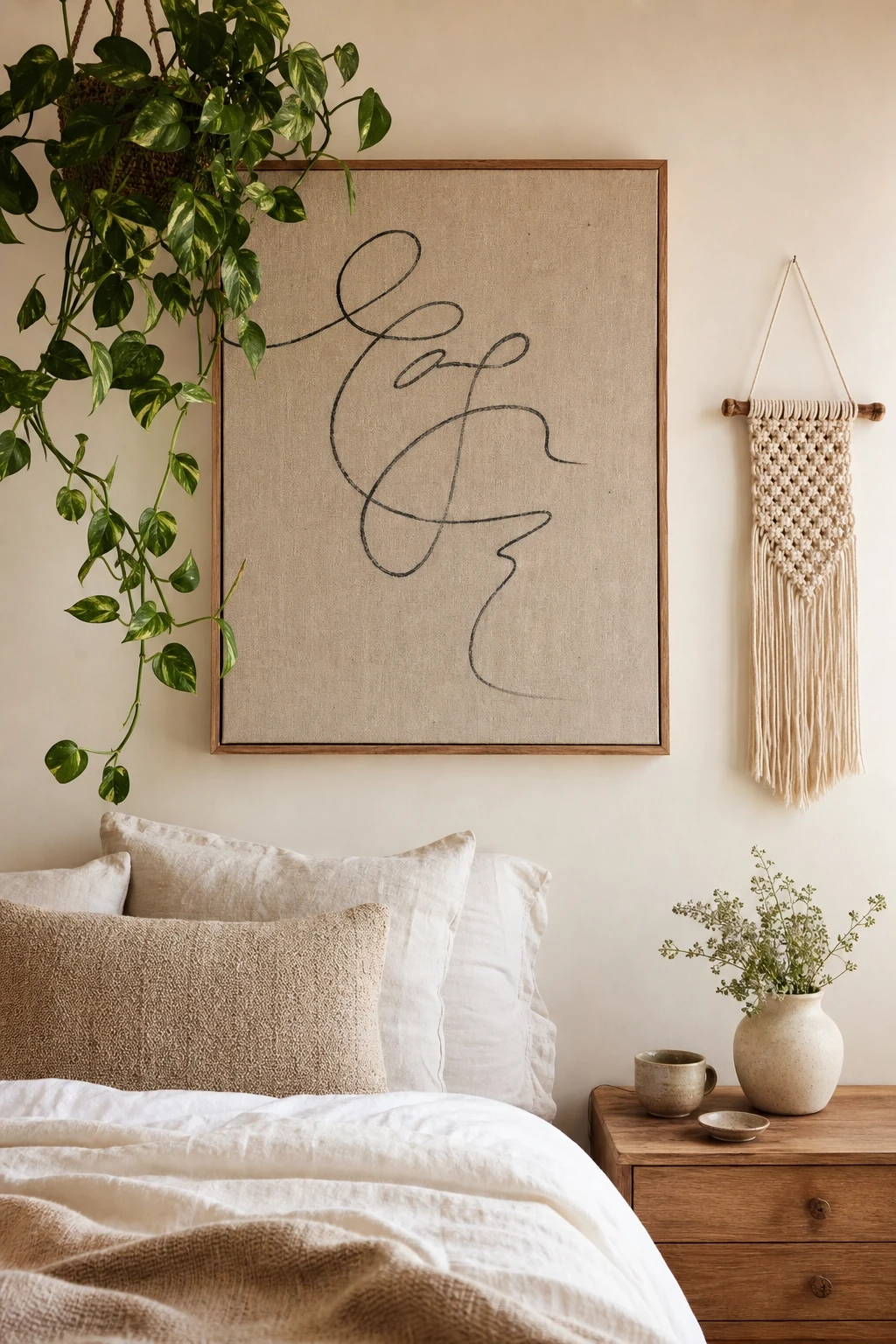
23. Hand-Lettered Inspirational Quote on Raw Linen
The bedroom needs one final personal touch, something that feels specific to who lives there rather than something that could have come from any store. Hand-lettered words on raw linen or cotton canvas are as personal as wall decor gets, and the organic quality of the material means it fits beautifully into a boho room.
Choose a quote, a word, or a short phrase that genuinely means something to you. It does not need to be trendy or widely recognizable. A line from a book you love, a phrase in a language you are learning, a single word that captures the feeling you want the room to have. Write it on unbleached linen or raw canvas using a fabric marker or brush and ink. Keep the lettering loose and slightly imperfect. The slightly uneven quality of hand-lettering on raw fabric is far more beautiful in a boho room than something that looks printed or typed.
Mount the linen on a simple wooden frame or stretch it over a canvas bar and hang it as you would any framed piece. The raw edges of the fabric can be left slightly frayed for an additional layer of texture. A piece like this works above a bed, beside a reading chair, or anywhere in the home where a personal, meaningful note would add to the atmosphere. Because the linen and ink are both natural materials, the piece ages gently over time, gaining a softness that only improves the look.
Designer Tip: If freehand lettering feels daunting, transfer your design onto the linen first using a light pencil or chalk transfer method, then go over it with ink. The base lines wash out or disappear under the ink and no one ever knows.
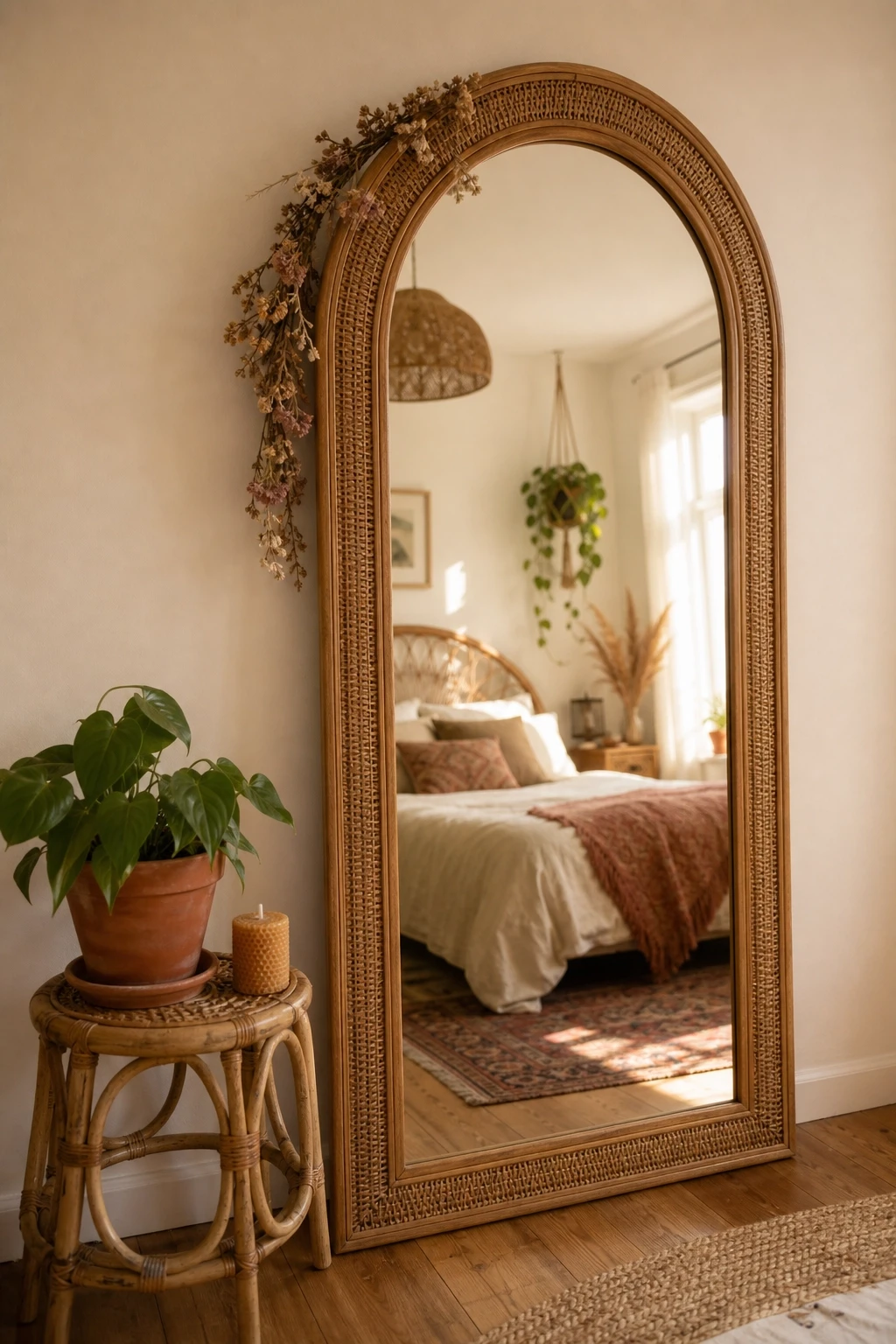
24. Arched Mirror with Woven Frame
The bedroom needs a full-length mirror but every standard rectangular option feels too structured and too formal for the relaxed, layered room you are building. An arched mirror with a woven or natural fiber frame is the option that solves this while also looking like a piece of art.
Arched mirrors have become one of the most popular furniture pieces in boho and coastal boho interiors because the softly curved top reads as organic rather than architectural. A frame woven from rattan, seagrass, or natural cord doubles down on that organic quality. Lean one of these mirrors against the wall in a bedroom corner or hang it flat on the wall as a statement piece. At full length, it reflects the room back in a way that makes the space feel larger, brighter, and more layered.
Style the corner around the mirror intentionally. A low rattan stool with a plant and a candle on it beside the mirror creates a dressing-room corner that feels designed. Layer a few hanging pieces above the mirror, a small woven hanging or a garland of dried flowers, to tie the mirror into the surrounding wall decor and make it feel embedded in the room rather than simply leaning against it. The reflected image of the room inside the mirror is essentially a second version of your decor, so the more interesting the room is, the better the mirror looks.
Designer Tip: Place a small table lamp or floor lamp just out of direct view of the mirror so the reflection shows warm ambient light rather than a window. It makes the room glow twice over at night.
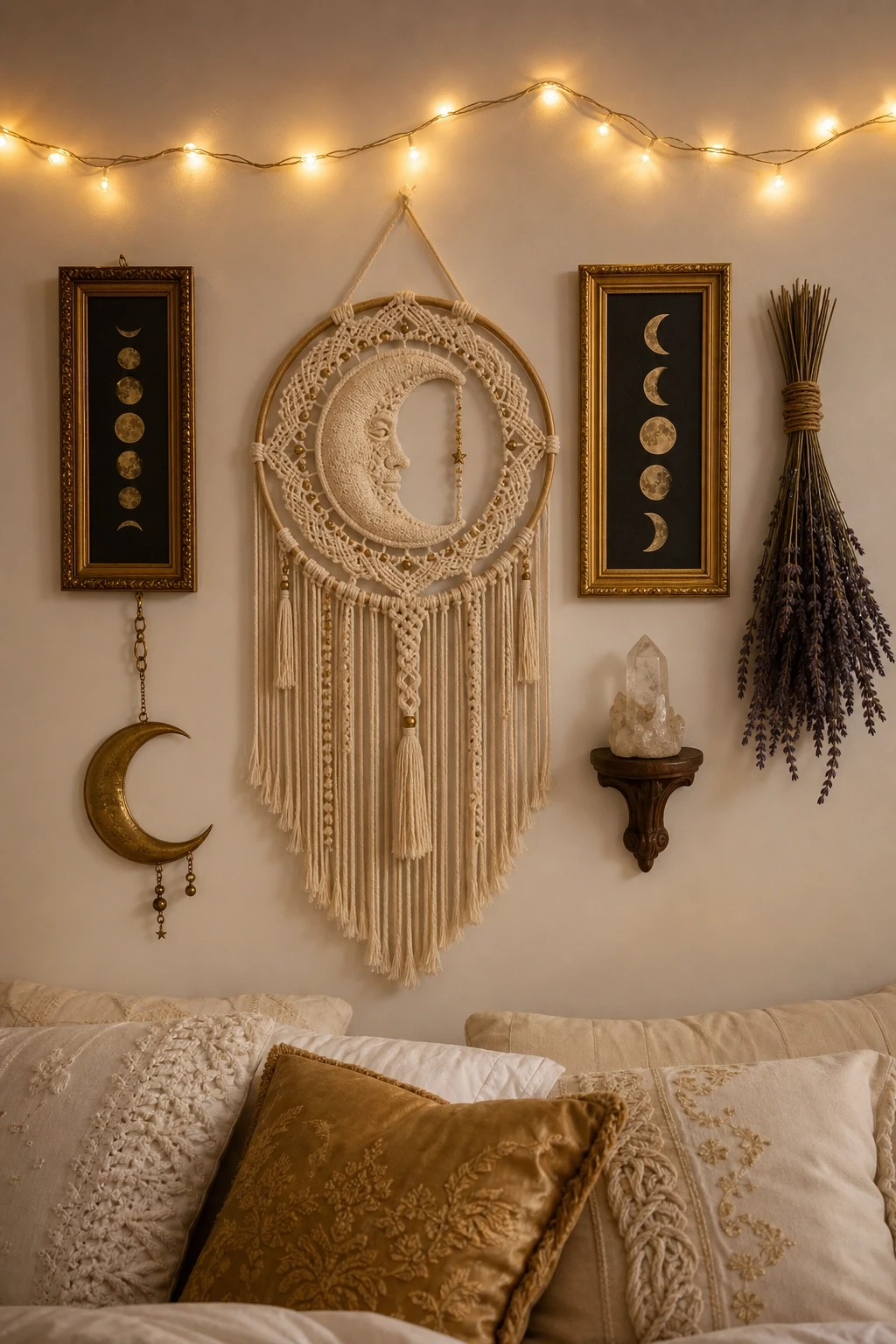
25. Celestial-Themed Mixed Media Wall Arrangement
The room has personality but it does not yet have a cohesive theme pulling everything together. You are drawn to something that feels a little mystical, a little cosmic, but not in a way that is heavy-handed or costume-like. A celestial-themed mixed media wall arrangement gives the room a direction without locking it into a rigid concept.
Build the arrangement around moon phases, stars, and celestial motifs. Start with a large circular piece as the center, a round woven piece with a moon or mandala pattern, or a large macrame circle. Around it, add: a set of moon phase prints in simple frames, a small hanging crescent moon in brass or natural wood, a few dried flowers or herbs bundled and tied with cord, and a crystal or geode piece mounted on the wall with a small bracket. The elements do not need to be from the same shop or artist.
What pulls a celestial wall together is consistency in material quality and color rather than matching themes. Choose pieces in warm gold, aged brass, ivory, cream, and natural wood tones and the diverse motifs will feel harmonious. This kind of arrangement suits a bedroom most naturally but works in a reading room, a meditation corner, or even a living room accent wall where you want a focal point that is symbolic and layered. Light the arrangement with a small plug-in sconce or a strand of warm fairy lights to make the celestial elements glow softly at night.
Designer Tip: Keep the celestial motifs slightly varied. A full moon, a crescent, and a star are enough reference to establish the theme. Repeating the same symbol across the whole wall tips it from intentional into themed in a way that dates quickly.
Bringing It All Together
Bohemian wall decor is less about achieving a specific look and more about building a wall that tells your story. The most beautiful boho walls are never finished all at once. They grow over months and years as new pieces are found, collected, made, and added to what is already there. That is the quality that makes them feel genuinely alive rather than staged.
The 25 ideas in this article cover a wide range of approaches, from a single oversized macrame statement to a layered gallery of vintage textiles, from a painted mural corner to a floating shelf collection. None of them require an unlimited budget or a professional decorator. What they all require is a willingness to look at a blank wall and see potential rather than a problem, and to treat the process of decorating it as something worth enjoying rather than rushing through.
Pick one idea that excites you, start there, and let the rest follow naturally. The room will tell you what it needs next. That is the boho way.
Frequently Asked Questions
What colors work best for bohemian wall decor?
Earthy, warm tones are the foundation of the boho palette. Terracotta, mustard, burnt orange, rust, olive green, and deep cream all work beautifully. In 2025, muted and dusty versions of these colors are particularly popular because they feel grounded and liveable rather than overly bright. That said, boho style welcomes jewel tones like deep teal, indigo, and dusty plum when used as accents. The key is keeping a warm, slightly aged quality to the palette rather than going too bright or too cool.
How do I make a bohemian wall arrangement look intentional rather than cluttered?
The most important thing is to leave breathing room between pieces. Spacing and negative space are what separate a considered arrangement from a cluttered one. Choose a general color story for the arrangement and stick to it across the different pieces, even if the materials and styles vary widely. Work in odd numbers where possible, and step back regularly to assess whether the wall is reading clearly from across the room.
Can bohemian wall decor work in a small room?
Absolutely. In fact, boho decor works particularly well in small rooms because the layering of texture and warmth makes compact spaces feel cozy rather than cramped. In a small room, choose one strong focal point, a large macrame piece or a mirror, rather than trying to fill every wall. Let one wall do the talking and keep the others relatively simple. Mirrors are especially useful in small boho rooms because they add light and perceived depth while contributing to the decorative scheme.
What is the easiest bohemian wall decor idea for beginners?
A woven basket cluster is one of the most beginner-friendly options because the pieces are affordable, lightweight, and simple to hang. There is also no wrong way to arrange them. A few baskets of different sizes hung together in a loose cluster looks good almost regardless of how you place them because the natural materials and organic shapes do most of the work. From there, you can add to the cluster over time without needing to overhaul the whole arrangement.
How do I mix different boho wall decor pieces without it looking random?
Choose a material palette and a color palette and apply both across everything you hang. If you are working with natural materials such as rattan, jute, cotton, and wood, pieces from very different sources will feel related because they share the same material story. Apply the same logic to color. A terracotta print, a rust-toned woven piece, and a wood-framed mirror all feel connected because of their shared warm undertone, even though they are completely different objects. Material and color are the threads that hold an eclectic arrangement together.
Is it possible to do bohemian wall decor on a tight budget?
Yes, and in many ways a tight budget actually produces more authentic results. Thrift stores, estate sales, handmade goods markets, and online secondhand platforms are the natural hunting grounds for boho wall decor pieces that have actual history and character. DIY options like hand-painted linen, stretched fabric panels, and homemade macrame are also completely viable and often more interesting than anything mass-produced. Some of the most beautiful boho walls are built almost entirely from repurposed, found, and handmade pieces.