Kitchen Cabinet Organization Ideas That Make Cooking Feel Effortless
There is a particular kind of frustration that only happens in the kitchen. You are in the middle of making dinner, one burner is already going, the timer is counting down, and you need that one pan. You open the lower cabinet and immediately three lids slide out, a cutting board tips over, and you have to pull out half the cabinet contents just to find what you were looking for. By the time you close the cabinet again, the mood for cooking has taken a serious hit. Sound familiar? Most kitchens suffer from exactly this kind of slow, invisible chaos. The cabinets look fine from the outside. It is only when you open them that reality hits.
The thing is, kitchen cabinet organization is not really about buying more stuff or spending a weekend rearranging everything. It is about understanding how you actually use your kitchen and then building a storage system around those real habits. The ideas in this article are not theoretical. They are practical, specific, and drawn from how real home cooks actually work. Some of them cost almost nothing. A few involve a small investment. All of them genuinely make a difference to how the kitchen feels and how smoothly cooking goes on a regular Tuesday night.
This article covers seventeen ideas, and each one is treated as its own complete solution rather than a one-line tip. You will find ideas for upper cabinets, lower cabinets, corner cabinets, the cabinet under the sink, and everything in between. Whether you cook every day or only on weekends, whether your kitchen is a generous open layout or a compact galley, at least several of these ideas will apply directly to your space. Read through, pick the ones that match your biggest frustrations, and start there. Small changes in a kitchen compound quickly.
1. Install Pull-Out Shelves in Lower Base Cabinets
You crouch down, peer into the back of the base cabinet, and squint. You know the pot you need is in there somewhere. You pull out the front pot, then the next one, then move the colander out of the way. By the time you find what you were after, you have made a small mess and wasted three minutes.
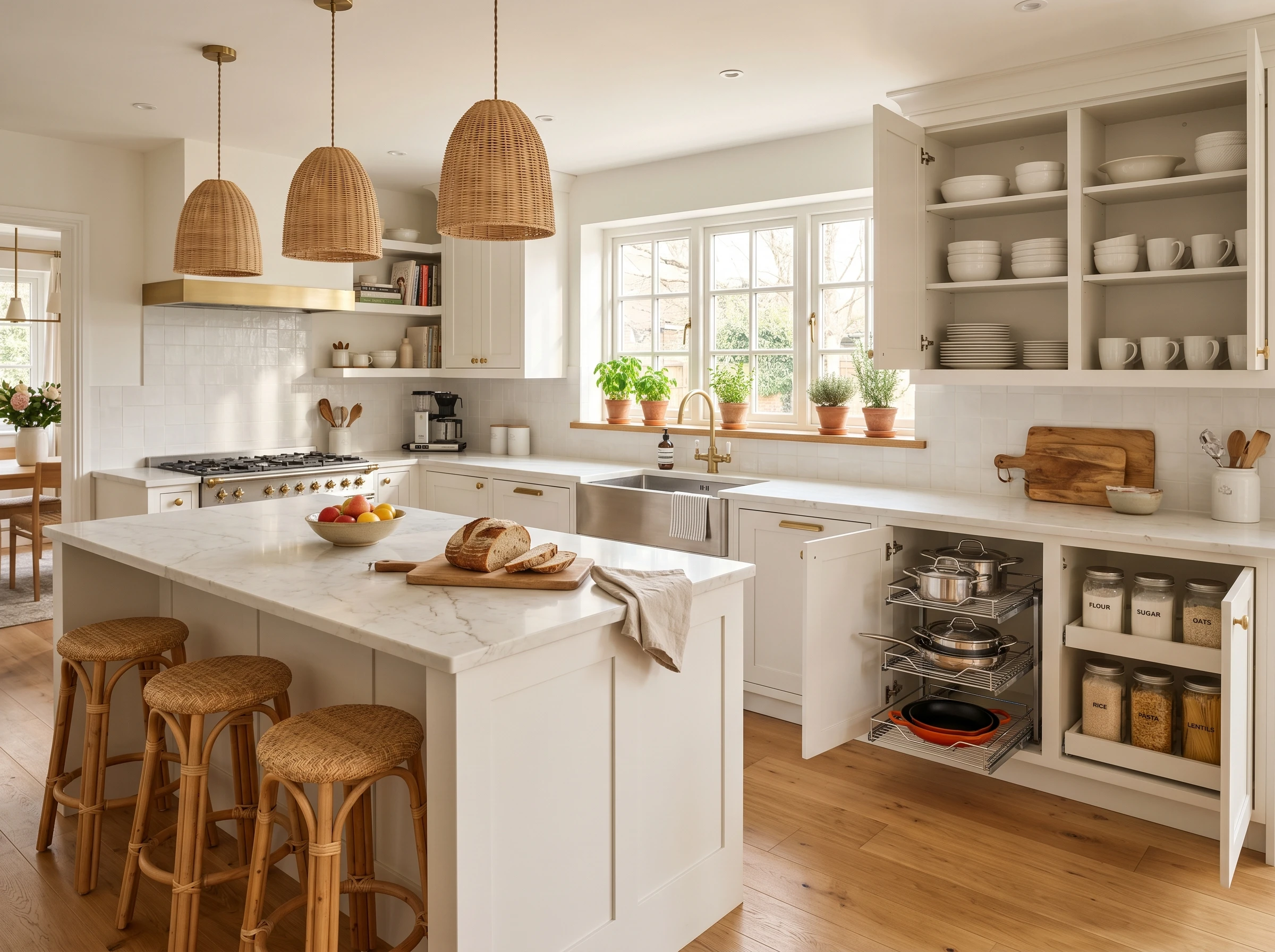
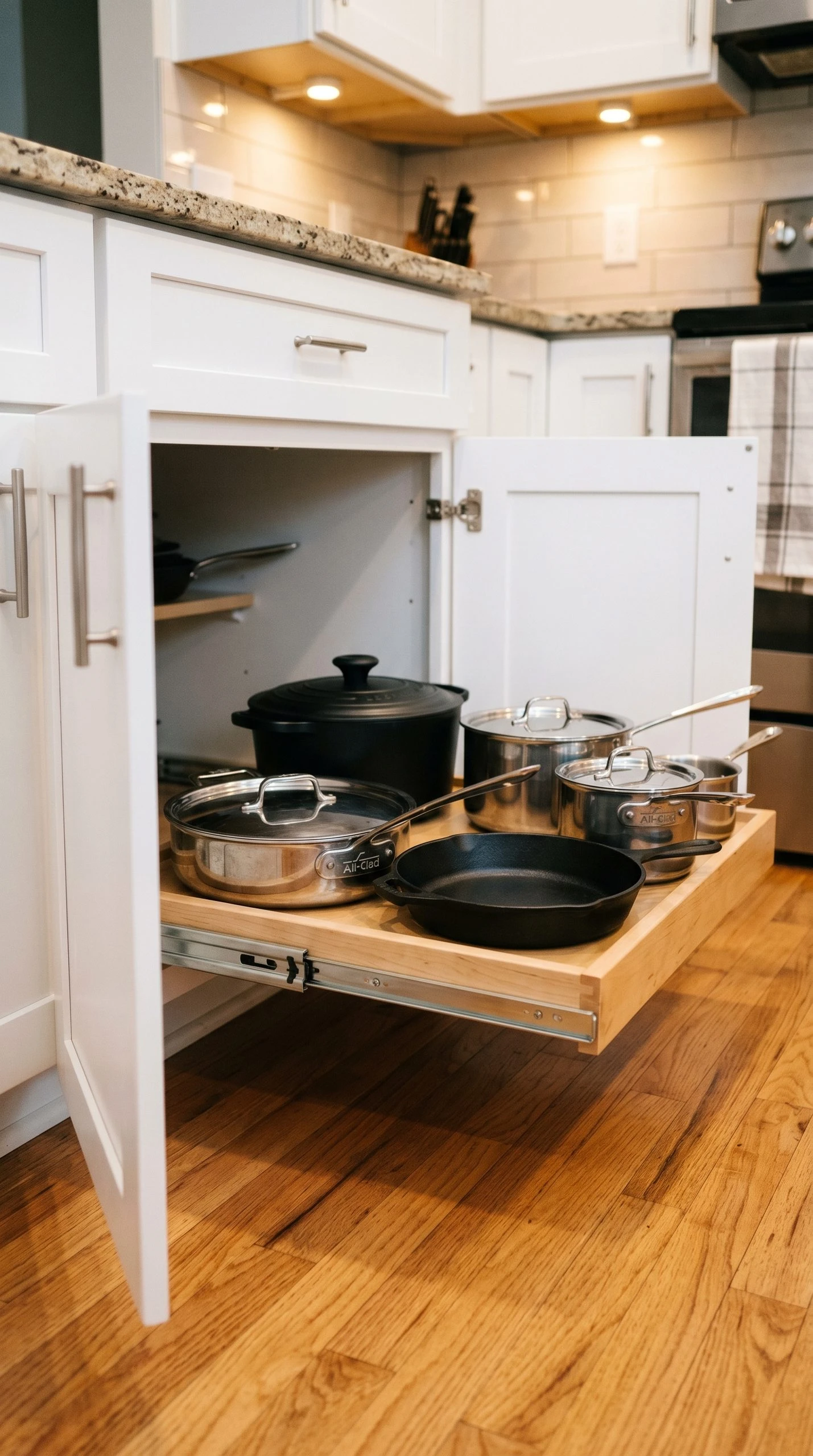
Pull-out shelves solve this problem permanently. Instead of a fixed shelf where things stack on top of each other and the back becomes an unreachable zone, a pull-out shelf slides forward on drawer runners and brings everything to you. The entire contents of the cabinet become visible and accessible without crouching, reaching, or pulling things out. Most base cabinets can be retrofitted with pull-out shelves without any structural changes to the cabinetry itself. You simply measure the interior width, order the right size shelf kit, and install it onto the cabinet floor or an existing shelf using the included hardware.
Pull-out shelves work especially well in lower cabinets used for pots, pans, mixing bowls, baking sheets, and any other large items that tend to stack awkwardly. They are also excellent under the sink where the plumbing takes up an awkward amount of space and everything else gets shoved around it. A two-tier pull-out under the sink, designed to work around the drain pipes, can nearly double the usable storage in that cabinet. From a style standpoint, pull-out shelves are invisible when the cabinet is closed, so they do not affect the look of the kitchen at all. They purely improve the function.
Designer Tip: When measuring for pull-out shelves, account for the door hinge clearance on the inside of the cabinet. Some hinges extend inward slightly when the door is open, which can prevent the shelf from sliding all the way out. Measure twice, order once.
2. Use Vertical Dividers for Baking Sheets and Cutting Boards
Every time someone needs a baking sheet, the whole stack has to come out. The cutting boards are wedged in sideways, the sheet pans are scratching each other, and there is a muffin tin somewhere at the bottom that nobody has seen in months.
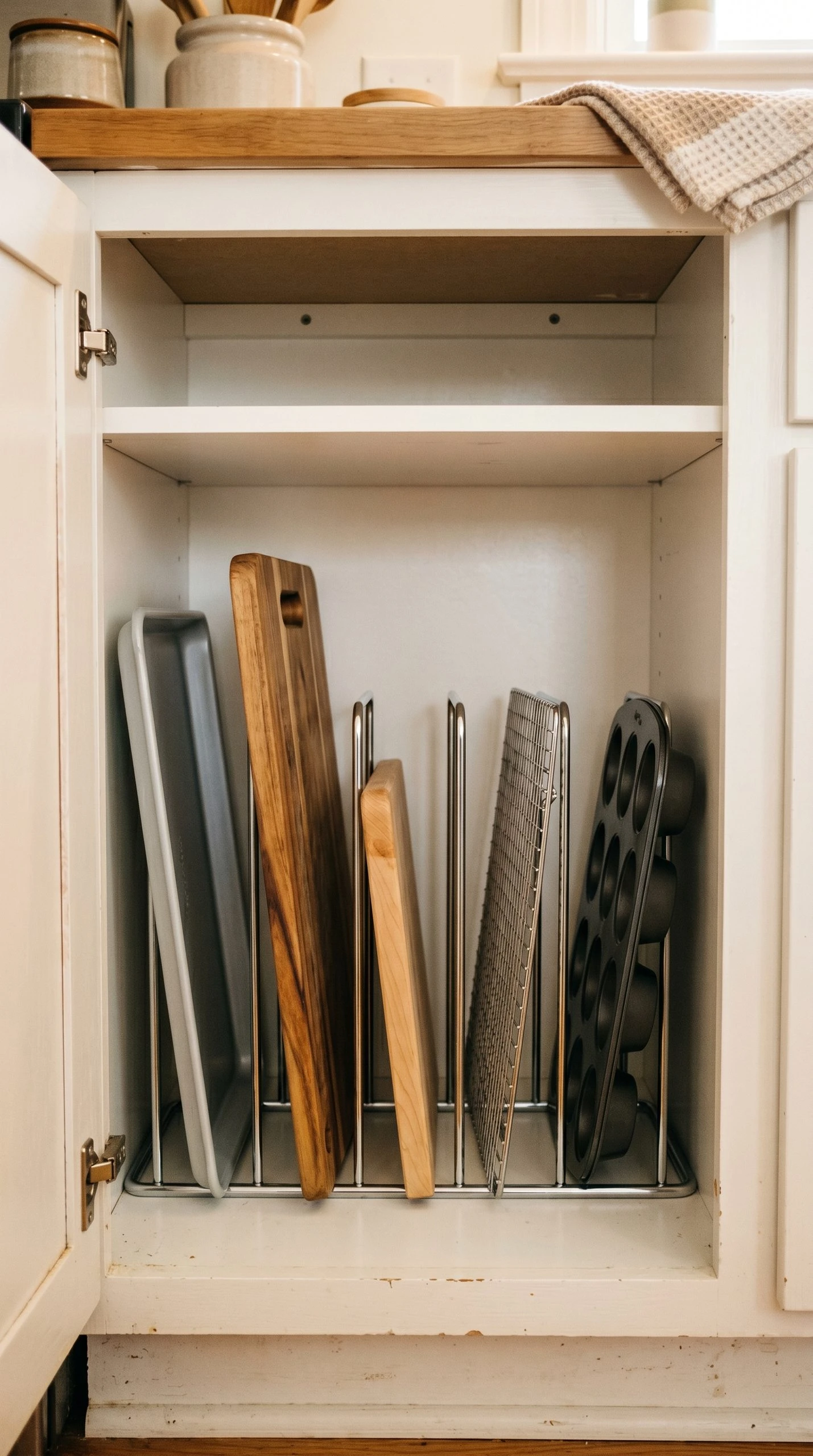
Vertical dividers turn a chaotic flat stack into a neat row of individually accessible items. The principle is simple: instead of laying baking sheets, cutting boards, and sheet pans flat on top of each other, you store them upright, separated by dividers, so you can grab any single item without disturbing the others. This is the same logic that makes file folders work in an office. Each item has its own slot, and pulling one out does not collapse everything else.
There are two main ways to add vertical dividers to a kitchen cabinet. The first is metal tension dividers that wedge between the top and bottom of the cabinet and can be repositioned without any tools. These are ideal for renters or anyone who wants flexibility. The second option is fixed wooden or metal dividers screwed into the cabinet walls, which gives a more permanent and polished result. Either way, the spacing between dividers should be generous enough that items slide in and out without snagging but tight enough that nothing tips sideways. A good rule of thumb is to space dividers about two to three inches apart. This approach works beautifully in a lower cabinet near the oven where baking supplies are closest to where they get used.
Designer Tip: Add one wider slot among the dividers specifically for cooling racks and oven splatter shields, which tend to be oddly sized and usually end up shoved in a corner because they do not fit neatly with regular sheet pans.
3. Add a Lazy Susan to Corner Cabinets
The corner cabinet is the black hole of most kitchens. Things go in and somehow never come back out. You know you have an extra jar of peanut butter and two cans of chickpeas back there somewhere, but reaching them means practically climbing into the cabinet.
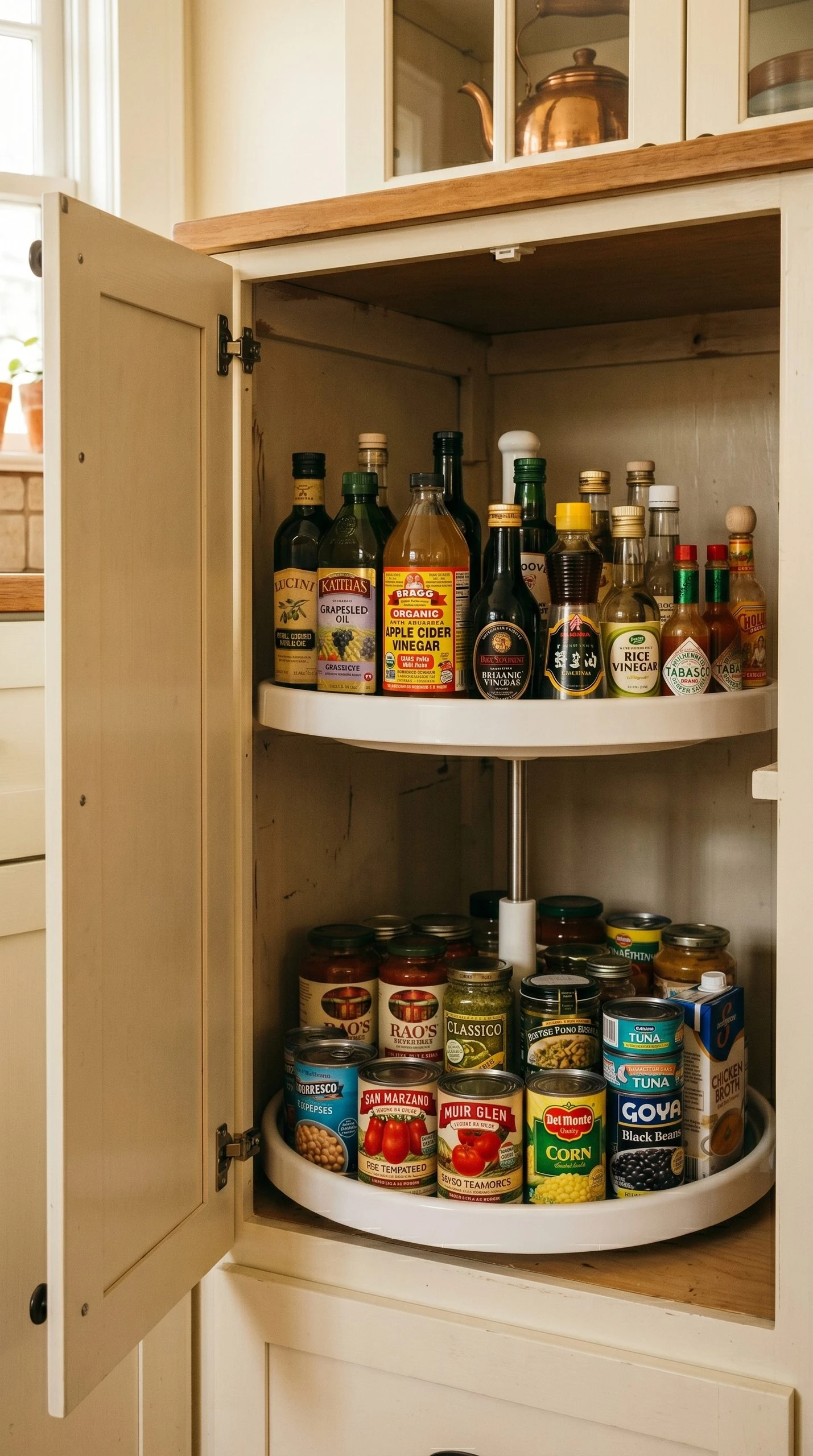
A lazy Susan is the most practical solution for corner cabinets that has ever been invented, and it holds up because it genuinely works. The rotating turntable brings everything to you with a single spin, meaning nothing ever gets permanently lost in the back again. For deep corner cabinets, a two-tier lazy Susan maximizes both the floor space and the vertical height of the cabinet. For upper corner cabinets, a smaller single-tier version keeps spices, oils, and condiments accessible without requiring you to reach blindly into the back shelf.
When choosing a lazy Susan, look for one that fits the cabinet as snugly as possible without rubbing against the walls. Kidney-shaped lazy Susans are designed specifically for pie-cut corner cabinets where the doors open at an angle, and they make the most of the awkward shape. Round lazy Susans work well in full-depth corner cabinets where the door opens straight. The material matters too. Solid plastic versions are easy to wipe clean when things spill, which will happen. Wire versions allow you to see through to items on lower tiers. Non-slip surfaces keep jars from sliding when the turntable spins.
Designer Tip: Group items on the lazy Susan by category and keep the heaviest things toward the center of the turntable rather than at the outer edge. This keeps the rotation smooth and prevents heavier items from sliding outward when the turntable spins quickly.
4. Mount Hooks or Racks on the Inside of Cabinet Doors
The back of every cabinet door in most kitchens is just empty painted wood. It is one of the most consistently wasted surfaces in the entire room, and it is hidden every time the cabinet is open, so it never gets addressed.
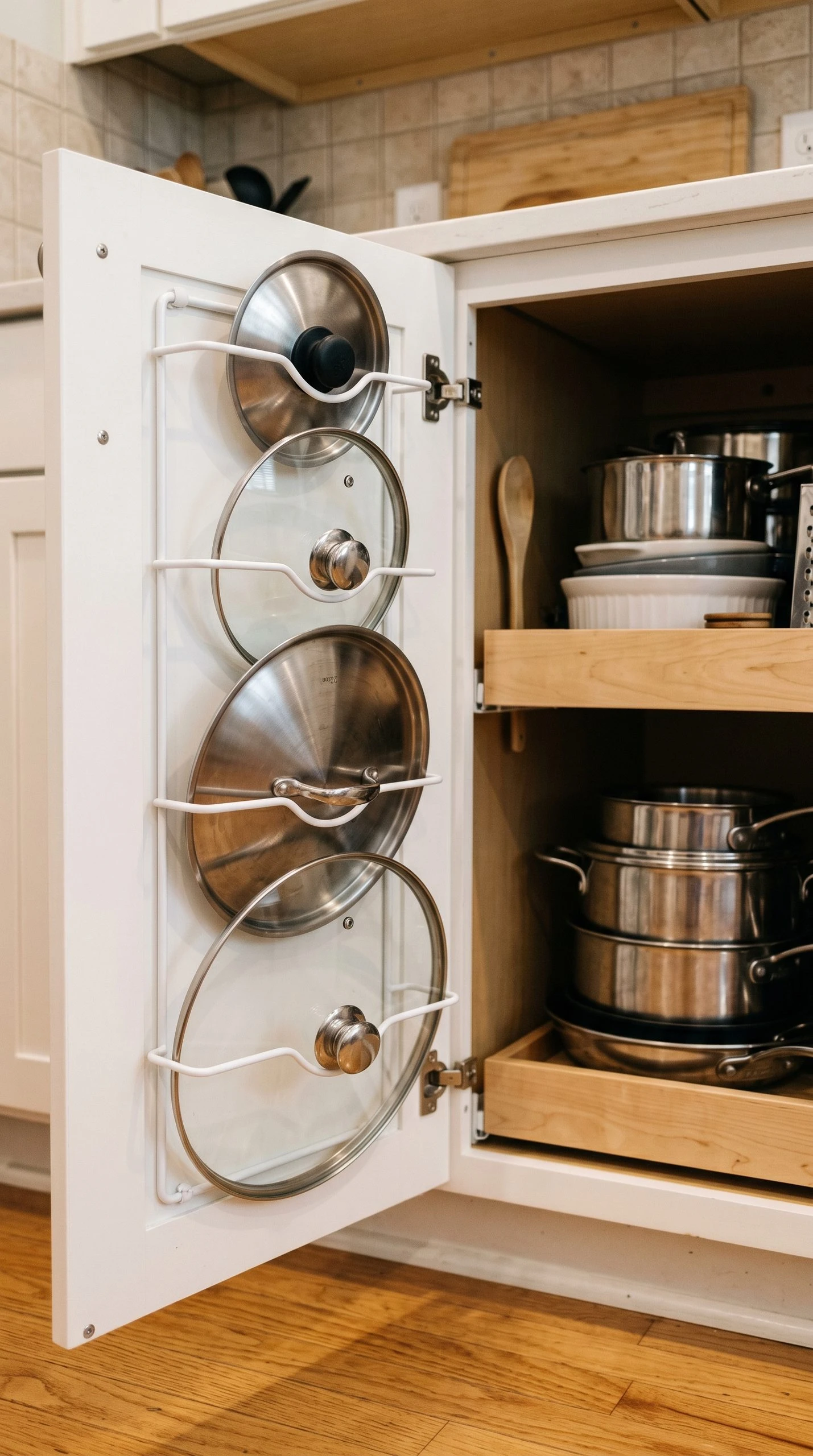
The inside of cabinet doors is genuinely useful storage space, and the beauty of it is that it does not require any new shelving or cabinetry. You are adding storage capacity to space that already exists. Command hooks, small tension bars, adhesive-backed racks, and over-the-door organizers all mount easily to the inside of cabinet doors and can hold a surprising amount. The inside of a lower cabinet door is perfect for holding pot lids, either on hooks or on a small mounted rack that holds several lids vertically. The inside of an upper cabinet door works well for a small spice rack that keeps your eight most-used spices within immediate reach without using any shelf space.
For a slightly more built-in look, screw-mounted wire racks are sturdier than adhesive options and can handle more weight. These are ideal if you want to hang heavier items like a cast iron lid, a small cutting board, or a collection of measuring cups and spoons. Before mounting anything, check the clearance between the door and the nearest shelf when the door is closed. You need at least an inch of clearance, ideally more, to make sure the door closes completely without the rack pushing against the shelf contents. This is a one-time check that takes thirty seconds and saves a lot of frustration later.
Designer Tip: Use the inside of the cabinet door directly next to the stove for your most-used cooking tools: a small rack with your everyday spatula, tongs, and wooden spoon means they are completely hidden but instantly accessible during cooking without crossing the kitchen.
5. Decant Dry Goods Into Clear Airtight Canisters
The pantry cabinet has four different open bags of pasta, a rolled-up bag of rice held shut with a rubber band, a half-empty box of breadcrumbs, and a quinoa bag that tipped over and scattered. Every time the cabinet opens, something falls out.
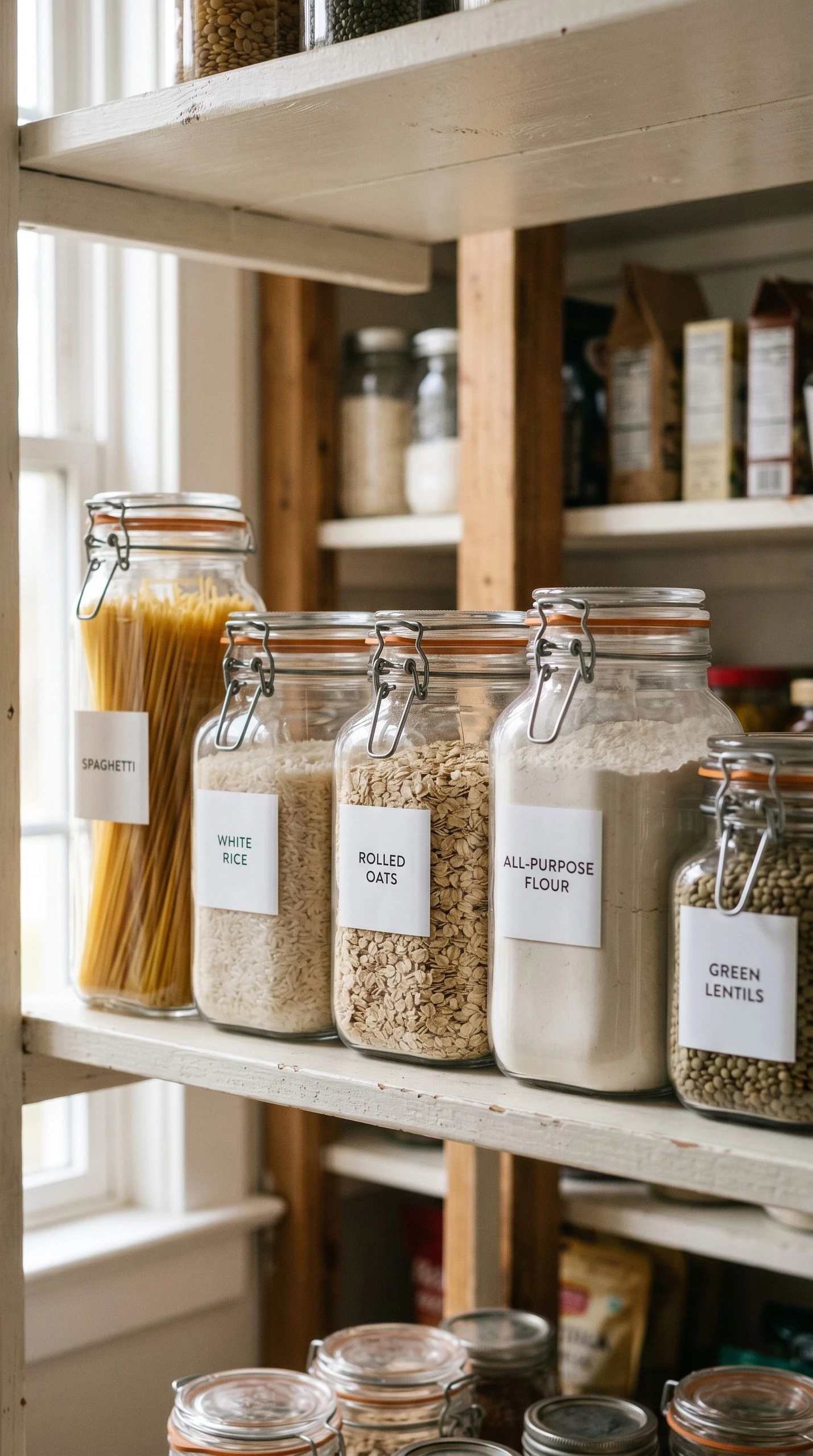
Decanting dry goods into matching clear airtight canisters is one of those organizational changes that improves the kitchen in two ways at once. First, it dramatically reduces the visual clutter of mismatched packaging in different sizes and shapes. Second, and more practically, it protects your dry goods from moisture, pests, and the steady degradation that comes from repeatedly opening and refolding bags. Pasta, rice, oats, flour, sugar, lentils, breadcrumbs, cornmeal, and any other regularly used dry ingredient all benefit from being transferred to a canister where they stay fresher longer and are genuinely pleasant to reach for.
The most satisfying canister setups use a single matching system throughout. Square or rectangular canisters are more space-efficient than round ones because they sit flush against each other with no wasted gap between them. Look for sets that include multiple sizes so that smaller quantities like poppy seeds or flaxseed get an appropriately sized container rather than rattling around in a giant one. Chalkboard labels or printed adhesive labels keep everything clearly identified. A label maker is one of the best small investments for a kitchen organization project because the result looks intentional and professional rather than improvised.
Designer Tip: Write the expiration date from the original packaging on the bottom of each canister in a dry-erase marker before filling. When the canister is empty and you refill it, wipe the old date off and write the new one. It takes ten seconds and means you never have to guess whether something is still good.
6. Create a Dedicated Spice System Inside a Cabinet
You reach for cumin, grab chili powder instead, put it back, find the paprika, realize it is smoked paprika and not sweet, then spend another thirty seconds hunting while the onions are softening in the pan. The spice cabinet is technically organized but practically impossible to navigate quickly.
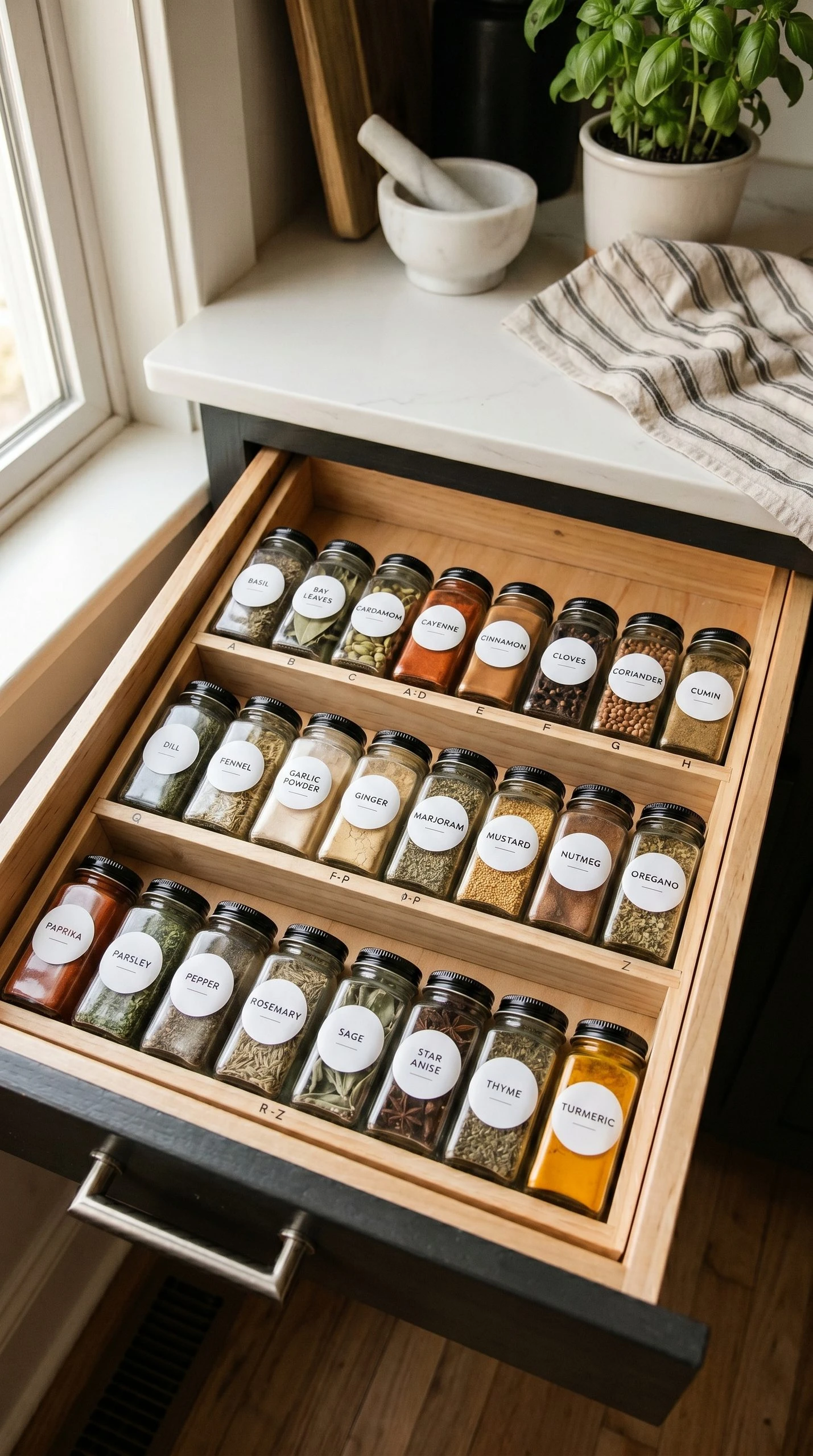
A dedicated spice system inside a cabinet solves the navigation problem by making every jar visible and identifiable at a glance rather than requiring you to read the label on the back of a row of identical bottles. There are a few approaches that work well. A tiered spice shelf that raises the back row above the front row means you can see all your spices simultaneously rather than having to remove the front row to check what is behind it. A pull-out spice drawer insert that lays spices on their backs with labels facing up is even more efficient because you look down into the drawer and read every label at once, like a filing cabinet for spices.
Standardizing your spice jars makes a significant visual and practical difference. Mismatched jars of different heights and shapes make a spice cabinet look chaotic even when it is technically organized. Transferring spices to uniform glass jars in one consistent size, then labeling the lids so you can read them from above in a drawer, gives a result that looks polished and works better. Many home cooks find that this process also prompts a useful audit: you discover which spices you have multiples of, which are almost empty, and which are so old they barely smell like anything anymore.
Designer Tip: Organize spices alphabetically within each category, baking spices together and savory spices together, rather than by frequency of use. The alphabetical system is intuitive for anyone in the household, not just the person who originally set it up.
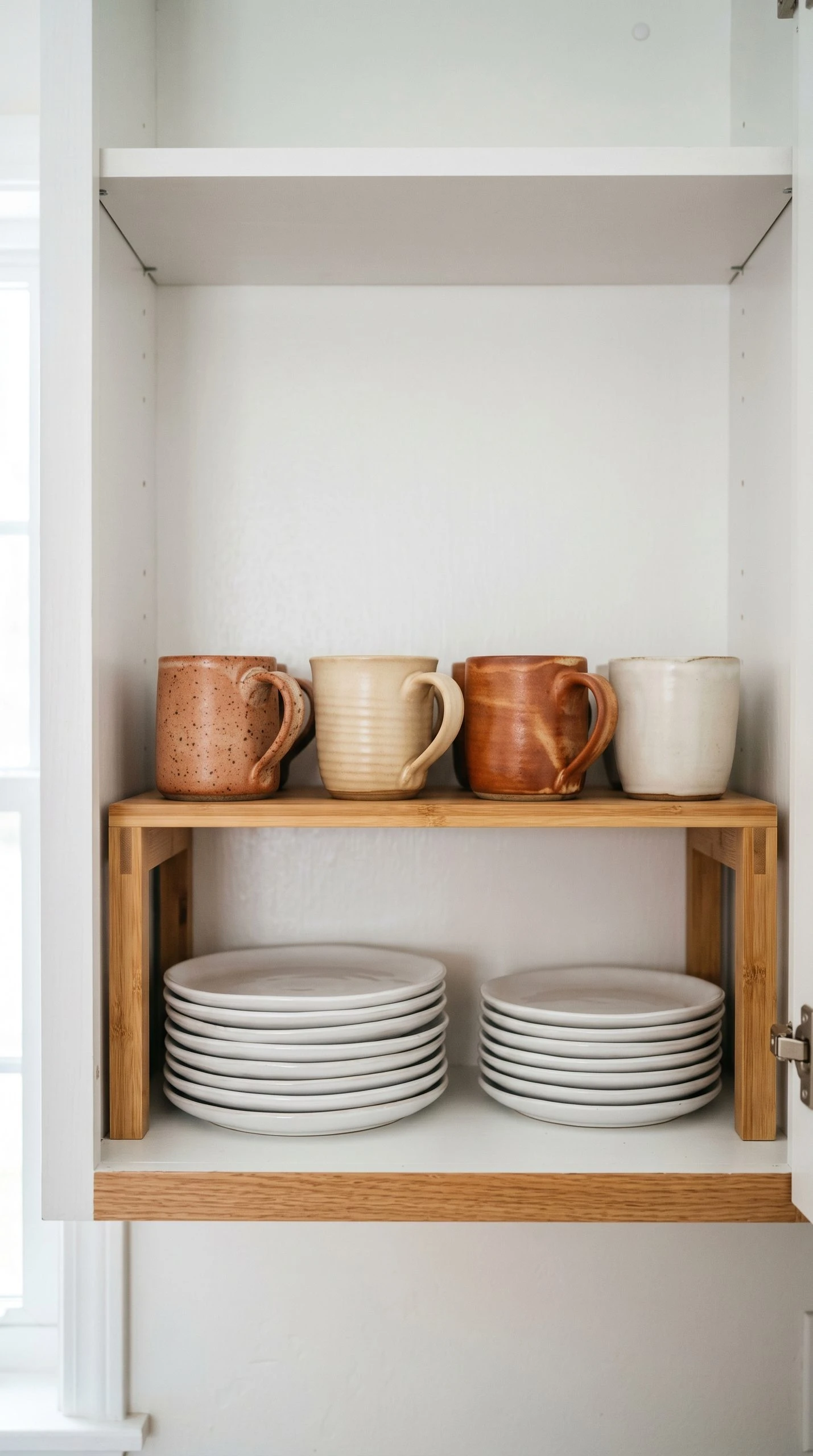
7. Use a Shelf Riser Inside Upper Cabinets
The upper cabinet has one flat shelf and everything sits on the same level. The mugs are in front of the glasses because they are taller. The plates are in a slightly precarious stack. When you need a bowl, you have to move two things to get to it.
A shelf riser, sometimes called a cabinet shelf doubler, is a simple freestanding unit that sits on the existing cabinet shelf and creates a raised second level above it. Items go on the top level of the riser and on the shelf below the riser, effectively doubling the usable storage area of that shelf without any installation or permanent changes. This is one of the most budget-friendly cabinet organization tools available, and it works in almost every kitchen regardless of cabinet size or style.
Shelf risers work best when used for items of similar height so the riser level and the shelf level each hold a logical category. Mugs on the riser level above, small plates on the shelf level below. Spice jars on the riser level above, sauce bottles on the shelf level below. The key is to avoid putting items on the riser level that are too tall to fit comfortably under the cabinet shelf above. Measure the clearance before buying, aiming for at least an inch of breathing room above the tallest item on the riser. Bamboo risers look warmer and more finished; wire versions allow air circulation and are easier to clean.
Designer Tip: Use shelf risers specifically in the cabinet where you store everyday dishes and glasses. This is the cabinet you open most often, and the improved accessibility of a tiered setup will have an immediate, daily impact on how the kitchen feels to use.
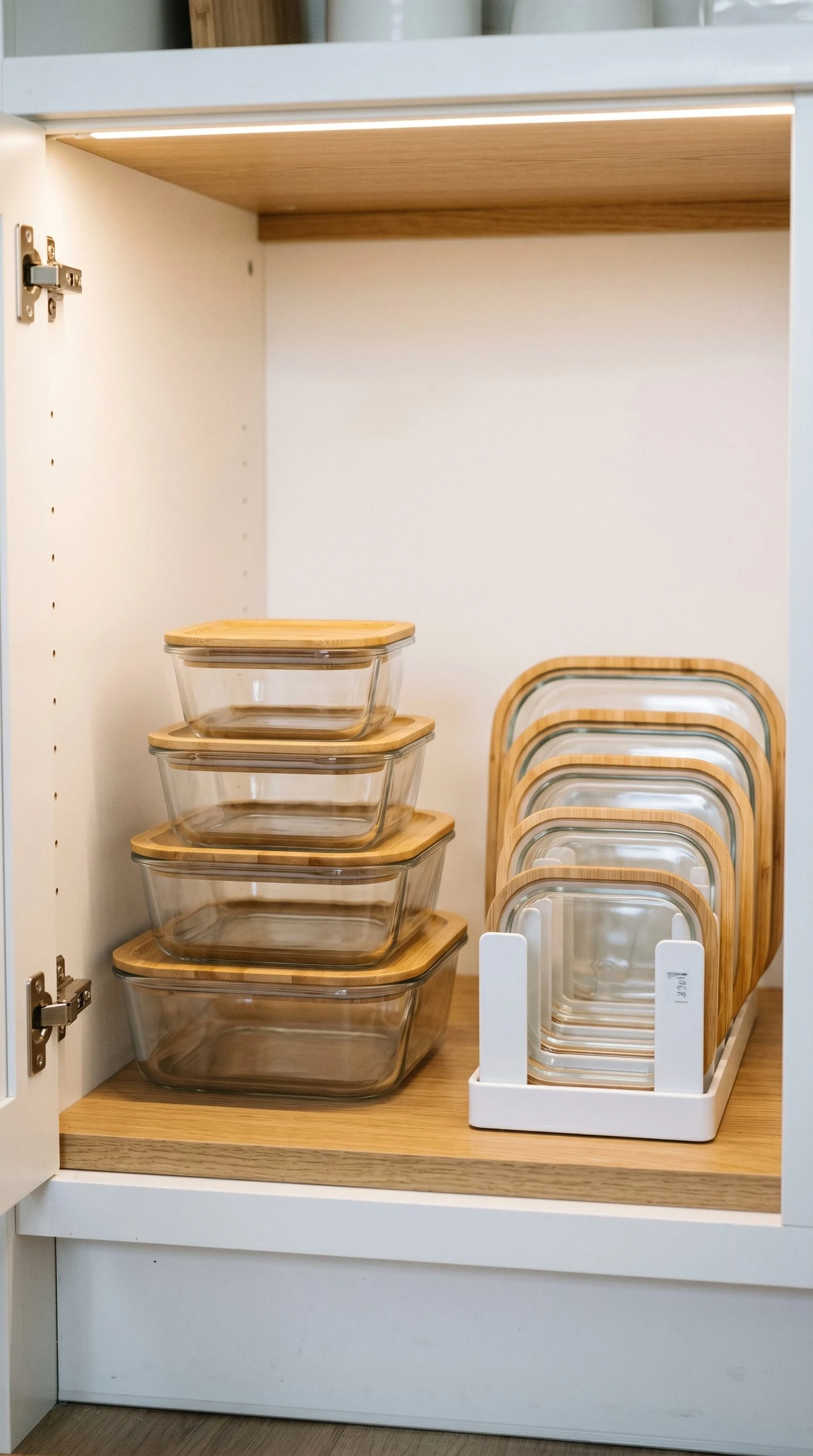
8. Organize Food Storage Containers With a Lid Holder
The food storage container cabinet is, in most kitchens, the one cabinet everyone dreads opening. Mismatched lids, stacked containers of different sizes sliding around, and that one lid that belongs to a container you no longer own but cannot bring yourself to throw away.
The food storage container problem has two parts: the containers themselves and the lids. Solving both requires treating them separately. Containers should be nested by size, with smaller ones inside larger ones to reduce the total number of stacked items. The lids should go into a dedicated lid organizer, either a tension rod rack that holds them vertically like books on a shelf, or a purpose-built lid holder with individual slots. When lids have a designated place and are stored separately from the containers, the whole cabinet becomes dramatically more manageable.
The deeper fix, which sounds obvious but makes an enormous difference in practice, is to keep only matched sets. Periodically go through the container cabinet and get rid of any lid without a matching container and any container without a matching lid. An orphaned lid is just clutter with a false sense of purpose. Once you are working only with complete matched sets, the nesting and the lid organizer do the rest of the work. If you are ready for a full reset, switching to one brand and one style of container throughout the kitchen removes the size and shape incompatibility problem entirely. Square containers in a single brand nest perfectly, stack reliably, and look clean in the cabinet or the fridge.
Designer Tip: Store your most frequently used container sizes at the front of the cabinet or on the most accessible shelf. Reserve the higher shelf or the back of the cabinet for holiday-sized serving containers and specialty pieces that only come out a few times a year.
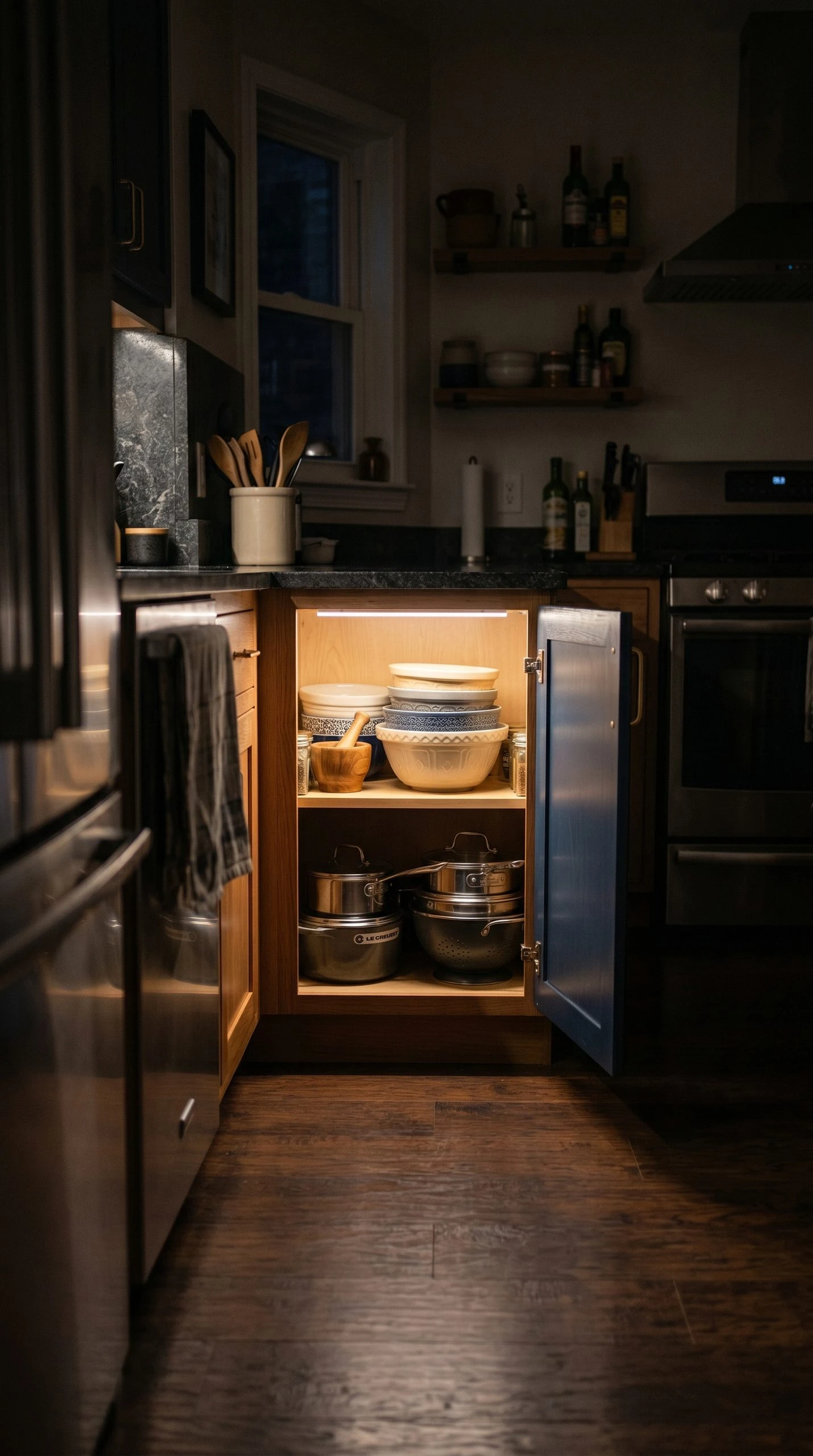
9. Add Interior Lighting to Lower and Deep Cabinets
You open the lower cabinet, peer into the back half where the kitchen light does not quite reach, and try to identify shapes by silhouette. Is that the Dutch oven or the stockpot? You drag things forward to see them better, then shove them back when you find what you need.
Cabinet lighting is one of those upgrades that sounds like a nice-to-have until you have it, at which point it becomes a genuine quality-of-life improvement. Battery-powered LED strip lights or motion-activated puck lights mounted inside lower cabinets illuminate the entire interior the moment the door opens, making every item immediately visible without any guesswork. For deep cabinets where the back half is always in shadow, the difference is particularly striking. You can see everything, reach for exactly what you need, and close the cabinet without moving anything out of the way first.
Installation is simple and requires no wiring. The best options use rechargeable batteries and mount with adhesive strips or small screws. Motion-activated versions turn on automatically when the door opens and off when it closes, so you never have to think about them. Under-cabinet versions that illuminate the shelf below are common, but inside-cabinet lighting mounted to the interior top surface is a less commonly done and more impactful upgrade. For the cabinet under the sink in particular, where the plumbing creates awkward shadows, a motion-activated light makes an immediate and welcome difference.
Designer Tip: Place the light source at the back of the cabinet interior rather than the front. A light mounted near the door mostly illuminates the front of the cabinet, which you can already see without it. Lighting from the back ensures the deepest, darkest section of the cabinet is what gets lit.
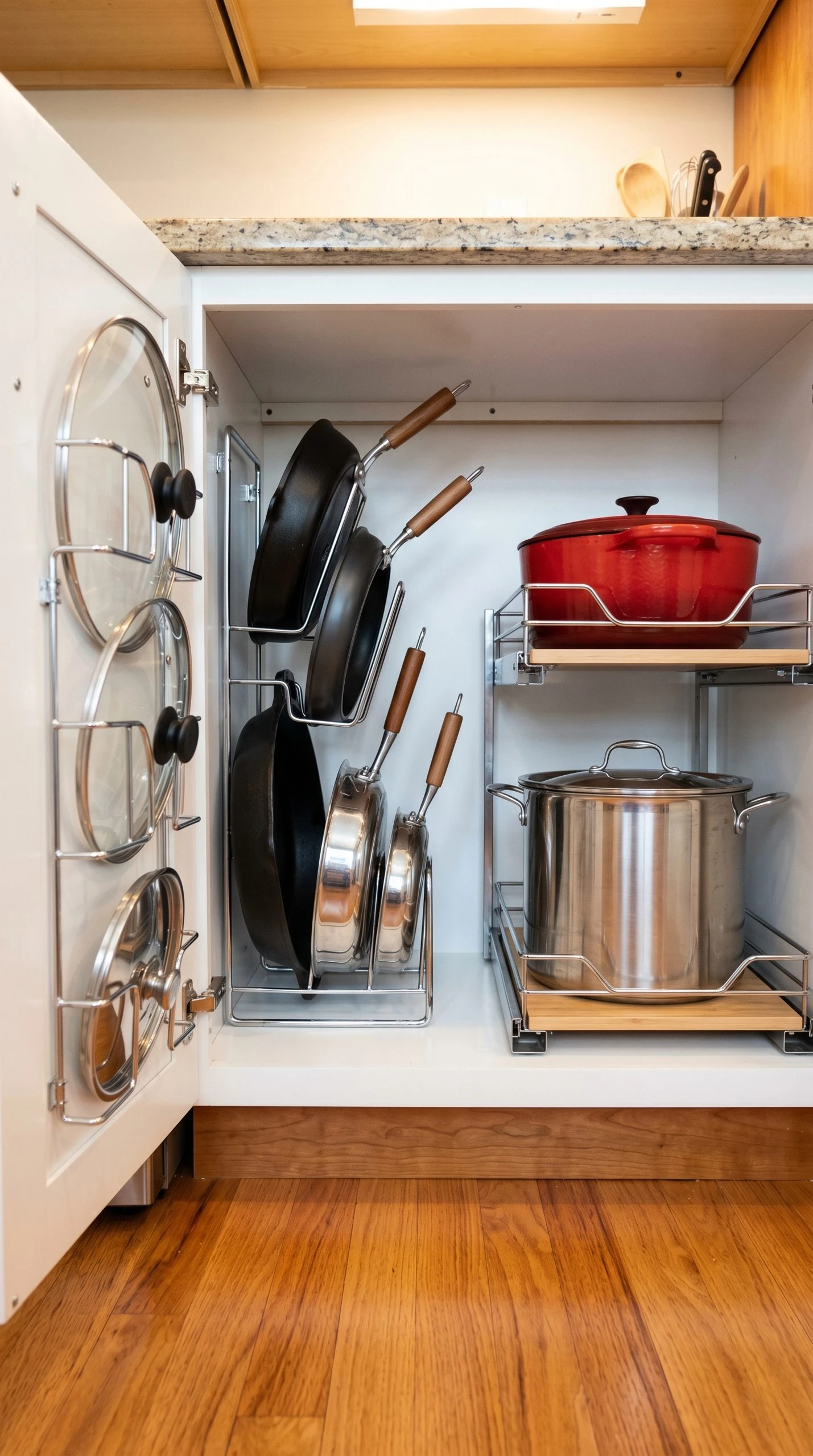
10. Store Pots and Pans With a Dedicated Pan Organizer
The pots and pans cabinet works on a precarious system of careful stacking that somehow gets disrupted every single time. Lids get separated from their pots, the frying pan is always at the bottom under everything else, and the whole cabinet rattles when you try to extract anything.
A dedicated pan organizer replaces the unstable stacking system with a structured rack that holds each pan or lid individually. There are two main styles that work well in kitchen cabinets. The first is a vertical pan rack with multiple slots, similar in concept to the baking sheet dividers, where each pan stands upright in its own slot and can be removed without disturbing the others. The second is a tiered horizontal rack that stores pans at staggered heights so you can see and reach each one without lifting the ones above it.
Vertical pan racks work best for pans that are relatively flat, like skillets and saute pans. They are less practical for deep pots with rounded sides that do not stand stably in a slot. For a cabinet that holds a mix of flat pans and deep pots, a combination approach works well: vertical slots on one side for the skillets and a simple two-tier pull-out shelf on the other side for the pots. Lids should be stored in their own section, either on a rack mounted to the cabinet door or in a separate lid organizer at the front of the cabinet. Keeping lids together and separate from the pots removes the search-and-match step every time you need to cover something on the stove.
Designer Tip: Store the pan you use most often at the very front of the organizer at a height you can grab without bending down. The best organizational system is one that matches your actual cooking habits, not one that looks good in a photo but requires extra steps every day.
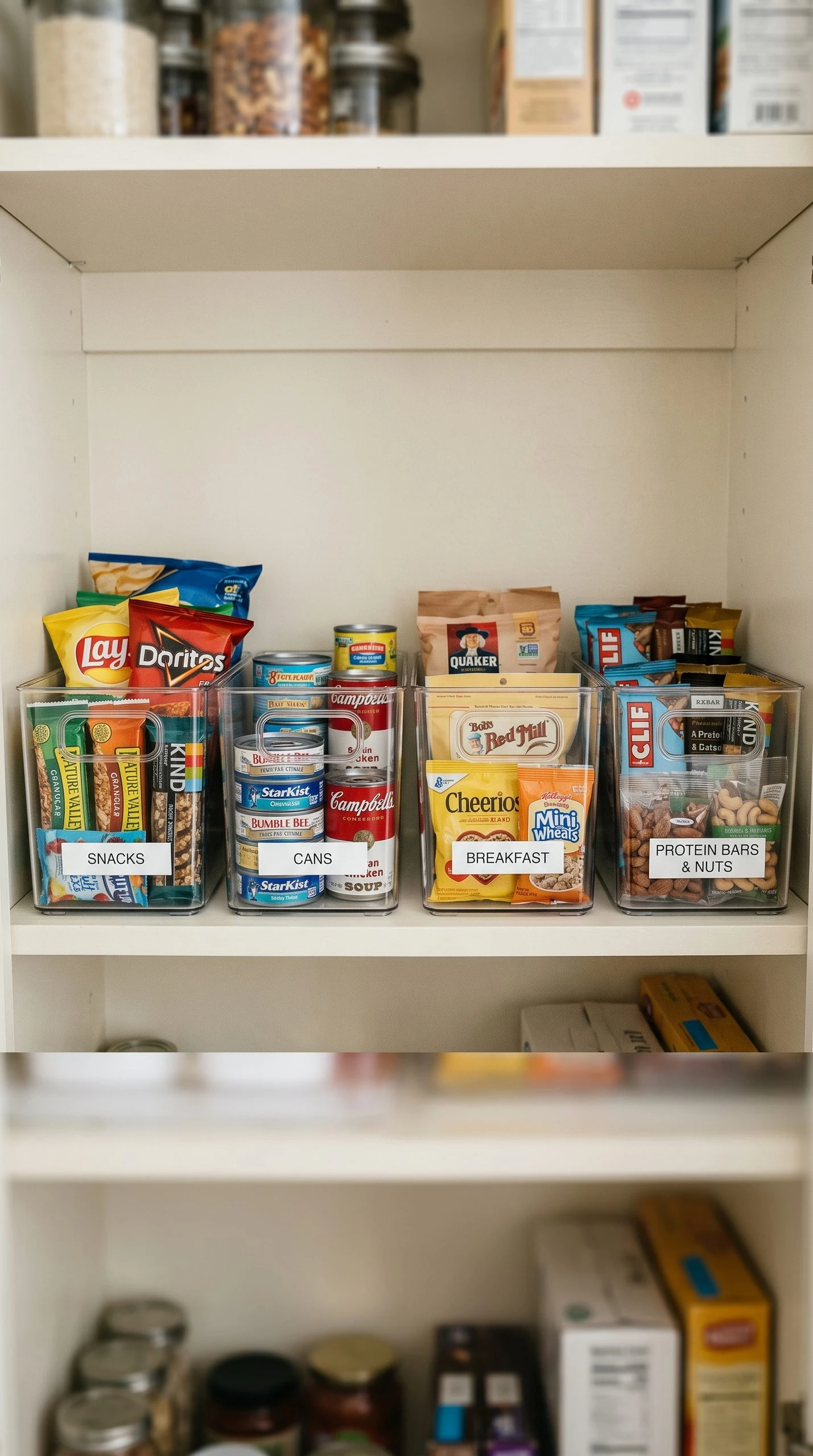
11. Use Clear Bins to Group and Contain Cabinet Contents
The snack cabinet has chips next to canned beans next to a random collection of protein bars, a box of crackers on its side, and two bags of nuts that may or may not still be fresh. Every time someone opens it looking for a snack, things fall out.
Clear bins inside cabinets work on the same principle as drawer dividers: they create defined zones so that similar items live together and the whole cabinet stays organized even through daily use. A bin for snacks, a bin for baking supplies, a bin for canned goods, and a bin for breakfast items means that each category has a contained home and nothing migrates across the shelf to create confusion. Because the bins are clear, you can see the contents without pulling them out, and when a bin gets low it is obvious at a glance.
The practical advantage of bins over organizing things directly on the shelf is that bins maintain their organization through regular use. When you reach into the snack bin and pull something out, the other items in the bin stay together because they are contained. Without a bin, reaching for one thing on a shelf tends to push other things around, and the organization degrades within a day or two. Bins also make it much easier to do a full cabinet wipe-down because you simply lift the bin out, wipe the shelf, and put it back. Choose bins with a small handle or an open front for easy removal. Measure the cabinet depth before buying so the bins fit all the way to the back.
Designer Tip: Pull the bins fully out of the cabinet when restocking groceries rather than trying to slot new items in from the front. It takes a few extra seconds but means items get properly rotated so older ones stay at the front and newer ones go to the back.
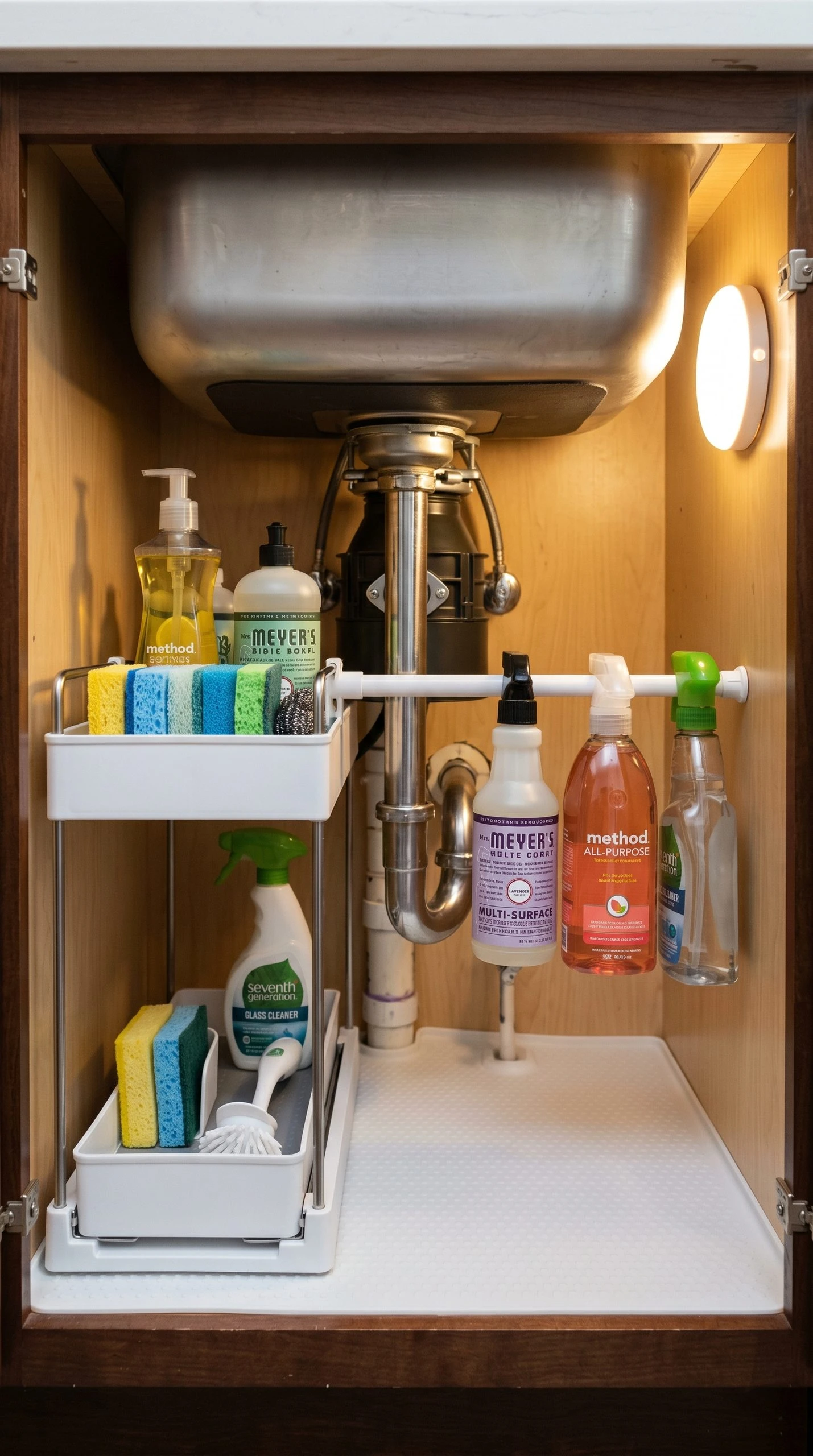
12. Organize the Under-Sink Cabinet With Purpose
The cabinet under the kitchen sink is where good intentions go to disappear. There are three different cleaning sprays, a bottle of dish soap that migrated back there somehow, an old sponge, some mystery bags from the hardware store, and a pipe that takes up exactly the wrong amount of space.
The under-sink cabinet requires a slightly different organizational approach from other kitchen cabinets because of the plumbing that runs through it. The key is to work around the pipes intentionally rather than just avoiding the space they occupy. A two-shelf pull-out caddy designed to fit on either side of the drain pipe gives you organized, accessible storage without requiring any structural changes. Tension rods mounted horizontally inside the cabinet hold spray bottles upside down from their triggers, keeping the cabinet floor completely clear and making it easy to grab the right bottle without anything tipping over.
Beyond the hardware, the under-sink cabinet works best when you commit to keeping only what actually belongs there. Dish soap, sponges, scrub brushes, garbage bags, kitchen cleaning sprays, and hand soap refills are logical residents. Anything else should find a more appropriate home. Once the cabinet is decluttered and equipped with a pull-out caddy and a tension rod for spray bottles, adding a battery-powered motion light inside makes the entire setup feel genuinely functional. Line the cabinet floor with a waterproof mat so any drips or leaks stay contained and easy to clean up before they damage the cabinet base.
Designer Tip: Use a small labeled bin under the sink specifically for backup supplies: an extra sponge, a backup dish soap, a replacement scrub brush. This way your primary supplies have open space around them while the backup stock is contained and easy to inventory.
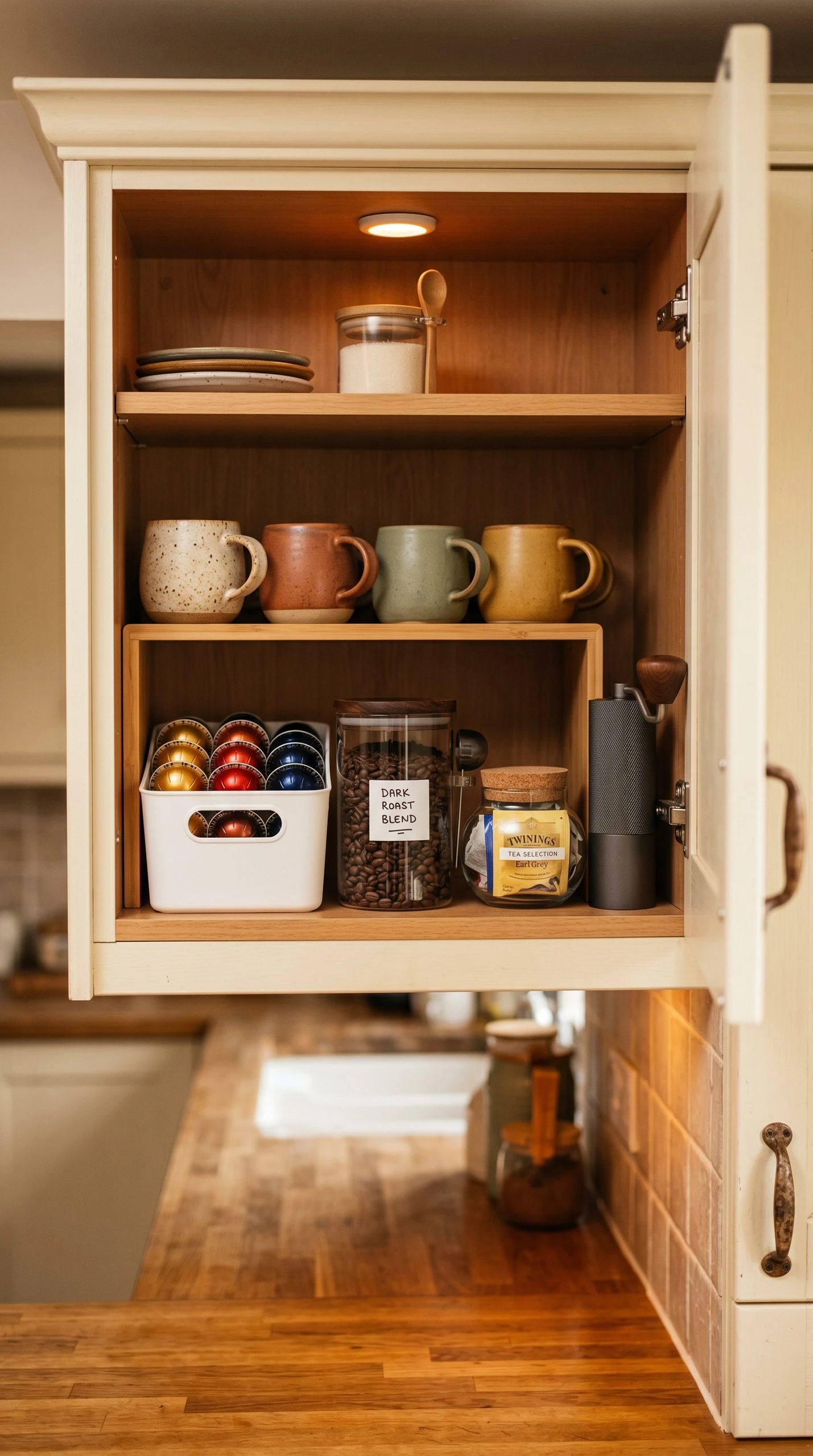
13. Dedicate One Cabinet Entirely to Your Coffee and Tea Station
The coffee supplies are spread across three different cabinets and two different counter areas. The filters are in one place, the pods are somewhere else, the coffee itself is in the pantry, and the mugs are across the kitchen. Making coffee in the morning is a minor scavenger hunt.
A dedicated coffee and tea station cabinet consolidates everything related to hot drinks into one organized, logical space, ideally the cabinet closest to the kettle or coffee maker. The idea is to open one cabinet and have everything you need within immediate reach: mugs, coffee beans or pods, filters, a small canister of tea bags, a jar of sugar, and any other daily-use items. When everything lives together, the morning routine becomes smooth and automatic instead of requiring any thinking before the first cup is made.
Inside the cabinet, a shelf riser at the back creates two levels so mugs and smaller items are visible simultaneously. A small handled bin for pods or tea bags keeps those contained and easy to grab. If you use a grinder, keeping it inside the cabinet with the beans eliminates counter clutter without making it inconvenient to use. The visual and practical effect of a well-organized coffee station cabinet is disproportionate to the effort it takes to set up. It is one of those changes that gets noticed and appreciated every single morning, which makes it one of the highest return-on-investment organizational projects in the kitchen.
Designer Tip: Store mugs on a small riser or a low mug tree inside the cabinet rather than stacking them. Stacked mugs require unstacking to get the bottom mug, and the clinking and rattling that comes with it is nobody’s idea of a peaceful morning.
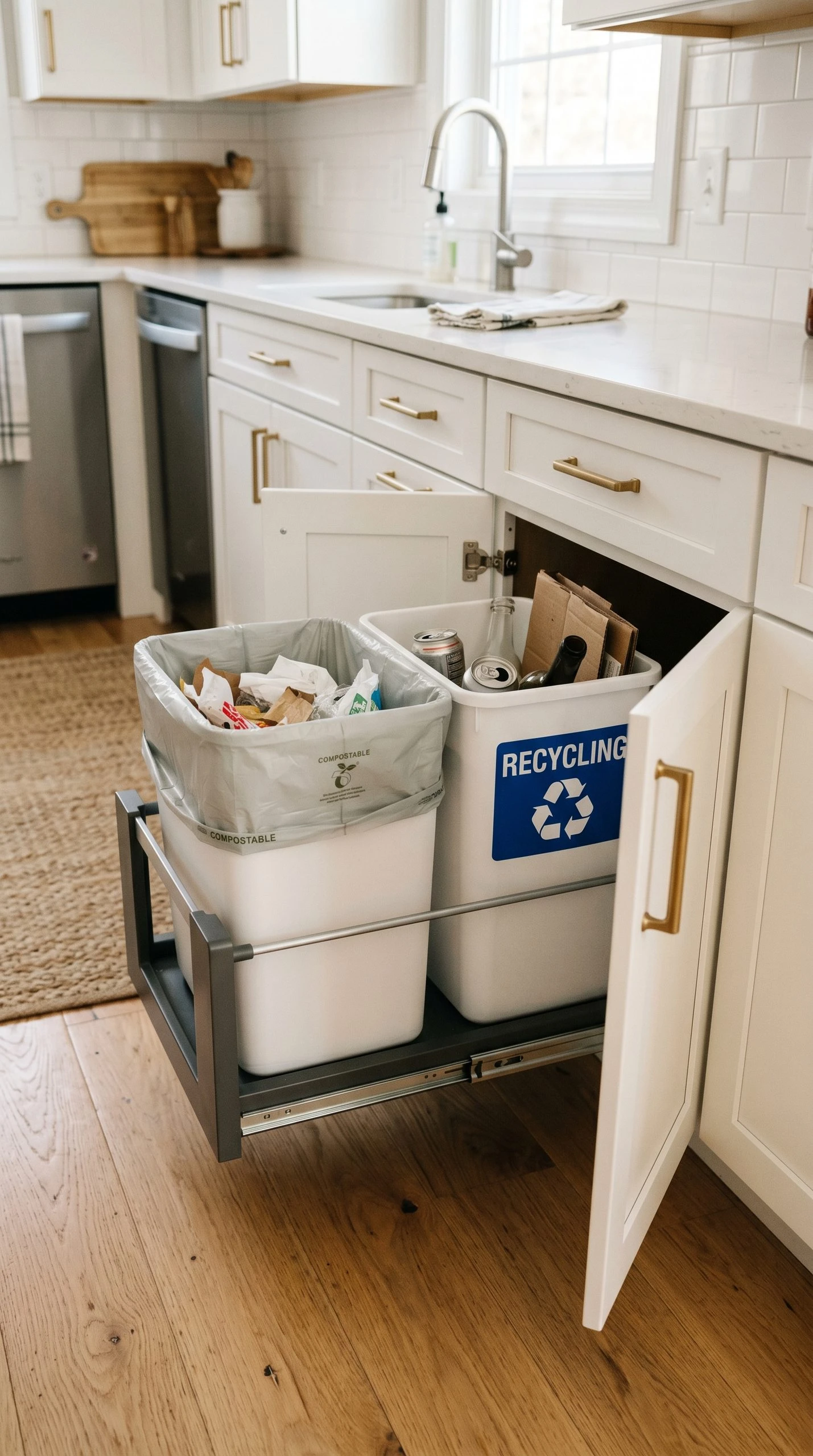
14. Install a Pull-Out Trash and Recycling Cabinet
The kitchen bin sits on the floor in whatever corner was most convenient when you moved in. It takes up floor space, it is visible from the living area, and every time you need to throw something away while cooking, you have to walk around the island or step over it.
A pull-out trash and recycling cabinet is one of those kitchen organizational upgrades that feels like a small renovation but is genuinely achievable as a DIY project or a relatively affordable addition during a kitchen refresh. A standard base cabinet can be converted into a pull-out waste bin station by adding a slide-out frame with one or two bins that extend forward when you open the door. When the door is closed, there is no visible trash can in the kitchen at all. When it is open, the bin is at the perfect height for scraping plates and tossing waste without bending down.
For kitchens where converting a cabinet is not feasible, a freestanding pull-out bin that fits inside an existing lower cabinet and attaches to the door so it opens with the cabinet is a simpler alternative. Either way, having a bin integrated into the cabinetry rather than sitting on the floor frees up floor space, removes the visual presence of the trash can from the kitchen, and usually results in more consistent separation of trash and recycling because both bins are in the same accessible location. Choose bin sizes based on your actual usage: a larger trash bin and a smaller recycling bin if you generate more general waste, or equal sizes if you recycle frequently.
Designer Tip: Place the pull-out trash cabinet as close to the food prep area as possible, ideally right next to the primary cutting board zone. The shorter the distance between where food is prepared and where scraps are discarded, the less mess gets made during cooking.
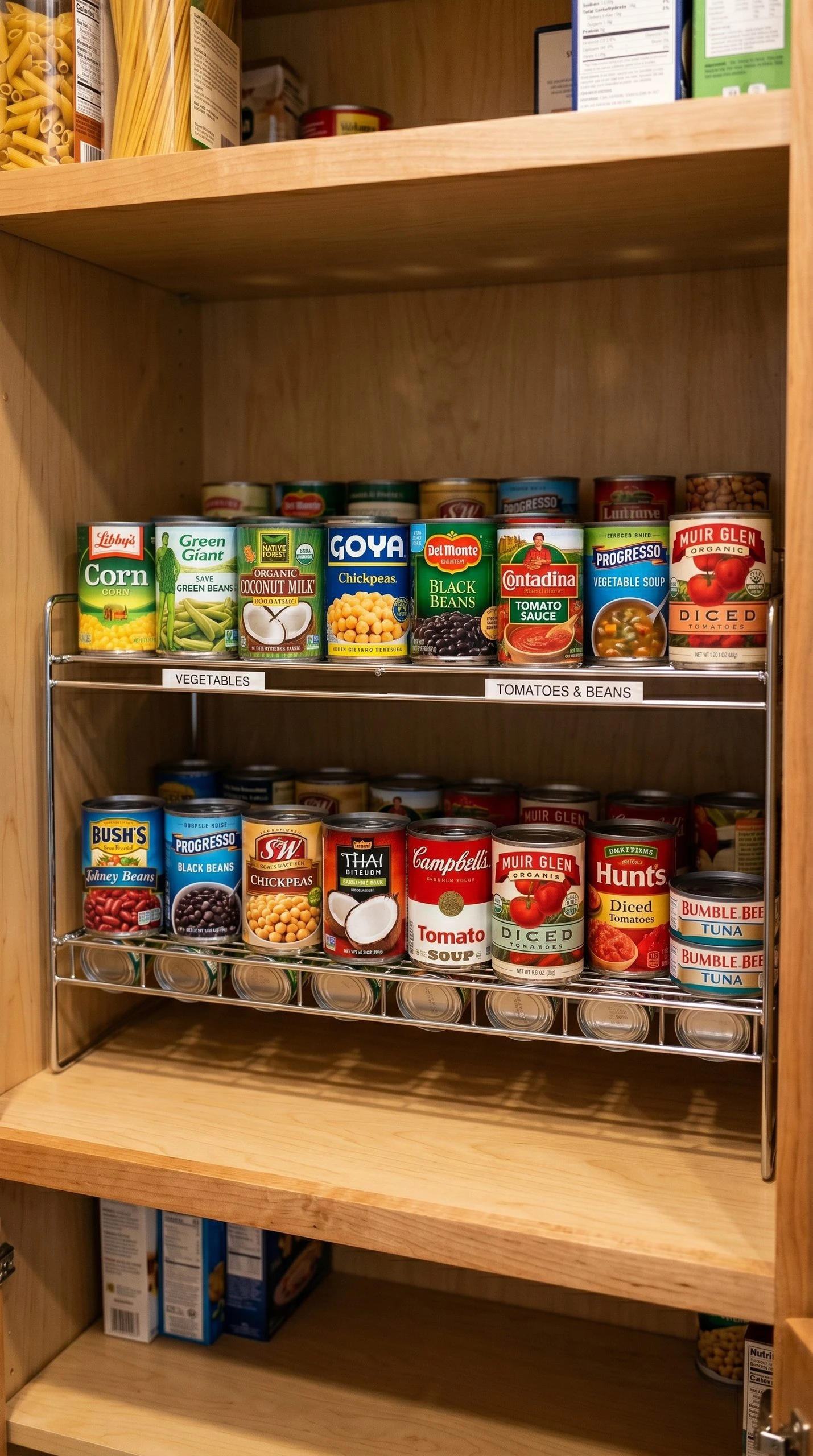
15. Use a Can Rack Organizer for Canned Goods
You go to grab a can of diced tomatoes and end up pulling out the tomato paste, then the coconut milk, then the chickpeas, before finding what you need. The cans at the back of the cabinet are a complete mystery because you cannot see their labels from the front.
A can rack organizer solves the stacking and visibility problem by storing cans on a slight incline so they roll forward automatically as the front one is removed. This is the same system used in grocery store shelving, and it works just as well at home. The oldest cans stay at the front, newer cans loaded from the back roll forward to take their place, and every label is always visible. No more mystery cans, no more digging through stacks to find what you need, and no more discovering expired cans that got pushed to the back and forgotten.
Can rack organizers come in several configurations depending on the depth and height of your cabinet. A single-row organizer works in shallower cabinets. A multi-row version with staggered heights stores significantly more cans while keeping all labels visible. For a pantry-style cabinet with multiple shelves, one organizer per shelf creates a very satisfying and efficient canned goods system. Before setting up the organizer, do a full audit of your canned goods: check expiration dates, remove anything expired, and group remaining cans by type. Starting with a clean and curated collection makes the system easier to maintain long-term.
Designer Tip: Tape a small label on the front of each row of the can organizer indicating what type of can goes there, like diced tomatoes or beans. When someone puts away groceries, the label tells them exactly where each can belongs without guessing or reorganizing.
16. Create a Dedicated Baking Cabinet
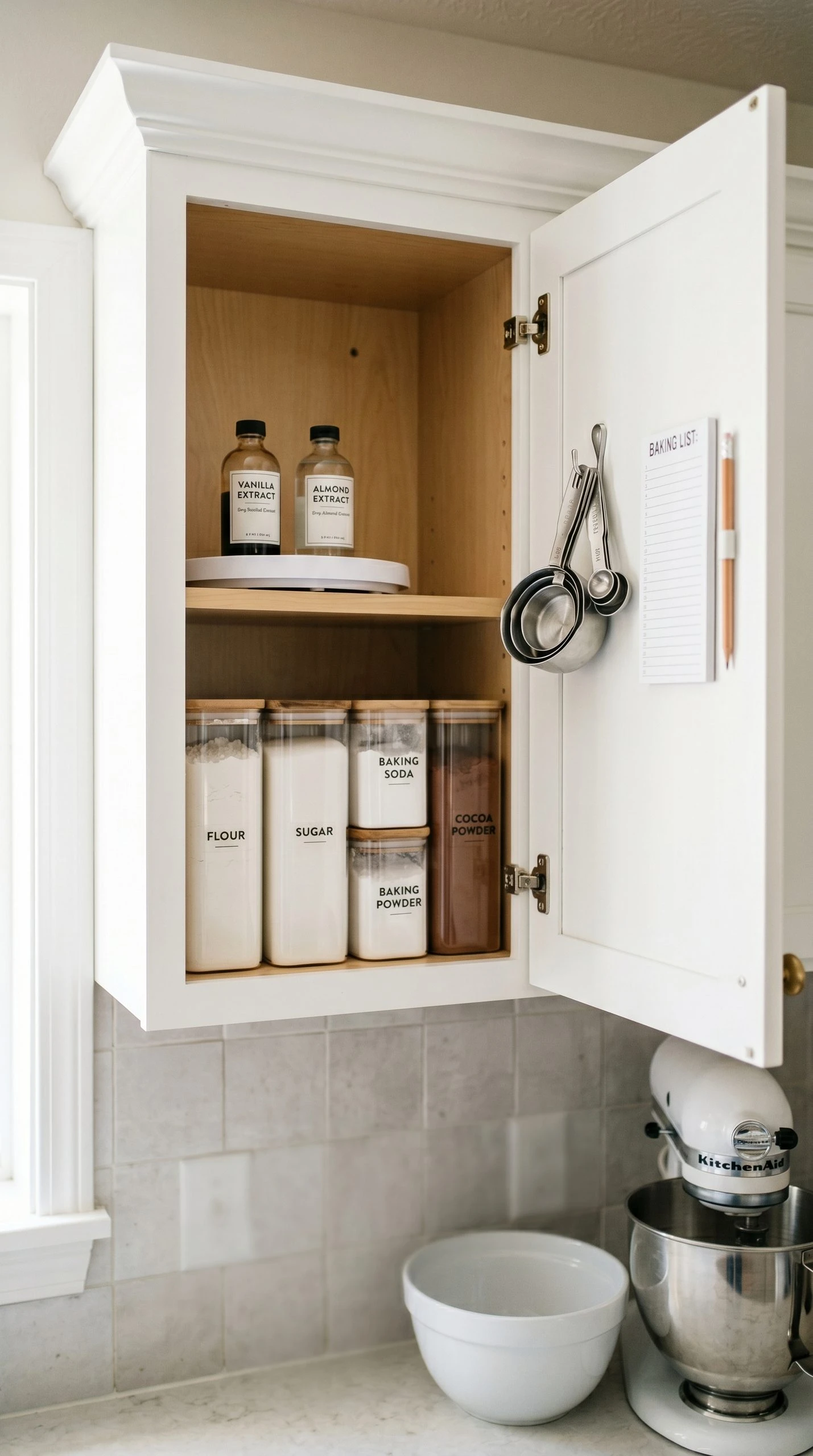
Baking day means pulling things from five different cabinets. The flour is in the pantry, the sugar is somewhere else, the vanilla extract is with the spices, the baking powder is on a different shelf, and by the time everything is assembled on the counter, half the kitchen has been opened and rearranged.
A dedicated baking cabinet brings every ingredient and tool needed for baking into one organized location so that setup before baking and cleanup afterward involve opening only one cabinet. The contents depend on how frequently you bake and what you typically make, but the core group usually includes flour, sugar, baking powder, baking soda, salt, vanilla extract, cocoa powder, and any other regularly used baking ingredients. Measuring cups and spoons, a sifter, a pastry brush, and parchment paper can all share the space if the cabinet is large enough.
Inside the baking cabinet, clear airtight canisters for the dry ingredients keep everything fresh and stackable. A small pull-out shelf or a turntable makes it easy to reach items at the back without disrupting the front. Measuring tools can hang from a hook inside the cabinet door or sit in a small handled container on the shelf. The goal is to make the cabinet function like a portable baking kit: open the door, pull out what you need, bake, put it all back. This approach is especially valuable in smaller kitchens where every cabinet has to earn its place. Consolidating baking supplies into one dedicated space usually frees up storage elsewhere because those ingredients are no longer scattered across multiple locations.
Designer Tip: Keep a small notepad inside the baking cabinet specifically for tracking what needs restocking. When you use the last of an ingredient during baking, write it on the list immediately rather than relying on memory. It takes five seconds and means you never start a recipe only to realize halfway through that something essential is missing.
17. Reassign Cabinets Based on Where You Actually Use Things
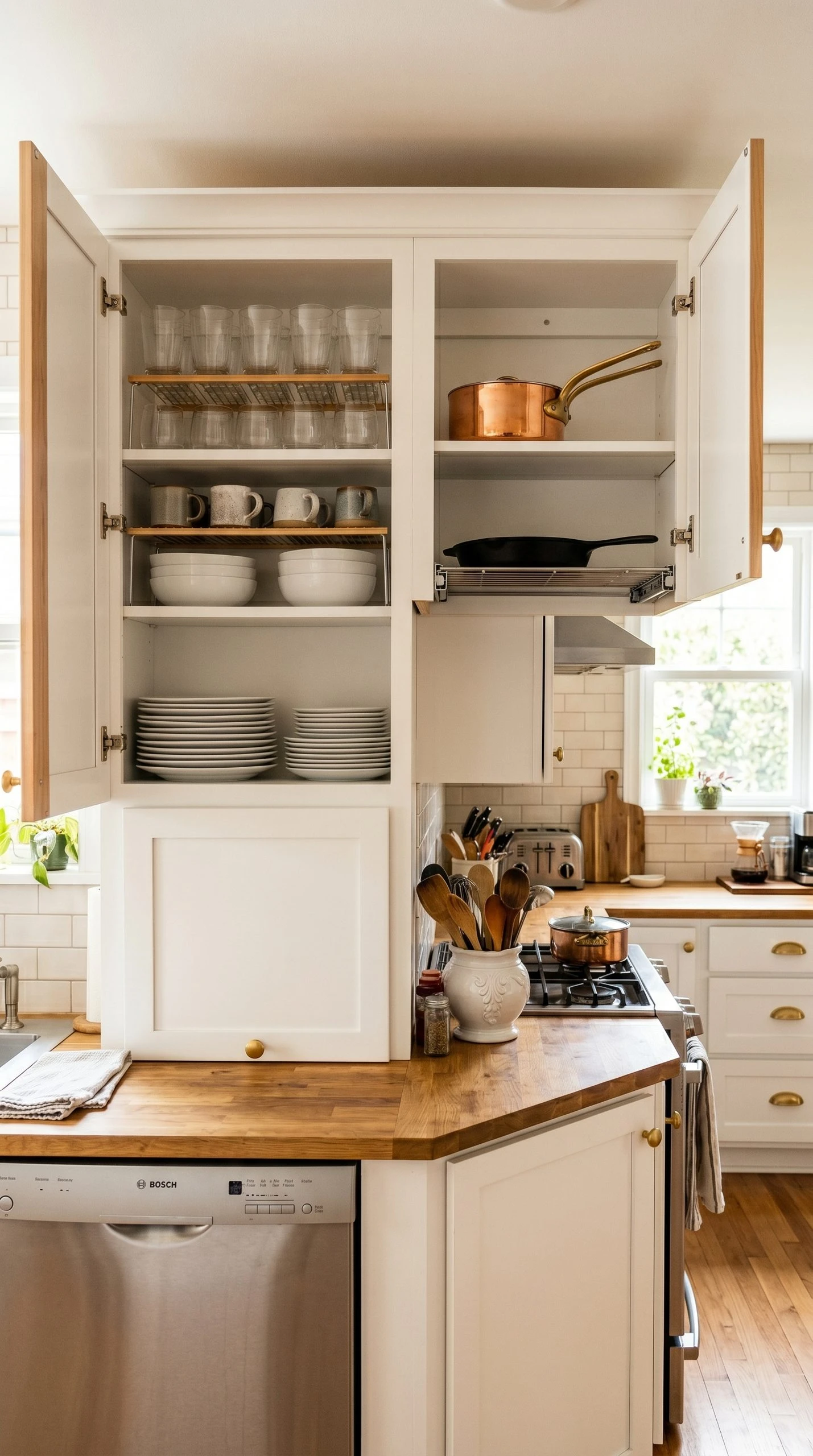
The plates are in the cabinet across the kitchen from the dishwasher, so putting them away means walking back and forth. The glasses are above the stove for some reason. The cutting boards live in a lower cabinet on the wrong side of the kitchen from where you actually prep food. Nobody made a bad decision on purpose. It just ended up this way.
One of the most impactful kitchen cabinet organization changes you can make does not involve buying a single product. It involves reassigning what lives in each cabinet based on where those items are actually used. This is called the zone system, and professional kitchen designers use it as a foundational principle. The idea is straightforward: items should live closest to the place where they are used. Plates, glasses, and cutlery go near the dishwasher and the table. Cooking pots and pans go next to the stove. Prep tools and cutting boards go near the primary prep area. Coffee and mugs go next to the kettle and coffee maker.
Most home kitchens develop their cabinet assignments organically over time, often based on where there happened to be available space when items were first brought home. This produces arrangements that feel slightly off without being obviously wrong. Going through the kitchen and deliberately asking where each item is used, then placing it in the nearest available cabinet, can reshape how the kitchen flows during both cooking and cleanup. It is a process that takes an afternoon and usually involves moving things between cabinets rather than adding new storage. The result is a kitchen that works intuitively, where reaching for something is a single smooth motion rather than a cross-kitchen detour.
Designer Tip: When reassigning cabinets, do it all in one session rather than gradually over time. Partial reassignment creates temporary confusion where nothing is quite where you expect it. One thorough reorganization session and a day or two of adjustment is far easier than a slow migration that keeps everyone uncertain about where anything lives.
Wrapping It Up
An organized kitchen cabinet system is not something you set up once and never think about again. Life changes, habits shift, new items come in, and old ones go out. But the good news is that once you have a solid framework in place, maintaining it takes very little effort. The hard work is the initial setup. After that, things tend to find their way back to where they belong because the system is logical and intuitive rather than arbitrary.
Start with the cabinets that frustrate you most. If it is the lower base cabinets where pots and pans live in chaos, tackle that first. If it is the corner cabinet where things disappear forever, add the lazy Susan this weekend. Pick one or two ideas from this list that address your actual pain points rather than trying to reorganize everything at once. Progress feels good, and one cabinet that genuinely works will motivate you to move on to the next one.
A kitchen that is easy to cook in is not just more pleasant to use. It makes you more likely to actually cook, which has a ripple effect on how the whole household eats and how the kitchen feels as a daily space. Good organization is not about perfection. It is about removing the small frictions that add up over time and turning the kitchen into a place that works with you rather than against you.
Frequently Asked Questions
Where should I start with kitchen cabinet organization?
Start with the cabinet you open most often or the one that causes the most frustration during your daily routine. This is usually either the pots and pans cabinet, the food storage container cabinet, or the pantry shelf. Tackling the most irritating spot first gives you an immediate sense of progress and usually motivates the next round of organizing.
How do I organize a kitchen with very little cabinet space?
In a kitchen with limited cabinet space, the priority is maximizing every inch of the space you do have. Use shelf risers to double the capacity of each shelf, pull-out shelves to access the full depth of base cabinets, and the inside of cabinet doors for additional storage. Decanting into matching stackable containers also compresses the footprint of pantry items significantly compared to the original bulky packaging.
What is the best way to organize pots and pans in a cabinet?
A vertical pan organizer with individual slots is the most efficient setup for flat skillets and saute pans. For deep pots, a two-tier pull-out shelf is more practical. Lids should always be stored separately from the pots themselves, either on a door-mounted rack or in a dedicated lid organizer on the shelf. Keeping the pan you use most often at the very front of the system is a small adjustment that makes a noticeable daily difference.
Should I use open shelving or closed cabinets in my kitchen?
Closed cabinets keep the kitchen looking clean and hide any organizational imperfections from view. Open shelving creates a more airy feel and works beautifully when the items on display are visually cohesive, like matching dishes or a curated collection of glass jars. Most kitchens benefit from a mix: closed cabinets for the majority of storage and open shelves for a small curated display of everyday items.
How do I keep kitchen cabinets organized after setting them up?
The key to maintaining cabinet organization is making sure the system is genuinely logical so that returning items to their correct place requires no extra thought. When everything has an obvious, intuitive home, the natural tendency is to put things back correctly. A monthly five-minute check-in where you confirm nothing has drifted out of its zone is usually all the maintenance a well-designed system needs.
Is it worth buying kitchen cabinet organizers, or can I use what I already have?
Many kitchen cabinet organization improvements can be made with items you already have or very inexpensive solutions. Repurposed food containers, tension rods, and simple decluttering cost almost nothing and make a significant difference. That said, a few targeted purchases like a can rack, a pan organizer, or pull-out shelves for base cabinets deliver enough practical value that they pay for themselves quickly in time and frustration saved.